
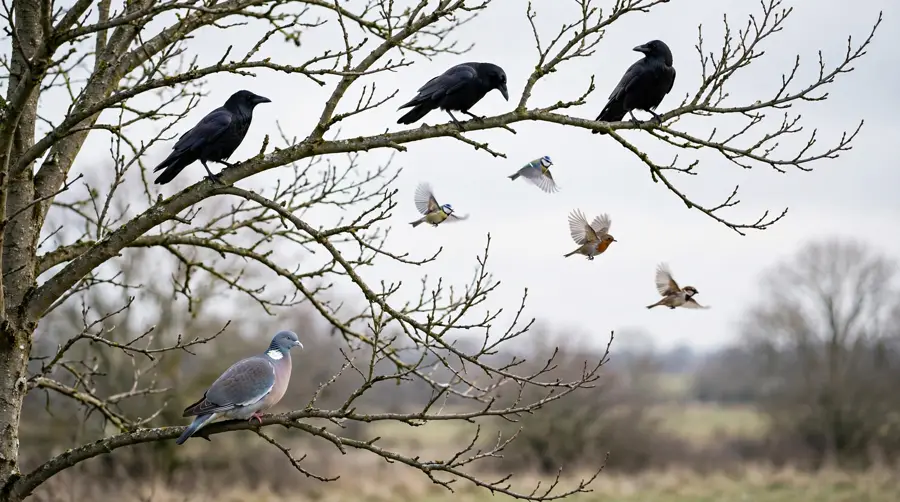
Birds dominate the world’s omen traditions, and the reason is not mystical. It is that they are the only wild animals most people see every day.
They are visible, they are loud, they move between the ground and the sky, and — this is the part that matters — they arrive and they leave. A tree does not turn up. A fox turns up once a year. A bird appears on your fence, says something, and goes, which makes it look like a message in a way that almost nothing else in nature does.
This page is the index to every bird encounter covered on this site, plus the four ideas that run underneath most of them. If you are here with a specific sighting, use the table. If you want to understand why these beliefs exist at all, the sections after it are the honest version.
Find your sighting
Owls
| What happened | Where to go |
|---|---|
| An owl hooting outside at night | Owl hooting at night — and the famous “twit twoo” is two birds, not one |
| A screech, shriek or scream rather than a hoot | Owl screeching at night |
| An owl sitting on your roof or chimney | Owl on the roof — it is a hunting tower over a rodent supply you created |
| An owl inside the house | Owl in the house — urgent, and the rescue advice is counter-intuitive |
| An owl flew in front of your car | Owl flying in front of you — it was hunting the verge |
| An owl out in daylight | Owl during the day — not rare, and not a sign of illness |
| You want the omen question answered directly | Are owls bad luck? — the answer is no, and the reasons are specific |
Crows and ravens
| What happened | Where to go |
|---|---|
| A crow cawing at you, or near the house | Crow cawing meaning |
| You counted the caws | Crow cawing by number |
| Crows calling after dark | Hearing crows at night |
| You found a dead crow | Dead crow meaning |
| A dead crow specifically in your yard or garden | Dead crow in the yard – and why to remove it discreetly |
| You want the religious and cultural readings | Dead crow in the Bible, Hinduism and other traditions |
| You saw just one crow, on its own | One crow meaning – it is probably the lookout |
| A crow that seemed to be following you | Crow following you — and the ten-second test |
Doves and pigeons
| What happened | Where to go |
|---|---|
| Doves gathering around your house | Doves around the house |
| A mourning dove, or two of them | Mourning dove meaning — the mourning call is a love song |
| The bird was white, grey or brown and you want to know if the colour matters | Dove colours — there is no wild white dove |
Everything else
| What happened | Where to go |
|---|---|
| A red cardinal, and you are wondering about someone you lost | Cardinal as a sign from heaven |
| A hawk, perched or circling | Seeing a hawk |
| Birds circling overhead, or a group wheeling above you | Birds circling overhead — where “auspicious” comes from |
| A goose crossing your path, or refusing to move | Goose crossing your path |
| A wild turkey | Wild turkey meaning |
| A bird pooped on you | Bird pooping on you — the page that checks the good-luck belief rather than repeating it |
| A bird inside your house | Bird in the house — get it out safely first, then the meanings |
If it looked white
White birds get treated as a category of their own — purer, rarer, more significant. It is worth knowing that in almost every case the whiteness is either a viewing artefact or a human product.
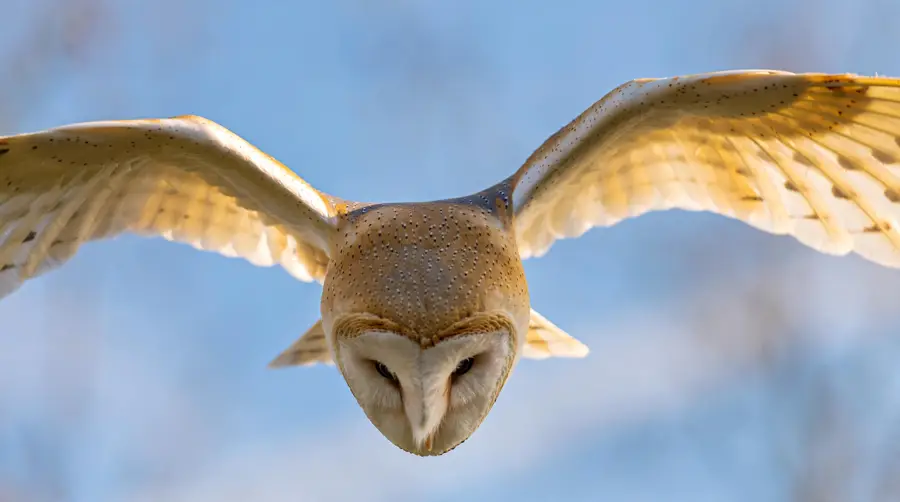
A white owl is nearly always a barn owl, and barn owls are not white. Their upperparts are warm buff and golden-grey, finely speckled; only the face and underside are pale. What makes them look white is how they are seen — at night, from below, in headlights, against a dark hedge. A barn owl crossing a lane in front of your car is the single most common “white owl” sighting there is, and in daylight the same bird is visibly golden.
If you are in North America and the bird was genuinely white all over, large, and in open country in winter, that is a snowy owl — and there is a detail worth having. Male snowy owls get whiter as they age. Females and young birds are heavily barred with dark markings; an old male is close to pure white. So a truly white snowy owl is usually an old male, which makes the whiteness a record of survival rather than of purity.
Genuinely albino owls occur and are vanishingly rare, and they rarely reach adulthood — albinism impairs eyesight, and an owl with poor vision is in serious trouble. Leucistic birds, which have reduced pigment but normal dark eyes, are commoner. As with white squirrels, the eyes are the test: pink or red means albino, dark means something else.
And the same pattern holds across the other white birds people ask about. There is no wild white dove — the bird at weddings and funerals is a domestic pigeon bred white by people. White squirrels in famous colonies are leucistic rather than albino and survive mainly where towns decided to protect them.
Which gives you a reasonably reliable rule. When an animal looks strikingly white, the usual explanations are the light, the angle, old age, or us. That is less romantic than purity and considerably more interesting.
The pattern underneath most death omens
If you read enough of these pages you will notice the same mechanism turning up, and it is the most useful idea on this site.
The animal arrives because something has already happened, and then gets blamed for announcing it.
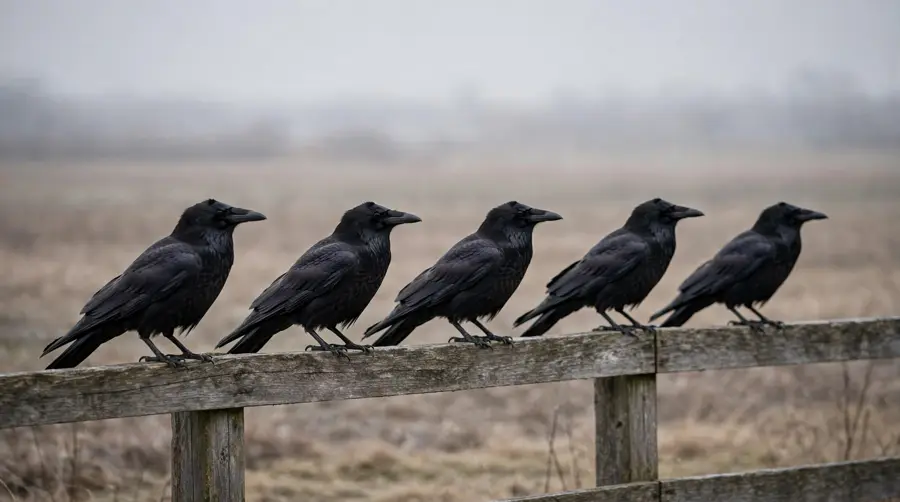
Vultures circle over an animal that is already dying. Crows gathered on battlefields after the battle. Owls get into buildings through gaps — and a house with gaps was a house that had stopped being repaired, which in a village usually meant illness, old age, poverty or a recent death in the family. A dog howls outside a home where routines have collapsed and people are coming and going at odd hours.
In every case the animal is a consequence rather than a cause, and in every case it looked prophetic a certain proportion of the time — enough to become a belief, and enough for the belief to survive for centuries.
That is not a debunking. It is a better explanation than either “it is a message” or “it is nothing”, because it accounts for why the belief exists, why it feels true, and why it keeps being confirmed. The animal really is correlated with the bad news. It just arrived second.
The Romans built a government department for this
Reading birds is not a folk habit that drifted into modern superstition. For centuries it was formal state procedure.
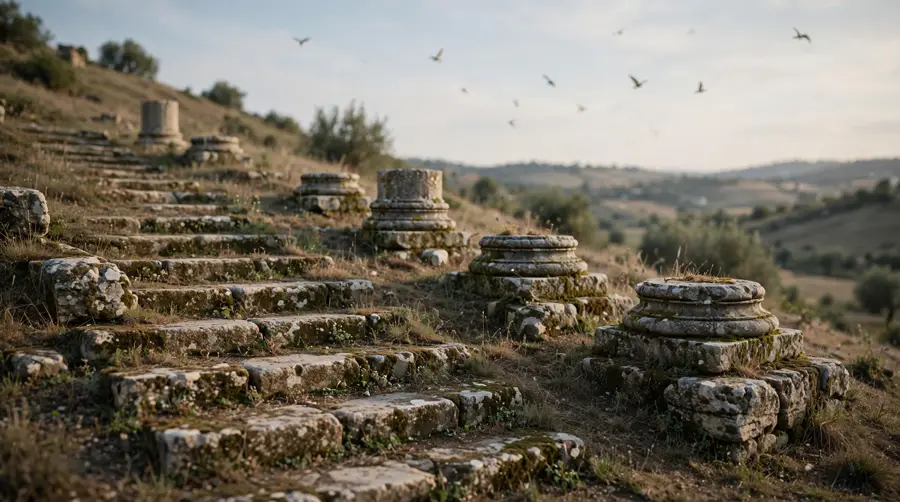
Roman public life ran on the observation of birds. Official augurs watched for them before battles, elections and major decisions, and the words have come down to us intact: auspices from the Latin for bird-watching, auspicious from the same root, and inaugurate — what you do when the augur has approved the omens.
Every time a president is inaugurated, the word is reporting that somebody checked the birds.
The full system — what the direction mattered, how it was done, and what happened when the omens were inconvenient — is in birds circling overhead. It is worth knowing because it explains why bird omens feel weightier than other animal signs. They had institutional backing for a thousand years.
Why so many birds mean ruin
There is a thread running through the oldest written bird omens and it is not about death. It is about abandonment.
Owls nest in cavities, and the best cavities in a landscape with people in it are in buildings nobody is using. So owls occupy ruins — and the biblical passages that list them do so alongside jackals, in descriptions of cities whose populations have gone. Isaiah on Babylon, Jeremiah on Jerusalem, and Micah pairing the howl of the jackal with the moan of the owl as the sounds of desolation.
Read those passages carefully and the birds are not predicting anything. They are the acoustic and visual signature of a place people have left. The owl in the ruin is a consequence of the ruin.
Which is a large part of how the owl acquired its reputation in the West, and the full case is in are owls bad luck. The short version: the owl is associated with death because it is associated with emptiness, and it is associated with emptiness because empty buildings are good nesting sites.
When someone says “across cultures”
One thing worth arming yourself with before reading anything else on this subject, here or elsewhere.
The phrases “across cultures”, “in many traditions”, and above all “Native Americans believed” are doing the work of a citation without being one. There is no single Indigenous view of any animal — there are hundreds of distinct nations with distinct traditions, and flattening them into one sentence is both inaccurate and disrespectful to all of them.
The same applies to claimed antiquity. A great deal of what circulates as ancient wisdom is recent and traceable: the two-wolves parable has no documented source before the late twentieth century, the scorpion and the frog is not Aesop and became famous through a 1955 film, and black squirrel symbolism cannot be ancient in Europe because Europe had no black squirrels until the twentieth century.
Where this site cites a tradition, it names the nation, the text or the period. Where it cannot, it says so. That is the standard worth holding anything you read to — including this.
Telling an encounter from a noticing
Last thing, and it is the question most worth asking about any sighting.
Almost every bird on this page was already there. The owl works that verge most nights. The crows have used that tree for years. The mourning doves nest in the same place every spring and the goose walks that route daily. What changed, nearly always, is not the bird’s behaviour but your attention.
That is not a reason to dismiss the experience. It is a reason to look at it from the other end. People start noticing birds during specific kinds of week — after a loss, during an illness, in the middle of a decision, when they are not sleeping. The bird is the constant. The noticing is the new information.
So when you are working out what a sighting meant, the more productive question is rarely “what is the bird telling me”. It is: what has changed in me that I am looking up?
That question has an answer, and it is usually available, and it is almost always more useful than anything the bird could have been carrying.
It was a raven, not a crow: Raven spiritual meaning — the wolf-bird, and raven versus crow.