
You are not looking for a general reading. You want to know what your own tradition says — whether scripture addresses this, whether there is a verse, whether the thing you were taught as a child is actually in the book.
So here is the honest answer first, and then something considerably better than the answer.
There is no dead crow anywhere in the Bible. Not one verse describes finding one, and nothing in scripture assigns it a meaning. Any page offering you a biblical interpretation of a dead crow has constructed it.
But the bird itself is all over the text, and what it is doing there is the opposite of what almost everyone expects. The crow family is the bird the Bible chose — more than any other — to demonstrate that God feeds creatures that cannot feed themselves. Jesus pointed at ravens specifically.
Dead Crow Meaning Across Traditions: The Short Answer
Across almost every tradition that has a view, the crow is the intermediary — the bird that moves between worlds, carries messages, attends the dead and mediates between the living and what comes after; for the general meaning of finding a dead crow, see our main guide.
Which gives a dead crow a consistent reading that holds up across cultures rather than being cherry-picked: the messenger itself has come to rest. The carrying is finished. In several folk traditions that is read specifically as ill luck spent rather than arriving.
Scripture does not address it. Hindu tradition has the richest material of any religion on crows and the dead. And in the Qur’anic account, a crow is the creature that taught humanity how to bury its dead in the first place.
First: the Bible Says Raven, Not Crow
A translation point that explains why searching for crows in scripture is frustrating.
The Hebrew word that appears in these passages is orev, and the Greek in the New Testament is korax. Both are conventionally rendered raven in English Bibles. Ancient Hebrew did not divide the corvids into the fine categories modern birdwatchers use — the word covers the black scavenging birds as a group, and crows fall inside it.
So if you are looking for the biblical view of crows, the raven passages are the answer. They are talking about the same family of birds, and in several cases almost certainly about birds a modern observer would call crows.
What the Bible Actually Says About Ravens
Here is the whole picture, and the balance of it is genuinely surprising.
The Raven Left the Ark First
Everyone remembers Noah’s dove. Almost nobody remembers that Noah sent the raven first.
In Genesis, before the dove is released at all, Noah sends out a raven, and the text says it went to and fro until the waters had dried. It did not come back.
Commentators have spent centuries reading that as the raven failing at its job while the dove succeeded. There is an obvious alternative reading the text supports just as well: the raven did not come back because it did not need to. It found the world survivable and got on with it. The dove returned because it could not.
Either way, the first creature to leave the ark and live was a corvid.
Ravens Fed a Prophet, on God’s Instruction
This is the passage that should end any argument that the Bible treats this bird as evil.
In the first book of Kings, Elijah is in hiding by a brook during a drought, and God’s provision for him is delivered by ravens, which bring him bread and meat morning and evening.
Consider the choice. The bird is ritually unclean under the law. It is a scavenger. It eats carrion. And it is the courier God selects to keep a prophet alive.

God Cites the Raven as Proof of His Own Provision
In the Book of Job, during the long passage where God answers Job out of the whirlwind, he asks who provides the raven with its food when its young cry out. It is offered as a demonstration that the world is cared for beyond human arrangement.
A psalm says the same: God gives food to the beasts and to the young ravens that call.
And Jesus Pointed at Them Specifically
The detail that most readers have never noticed, and it is worth knowing precisely.
In the gospel of Luke, teaching about anxiety and provision, Jesus says to consider the ravens — they neither sow nor reap, they have no storehouse or barn, and God feeds them, and you are worth more than the birds.
The parallel passage in Matthew says “the birds of the air.” Luke names the raven. Of every bird available, the one chosen to illustrate being provided for without providing is the black scavenger the law called unclean.
The Two Genuinely Negative Passages
Honesty requires both sides, and there are two.
Ravens appear in the dietary lists of Leviticus and Deuteronomy among birds not to be eaten. That is a category rather than a condemnation — the eagle, the hawk, the owl and the heron are in the same lists, and nobody reads eagles as evil.
And Proverbs contains a hard line about ravens of the valley picking out the eye of someone who dishonours their parents. That is the one properly ominous raven image in scripture, and it rests on a real behaviour — corvids do scavenge the unburied dead, which is also the root of the European death association.
Ravens also appear in Isaiah among the creatures inhabiting a ruined land. Notice what that is doing: the bird is the evidence that a place is empty, not the cause of its emptiness. It is the same literary function the owl performs in those passages — a marker of abandonment.
So the Net Picture
Ritually unclean as a dietary class. Twice used as an image of scavenging the dead. And four times held up as the specific example of divine provision, including once by Jesus and once by God directly.
That is not a bird the Bible condemns. It is a bird the Bible uses to argue that even what you consider unclean is fed.
And there is still no dead one anywhere in it.
In Islamic Tradition, a Crow Taught Humanity to Bury the Dead
Of everything in this article, this is the detail that most deserves to be better known, and for an article about a dead crow it could not be more apt.
The Qur’an tells the story of the two sons of Adam, one of whom kills the other. In the account, after the killing, the murderer does not know what to do with the body. And a crow is sent, which scratches at the earth — showing him how to cover his brother and hide him in the ground.
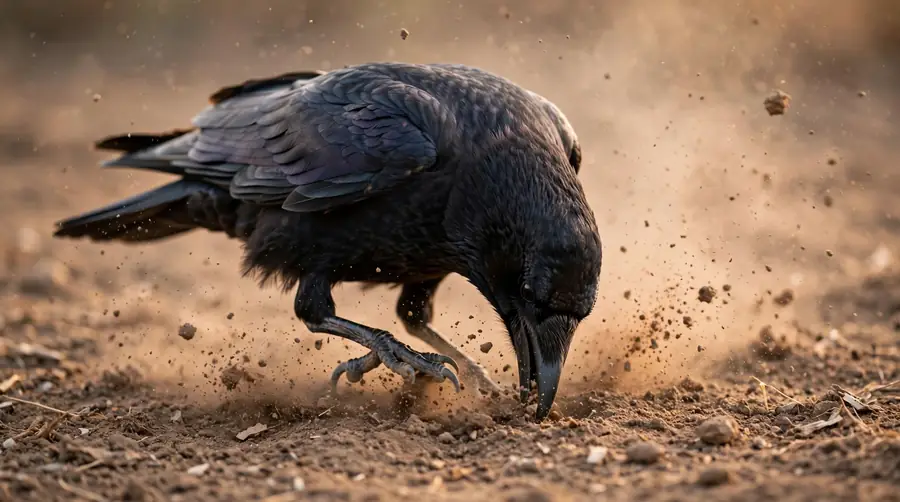
In that telling, the first human burial was demonstrated by a crow.
Sit with the shape of that for a moment. The bird that has been feared across half the world as an omen of death is, in this account, the creature that taught people what to do about death — the origin of the grave itself. Not a harbinger of mortality but the first instructor in how to meet it with dignity.
Crows and pigeons are generally regarded warmly in Islamic tradition, and there is a broader principle worth knowing alongside this: drawing omens from the behaviour of birds and animals is a practice mainstream Islamic teaching sets aside as pre-Islamic superstition. So a reader asking whether a dead crow is a sign is, within that framework, being gently told that it is not the kind of thing signs are made of.
I am not a religious scholar and this page is not the place to settle anything. If this is your tradition, a local scholar is a far better source than any website, including this one. But the story of the crow and the burial is in the text, and it is remarkable.
Hinduism Has the Richest Crow Tradition of Any Religion
And it is the one not a single page competing for this search mentions, which is strange, because no other tradition connects crows and the dead so directly or so practically.
Crows Carry the Ancestors
In Hindu tradition crows are associated with the pitrs — the ancestors. The association is not abstract: it shapes practice.
During Pitru Paksha, a fortnight set aside for the ancestors, food is offered to them, and crows are fed deliberately as part of the rites — a practice often called kakabali. A crow accepting the offering is taken as the ancestors accepting it. A crow refusing, or not arriving at all, is read as the ancestors being unsatisfied, and families have been known to wait anxiously for one to come.
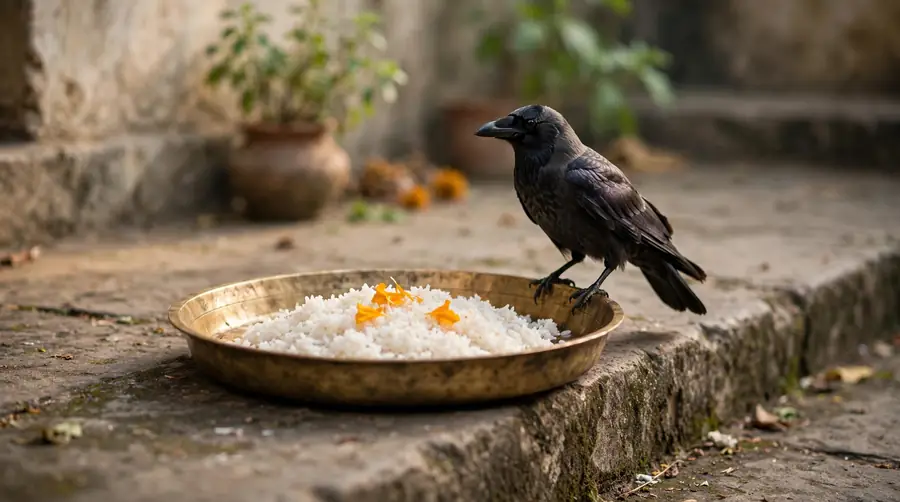
That is an extraordinary inversion of the Western position. In Europe the crow near the dead was an omen to be dreaded. In Hindu practice the crow near the offering is the confirmation that the rite has worked, and its absence is the bad sign.
The Crow Is Shani’s Mount
The crow is the vahana — the vehicle — of Shani, the deity associated with Saturn, and that association colours the bird considerably.
Shani is connected to discipline, delay, karma and strict justice. He is not an evil figure but he is a demanding one: the deity of consequences arriving on schedule. A bird that carries him inherits that register — serious rather than malevolent, concerned with what is owed.
And One Crow Narrates the Ramayana
A detail most readers outside the tradition have never encountered. In some versions of the Ramayana story, a crow named Kakabhushundi is a narrator — an immensely long-lived sage in crow form who has watched the story unfold across ages and recounts it.
So in this tradition the crow is not only the bird that attends the dead. It is also, in one telling, the one who remembers everything and tells the story.
So What Does a Dead Crow Mean Here?
Carefully, because regional belief varies a great deal and I would rather be useful than confident.
There are regional traditions in which a dead crow is read as inauspicious, and some which connect it to ancestral matters needing attention — which follows logically from the pitr association. There is no single pan-Hindu doctrine on it, and anyone presenting one is overstating.
What the tradition does say clearly is that the living crow is an honoured intermediary with the ancestors. If you want a reading consistent with that rather than invented alongside it, the natural one is the same as the cross-cultural reading: the intermediary has completed its own passage.
Again — I am not a Hindu scholar or a priest. For anything that matters to you religiously, ask someone within the tradition.
The Crow Across Other Cultures
The pattern across the rest of the world is remarkably consistent once you look for it, and it is not the pattern people expect.
Norse. Odin keeps two ravens, Huginn and Muninn — usually glossed as Thought and Memory — who fly over the whole world each day and return to tell him what they saw. One of Odin’s own names means raven-god. The birds are his intelligence service.
Celtic and Irish. Corvids are tied to the Morrígan, a goddess associated with war, fate and sovereignty, who appears in crow form. In the death of Cú Chulainn a crow lands on his shoulder, which is how those watching know he is gone. The bird marks the death; it does not cause it.
Japanese. The strongest positive position anywhere. Yatagarasu, a great three-legged crow, is a divine messenger associated with the sun who guided the first emperor on his journey. It remains a recognised national emblem and appears on the crest of Japan’s football association. A crow in Japan is a guide, not a warning.
Chinese. Two traditions, and the second is lovely. A three-legged crow appears in the sun in early mythology. And crows were believed to feed their aged parents, which made them a Confucian emblem of filial devotion — the bird held up as an example of looking after your mother and father.
Greek. The origin story of the crow’s colour, and it is the whole theme of this page in one myth. The crow was originally white. It brought Apollo news he did not want to hear — true news — and Apollo in his anger scorched it black.
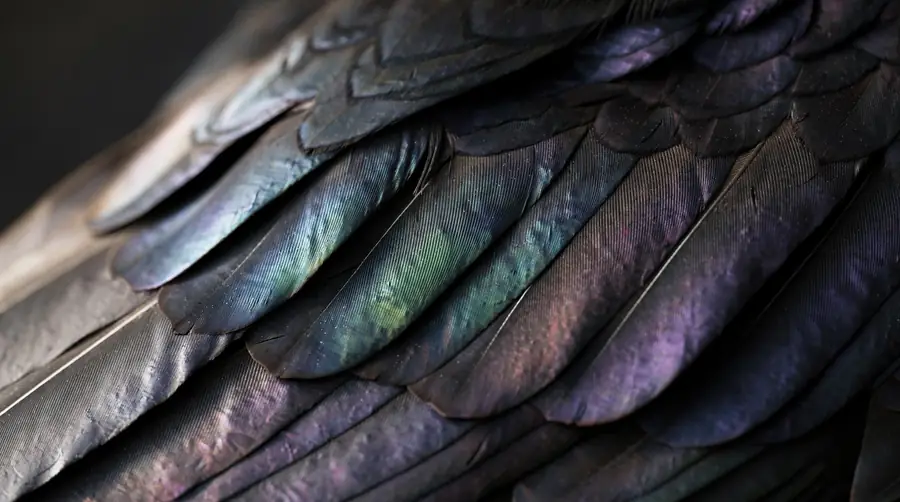
The crow’s blackness is, in that tradition, a punishment for accurate reporting. Which is an unusually direct statement of what has happened to this bird everywhere since.
Native American. Enormously varied and should not be flattened. In several Pacific Northwest traditions Raven is a creator and trickster credited with bringing light into the world — one of the most elevated positions any animal holds in any mythology. Other nations hold quite different views, and the specifics belong to those nations rather than to a summary.
Tibetan Buddhist. The raven is associated with Mahakala, a fierce protector figure, and corvids appear as messengers and guardians rather than as omens of harm.
Why the Crow, and Not Some Other Bird
Worth answering, because the consistency across unrelated cultures needs explaining and the explanation is not mystical.
Three things made the crow the universal candidate.
It is everywhere humans are. Corvids live on every continent except Antarctica and thrive alongside people, following agriculture, settlement and waste. Every culture had one to think about.
It is conspicuously intelligent. Crows use tools, solve multi-step problems, recognise individual human faces, hold grudges for years and teach them to other birds. People noticed this long before anyone studied it, and a bird that appears to be watching and remembering gets cast as a watcher and a rememberer.
And it attends the dead. This is the decisive one. Corvids are scavengers, so they gathered at battlefields, gallows and plague pits — reliably, visibly, in numbers. Any culture that fought wars or executed criminals or buried plague victims saw crows at those places, repeatedly, for centuries.
Put those together and you get a bird that is always present, appears to understand what it is seeing, and turns up wherever people die. It was going to become the intermediary. There was no other candidate.
And notice, as with the vulture, the direction of the causality. The crows arrived after. They were the consequence of the death, not its announcement. Our guide to hearing crows at night covers how that association formed in detail.
What a Dead Crow Means in Each Tradition
The direct answers, including where the honest answer is “nothing.”
Biblical. Nothing. No verse addresses it. The bird itself is primarily an emblem of divine provision, so if you want a reading consistent with scripture rather than invented beside it, a dead raven is simply a creature whose feeding is finished.
Islamic. No specific tradition on finding one, and the broader teaching discourages reading omens from birds at all. The crow’s significance in the text is as the teacher of burial.
Hindu. No single doctrine. Regional beliefs vary, some treating it as inauspicious and some connecting it to ancestral attention. The living crow is the honoured intermediary; the dead one is not a fixed sign.
European folk tradition. This is where you actually find material, and it is better than expected. Folk records from Celtic, British and Japanese sources point the same way: a dead crow reads as a cycle ending or ill luck already spent, not as a fresh omen. For a bird as burdened with dread as this one, its death inverts the sign rather than doubling it.
And nowhere at all is there a substantial tradition reading a dead crow as a warning of a death in the household. That claim circulates widely online and it does not come from the folk record.
What to Do
If this is a religious question that matters to you, ask inside your tradition. A priest, imam, pandit or minister who knows you is worth more than any article, and that is true of this one too.
Be sceptical of any page quoting you a verse. There is no dead crow in scripture. If you are shown chapter and verse for one, look it up — the passage will turn out to be about something else, usually ravens in a ruined landscape.
And if you found one in your own garden, there is a practical side to this that the religious question does not cover — including why the other crows gather and why you should move it discreetly. Our guide to a dead crow in your yard handles that.
Then the thing worth taking from all of this, which is not about luck at all.
Across every tradition surveyed here the crow is doing the same job in different costumes: it carries, it watches, it remembers, it attends, it reports. In Norse myth it is Odin’s memory. In the Ramayana it narrates. In Hindu rites it confirms the ancestors have been fed. In the Qur’anic account it shows a man how to bury his brother. In Greek myth it was turned black for telling the truth.
Humanity has handed this bird its most difficult errand — standing between the living and the dead — and then blamed it for the news.
Frequently Asked Questions
What does a dead crow mean biblically?
Nothing — there is no dead crow or dead raven anywhere in the Bible, and no verse assigns one a meaning. The bird itself appears often, though, and mostly positively: ravens feed Elijah on God’s instruction, God cites the raven in Job as proof of his provision, and in Luke Jesus specifically says to consider the ravens, which neither sow nor reap and are fed anyway.
Does the Bible mention crows or only ravens?
The Hebrew orev and Greek korax are both conventionally translated raven, and ancient Hebrew did not separate the corvids into modern species categories — the word covers the black scavenging birds as a group. So the raven passages are the biblical material on crows, and some of them almost certainly describe birds we would call crows.
What does a dead crow mean in Hinduism?
There is no single doctrine and regional beliefs vary, with some treating it as inauspicious and some connecting it to ancestral matters. What the tradition says clearly is that living crows are honoured intermediaries with the ancestors — crows are fed during Pitru Paksha, and a crow accepting the offering is taken as the ancestors accepting it. The crow is also the mount of Shani.
Is it true that a crow taught people to bury the dead?
That is the Qur’anic account of the two sons of Adam: after the killing, the murderer does not know what to do with the body, and a crow is sent which scratches at the earth to show him how to cover his brother. In that telling the first human burial was demonstrated by a crow — so the bird most feared as an omen of death is credited with teaching people what to do about it.
Is a dead crow a warning that someone will die?
No, and no substantial tradition says so despite how widely the claim circulates. The European crow-and-death association is about living crows gathering at battlefields, gallows and plague pits — they arrived after the deaths, as scavengers. The folk records that do address a dead crow read it as a cycle ending or ill luck spent.
The raven has its own page: Raven spiritual meaning.