
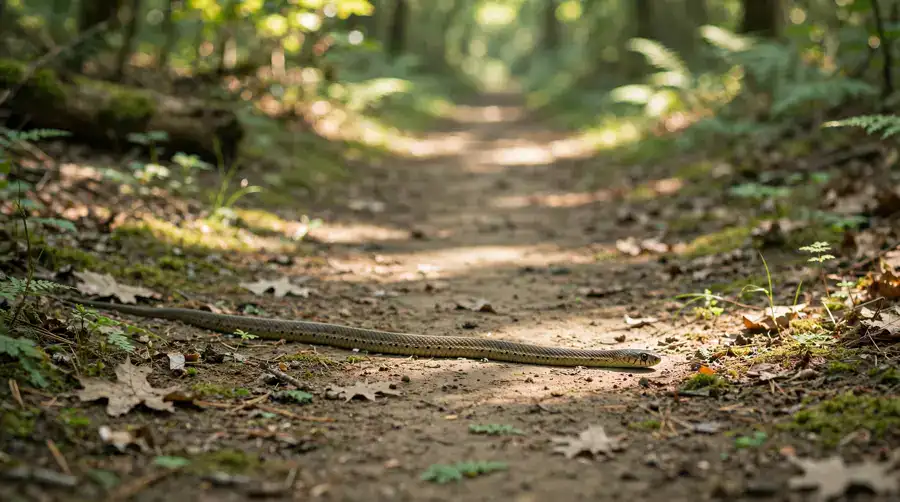
You stopped mid-step. It was lying across the path in front of you, or moving over it with that unsettling lateral ease, and your whole body reacted before any part of your mind had caught up.
Then it was gone into the grass, or it stayed exactly where it was and looked at you, and you backed away and have been thinking about it since.
Here is something that changes the encounter completely, and no page about this mentions it. The snake almost certainly was not crossing your path at all. Paths, trails and roads are the warmest surfaces in a landscape, and a snake cannot make its own body heat. You did not interrupt a journey. You walked across its radiator.
Snake Crossing Your Path: The Short Answer
A snake crossing your path is traditionally read as transformation that has already begun — the shedding reading — and as a prompt about something you need to look at directly rather than step around.
It is one of the very few animal encounters where the symbolism is genuinely double-edged, because the snake is simultaneously the oldest symbol of danger and the oldest symbol of healing. That is not a contradiction and the reason why is in the section below on antivenom.
Practically: it was there for warmth, a snake that did not move was cold rather than bold, and the single most useful thing to know is that almost all snakebites happen to people who try to kill or move the snake.
The Path Is a Heater, and the Snake Is Using It
This is the spine of the whole encounter and it is missing from every page on the subject.
Snakes are ectotherms. They produce essentially no body heat of their own, which means their temperature — and therefore their digestion, their muscle speed, their reaction time, their ability to do anything at all — is set by their surroundings. A snake’s entire day is organised around managing that.
Now think about what a path is. It is a strip of ground with the vegetation removed, open to the sky, often made of stone, gravel, compacted earth or tarmac — materials that absorb solar heat during the day and release it slowly afterwards. In the middle of surrounding grass and leaf litter, a path is the warmest available surface by a wide margin.
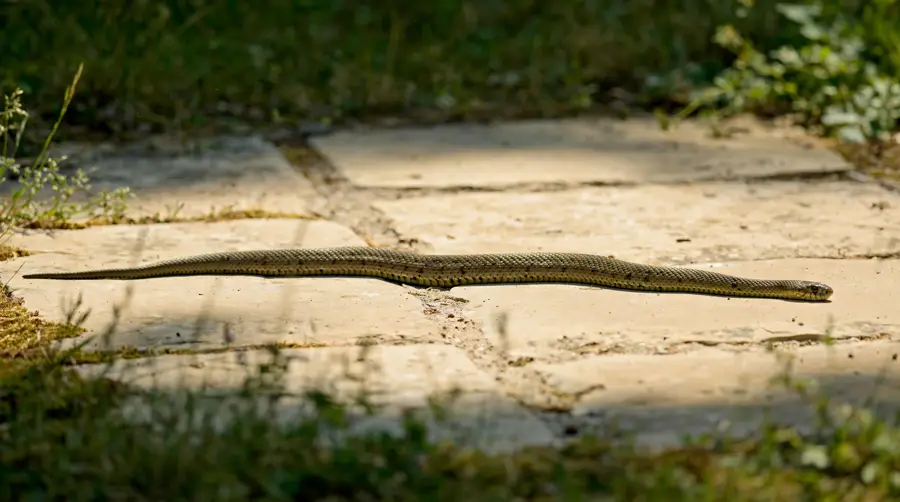
Which is why snakes are on paths and roads so disproportionately often. They are not using them as corridors in the way a deer or a bear does. In many cases they are not travelling at all — they are lying on the warm surface deliberately, soaking up heat they cannot generate.
That is also, incidentally, why so many are killed by cars. A snake on tarmac at dusk is not caught mid-crossing. It has chosen to be there because the road is the last warm thing in the landscape as the air cools.
So the folklore has the geometry backwards. The crossing-your-path tradition assumes an animal moving across your line of travel, with the direction meaning something. What actually happened is more likely that a snake was already there, managing its temperature on the best surface available, and you arrived.
Which is a better reading, not a lesser one. The snake was not sent and did not seek you out. It was doing the single most necessary thing in its day, on the ground you had both chosen for the same reason — because it was the clearest way through.
If It Did Not Move, It Was Cold — Not Bold
The most useful thing on this page, and it reframes the part that frightens people most.
People read a motionless snake as confident, territorial or threatening. It is almost always the opposite. A snake that stays put as a human approaches is usually too cold to leave.
A cold snake is a slow snake. Its muscles will not deliver speed, it cannot flee effectively, and it knows it. So it does the only thing left available: it stays still and hopes not to be noticed. That is a vulnerable animal, not an aggressive one.
And this matters for a practical reason. A cold snake that cannot run is also the snake most likely to bite defensively, because the escape option has been removed from its repertoire. The danger is not its boldness. The danger is its inability.
Which gives you the timing rule. A snake encountered early on a cool morning is sluggish and should be given a wide berth and plenty of time. The same snake at midday on a warm day will be gone before you have finished reacting.
Four Readings of a Snake Crossing Your Path
1. Something You Have to Look At
The core reading for this specific encounter, and it comes from the geometry. A snake across a path is an obstacle you cannot simply walk through. You must stop, assess it, and decide — and you cannot do any of that without looking directly at the thing you least want to look at.
That is the traditional interpretation, and it is unusually specific: not a general message about fear, but a prompt about a particular thing you have been navigating around rather than examining. (The same crossing framework applies to other encounters, such as a bear crossing your path.)
2. Movement That Needs Resistance
A fact about snake locomotion that almost nobody knows and that makes an excellent reading.
Snakes move by pushing against irregularities in the ground — stones, stems, ridges, texture. Put a snake on a genuinely smooth surface, glass or polished plastic, and many species cannot move effectively at all. They thrash and get nowhere. The friction is not an obstacle to their movement. It is the mechanism of it.
Read as a message, that is one of the better things in animal symbolism: progress that depends entirely on having something to push against. Remove the resistance and the snake does not glide faster — it stops.
3. The Shed, Properly Understood
Every page says transformation and renewal, and none of them describe what actually happens, which is far more interesting and considerably less graceful.
Before a snake sheds, its eyes turn milky blue-grey. Snakes have no eyelids — each eye is covered by a fixed transparent scale — and that scale clouds over along with the rest of the skin. For several days the snake is effectively blind.
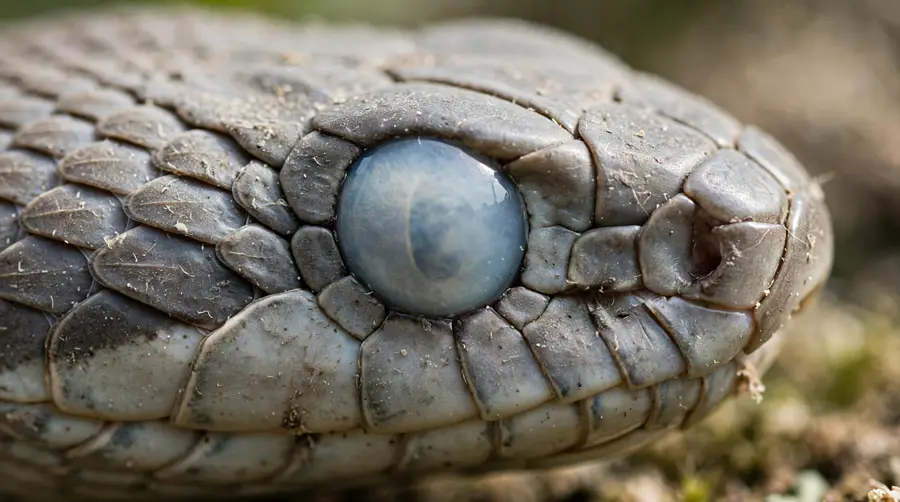
During that period it hides. It is defensive, irritable and reluctant to move, because it cannot see what is approaching. Then the old skin splits and comes away in one piece — including the clouded caps over both eyes. The snake sheds its own corneas and can see again.
So the renewal reading is real, but the honest version is not a smooth emergence into something better. It is this: you cannot change without a period of not being able to see where you are going, and during that period you will be withdrawn and bad-tempered and should probably be left alone.
That is a much more useful message than new beginnings, and anyone who has been through a real transition will recognise it immediately.
4. It Knew You Were There First
The snake’s forked tongue is not decoration and it is not tasting the air in the way people assume. It collects airborne particles and delivers them to a sensory organ in the roof of the mouth — and the fork is functional. Each tip samples a slightly different point in space, so the snake can tell which side a scent is stronger on.
It smells in stereo. It has directional chemical information, the way you have directional hearing.
And if it was a rattlesnake, copperhead, cottonmouth, python or boa, it has something stranger still: pit organs that detect infrared. It can form an image of your body heat. In complete darkness it would still have known exactly where you were.
So the reading is not about being watched. It is about being detected by means you do not possess. The snake had a complete picture of you before you noticed it, assembled from chemistry and warmth, and it chose not to act on it.
What to Do — and What Not to Do
This section has real stakes, so it is plain and it is early.
Back away and go around. That is the entire procedure. Snakes do not pursue people. A snake you leave alone is a snake that has no further interest in you, and giving it a few metres of space resolves the situation completely.
The single most important fact about snakebite: the great majority of bites happen to people who were trying to kill, catch, move or photograph the snake at close range. Not to people walking past. Deciding to deal with it is the risk. Walking away is not.
Do not try to identify it up close. Most snakes are harmless and identification is genuinely difficult, and the rhymes people half-remember about red and yellow bands only apply to particular species in particular regions and mislead everywhere else. If you want to know what it was, take a photograph from a safe distance and look it up afterwards. If the snake was small, our guide to a baby snake in the house covers the most common worries about small snakes and which ones are myths.
Do not kill it. Beyond the fact that this is when people get bitten, snakes are significant rodent predators and in many places are legally protected. The snake on your path is doing pest control you would otherwise pay for.
If it is in a place it cannot stay — inside a building, in a garage, somewhere with children or dogs — do not handle it. Call a local snake removal service, wildlife officer or animal control. Many areas have volunteers who do this free. And if the snake was indoors rather than on a path, that is a different encounter — see our guide to a snake in the house.
And if anyone is bitten: get to emergency medical care immediately, and call the emergency services on the way. Keep the person calm and still, keep the bitten limb below heart level, and remove rings, watches or anything tight near the bite in case of swelling. Do not cut the wound, do not try to suck out venom, do not apply a tourniquet, and do not apply ice — all of those cause harm and none of them help. Do not go back for the snake. Antivenom decisions are made clinically and your photograph, if you safely have one, is enough.
That is a short list and it is not alarming in context: bites are uncommon, outcomes with prompt treatment are good, and nearly every bite in the statistics involves somebody who chose to approach.
What Changes the Reading
It Crossed and Kept Going
The classic version, read as information about your direction rather than a confrontation — two paths intersecting and both continuing. Practically, a snake moving steadily across open ground is a warm snake going somewhere, usually between cover and a basking site, and the trip is short.
It Stayed Still and Watched You
Read as the most personal and most arresting version. And worth knowing the anatomy: snakes have no eyelids and cannot blink or close their eyes. The unblinking stare that unsettled you is not intensity. It is the only expression a snake has.
Go back to the cold-not-bold section for what the stillness actually meant.
It Reared, Hissed or Rattled
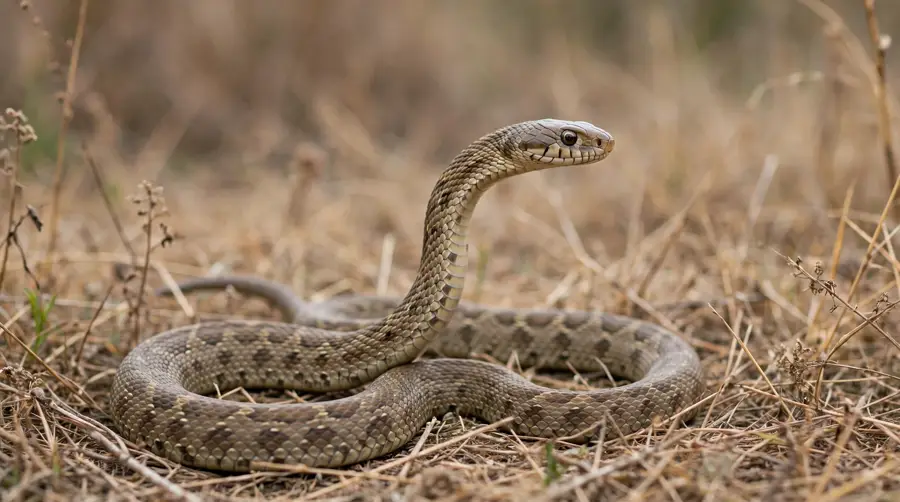
Read as an unmistakable warning, and it is exactly that — but the direction of the warning matters. A snake that rattles, hisses, flattens its head or holds up its forebody is asking you to stop and go away. It is spending energy to avoid a fight it does not want, because biting costs venom that takes time to replace and risks injury.
A displaying snake is the clearest communication you will get from any wild animal. Take the instruction.
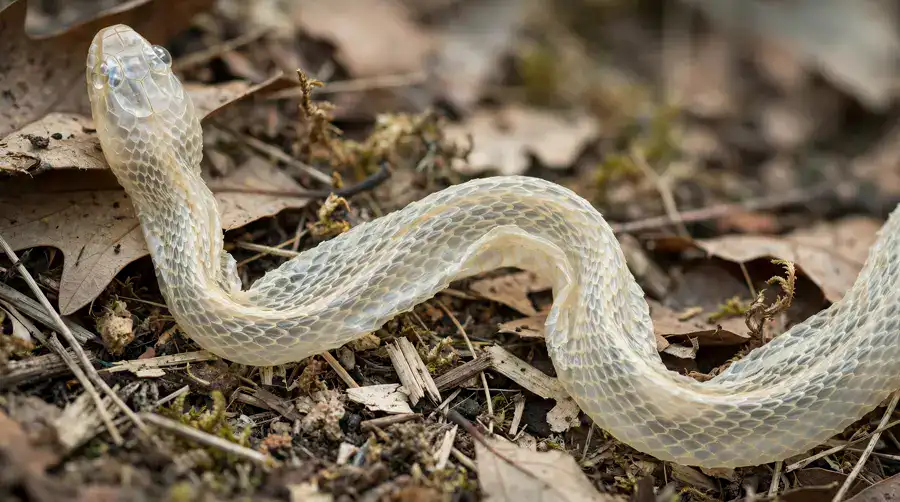
A Snake Shedding, or a Shed Skin on the Path
Finding a complete shed skin is treated across traditions as a notably good sign — the transformation evidenced rather than merely promised, and something left behind for you specifically. It is also the one snake souvenir that is safe and legal to pick up almost everywhere.
Look at the head end for the two clear eye caps. That is the detail that makes the shedding section above real rather than abstract.
Two Snakes Together
Read as partnership, duality and balance — and it is the image behind the caduceus, two snakes wound around a staff. Practically, two snakes together in spring are usually courting or mating, and two intertwined and rearing may be males in a dominance contest rather than a pair.
A Dead Snake on the Path
Read as a threat that has passed or a transformation that did not complete, rather than as an omen. Overwhelmingly the cause is a vehicle, for the thermal reason explained above. Do not handle it — a reflex bite is possible for some time after death in some species, and there is no reason to find out.
If you found a dead snake or a shed skin, see Dead Snake Spiritual Meaning.
The Same Spot, Repeatedly
Repetition is read as emphasis in every sign tradition. Practically, it means you have found a good basking site, and snakes reuse them — a particular flat rock, a south-facing step, a warm patch of path. If you keep meeting a snake in one place, the place is the reason, and you now know where to look before you step.
The Animal That Is Both the Poison and the Cure
The snake is the most thoroughly double-coded animal in human symbolism. It is the oldest emblem of danger and deceit, and simultaneously the oldest emblem of healing and medicine — frequently within the same culture and occasionally within the same text.
That looks like a contradiction people never resolved. It is not. It is accurate, and here is why.
Antivenom Is Made From Venom
The treatment for a venomous snakebite is produced by injecting small, controlled doses of that same venom into an animal, allowing it to generate antibodies, and harvesting those antibodies. The cure is manufactured out of the poison.
And it goes further. Snake venoms are complex cocktails of compounds that act on blood pressure, clotting and the nervous system with enormous precision, which makes them a serious source of pharmaceutical leads. One of the most widely used classes of blood pressure medication in the world was developed from a peptide found in the venom of a Brazilian pit viper.
Millions of people take a drug descended from snake venom every morning.
So when ancient cultures made the snake the symbol of medicine, they were not being ironic or paradoxical. They were right, and it took us two thousand years to catch up to the mechanism.
Which Is Why the Snake Is on the Ambulance
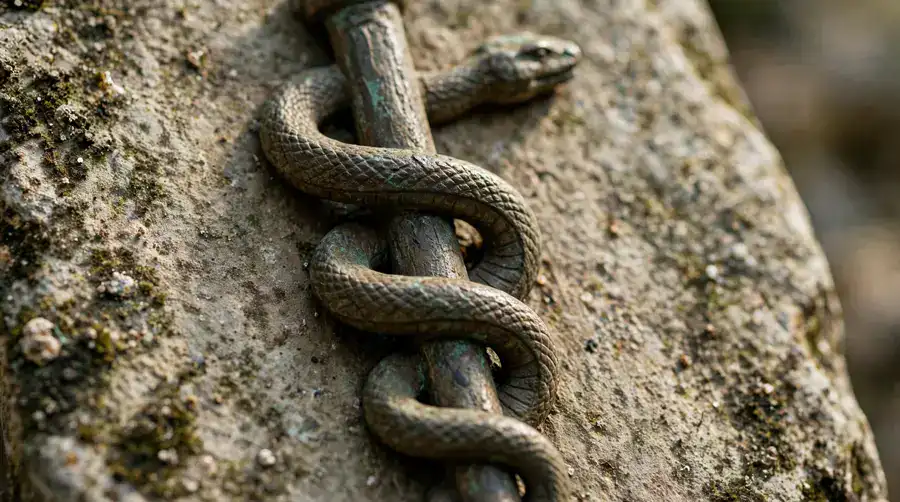
Look at the medical symbol you have seen your whole life. The rod of Asclepius — a single snake wound around a staff — is the emblem of medicine worldwide, named for the Greek god of healing, in whose temples live snakes were kept.
The caduceus, two snakes around a winged staff, belongs properly to Hermes and to commerce, and ended up on American military medical insignia through a historical mix-up — so there are now two snake symbols in medicine, one correct and one accidental.
Either way: the universal sign for help, treatment and rescue is a snake. That is worth remembering if one frightened you on a path this week.
Even the Bible Does It Both Ways
Most readers know the serpent in Eden, and that single passage carries most of the weight of the snake’s reputation in the West.
Far fewer know the other one. In the Book of Numbers, with the people being killed by snakebite in the wilderness, Moses is instructed to make a bronze serpent and raise it on a pole — and those who look at it live. A snake lifted up becomes the instrument of healing.
And in the Gospel of John, Jesus draws the comparison explicitly: as Moses lifted up the serpent in the wilderness, so must the Son of Man be lifted up.
So within the same scripture the serpent is the deceiver in the garden and the raised emblem of rescue that prefigures the crucifixion. If you were taught that the Bible is simply against snakes, it is not — it is doing the same double-coding as everyone else.
And Elsewhere It Is Mostly Protective
Outside the Western tradition the balance tips further toward the snake than most readers expect.
In Hindu and Buddhist tradition the nāgas are serpent beings, often guardians of water and treasure. Vishnu rests on the serpent Shesha. A cobra is said to have spread its hood to shelter the Buddha while he meditated. And in yogic tradition kundalini — spiritual energy — is described as a coiled serpent rising through the body, so the snake is the very image of awakening.
In ancient Egypt the rearing cobra, the uraeus, sat on the pharaoh’s brow as a protective emblem — the snake as royal bodyguard.
In Mesoamerica the feathered serpent is among the highest deities. In Aboriginal Australian tradition the Rainbow Serpent is a creator being who made the rivers and the land.
And the ouroboros — the snake swallowing its own tail — is the oldest symbol humans have for eternity and for cycles that close and begin again.
Weigh all that against one passage in Genesis and the picture is not what most people inherited.
What to Take From It
Note the time of day and the weather. Cool and early means a sluggish snake that needs room. Warm and bright means it has already gone. Those two details decide which of the readings above is yours and how carefully you needed to behave.
Note the surface. If it was lying on stone, gravel or tarmac in sun, it was basking, not crossing — and the whole crossing-your-path framing dissolves into something simpler.
Watch the same spot next time. Snakes reuse basking sites, so you probably now know where one lives.
And if you were frightened, that is not a failure of nerve. Fear of snakes is one of the most widely shared responses in our species and there is reasonable evidence it is partly inherited rather than learned. You did not overreact. You reacted the way almost everyone does.
Then the reflective part, which this animal supplies more sharply than most. A snake across a path cannot be walked through. It has to be looked at, assessed and gone around deliberately, and the one thing that does not work is pretending it is not there.
What have you been stepping around on your way past, that you are going to have to stop and actually look at?
Frequently Asked Questions
What does it mean spiritually when a snake crosses your path?
It is read as transformation already underway and as a prompt to look directly at something you have been navigating around — a snake across a path cannot be walked through, only assessed and deliberately avoided. The snake is also the oldest symbol of healing as well as of danger, which is why the reading is genuinely double-edged rather than simply ominous.
Why was the snake on the path in the first place?
Almost certainly for warmth. Snakes cannot generate their own body heat, and a path or road is the warmest surface in a landscape — open to the sky and made of materials that absorb and hold solar heat. In many cases the snake is not crossing at all but basking on the warm surface deliberately, which is also why so many are hit by cars at dusk.
Is a snake crossing your path a bad omen?
Not in most of the world. The negative reading in the West rests heavily on one passage in Genesis, while the snake is the emblem of medicine worldwide through the rod of Asclepius, a protective figure as the Egyptian uraeus and the Hindu and Buddhist nāgas, a creator being in Aboriginal Australian tradition, and the image of spiritual awakening in yogic tradition.
The snake did not move — was it being aggressive?
Almost certainly the opposite: it was too cold to leave. A cold snake cannot produce speed, so staying still and hoping to go unnoticed is the only defence available to it. That also makes it more likely to bite defensively, because fleeing has been removed from its options — so give a motionless snake more room, not less.
What should I do if a snake is on my path?
Back away and go around it. That is the whole procedure — snakes do not pursue people. The most important thing to know is that the great majority of snakebites happen to people who were trying to kill, catch, move or closely photograph the snake, not to people walking past. If it needs removing from a building, call a local snake removal service rather than handling it.
The same route-first logic applies to mammals, too — a raccoon crossing your path is working a fixed corridor night after night, not choosing to meet you.
The same route-came-first logic applies when a bird crosses your path — see what it means when a goose crosses your path.