
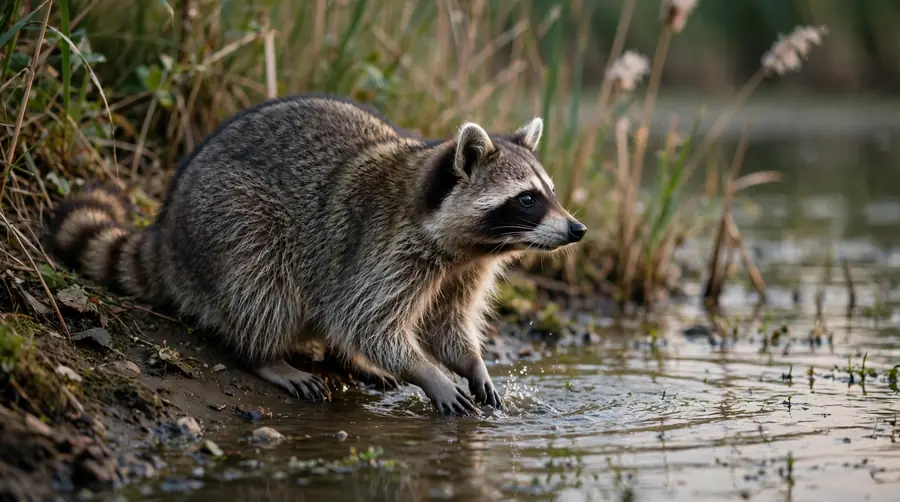
Nearly every page ranking for this search tells you the raccoon means spiritual cleansing. The reasoning is never stated, but it is obvious enough: raccoons wash their food, so they must symbolise washing.
Here is the problem. Raccoons do not wash their food. The behaviour everyone has built that symbolism on is not cleaning at all — it is something considerably more interesting, and once you know what it is, the whole encounter reads differently.
The animal that crossed your path was not tidying anything. It was looking at the world with its hands.
First, make sure it was a raccoon
Usually obvious, occasionally not, and it matters for the practical sections below.
| What you saw | What it was |
|---|---|
| Black facial mask, ringed tail, hunched walk, dextrous front paws | A raccoon |
| Masked face but a bushier, unringed tail, more dog-shaped, in Europe or East Asia | A raccoon dog. Not a raccoon at all — it is a canid, and a different animal entirely |
| Pale grey-white, pointed pink snout, long naked tail, no mask | A Virginia opossum |
| Mask-like markings but cat-shaped, long slim ringed tail, southwestern US | A ringtail. A relative, and much rarer to see |
A raccoon out in daylight is usually not rabid
Taking this early because it is the thing people are actually worried about, and because the belief is wrong in a way that gets healthy animals killed.
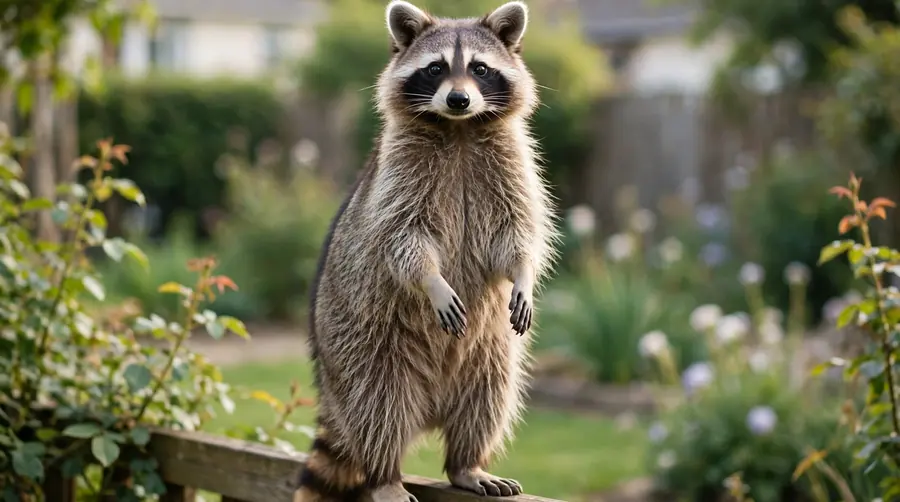
Raccoons are mostly nocturnal, but daytime activity is normal and common — particularly in spring and early summer, when a nursing mother has four or five kits to feed and cannot do it in the dark alone. A raccoon crossing a lawn at two in the afternoon is very often a mother on a double shift.
What actually warrants concern is behaviour, not timing: staggering, circling, apparent paralysis of the hind legs, unprovoked aggression, complete indifference to your presence, or discharge around the eyes and mouth. Those are worth a call to animal control. Being awake is not.
Rabies is genuinely present in raccoon populations in the eastern United States and it should be respected — never handle a raccoon, never corner one, and keep pets vaccinated. But a healthy raccoon’s response to you is to leave, and most of them do.
It is not washing the food
The behaviour is called dousing. A raccoon in shallow water will rotate, rub and manipulate an object between its front paws, often for a long time, and it looks exactly like washing.
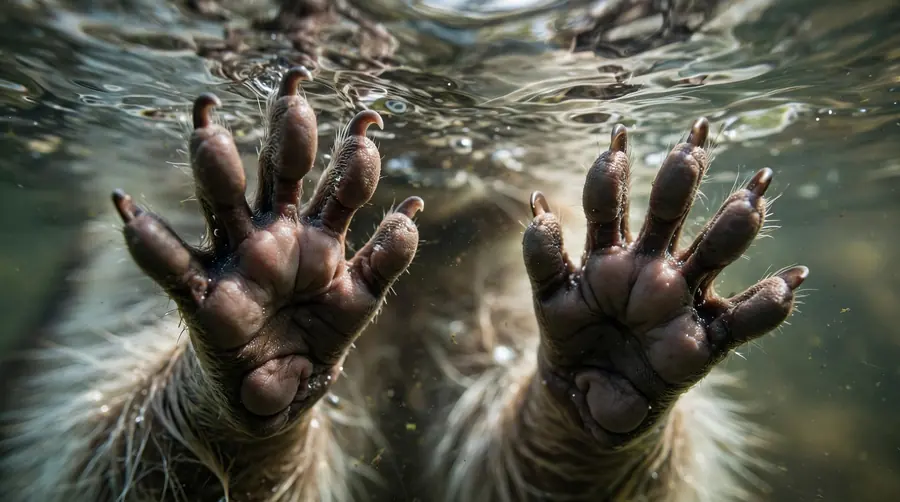
It is not. Wetting the forepaws increases their sensitivity — water softens the tough outer layer of the paw and improves the flow of information from the touch receptors underneath. The raccoon is not cleaning the object. It is reading it.
Watch one do it and the giveaway is the eyes. A dousing raccoon frequently looks away entirely, or stares at nothing, while its hands work. It is not inspecting visually at all. The hands are doing the perceiving and the eyes have been taken off the job.
And here is where it becomes genuinely remarkable. The misreading is embedded in the animal’s own names. Its scientific name is Procyon lotor, and lotor is Latin for “washer.” In German it is Waschbär — wash-bear. Across multiple languages, the species has been formally named after a thing it does not do.
So when ten pages tell you the raccoon symbolises cleansing, they are not interpreting the animal. They are repeating a four-hundred-year-old observational error that got written into the taxonomy and never corrected.
The raccoon is not the only animal carrying symbolism built on a misreading of the animal — the white dove is not a wild species at all.
Two-thirds of its touch brain is in its hands
The dousing makes sense once you see what the raccoon is built around.
In the raccoon’s brain, the region that processes touch is dominated by the forepaws — reported at around two-thirds of the whole area devoted to tactile sensation, a proportion in the same territory as primates and their hands. The paws themselves carry several times the density of touch receptors found in most mammals.
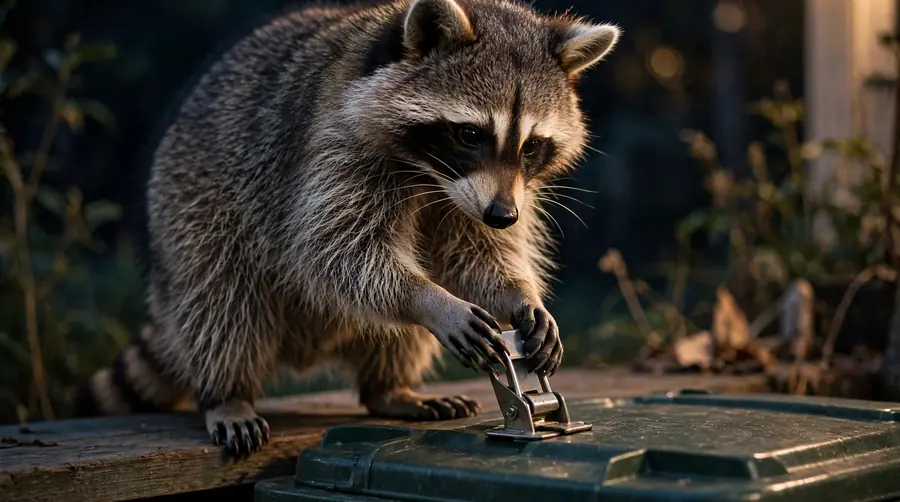
They have no opposable thumbs, which makes what they manage with those paws more impressive rather than less: latches, jar lids, bin clips, bolts, door handles. A raccoon solving your bin is not being naughty. It is doing the thing it is most highly specialised to do.
Its eyes, meanwhile, are mediocre. Raccoons are nearsighted and see colour poorly. The mask across the face is widely thought to cut glare and sharpen contrast at night, in roughly the way athletes use eye black — plausible, commonly cited, and not fully settled.
Put it together and you have an animal that does not primarily look at the things. It handles them.
The oldest name for it also describes the hands
This is the detail I liked most while researching, and no competitor has it.
The English word raccoon comes from Virginia Algonquian — the Powhatan language — recorded by early English colonists in forms like aroughcun and arathkone. The sense of the original term refers to the animal’s use of its hands: scratching, rubbing, handling with the forepaws.
So compare the two naming traditions. The people who had lived alongside the animal for thousands of years named it for what it does with its hands. The Europeans who arrived and watched it in a stream for a while named it the washer.
One of those is a description. The other is an assumption about motive, and it is the one that ended up in the scientific literature and in every symbolism article you will read today.
Why it crossed your path
Raccoons are creatures of routine. They work a home range along fixed travel routes — fence lines, drainage ditches, culverts, creek beds, hedge bottoms, the gap between two garages — and they use the same routes repeatedly, night after night, because a known route is a safe one.
Which means a raccoon crossing in front of you almost never represents a decision about you. It represents a commute. You were standing on a corridor that was established before you got there and will be in use tomorrow.
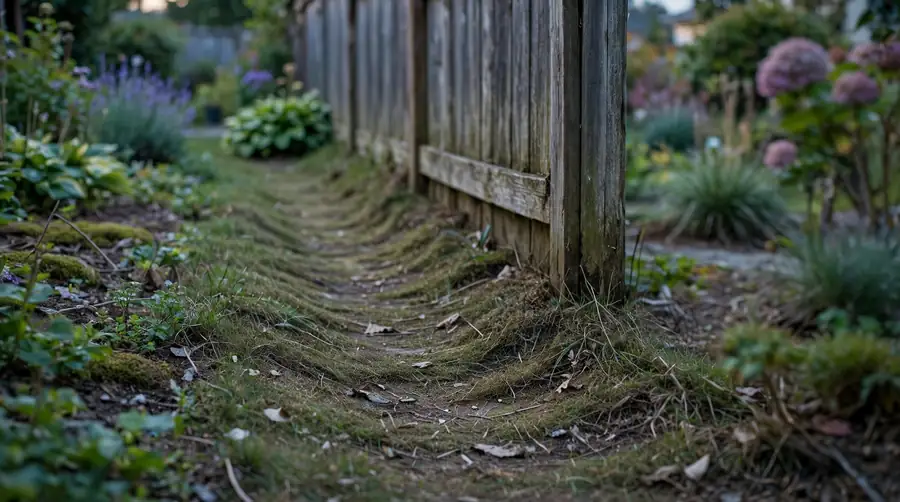
There is something useful in that rather than something deflating. If one crossed your path, the same animal is probably crossing that spot most nights — so the encounter was not rare. Your presence at that hour was the unusual variable.
The same route-first logic applies to other animals crossing your path — a snake on a trail is often using the sun-warmed ground as a heater, the way the raccoon uses it as a commute.
Four readings
1. What looks like fastidiousness is investigation
The whole article turns on this. For four centuries people watched an animal handle an object in water and concluded it was concerned with cleanliness. It was gathering information.
That mistake is very human and it has a shape worth recognising. Someone goes over the same thing repeatedly — the document, the message, the conversation — and observers read it as fussiness, perfectionism, an anxious need for things to be tidy. Sometimes it is. Often they are still trying to find out what they are holding.
Repeated handling is not always about standards. Sometimes it is the only way the information arrives.
2. Some things only yield to handling
There is a real distinction here that most advice ignores. Some problems genuinely do resolve by looking at them from a distance — and some give up nothing at all until you are inside them with both hands, having made some mess. Reading about a job is not doing it. Thinking about a conversation is not having it.
If the thing you are circling has stopped revealing anything to inspection, that may not be a failure of analysis. It may be the wrong sense organ.
3. Sensitivity has a precondition
The small mechanical detail inside the dousing is the best part. The paw becomes more sensitive when it is wet, because the tough outer layer softens.
So the raccoon’s fine perception is not simply a gift it carries around. It is a capacity that switches on under a specific condition, and the condition involves the hard protective surface giving way.
Make of that what you like. I think it is the most honest thing an animal has ever said about why people tend to notice more during the periods they would not have chosen.
4. The city animal is the cleverer one
Research comparing urban and rural raccoons has found urban animals performing better on problem-solving tasks, which is the opposite of the sentimental expectation that the wild version is the more capable one. Treat it as a real finding and a developing one rather than settled law.
The mechanism is not mysterious. A city is a dense field of novel puzzles with food behind each one, and solving them is rewarded nightly. The bins are the curriculum.
Which makes the raccoon an awkward and useful figure. It is not thriving because it is noble or because it is in balance with anything. It is thriving because it was dropped into a harder environment and got better.
The real hazard is the latrine, not the animal
Everyone worries about rabies and almost nobody knows about this one, which is the wrong way round if you have a garden, a sandpit or a dog.
Raccoons commonly carry a roundworm, Baylisascaris procyonis, and they use communal latrine sites — the base of a tree, a flat rock, a deck, a woodpile, the corner of an attic. The eggs in the droppings are extraordinarily tough: they survive for years, resist ordinary disinfectants, and are infectious if swallowed. In humans, infection is rare but can cause serious neurological damage, and small children are the group at risk because of what ends up in their mouths.
So: do not sweep or hose a raccoon latrine, because that spreads the eggs. Wear disposable gloves and a mask, bag the material, and clean the surface with boiling water if it is safe to do so — heat is more effective than disinfectant. Keep sandpits covered. Wash hands and garden produce. If there is a latrine in an attic or crawl space, this is a reasonable thing to pay a professional to handle.
California’s public-health department keeps a plain-English guide to raccoon roundworm and latrine cleanup if you want the official steps.
None of that makes the raccoon sinister. It makes its bathroom a problem, which is a much smaller and more manageable fact.
If one is living in your yard or attic
The permanent solution is always removal of the attraction rather than removal of the animal, because a cleared territory refills within weeks.
Raccoons are far from the only animals that get into roofs — squirrels are equally committed attic occupants.
Secure the bins with clips or straps — a raccoon with those paws will defeat a simple lid in seconds. Feed pets indoors, pick up fallen fruit, take bird feeders in overnight, and do not leave water bowls out. Close off the space under decks and sheds, and check your roofline, soffits and chimney, because an attic is a warm hollow tree to a raccoon.
One timing point that matters a great deal. From roughly early spring into summer, a raccoon in your attic is very likely a mother with kits, and blocking the entry hole will wall non-mobile young inside — which ends badly for them and worse for your ceiling. Wait until they are mobile, or get a humane exclusion service that will check. Many areas also have legal restrictions on trapping and relocation, so check before you act.
The famous Japanese raccoon is not a raccoon
If you have read about raccoon folklore in Japan — the shapeshifter, the statues outside restaurants, the trickster with the straw hat and the sake flask — that animal is the tanuki, and it is a raccoon dog. A canid. Not a raccoon, not even a close relative.
This confusion is everywhere, including in English translations, and it matters here because the raccoon has no deep folklore of its own in Europe or Asia. It could not have any, for a reason worth stating plainly.
Why there is no raccoon in the Bible
The raccoon is a New World animal. Its natural range is the Americas, and it was unknown in Europe, Africa and Asia until after contact.
What does exist is Indigenous American material, which is where you would expect it, and it is specific rather than general. In Abenaki tradition, for instance, Azeban is a raccoon trickster figure with his own stories. That is a particular figure in a particular tradition — not evidence for a universal raccoon meaning, and anyone writing “Native Americans believed the raccoon symbolises X” is flattening hundreds of distinct nations into one sentence.
A cartoon created an invasive species
The raccoon’s spread beyond the Americas has two causes and both are human, and one of them is extraordinary.

Germany has a large and growing raccoon population descended from deliberate releases in the 1930s and from animals that escaped fur farms during and after the war. They are now established across much of central Europe.
Japan’s story is better. In 1977 an anime called Rascal the Raccoon became hugely popular, and a pet boom followed. Raccoons, it turns out, make poor pets — they get big, strong, destructive and hard to handle — and owners released them. Raccoons are now established as an invasive species across much of Japan, where they damage crops and historic temple buildings.
A children’s television programme produced a national wildlife problem that is still being managed half a century later. If you want a lesson from the raccoon, that one is free: the animal is not the problem, and it never asked to be here.
The question to sit with
It crossed your path because the route was already there. It has hands that take up two-thirds of its sense of touch and eyes that are not much use. And the thing we named it for — washing, cleaning, purifying — it has never once done.
It was feeling for the shape of something it could not see properly, which is a more honest description of most decisions than cleansing ever was.
So: what have you been told you are being fussy about, when you were actually still trying to work out what you were holding?