
You saw a dove and you noticed its colour. Brown, or grey, or startlingly white — and every page you are about to read will hand you a colour chart. White for purity. Grey for calm. Brown for grounding and earth energy.
None of them will tell you where the colours come from. So here it is, and it reverses the whole hierarchy: grey is the wild original, and the white dove is not a wild bird at all.
There is no wild species anywhere that looks like the uniform white bird released at weddings and funerals. That bird is a domestic pigeon, bred white by people over centuries, and if one is standing in your garden right now it is probably in trouble.
What you probably saw
Start here, because the colour you noticed usually identifies the bird, and the bird matters more than the colour does.
| What you saw | What it almost certainly was |
|---|---|
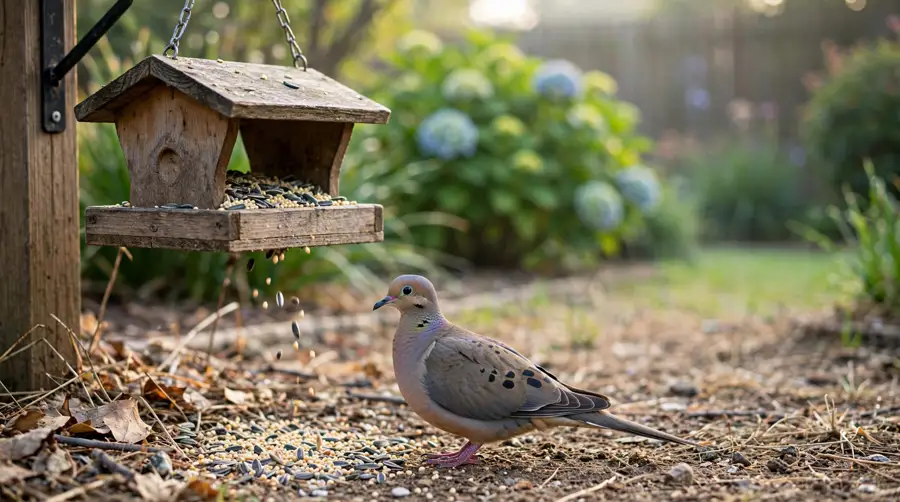
| Soft grey-brown, slim, long pointed tail, whistling wings on take-off | A mourning dove. The most abundant dove in North America, with a population in the hundreds of millions |
| Browner, scruffier, with a scaly or spotted look to the feather edges | Usually a juvenile mourning dove — this year’s bird, a few weeks out of the nest |
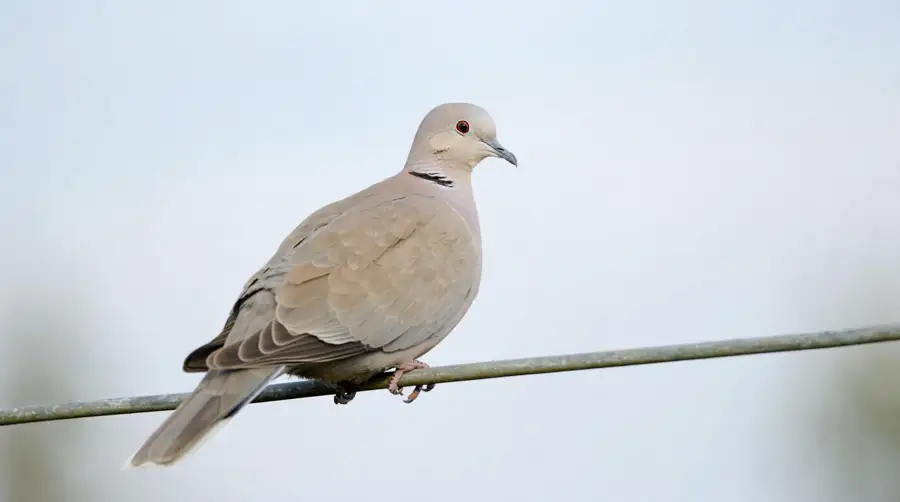
| Pale sandy-grey, chunkier, square tail, a thin black half-collar on the neck | A Eurasian collared dove. Not native to the Americas — see below, the story is remarkable |
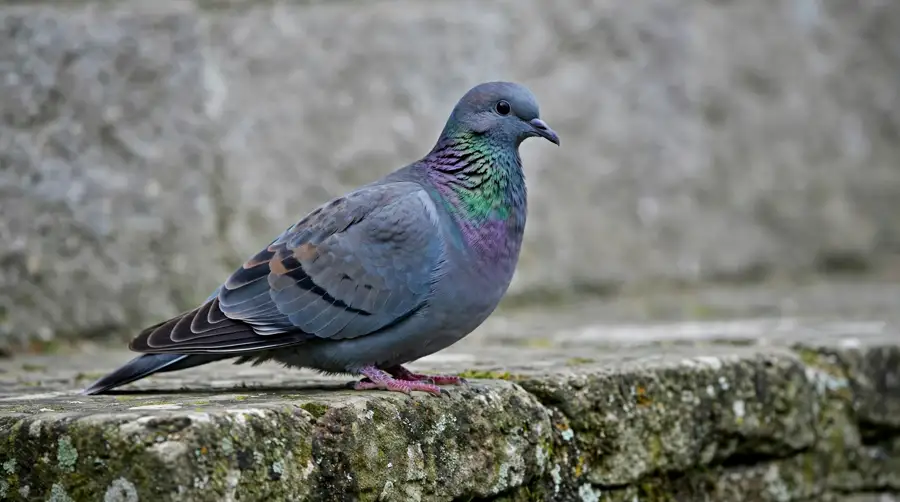
| Blue-grey with two dark bars across each wing, iridescent green-purple neck | A rock dove in its original wild plumage. Also called a rock pigeon. Same bird |
| Rusty brown or reddish-brown, chunky, in a town or city | A feral pigeon carrying a domestic colour variant |
| Patchy white and grey, or mottled | A feral pigeon with mixed domestic ancestry. Extremely common |
| Pure white, plump, and noticeably unbothered by you | A domestic bird. A lost release dove or an escaped pet. Read the next two sections |
Notice what is missing from that table. There is no wild brown dove species that turns up as an unusual visitor, and there is no wild white one either. One ranking page opens by telling you that “a brown dove is wild, and seeing it approaching people is unusual.” It is the single most ordinary dove on the continent.
There is no such thing as a wild white dove
The white dove of the Holy Spirit, of the peace emblem, of the wedding release and the funeral release, has no wild counterpart. It is a domesticated rock pigeon selected for white plumage, or a ringneck dove — a bird that exists only in captivity.
Which means the most symbolically loaded bird in Western culture is a bird we made. Not found. Not encountered. Produced, in lofts, over generations, by people choosing which birds to breed.
And the symbolism gets stranger the closer you look at it. The gesture of releasing a white dove is supposed to mean freedom, peace, a soul set loose. The bird performing that gesture is, in many cases, an animal that cannot survive being free.
Professional release services use trained white homing pigeons, which navigate home to their loft within hours and are collected. That is the responsible version and it works. The cheap version uses ringneck doves, which cannot home, cannot find food they have never had to look for, and cannot evade a hawk. Released, they are usually dead within days.
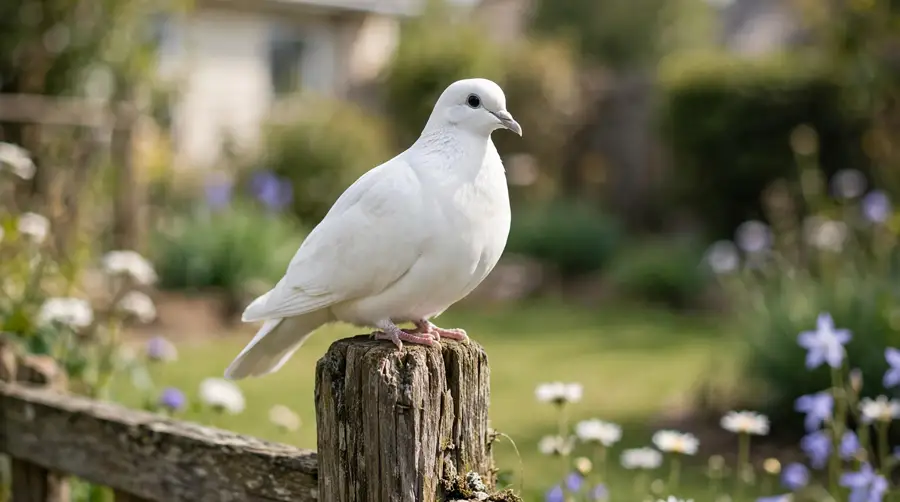
Rehabilitators receive these birds every wedding season. If you have been handed a white dove to release at a ceremony, that is worth knowing before you open the basket.
If it is not one lost bird but doves gathering around your house regularly, that is a different question with its own reading.
If a white dove is in your garden, it needs help
I am putting this before the symbolism, which is not my usual order, because it is time-sensitive and because the symbolic reading is actively unhelpful here. A tame white bird that lets you walk close is not a visitation. It is lost.
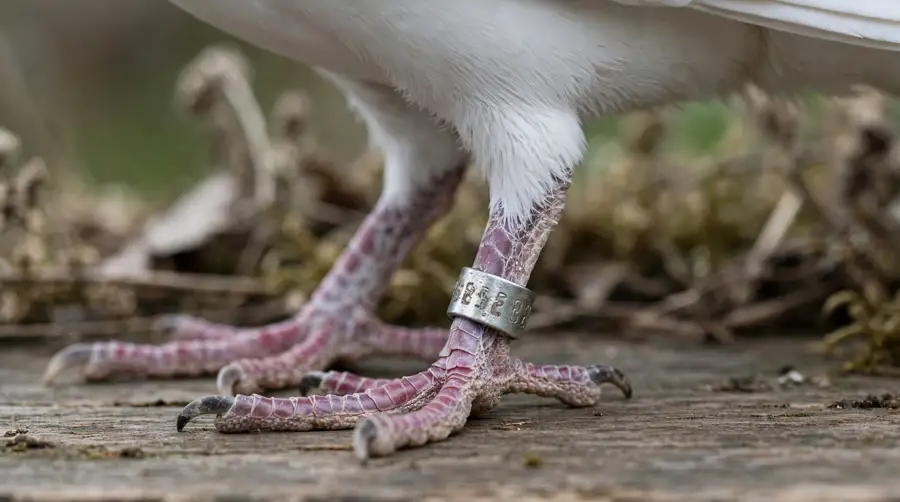
Look for a leg band. Release birds and racing pigeons are almost always banded, and the band carries a code that identifies the owner — in the United States through the American Racing Pigeon Union or the International Federation, in the UK through the Royal Pigeon Racing Association. Many owners will arrange collection.
In the meantime: put down water and seed. Wild bird seed, uncooked rice, lentils, split peas, defrosted frozen peas and corn are all fine. Bread is not. If the bird is approachable, a cardboard box with air holes in a quiet dark room buys it time, and a towel thrown gently over it is the easiest way to pick it up.
Then call a local wildlife rehabilitator or a pigeon rescue. Be aware that some wildlife centres will not take domestic pigeons, since they are not wild animals, so a pigeon-specific rescue is often the better first call.
One honest note. If the bird has been loose for a while it may be thin, and thin birds hide it well. A dove that lets you pick it up without a struggle is usually a dove that has run out of options, not a dove that trusts you.
Grey-blue is the original colour
Every pigeon on earth — the white release birds, the rusty brown ones, the chequered ones, the pied ones — descends from the rock dove. And the rock dove’s wild plumage is blue-grey, with two dark bars across each wing and a green-and-purple iridescence on the neck.
That pattern has a name among breeders: blue bar. It is the baseline, the colour the bird wore before anyone kept it.
Everything else is a record of the loft. White, brown, red, black, chequered, pied — these are the products of selective breeding for appearance, and when captive birds escape and go feral they take those colours into the street with them. The patchy, mottled, rust-brown pigeons in any city centre are a visible archive of which birds people once kept.
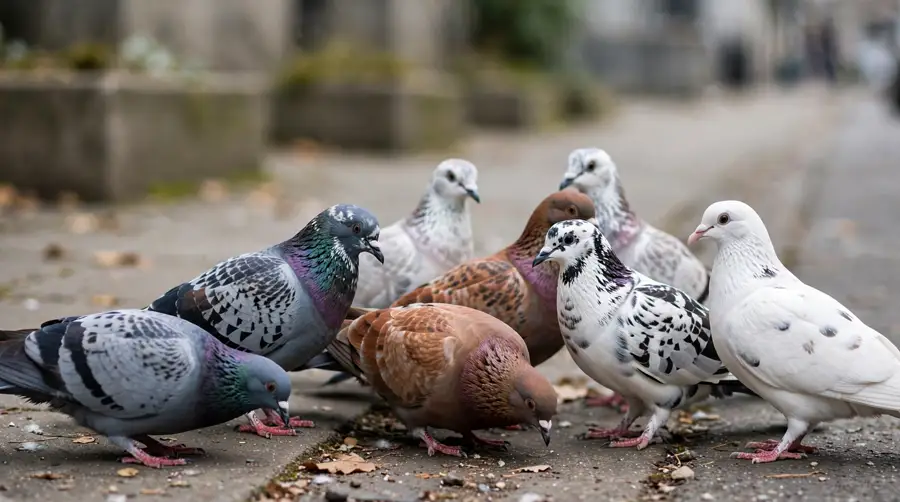
Charles Darwin understood exactly how useful this was. He kept pigeons, studied the breeds closely, and gave them a long and detailed run in the opening chapter of On the Origin of Species — because the fantails and pouters and tumblers, which look like different species, all descend from one unremarkable grey rock dove. It was his clearest available demonstration that enormous variety can come from a single ancestor.
So when you rank a white dove above a grey one, you have the order exactly backwards. The grey bird is the ancestor. The white one is the descendant of a breeding programme.
“Brown dove” nearly always means one bird
In North America, if you saw a brown dove, you saw a mourning dove. They are described as grey-brown, buff, fawn, dusty pink or plain brown depending on the light and the observer, and they are everywhere — one of the most numerous birds on the continent.
If it looked browner and scruffier than you expected, with a scaly edging to the feathers, you probably saw a juvenile. Young mourning doves are browner than adults and lose that look as they moult, which means a brown dove in late summer is frequently just a young bird of that year.
And if it was sandy-pale with a thin black collar, you saw a Eurasian collared dove — which has the best origin story of any bird in this article.
The usual account is that a pet shop in Nassau, in the Bahamas, was broken into in the mid-1970s, and the collared doves inside got out. They reached Florida within a few years, and from there spread across North America at remarkable speed. A bird that now turns up in gardens from Florida to Alaska arrived on the continent because of a burglary.
Which is worth holding next to the colour symbolism. Three of the doves you are most likely to see owe their presence to a cage door: the white one bred in a loft, the collared one released by accident, and the feral pigeon descended from birds kept for food and sport.
Four readings
1. The purest-looking bird is the least wild one
This is the reading the whole article is built on. White does not occur out there. It occurs in lofts, because people found it beautiful and bred for it, and the bird that carries it is dependent on us in a way the grey one is not.
Which is a sharp observation about purity generally. The spotless version of almost anything — the clean story, the unmarked record, the person with no visible difficulty — is usually not the natural state of the thing. It is the maintained state, and something is doing the maintaining.
That is not a reason to admire it less. It is a reason to ask what is holding it up.
2. Grey is not a lesser version of white
Every page on this subject puts grey in the middle of a ladder — not as good as white, more spiritual than brown. The actual relationship is not a ladder at all. Grey is the ancestor and white is one of its variants.
You have almost certainly done this ranking with people and not noticed. The impressive one and the ordinary one, where the ordinary one is quietly the source of everything the impressive one is drawing on.
If a grey dove is what turned up, you did not get the lower-tier visit. You got the bird the symbol was made out of.
3. Brown means availability, not rarity
A brown dove is the commonest dove there is. That sounds deflating until you turn it over, because it changes what the sighting can honestly mean.
Nothing travelled to reach you. Nothing was arranged. The bird was there last week and the week before, and what changed is that this time you looked up. The event is in the noticing, and the noticing is yours — which makes it more interesting, not less, because something caused you to start paying attention.
People generally start noticing doves during a specific kind of week. If that is where you are, the bird is not the message. Your sudden attention to it is.
4. Colour records proximity, not meaning
Put the four colours in a line and they are not a scale of spiritual value. They are a scale of how close that bird’s ancestors lived to human beings.
Blue-grey is the bird before us. The chequers and browns and pieds are the bird among us, descended from lofts and dovecotes. White is the bird entirely within our keeping, which cannot reliably live outside it.
So a dove’s colour is a biography rather than a message. It tells you where that bird’s line has been. Whether that says anything about your week is a separate question, and an honest page has to leave it to you.
What the traditions actually say about colour
Here is the part that surprised me most while checking this. The great dove passages do not mention colour.
Noah’s dove, which goes out from the ark and comes back with an olive leaf in Genesis 8, has no colour given. The Spirit descending “like a dove” at the baptism is described in all four gospels, and not one of them says white. Two thousand years of white dove imagery rests on passages that are silent on the question.
And in the one place where scripture does describe a dove’s colouring, it is not white at all. Psalm 68:13 speaks of a dove whose wings are covered with silver and her feathers with yellow gold — which is a startlingly good description of the iridescence on an ordinary rock dove’s neck when the light catches it.
Doves were sacred to Aphrodite in Greece and to Ishtar and Astarte before her, and the association there is with love and fertility rather than purity, which is nearer to what the birds actually do — they pair closely, nest repeatedly, and both parents feed the young.
Then there is the modern emblem, and it is almost too neat. The dove of peace that spread across the twentieth century came from a Picasso lithograph made in 1949 for a peace congress. The bird he drew it from was a pigeon, given to him by Matisse. He named his daughter Paloma — dove — the same year.
The official dove of peace is a portrait of a pigeon. Which brings us to the last thing worth clearing up.
Dove or pigeon? There is no difference
“Dove” and “pigeon” are not scientific categories. Both words describe birds in the same family, Columbidae, and no biologist uses them to draw a line.
In loose English usage “pigeon” tends to mean the larger, chunkier ones and “dove” the smaller, slimmer ones, but the usage is inconsistent enough to be useless. The same bird is called the rock dove and the rock pigeon in different field guides. The mourning dove and the band-tailed pigeon are close in size and differently named.
What actually happened is that English inherited two words — one from Germanic roots, one via French — and they sorted themselves by prestige rather than biology. The bird you feed is a dove. The bird you shoo is a pigeon. Same family, same habits, same intelligence, different vocabulary.
Worth knowing, if you are trying to work out what a sighting means, that the difference between a blessing and a nuisance was decided by word choice.
The question to sit with
The white dove is a bird we bred and cannot always survive our generosity. The grey one is the original, walking around being called just a pigeon. The brown one is the commonest dove on the continent, and it was in your garden long before the week you noticed it.
None of which empties the sighting of meaning. It moves the meaning out of the colour and into the looking.
So: what have you been ranking by appearance, when the plainer version was the one holding everything up?