
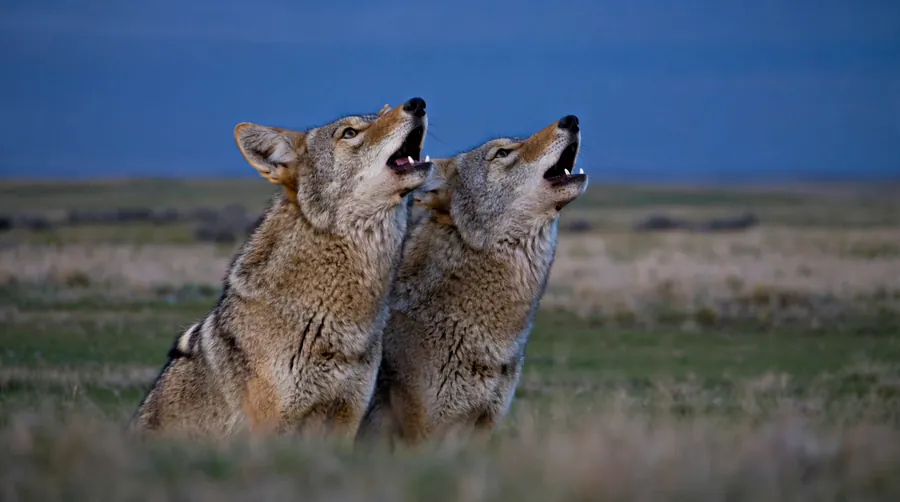
It woke you, or it stopped you on the way to the car, and the first thing you did was try to work out how many there were. It sounded like a lot. It sounded close.
Here are the two things that are almost certainly true, and that not one page on this subject will tell you. There were probably two animals. And they were much further away than they sounded.
Both of those are physics and biology rather than reassurance, and I am putting them first because the symbolism can wait and your pulse cannot. The meaning comes after, and there is a real one.
What you probably heard
Start here, because every article on this subject assumes you already know what animal you heard. You almost certainly do not, and the answer changes everything that follows.
| What it sounded like | What it most likely was |
|---|---|
| A chaotic chorus — yipping, barking, rising and falling, sounding like many animals at once | Coyotes. This is the single most common answer, and the number is usually two |
| One long, low, smooth, mournful note held for several seconds, no yipping | A wolf — but only if you live in wolf country. Most of the US and all of the UK does not |
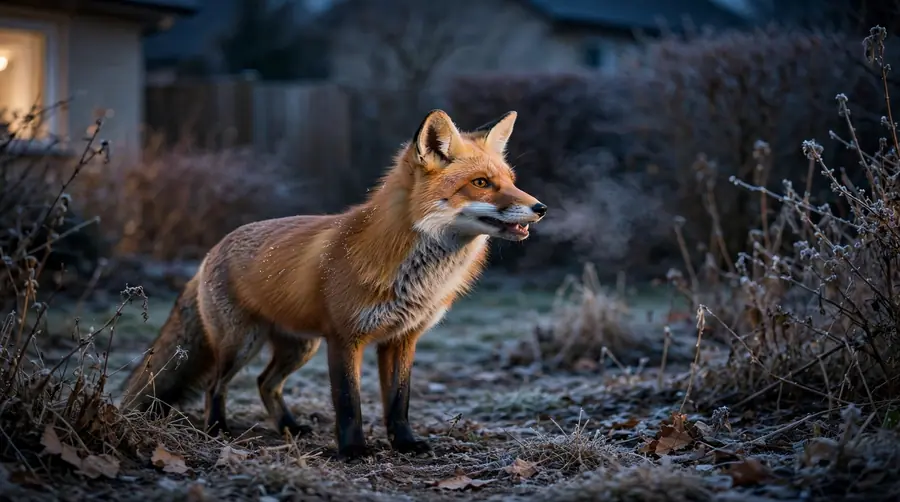
| A short, hoarse, repeated scream, almost like a woman in distress | A red fox. Peaks in midwinter. It is the most frightening sound on this list and completely harmless. If it crossed your path rather than just calling at night, read what a fox crossing your path means spiritually |
| Howling that started the instant a siren did | Domestic dogs. Dogs answer sirens, and one dog starts a neighbourhood |
| Screaming, cackling, hooting that rose into something like laughter | Barred owls, usually a pair duetting. Often mistaken for primates or people — if the sound was an owl, start here |
| A drawn-out yowl or scream, winter, repeated over several nights | Bobcat in breeding season |
| A rising wail across water, northern lake country | A loon |
| Snarling, chattering and shrieking low down, close to the house | Raccoons arguing. Far noisier than their size suggests |
One note on a sound you may have searched for: the famous “fisher cat scream” recordings circulating online are generally misattributed. Fishers are mostly quiet animals, and the audio is usually a fox or a raccoon.
The pack you heard was probably two animal
This is the fact the whole article rests on, and it is genuinely strange.
A coyote group howl is not a set of clean voices you can count. It is full of rapid pitch changes and abrupt breaks, and the acoustic result is that human ears cannot tell how many animals are producing it. Two coyotes are often described as sounding like six or more.
Researchers have a name for this — the beau geste effect, borrowed from birdsong studies, where a single singer gives the impression of a crowded territory. Whether coyote voices evolved for that purpose is still argued about. The perceptual result is not in doubt: you cannot count coyotes by ear.
So the experience you had — surrounded, outnumbered, a whole pack out there in the dark — was produced by a mated pair advertising that the field behind your house is taken.
The exaggeration was not in your nerves. It was built into the signal.
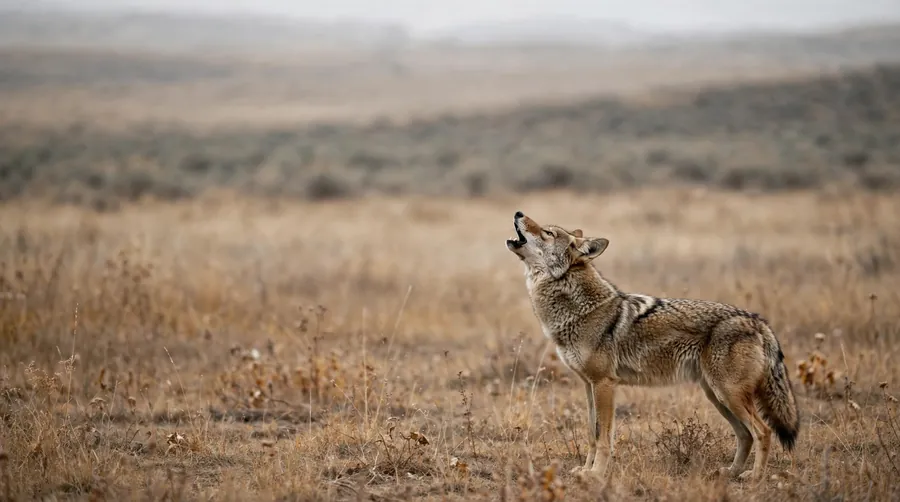
And it was further away than it sounded
On a clear, still night the ground loses heat fast, and the air sitting on it becomes cooler than the air above. Sound travelling upward through that boundary bends back down instead of escaping.
The effect is called a temperature inversion, and it is why a train you never hear in the afternoon sounds like it is in your garden at two in the morning. Night does not make animals louder. It makes distance stop working the way you expect.
Wolf howls can carry something like six miles across open country, less through forest. Coyote howls carry a long way too. On a cold, calm, windless night, an animal that sounds like it is at the fence line can be a mile or more away, on the far side of ground you cannot see.

Which means two of the three things that frightened you — the number and the closeness — were artefacts. The animal was real. The scale was not.
What to do tonight, if anything
Very little, and this is deliberately short.
Bring cats and small dogs inside, and keep them in at night as a general rule in coyote country — that single habit prevents almost every bad outcome people worry about. Do not go outside to look for the source in the dark, not because it is dangerous but because you will not find it and you will sleep worse.
That is it. Howling is not a hunting signal and it is not directed at you. There is a fuller practical section further down if coyotes are a regular feature where you live.
Wolves do not howl at the moon
They howl more at night, which is not the same thing. Wolves and coyotes are most active around dusk, dawn and darkness, and night air carries sound better — so the howling you hear is a product of activity and acoustics, not astronomy.
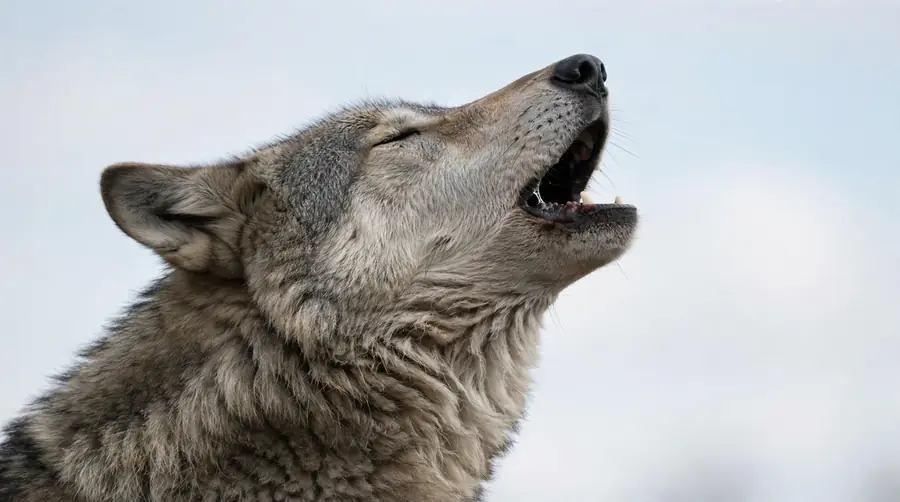
The head tilt has a real explanation, and it is better than the myth. A wolf raises its muzzle when it howls because that projects the sound outward across the landscape instead of down into the ground. It is not gazing upward. It is aiming. And if you saw the animal rather than hearing it, that is a different identification question — our guide to wolf crossing your path handles it for sightings; this page is for sounds.
As for where the moon got attached to all this: the full-moon transformation we all take for granted is largely a creation of twentieth-century cinema rather than old folklore. Earlier werewolf traditions used all sorts of triggers — ointments, belts, curses, particular nights. Hollywood in the 1940s standardised the moon, and it stuck so hard that it now feels ancient.
What a howl is actually for
Three things, mostly. Announcing that a territory is occupied. Finding family members who have become separated. And maintaining the bond between a mated pair, which is why the chorus so often comes from exactly two animals.
Note what is not on that list. Howling is not a hunting cry and it is not a kill announcement — if anything, a canid with food has reason to stay quiet rather than advertise to competitors. The belief that a howling pack is a pack closing in has the behaviour backwards.
A howl is an address. It says: we are here, this is ours, where are you. It is aimed at other coyotes, and you heard it the way you hear a neighbour’s phone call through a wall — accurately, and not as the intended recipient.
One timing note that explains a lot of searches. Howling increases sharply in late winter, when pairs are forming and defending ground, and again in autumn, when the young of that year disperse and start calling to locate each other. If the noise has suddenly started where it was quiet before, it is usually one of those two things rather than anything new moving in.
Four readings
1. The crowd was two
Hold on to this one, because it describes something that happens to people constantly. A sound designed to seem like many turned out to be a pair, and no amount of listening harder would have corrected it, because the distortion was in the signal rather than in you.
You have been on the receiving end of this. The pile-on that was three accounts. The consensus that turned out to be one loud person and an echo. The impression that everyone thinks something, which dissolves the moment you can actually count.
The useful instinct is not scepticism about your own hearing. It is remembering that some signals are built to resist counting, and that the right response is to go and count.
2. Proximity is the easiest thing to get wrong
The inversion reading. In the cold and the quiet, things that are far away arrive sounding like they are at the door, and nothing about the experience tells you it has happened.
Which is exactly how three in the morning works on a worry. The conditions that make the night quiet are the same conditions that bend distant things toward you, and the distortion is not detectable from the inside.
If something felt enormous and adjacent last night and merely annoying by lunchtime, you were not being brave in the morning. You were measuring in better conditions.
3. You overheard something that was not about you
Every page on this subject assumes the howl was sent. It was not. It was an exchange between animals about ground and family, and you happened to be inside its range.
That is worth sitting with, because the instinct to read a frightening sound as addressed to us is strong and usually wrong. Most of what reaches you at night — the noise, the overheard remark, the thing you were not meant to see — is traffic between other people about their own territory.
You are not always the subject. Sometimes you are just in earshot, and knowing the difference is most of the relief available.
4. It is the sound of a place with the people gone quiet
Here is the honest version of the dread, and it is the oldest reading there is. You hear howling when human noise has thinned out — late, cold, nothing running, no traffic. The animals have not come closer. The cover has been removed.
Which is why this sound has meant abandonment for thousands of years, and why the scriptural passages below describe exactly that. Howling is what a place sounds like when the people in it have stopped making noise.
Sometimes that means a ruin. Usually it means three in the morning, and the quiet is yours rather than the world’s.
The howling-dog death omen, and where it comes from
If something in you tightened at the sound, there is a reason that is not personal to you. The belief that a dog howling outside a house foretells a death in it is one of the best-attested folk beliefs in the English-speaking world, recorded across Britain, Ireland, Germany and widely in American folklore.
It is worth knowing that is in the water, because it explains the specific shape of the fear — not “an animal is nearby” but “something is being announced about this house.”
And it is worth knowing where such a belief comes from. Dogs do howl near houses where something is wrong: where a person is very ill and routines have collapsed, where there is unusual coming and going, where someone has stopped appearing at the door. A dog responding to disruption, in a village where disruption often meant dying, will look prophetic a certain proportion of the time.
That is not a sign. It is an animal noticing a change you already know about. Which is the same reversal that runs through most death omens — the animal arrives because something has happened, and gets credited with announcing it. We trace the same pattern in the dead crow, where birds that came to mourn get blamed for announcing the death.
In scripture, howling is the sound of an emptied place
The Bible is consistent on this, and more specific than most people expect.
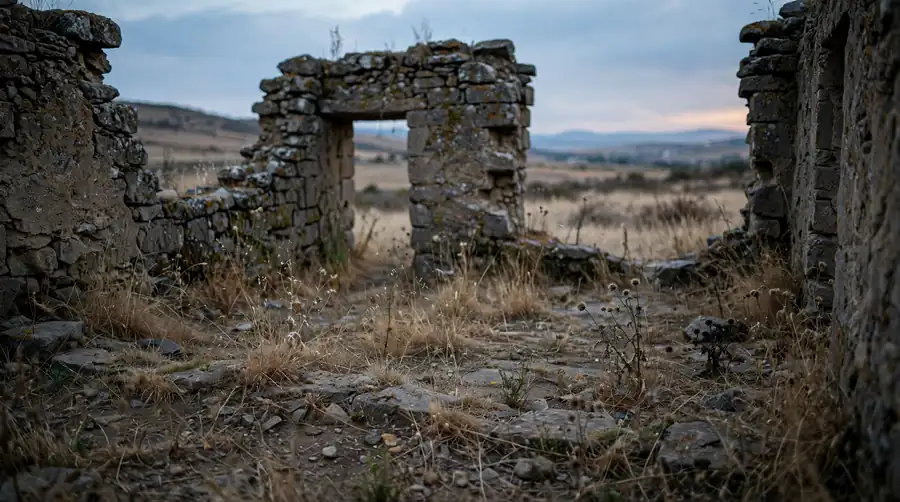
Jackals — rendered in some older translations as dragons or wild dogs — are repeatedly named as the occupants of cities that have been abandoned. Babylon in Isaiah 13, Edom in Isaiah 34, Jerusalem becoming “a haunt of jackals” in Jeremiah 9. The image is always the same: the people are gone, and this is what you hear instead.
And in Micah 1:8 the prophet says he will wail and howl, making a wailing like the jackals and mourning like the owls. Two animals, both chosen for their voices, both associated with ruins — which is exactly the same logic that put owls in abandoned buildings.
So the biblical meaning of howling is not evil and not a warning. It is desolation — the acoustic signature of a place people have left. Those passages are not predicting anything. They are describing what empty sounds like, and they are accurate.
One honest caveat. Translations vary considerably on these animal names, and the Hebrew terms are debated. The pattern across the passages is clear even where the species is not.
The trickster, and why the name fits
Coyote appears as a trickster and transformer figure in the traditions of many Indigenous nations across North America — Navajo, Apache, Crow, Chinook, Maidu and others — though the figure differs substantially between them and is not one shared character. Anyone who tells you “Native Americans believe the coyote means X” is flattening dozens of distinct traditions into a single sentence.
What I will point out, carefully, is an observation rather than a claim about belief. The animal that so many of these traditions characterised as a deceiver is also, measurably, the animal whose voice misreports its own numbers.
I am not suggesting anyone knew about frequency modulation. I am suggesting that people who lived alongside coyotes and listened to them closely for a very long time arrived at a description that turned out to match the acoustics.
If coyotes are regular visitors
Coyotes now live in every US state except Hawaii, including the centre of every major city, and with regular visitors the goal is not removal — removed territories refill — but keeping them wary: never feed them, haze any that approach, and report any that seem unafraid of people.
For the animal itself, see what a coyote crossing your path means spiritually.
The question to sit with
What you heard was two animals, a mile off, telling each other where they were. What arrived in your bedroom was a crowd at the fence. Nothing lied to you — the air bent the distance and the voices resisted counting, and the result was a sound much bigger than its source.
Which leaves the question the night actually asked you.
What else have you been hearing in the small hours that is smaller and further away than it sounds?
And if the sound you heard was a fox’s scream rather than a howl, the reading changes: here is the spiritual meaning of a fox crossing your path.