
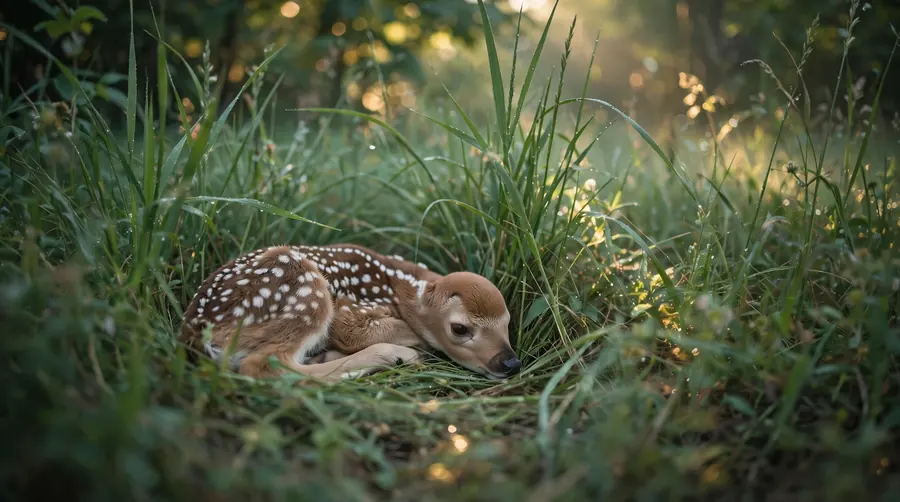
It was curled in the long grass, or at the edge of the lawn, or under a hedge. Spotted, impossibly small, head down, absolutely still — and completely alone.
And your first thought, because it is everyone’s first thought, was that something had gone wrong.
Nothing has gone wrong. And this is the one article on this site where I am going to put the practical information before the symbolism, because every spring wildlife rehabilitators receive hundreds of fawns that were never orphaned — picked up by kind people who found exactly what you found and drew the obvious conclusion.
The doe is nearby. She left on purpose. And the reason she left is the most remarkable thing about this animal.
Seeing a Fawn: The Short Answer
A fawn is traditionally read as innocence, new life and something in your care that is not ready yet. Every page on the subject says that much.
The reading worth having is more specific and comes from what the animal is actually doing. A fawn lying alone is not abandoned — its mother stays away deliberately, because her scent would lead predators to it. The fawn is being protected by an absence. The distance is the care.
If you have found one: leave it exactly where it is, go away, and keep dogs inside. If you have already picked it up, put it back in the same spot now.
The Doe Stays Away Because Her Presence Is the Danger
This is the spine of the whole encounter and it is absent from every page about fawns I can find.
A newborn fawn cannot run. It can stand within hours and walk soon after, but it has no speed for weeks — nothing that would let it escape a coyote or a dog. So it does not rely on speed. It relies on not being found at all, and the strategy is extraordinary.
A fawn lies flat in cover, head low, and does not move. Not when you approach, not when you stand over it, not when a dog walks past. It will hold that position for hours. This is called a hider strategy, and the fawn is very good at it.
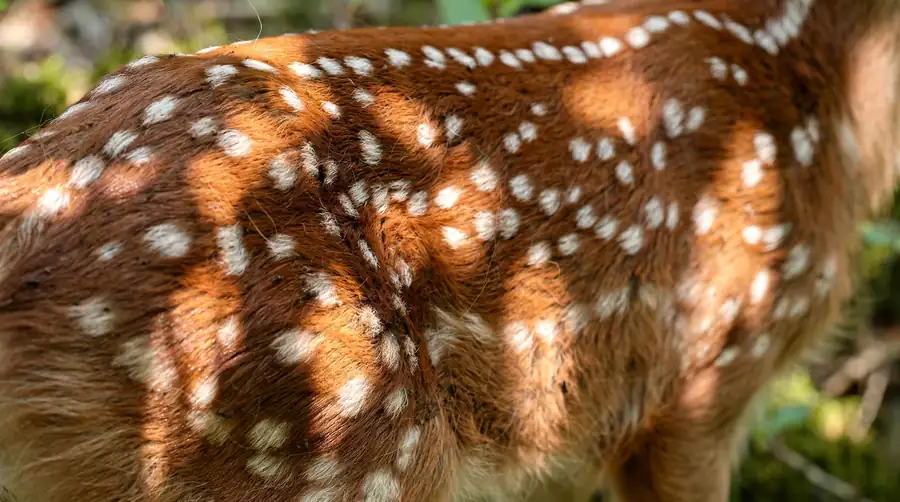
It is helped by two things. The spotted coat breaks up its outline in dappled light so completely that experienced people walk past fawns constantly. And a very young fawn produces almost no scent — it is close to undetectable to a predator’s nose, which for most of the animals that would eat it is the primary sense.
Now the part that matters.
The doe has a strong scent. She is a large adult animal that smells unmistakably of deer. If she stayed beside her nearly scentless, perfectly camouflaged fawn, she would be a signpost pointing directly at it.
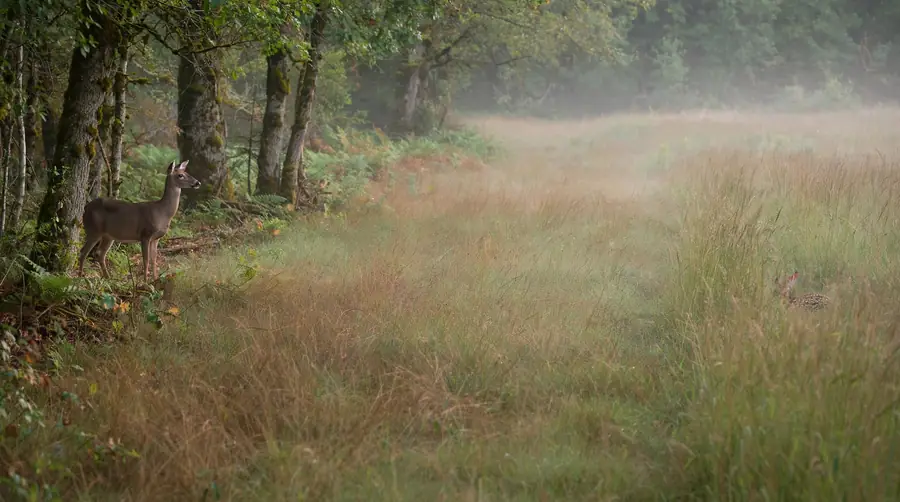
So she leaves. She feeds elsewhere, keeps her distance through the day, and returns only a few times — often around dawn and dusk — to nurse, briefly, and then goes again. She is usually within a hundred metres or so, aware of exactly where the fawn is and aware of you standing near it.
Her absence is not neglect. It is the most effective thing she can possibly do, and it costs her the ability to be with her young.
Read that back as a reading and it is the best thing this animal has to offer, and it is nowhere on the internet. The fawn is not alone because something failed. It is alone because being alone is what is keeping it alive, and the one who arranged that is standing out of sight paying the price for it.
If you have ever had to step back from someone you love, or been on the receiving end of a distance you did not understand at the time, that is the whole encounter in one image.
What to Do If You Found One
Short, and it genuinely matters.
Leave it exactly where it is and walk away. That is the whole instruction. Do not move it to somewhere you think is safer, do not put it in shade, do not bring it water.
Do not wait nearby to see the doe come back. She will not approach while you are there, and every minute you stand watching is a minute the fawn goes unfed. Leave the area completely.
If you already picked it up, put it back now — same spot, or as close as you can manage. The belief that a doe will reject a fawn that smells of human is, for deer, largely a myth. She wants it back. The longer it is away, the worse the odds.
Keep dogs in. This is the single most useful thing you can do. A dog that finds a hiding fawn is the most likely cause of harm in a suburban setting, and the fawn will not run.
And do not feed it anything. Cow’s milk and formula are genuinely dangerous to fawns, and a fawn that loses its fear of people has a far worse life ahead of it — including, if it is male, the real possibility of becoming dangerous as an adult and being destroyed for it.
When It Genuinely Does Need Help
There are real exceptions, and they are specific rather than vague. Call a licensed wildlife rehabilitator — not animal control, and do not transport it yourself unless told to — if the fawn is visibly injured or bleeding, is covered in flies or has maggots, is lying on its side rather than curled upright, is crying continuously for hours, is wandering and bleating in the open, or if you know for certain the doe is dead nearby.
A curled, quiet, alert fawn with no visible injury is a healthy fawn doing precisely what it is supposed to do.
Four Readings of Seeing a Fawn
1. Protection That Looks Like Absence
The core reading, from the section above, and it is the one worth carrying away.
Not every distance is abandonment. Some of it is the only form of protection available, chosen at cost by someone who would rather be closer. The traditional interpretation is a prompt to re-examine a withdrawal you read as rejection — either one you received or one you imposed.
2. Stillness as a Strategy
A fawn’s defence is to do nothing, very well, for a long time. It is not frozen with fear in the way people assume — it is executing the correct plan, and the plan is to remain completely still while something frightening passes.
Read as a message, that is unusually practical for anyone who feels they should be acting. Sometimes holding position is not paralysis. Sometimes it is the only thing that works, and moving is what gets you found.
3. Something Not Ready Yet
The reading most people arrive with, and it holds up. A fawn is capable and unfinished at the same time — on its feet within hours, unable to outrun anything for weeks.
So the message is usually about something new in your life that is further along than it looks and more fragile than it looks, both at once. People most often report this sign in the early weeks of something they are protective of.
4. A Disguise Designed to Expire
The spots are the fawn’s whole defence, and they are temporary by design.
A white-tailed fawn is born with a few hundred white spots arranged in rows along its back and flanks, which break up its outline in broken light. They fade through the first summer and are gone by its first autumn moult — which is exactly when the fawn becomes fast enough to run instead of hide.
The camouflage is withdrawn at the precise moment it stops being the right strategy. Nothing is wasted and nothing is kept past its usefulness.
Read as a sign, that is the gentlest thing here: the protection you needed at the start was never meant to be permanent, and losing it is not a loss.
She May Have Hidden Two of Them, Separately
A detail that makes the doe’s behaviour even more deliberate than it already looks.
Twins are common in white-tailed deer and triplets happen. And when a doe has two fawns, she frequently hides them in separate places, some distance apart.
The logic is brutal and sound: a predator that finds one hiding place does not find both. She is splitting the risk deliberately, and visiting two locations instead of one to do it.
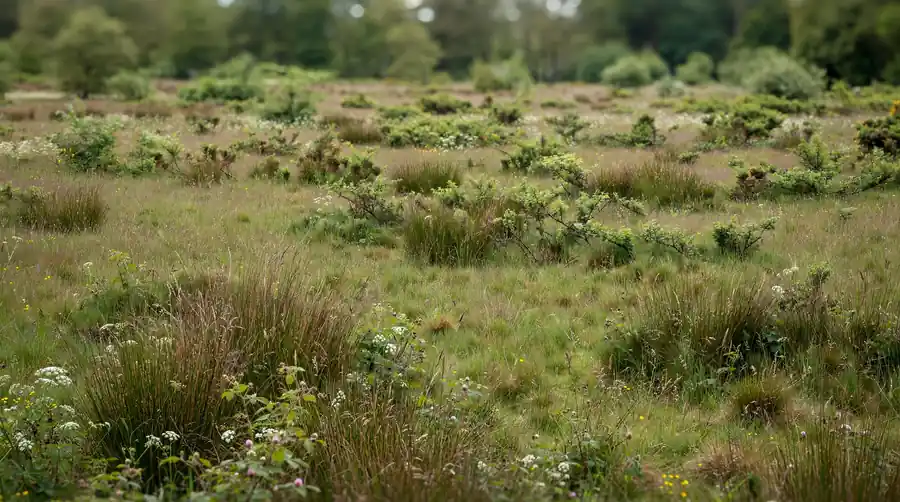
Which means two practical things. If you found one fawn, there may be a second nearby that you have not seen, so be careful where you step and where you mow. And if you find two together, they are probably older — past the hider phase and moving with their mother.
Seeing a Doe and Fawn Together
A different encounter from the one above, and worth separating, because the two readings are almost opposites.
A fawn hidden alone is in the early phase — days or a few weeks old, scentless, spotted, immobile, protected by the doe’s absence.
A fawn walking at its mother’s side has graduated. It is several weeks old at minimum, it can run, it has started eating vegetation as well as nursing, and it is now protected by her presence — her eyes, her ears, her alarm snort and her willingness to put herself between it and a threat.
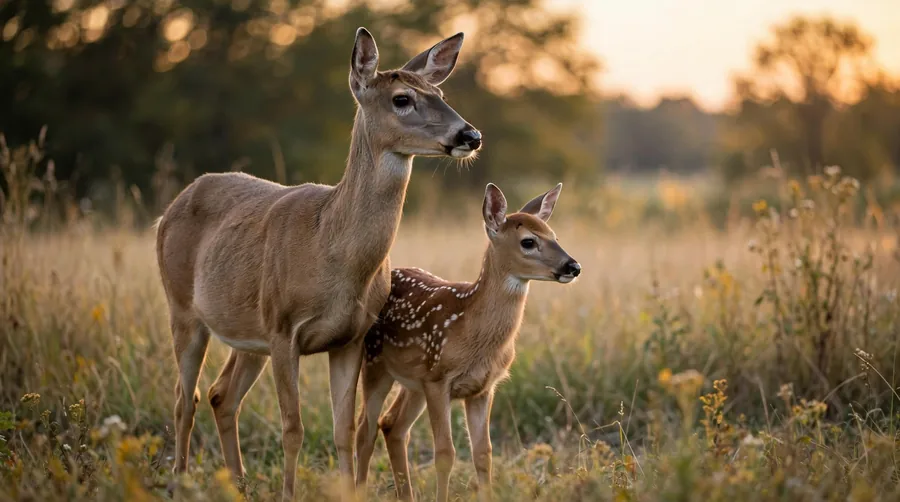
So if you saw them together you watched the later stage of the same relationship, and the reading shifts accordingly: from protection through separation to protection through company. Something that had to be kept hidden is now able to be seen in public.
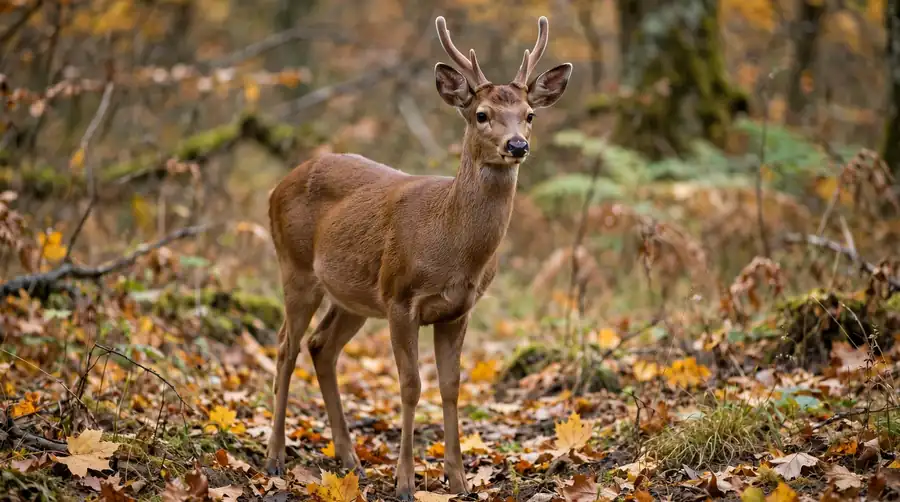
One further detail with a long tail to it. Fawns stay with the doe for around a year, and then the paths diverge by sex — young females often remain in or near their mother’s home range, sometimes for life, while young males are pushed out to find territory of their own. That dispersal is what produces the lone young buck, and our guide to seeing a buck covers what it means when you meet one.
Which gives the doe-and-fawn sighting a quiet extra layer: if that fawn is female, you may be looking at two animals who will still be within sight of each other in five years. If it is male, you are looking at the last summer they will spend together.
What Changes the Reading
Curled and Still, Alone
The classic encounter. Read as the protection-by-absence message above, and practically it means a healthy fawn doing its job. Leave it.
It Let You Get Very Close
Read across traditions as an unusual intimacy, and people remember it for years. The honest explanation is that a hiding fawn’s instinct is not to flee at any distance, so proximity is not trust — it is the strategy still running.
Which does not make the moment less. You were close to a wild animal that had decided its best option was to let you be there.
In Your Garden or on Your Lawn
Read as the sign arriving at your home, so the interpretation shifts toward household and family. Practically, does choose suburban gardens deliberately – fewer coyotes than in open woodland, plenty of cover, and plenty of food. It is not a mistake on her part. For the wider deer encounter, see our guide to deer crossing your path.
Check before you mow, and if you have a fawn in the garden, give that corner a fortnight.
Crying or Bleating
Worth taking seriously. Brief bleating when the doe returns is normal. Continuous crying for hours, or a fawn walking around bleating in the open, is distress — that one warrants a call to a wildlife rehabilitator.
Twins, or Two Fawns Playing
Read as abundance and as a doubled version of the new-life message. Fawns genuinely do play — bounding, chasing, mock-fleeing in circles — and it is one of the better things you will see in a field. Two fawns running about together are older, mobile and in no need of help.
A Fawn With No Spots
Read as a transition completing. Practically, it is an older fawn heading into its first winter, past the hiding phase, now running with its mother and functionally a young deer rather than a fawn.
A Dead Fawn
Difficult, and generally read as a loss of something that had only just begun rather than as an omen about anyone. Fawn mortality in the first months is genuinely high — predation, vehicles and dogs account for most of it — so the honest answer is that this is sadly ordinary rather than directed at you. Do not handle it, and keep pets away.
The Fawn in Tradition — and the Bambi Problem
Deer carry a long and consistent symbolic record of gentleness, vigilance and grace, and our guide to the buck, doe and fawn sets out how the three compare across traditions.
What is worth adding here is specific to the fawn, and it is more recent than anyone realises.
The fawn’s position in the Western imagination as the emblem of threatened innocence owes an enormous amount to one film from 1942. The effect is so pronounced that conservation and wildlife-management discussions have a term for it — the Bambi effect — describing the sentimental difficulty of talking about deer populations honestly.
Two details make this more interesting rather than less. The original 1923 novel the film came from is considerably darker than the adaptation and was written as a book for adults, with the natural world portrayed as far harsher than the film allows. And in the novel Bambi is a roe deer, a European species, rather than the white-tailed deer the film made him.
So the most powerful fawn image in the world is an American adaptation of an Austrian novel about a different species, softened considerably on the way.
None of which means the innocence reading is wrong. It means the reading is younger than it feels, and that the part everyone remembers — the orphaned fawn — is the part the biology most firmly contradicts. The fawn you found almost certainly has a mother within earshot.
Older traditions are gentler about this than the film is. Deer appear across Celtic material as creatures of the Otherworld, in Greek myth as sacred to Artemis, and in Chinese tradition as emblems of longevity and prosperity. In none of them is the young deer primarily an object of pity. It is simply the beginning of a deer.
What to Take From It
Leave it, and go. Everything else on this page is secondary to that.
Keep the dog in for a fortnight if it is in your garden, and check the grass before you mow in late spring and early summer.
Note whether it was alone or with the doe, and whether it still had spots. Those two details tell you which stage you witnessed and which of the readings above is yours.
And if you were close enough to really see it, that was rare. Most people never get within a few feet of a wild deer in their lives. You did, because the animal’s survival strategy happens to be stillness, and for a minute you were inside something very few people see properly.
Then the question, which this encounter puts more precisely than most on this site.
Somewhere out of sight, a doe is standing still, deliberately not coming to her own young, because arriving would be the thing that gets it killed. She will come back twice today and leave again both times.
Whose absence have you been reading as indifference?
Frequently Asked Questions
What does seeing a fawn mean spiritually?
It is read as innocence, new life and something in your care that is not ready yet. The sharper reading comes from the animal’s behaviour: a fawn lying alone is protected by its mother’s absence, because her scent would lead predators to it. So the message is often about a distance that looks like abandonment and is actually the only available form of care.
Is a fawn alone abandoned?
Almost never. Does leave their fawns alone for most of the day on purpose and return only a few times to nurse, usually around dawn and dusk, because an adult deer has a strong scent and a newborn fawn has almost none — staying beside it would point predators straight to it. She is usually within a hundred metres and knows exactly where it is.
What should I do if I find a fawn alone?
Leave it exactly where it is, walk away, and keep dogs indoors. Do not move it, do not wait nearby to watch for the doe — she will not approach while you are there — and do not feed it, as cow’s milk and formula are dangerous to fawns. If you have already picked it up, put it back in the same spot immediately; the idea that a doe rejects a fawn that smells of human is largely a myth.
When does a fawn actually need rescuing?
Call a licensed wildlife rehabilitator if the fawn is visibly injured or bleeding, covered in flies or maggots, lying on its side rather than curled upright, crying continuously for hours, wandering and bleating in the open, or if you know the doe is dead nearby. A curled, quiet, alert fawn with no visible injury needs nothing from you.
What does it mean to see a doe and fawn together?
It is a later stage than a fawn hidden alone, and the reading flips: a hidden fawn is protected by the doe’s absence, while a fawn walking at her side is old enough to run and is now protected by her presence. So the message shifts from protection through separation to protection through company — something that had to be hidden can now be seen in public.