
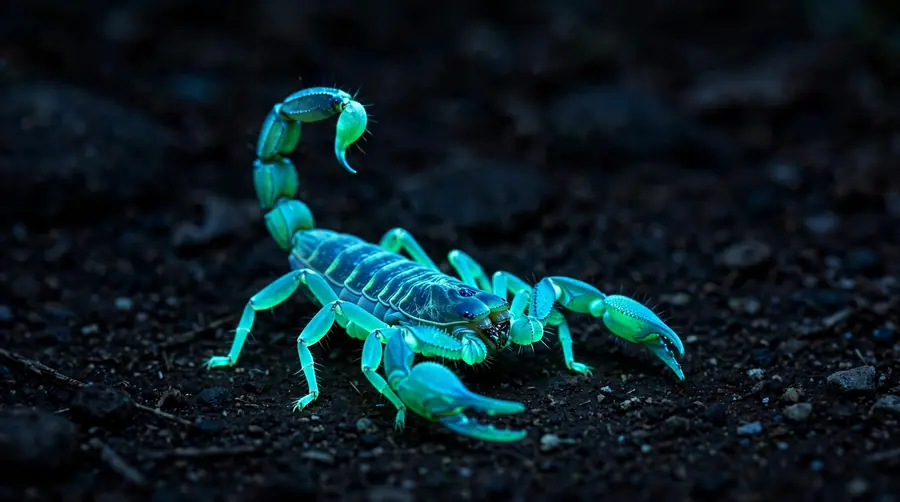
Before anything else, here is the single most useful fact about scorpions, and not one page competing for this search mentions it.
Scorpions glow under ultraviolet light. All of them, a vivid blue-green, bright enough to spot across a dark room. A cheap UV torch is how pest control professionals find them, and if there is one scorpion in your house tonight it is the fastest way to find out whether there are others.
Every page on this subject will tell you the scorpion symbolises hidden truths and things brought to light. None of them seems to know that the animal is literally impossible to hide from the right wavelength — or that after decades of research, nobody can say why.
Find it tonight: use a UV torch
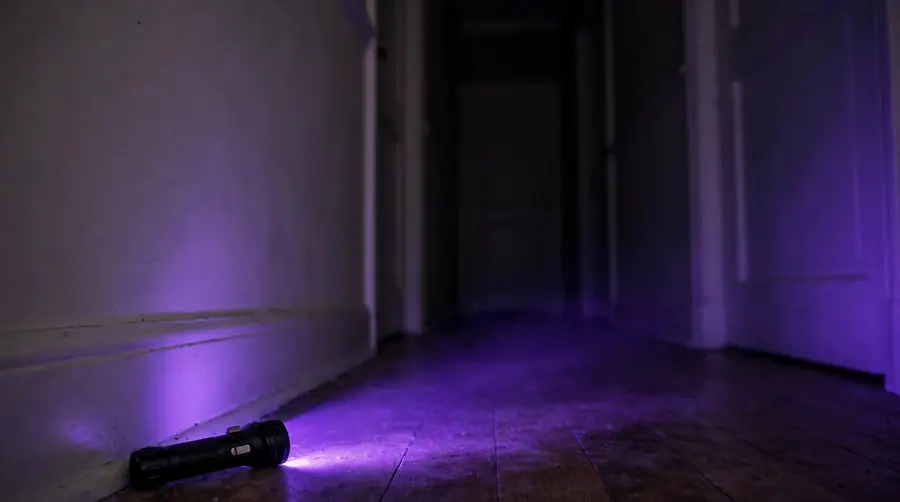
Wait until full dark, turn off the lights, and sweep a UV torch slowly along skirting boards, around door frames, under furniture, behind the toilet, in the shower, and across the ceiling. A scorpion will light up like something switched on.
Check outside too, along the foundation, under the edge of paving, in woodpiles and around any stacked material. In places where scorpions are common, people doing this for the first time are routinely shocked by the count.
Two practical notes. The glow comes from the hardened outer shell, so a recently moulted scorpion will not fluoresce — a dark sweep is reassuring but not proof. And wear closed shoes while you do it.
How dangerous is it? That depends entirely on where you live
This is where most writing on scorpions fails badly, in one direction or the other. The honest answer is regional, so find yourself below.
Of roughly 2,500 known scorpion species, only around 25 to 30 have venom capable of killing a person. For most of the world, a sting is a severe local pain — like a bad wasp sting, lasting hours — and nothing worse.
In the United States, one species matters: the Arizona bark scorpion. Its sting can cause serious symptoms, particularly in small children, and effective antivenom exists. Deaths are now very rare. Every other US species is painful and not dangerous.
In India, this is a different conversation. The Indian red scorpion is among the most medically serious scorpions in the world, and stings — especially in children — can cause life-threatening complications affecting the heart and lungs. Hospital treatment exists and works, and it matters enormously that it is given early. If a child in India is stung, that is a hospital trip, not a wait-and-see.
In North Africa, the Middle East, parts of Brazil and southern Africa, there are also genuinely dangerous species, and the same rule applies: a stung child, elderly person, or anyone showing symptoms beyond local pain goes to a hospital.
Basic first aid anywhere: wash the area, apply something cold, keep the limb still and lower than the heart, take ordinary pain relief. Do not cut the wound, do not try to suck out venom, and do not apply a tourniquet — all three cause harm and none of them helps. Seek medical care for a child, for anyone with difficulty breathing, muscle twitching, vomiting, agitation or blurred vision, and whenever you are unsure.
For an authoritative run-through of symptoms and treatment, the National Capital Poison Center has a dedicated page on scorpion stings.
How it got in, and how to keep it out
Scorpions come indoors for two things: moisture and prey. They eat insects, and your house has both water and insects in it.
They get in through gaps you would not consider — a scorpion can flatten through a space about the width of a credit card. Check door sweeps, window seals, weep holes in brickwork, pipe penetrations under sinks, and the gap where cables enter. Sealing those is the only control that lasts.
Then reduce the harbourage: move woodpiles, stone and clutter away from the walls, trim plants back from the house, and clear leaf litter. Dealing with the insects reduces the reason to come in at all.
And the habits that actually prevent stings, because nearly all stings are contact accidents rather than attacks. Shake out shoes before putting them on. Shake out towels and clothing left on the floor. Check bedding, and move beds away from walls. Do not walk around barefoot at night in scorpion country. Wear gloves when moving wood or lifting stored boxes.
To remove one safely, trap it under a glass, slide stiff card underneath, and release it well away from the house. Long tongs work too. Do not try to pick one up, and do not crush one against your own skin.

Scorpions are far from the only animal that gets indoors through those same gaps — see also our piece on the lizard in the house, which faces the same entry-point problem.
Nobody knows why they glow
This is my favourite unsolved problem in the whole animal kingdom, and it sits right at the centre of what you came here to ask.
The fluorescence comes from compounds in a thin layer of the scorpion’s cuticle. Shine ultraviolet on it and the shell converts that invisible light into visible blue-green. The mechanism is well understood. The purpose is not.
Several explanations have been proposed. That it screens the animal from ultraviolet damage. That it attracts prey. That it helps scorpions recognise each other. And the most interesting one: that the entire body works as a light detector, converting ultraviolet into a wavelength the scorpion can sense, so that it can judge how bright the night is and decide whether to stay hidden.
That last idea is genuinely elegant — a nocturnal animal using its whole shell to measure the moonlight it needs to avoid. It is a hypothesis rather than a settled finding, and it is worth saying plainly that none of the explanations has won.
So the most secretive animal in your house carries a property that makes concealment impossible, and it is not clear that the property is for anything at all.
It only glows once the shell has hardened
Here is the detail that turns the fluorescence into something worth thinking about.
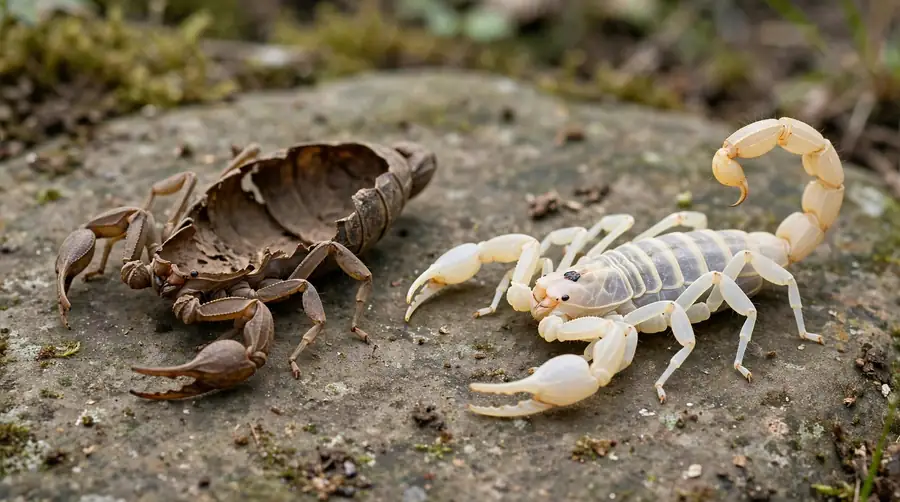
A scorpion grows by moulting out of its shell. Immediately afterwards it is pale, soft and almost defenceless, and it has to wait for the new cuticle to harden before it can function normally. During that window, it does not fluoresce. The glow appears as the shell sets.
Which means the armour and the visibility arrive together. The same hardening that makes the animal capable of defending itself is what makes it findable in the dark. It cannot have the one without the other.
The soft scorpion is invisible and helpless. The hard one is dangerous and lit up. There is no version that is both protected and undetectable.
Older than trees
Scorpions appear in the fossil record from around 430 million years ago, which makes them one of the oldest groups of land animals we know of.
Hold the comparisons next to each other, because they are hard to absorb. Scorpions predate the dinosaurs by roughly two hundred million years. They predate trees — real woody trees — by around fifty million. A scorpion recognisable as a scorpion was walking around a world that had no forests in it yet.
And the body plan has barely moved. Pincers, armoured segments, a tail with a sting on the end. Whatever that design is for, it was finished early and has needed almost no revision since.
They are built for scarcity too. Scorpions have remarkably low metabolic rates, and some species can survive many months without food — in some reports approaching a year. Not a fast animal, not a productive one. A persistent one.
The mother carries her young on her back
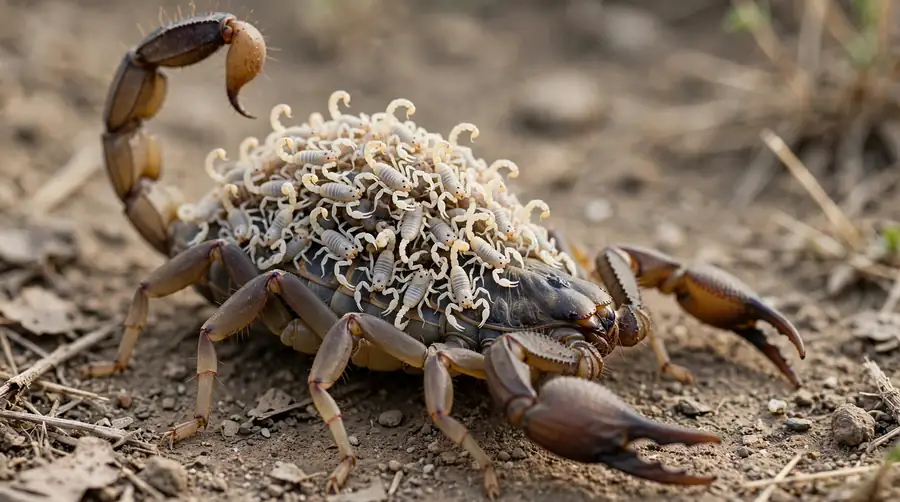
Scorpions do not lay eggs. They give birth to live young — unusual among arachnids — and then the newborns climb onto the mother’s back and ride there.
They stay for days or weeks, until their first moult, and she carries them the whole time: feeding, moving, defending the lot of them. A female scorpion covered in pale young is one of the stranger sights in nature, and it is a good deal more tender than the animal’s reputation allows.
So the creature we use as the standing symbol of unprovoked treachery is one of the relatively few invertebrates that gives birth to live offspring and then carries them around on its body until they can survive alone.
Four readings
1. The hidden thing has a wavelength
Ten pages will tell you the scorpion means hidden things coming to light. Here is the version with something underneath it.
The scorpion is not hidden absolutely. It is hidden under ordinary light. Change the wavelength and it is the most obvious object in the room — and it was always that obvious, waiting for the right kind of looking.
That is a more useful picture than secrecy. Most things people describe as hidden are not concealed, they are simply not visible under the conditions being used. The question is rarely “what is being kept from me.” It is more often “what am I illuminating this with.”
That shift — from arrival to noticing — is the same one at work when people start seeing spiders everywhere: the animals were there all along; the seeing is what changed.
2. The armour and the visibility arrive together
This is the best reading on the page and it comes from the moulting detail. Soft scorpion: invisible, defenceless. Hardened scorpion: capable, and lit up like a sign.
People want the combination that does not exist. To become capable without becoming conspicuous — to get good at something, or strong, or protected, and somehow not be seen doing it. The shell does not work that way. The thing that makes you hard to hurt is the thing that makes you easy to spot.
If you have been feeling more exposed lately rather than less, that is not evidence that something has gone wrong. It may be the shell setting.
3. Some designs do not need updating
Four hundred and thirty million years, and the scorpion has changed remarkably little. No reinvention, no diversification into a thousand elaborate forms. The same arrangement, repeated, through every extinction event since.
We are heavily encouraged to read persistence as stagnation. Sometimes it is. Sometimes a thing is simply finished, and the pressure to keep developing it is coming from people who need movement rather than from the thing itself.
Add the starvation tolerance and the picture sharpens further. The scorpion’s strategy is not to grow fast or produce much. It is to need very little and still be here afterwards.
4. Reputation is not behaviour
The scorpion is the Western world’s shorthand for someone who will hurt you for no reason, by nature, unavoidably. And the animal gives birth to live young and carries them on its back until they can look after themselves.
It also stings defensively, almost always because something has trodden on it or put a hand on it — which is why nearly every sting is a contact accident rather than an ambush.
Worth holding on to if you have ever been the one with the reputation. The story about what you are is doing its own work out there, and it is not being updated by what you actually do.
If you dreamt about a scorpion
Dream pages for this topic run to twelve, twenty-five, even sixty listed meanings, which tells you how little is being said per item. Here is a shorter and more honest version.
Dream imagery has no dictionary. What follows is what each version most often tracks, offered as a starting point you may reject — and note that threatening-animal dreams are among the most commonly reported dream types worldwide, so this is a very ordinary dream to have.
| In the dream | What it most often tracks |
|---|---|
| A scorpion on you, not stinging | Proximity rather than harm. Something near you that you are managing by staying very still |
| Being stung | A specific anticipated hurt with a source. People usually know who or what on waking |
| Seeing one across the room | Awareness without contact. Frequently a situation being watched rather than acted on |
| Killing it | Resolution you have decided on but may not have carried out yet |
| Many scorpions | Overwhelm rather than threat. Count matters less than whether there was a way out |
| In your bed or shoes | The boundary version. Something unsafe has turned up in the part of life you treat as sealed |
| A scorpion that did not react to you | Often the calmest of these dreams, and worth noticing as such |
If the same frightening dream keeps returning and you are starting to dread sleep, that is a recognised and treatable thing rather than a message. There is more on that, and on why pursuit and threat dreams are so common, in the piece on black wolf dreams.
Scorpions in the Bible
Unlike many animals people ask about, the scorpion is in scripture repeatedly and specifically.
It appears as a hazard of the wilderness in Deuteronomy 8:15, and as a figure of harsh rule in 1 Kings 12:11, where Rehoboam promises to chastise the people with scorpions rather than whips. Ezekiel 2:6 tells the prophet not to fear the people he is sent to, though he dwells among scorpions. Revelation 9 gives its locusts the sting of scorpions.
But the verse most readers are half-remembering is Luke 10:19 — authority to tread on snakes and scorpions. Note what it actually says. Not that the scorpions are gone, and not that they were never real. That they can be walked over.
And there is a quieter one in Luke 11:12, in the passage about a father’s gifts: no father, asked for an egg, would hand his child a scorpion. The scorpion there is the opposite of provision — the thing nobody who loved you would give you.
The scorpion goddess was a protector
If you want older material, it exists, and it runs in the opposite direction to what you would expect.
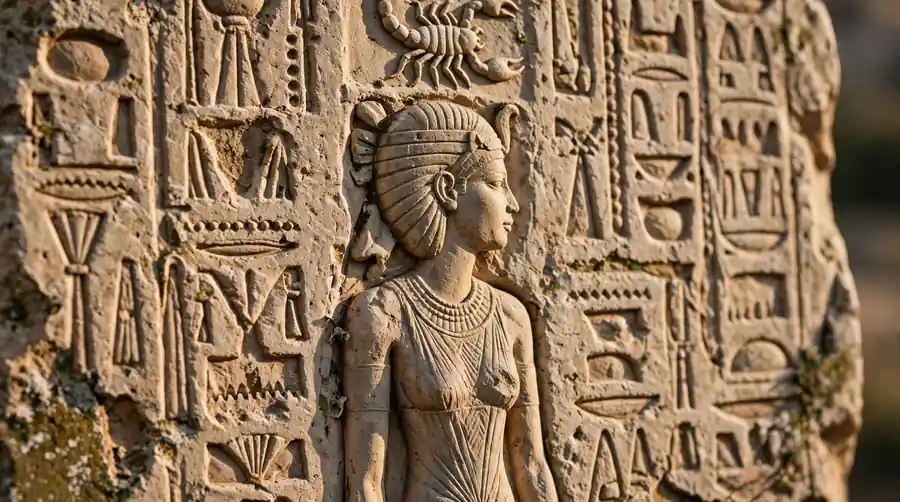
In ancient Egypt, Serqet — also written Selket — was a goddess shown with a scorpion on her head, and she was protective. She was invoked against venom and associated with healing stings, and she is one of the four goddesses who stood guarding the canopic shrine of Tutankhamun. There is also a well-known Egyptian story in which seven scorpions accompany and protect the goddess Isis.
In Mesopotamia, the scorpion-men of the Epic of Gilgamesh guard the mountain gates through which the sun passes — fearsome gatekeepers rather than villains. And the constellation itself is older than Greek astronomy: the Babylonians had already named that group of stars the scorpion.
There is a living example too. At Kolar in Karnataka, the scorpion goddess Chelamma is worshipped, and devotees hold that she protects them from scorpion stings.
So across several independent traditions, the scorpion’s job is guarding the dangerous threshold and defending against the very venom it carries. The purely treacherous scorpion is a much more modern invention — and it has one very specific source.
The scorpion and the frog is not Aesop
You know the story. A scorpion asks a frog to carry it across a river, promises not to sting, stings anyway, and as they both sink says: I could not help it, it is my nature.
It is attributed to Aesop almost everywhere it appears. It is not in the Aesop corpus. Its documented history begins in the twentieth century, and it became famous through Orson Welles’s 1955 film Mr. Arkadin, where he tells it as a parable about himself.
There is an older relative — a tale of a scorpion carried across water by a turtle turns up in Persian and Indian story collections — but the version everyone quotes, with its fatalistic punchline about unchangeable nature, is modern.
That matters because of how the fable is used. “It’s my nature” is invoked constantly to explain why someone cannot change, and it is presented as ancient wisdom. It is a line from a film from 1955. Three thousand years of actual tradition made the scorpion a guardian.
The venom that makes tumours glow
One last thing, and it is almost too neat to be true.
A protein found in the venom of a desert scorpion binds with unusual selectivity to certain tumour cells. Researchers attached a fluorescent marker to it, and the result — developed under the name tumour paint — makes cancerous tissue light up during surgery, so a surgeon can see where the tumour ends and healthy brain begins.
Read that next to the first section of this article. The animal that glows under the right light produces a molecule that makes hidden things glow under the right light.
Nobody designed that symmetry. It is simply what happened when people stopped treating the scorpion as a meaning and started treating it as an animal.
The question to sit with
It came in for water and insects. It is older than the trees outside your window. It carries its children on its back. And it cannot stop glowing, under a light it probably cannot even use, for reasons nobody has worked out.
The one thing it cannot do is be both protected and unseen.
So: what have you been trying to armour yourself for without being noticed doing it?