
One in the bath. One on the ceiling above the bed. One that dropped from the door frame as you walked through it, and a web across the garden path that was not there yesterday.
Three or four days of this and it stops feeling like coincidence. It starts feeling like something is being pointed out to you.
Here is what almost no page about this will tell you: there are two completely real reasons you are suddenly seeing spiders everywhere, and both of them are more interesting than the usual answer. One is happening outside you. The other is happening inside you, and it is the one that actually explains the timing.

Seeing Spiders Everywhere: The Short Answer
Spiritually, repeatedly seeing spiders is read as a message about what you are building and whether you are building it deliberately. The spider is the weaver, so the sign points at your own construction: a project, a relationship, a reputation, a life.
Repetition is read as urgency, meaning the message has been sent more than once because it was not received the first time.
It is almost never read as a warning of harm. And practically, if this started in late summer or autumn, there is a specific reason the spiders appeared all at once.
Why You Are Suddenly Seeing Them
This is the part the other pages skip, and it is the question you actually typed.
Reason One: It Is Probably Spider Season
From roughly late August through October in the northern hemisphere, something specific happens. Male spiders that have spent the whole summer small, hidden and sitting still reach maturity, and then they abandon their webs completely and go wandering to look for females.
That is why they appear everywhere at once. A spider sitting motionless in a corner is invisible. A spider walking across your living room floor at speed is impossible to miss. The population did not change. The behaviour did.
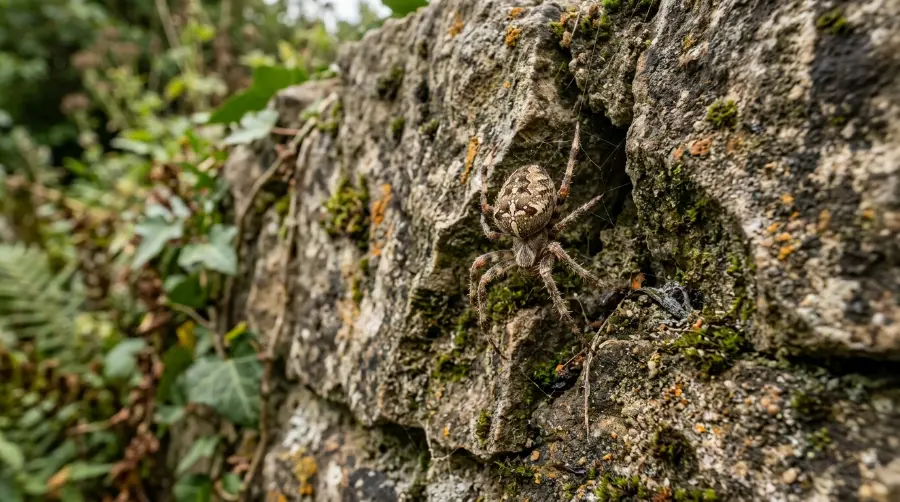
This is also why the big ones show up indoors in autumn and why people assume spiders come inside to escape the cold. Mostly they do not. The large house spiders you find in the bath in September are males who were already living in your walls and have come out to look for a mate.
If instead you are seeing hundreds of tiny spiders, and it is spring or early summer, that is a different event.
Spiderlings disperse by ballooning: they climb to a high point, lift their abdomens, release a strand of silk and let air currents carry them away, sometimes for considerable distances.
Mass ballooning can leave fields and fences draped in fine silk. Thousands of spiders appearing from nowhere in one morning is not an omen. It is a hatch.
Reason Two: Your Attention Changed
There is a well-documented effect where, once something enters your awareness, you suddenly notice it constantly. It is often called the frequency illusion, or the Baader-Meinhof phenomenon. You learn a word and then hear it four times that week. You consider buying a particular car and then the road is full of them.
The spiders were already there. Worth knowing how many: spiders are present in essentially every habitat on land, in densities most people would find hard to believe, and the average home contains them year-round in numbers nobody wants quantified. “Spiders everywhere” is not a new situation. It is the permanent situation, briefly visible.
Now here is where most pages would stop, as though they had explained the thing away. They have not, because they have answered the wrong question.
The frequency illusion tells you the spiders did not multiply. It does not tell you why your attention opened to them this particular week. Your filter changed.
Something shifted in what your mind decided was worth flagging, and that shift is not random. It usually happens when you are in a period of heightened alertness: a decision you have not made, a situation you are watching closely, a change you can feel coming but cannot name.
So the honest version of the answer is this. The spiders are ordinary. The noticing is the signal. Something in you started looking, and the useful question is what it was looking for.
What the Spider Actually Symbolises
What You Are Weaving
The core reading, and the one every tradition agrees on. The spider builds a structure out of material produced from her own body, and she builds it to a pattern she did not have to learn. Nothing else you encounter is such a clean image of making something out of yourself.
Read as a sign, it asks about the thing you are currently constructing, and specifically whether you are constructing it on purpose or by accident. Webs are not improvised. The question is whether yours is.
Patience That Is Not Passive
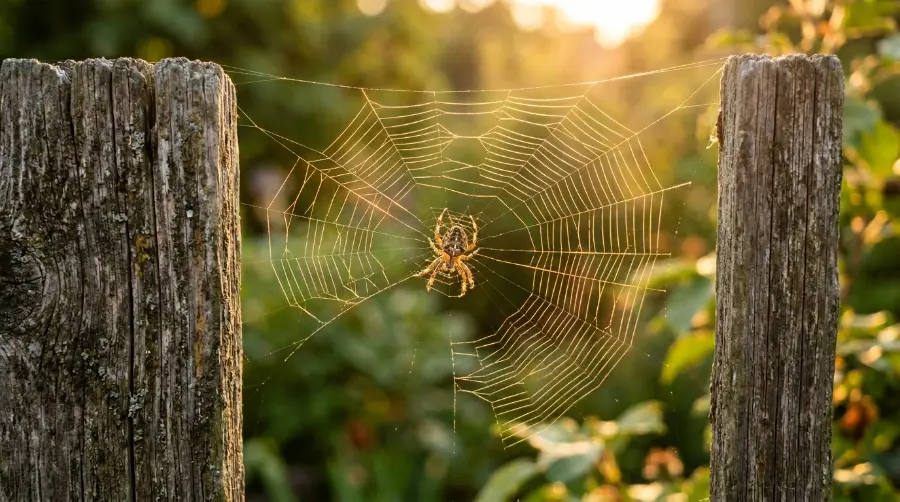
An orb-weaver does not chase. She builds, then waits, and the waiting is the strategy rather than a gap in it.
This is the most commonly needed reading and the most commonly misread. It does not mean do nothing. It means the building phase and the waiting phase are different kinds of work, and forcing an outcome during the waiting phase destroys the structure.
Many web-builders also rebuild entirely, often daily, and frequently eat the old silk to recover the material. Patience in the spider’s version includes starting over as routine maintenance.
The Thread of Fate
Spinning and destiny are linked across an extraordinary number of cultures: the Greek Fates measuring out thread, the Norse Norns at the roots of the world tree, weaver-goddesses across West Africa and the Americas. The image of a life as a thread being spun is close to universal.
In that frame the spider is read as a reminder that the thread is being spun now, by you, and that it is still soft.
Something You Are Avoiding
The reading nobody enjoys. For a great many people the spider is the specific animal they do not want to look at, and a sign that arrives in the form of the thing you flinch from is traditionally read as pointing at the thing you are flinching from elsewhere.
If your reaction to these sightings has been genuine dread rather than curiosity, this is the reading most likely aimed at you. Not the spiders. The flinch.
What “Everywhere” Adds to the Meaning
One spider is read as a message. Spiders repeatedly, in different places, is read differently in two specific ways.
Repetition reads as emphasis. In almost every sign tradition, something shown once is information and something shown over and over is insistence. The standard interpretation of a repeated animal sign is that the first one was missed.
Different locations read as breadth. A spider in one place points at one area of your life. Spiders in the kitchen, the car, the office and the garden are read as pointing at something general rather than local, which usually means a pattern in how you are operating rather than a single situation.
If you want one question out of this section, it is that one. What is true of several areas of your life at once right now?
Seeing Spiders When You Wake Up
This deserves its own section, because it is a distinct experience and it frightens people far more than ordinary sightings do.
You wake and there is a spider on the ceiling, or on the wall, or coming across the duvet. You are certain you see it. Then you properly wake up, and there is nothing there.
That experience has a name. It is a hypnopompic hallucination, which means a brief vivid image occurring in the state between sleep and full wakefulness. It is common in people with nothing whatsoever wrong with them, and insects or spiders on the wall or ceiling are among the most frequently reported images of all.
Your visual system is still partly running on sleep and partly on waking input, and for a few seconds it renders something that is not in the room.
Knowing that usually helps a great deal, because the frightening part is not the spider. It is the suspicion that you cannot trust your own eyes.
Read symbolically, the traditional interpretation is close to the experience itself: something your mind is holding at the edge of awareness, surfacing at the one moment your defences are down.
The threshold between sleeping and waking is treated as a liminal state in most traditions, so a sign delivered there is considered to be aimed at something you are not consciously admitting.
One practical note, offered gently. If this is happening often, if it is severely distressing, or if it comes alongside other sleep problems, that is worth mentioning to a doctor.
Not because it indicates something sinister, but because disrupted sleep is treatable and there is no reason to spend months frightened of your own bedroom.
Where You Keep Seeing Them
All Over the House
Read as pointing at home, family and the structure of your private life. Folklore is overwhelmingly positive here: across much of Europe a spider in the home was considered lucky and killing one was thought to invite misfortune, hence the old rhyme about letting a spider run alive.
Practically, most spiders you find indoors are house spiders that have lived their entire lives inside and never lived outdoors at all. Putting one out in the garden in October is not a rescue.
In the Bedroom or on the Bed
Read as the most personal placement, pointing at rest, intimacy and what you carry privately. It is also the placement most likely to produce the waking-up experience above, so check that section first.
Webs Everywhere But No Spiders
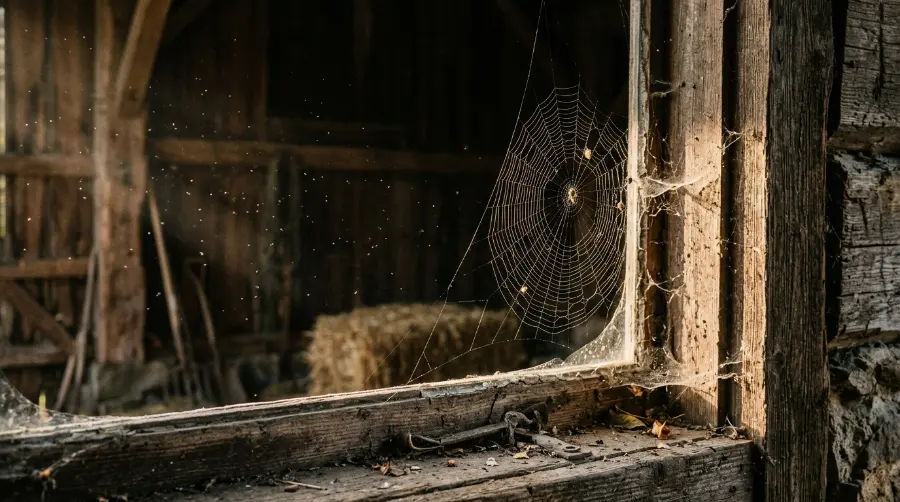
An interesting one. Read as evidence of work already done, by you or by someone else, and the traditional interpretation concerns structures you are inside without having noticed: habits, arrangements, obligations you never agreed to out loud.
The reason you see them suddenly is usually dew or low morning sun, which makes silk visible that was there all along. Which fits the reading almost too neatly.
The Same Spider in the Same Place
Web-building spiders are sedentary and will hold one good spot for weeks or months, so it very likely is the same individual. Traditionally this is read as the strongest form of the sign, because it is not a passing encounter but a presence that has settled in and is waiting for you to acknowledge it.
Does the Colour or Size Change It?
People ask, so here it is, with the caveat that colour readings are the softest layer of any sign.
Black spiders are read as the shadow material: something hidden, suppressed or not yet looked at. The most common reading and the most commonly over-dramatised.
White or pale spiders are read as clarity, purity of intention, and in some traditions as a message connected to someone who has died.
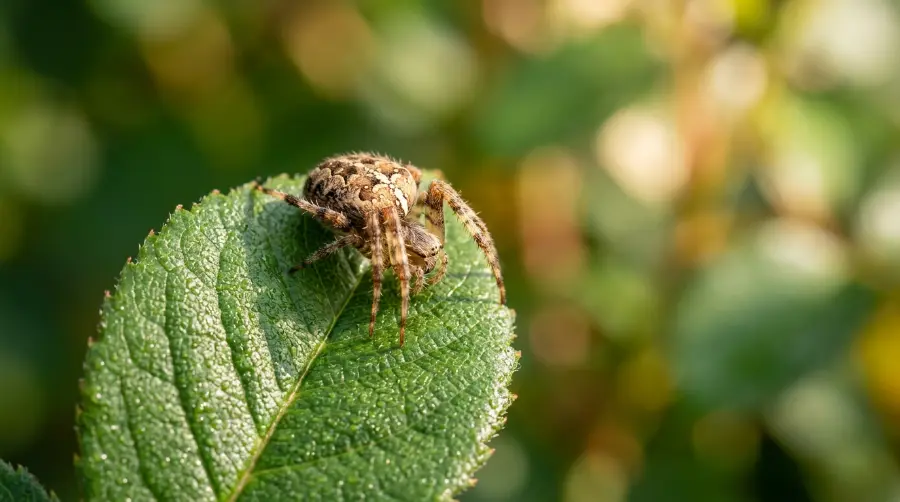
Brown spiders, which is most of them, are read as groundedness and practical matters: money, home, work.
Red markings are read as urgency or passion, and this is the one place to add a practical note: a few genuinely medically significant spiders carry red markings, so identify before you handle rather than after.
Very large spiders are read as a message you will not be able to ignore. Very tiny spiders are read as small beginnings, and in Korean tradition a spider seen in the morning is held to bring good luck, which is a cheerful counterweight to the Western gloom.
The Spider Across Traditions
The spider is one of the few creatures that is honoured more often than it is feared, which surprises most readers.
In several Native American traditions, including Hopi and Navajo, a Spider Woman or Spider Grandmother figure appears as a creator and a teacher, credited in some accounts with bringing weaving to people. The specifics differ meaningfully between nations and should not be collapsed into a single story.
In West African and Caribbean tradition, Anansi is a spider and a trickster who wins through cleverness rather than force, and who in many tellings owns all stories.
Greek tradition gives the darker version: Arachne, a mortal weaver so skilled she challenged Athena, and was turned into a spider for it. Pride, skill and punishment in one figure.
Biblical references are sparse and double-edged. Job uses the spider’s web as an image of fragile false security, while Proverbs notes the spider’s presence in the palaces of kings, which has long been read as small persistence reaching high places.
And in Scottish tradition there is the story of Robert the Bruce, in hiding and defeated, watching a spider fail repeatedly to anchor a thread and then succeed, and deciding to try once more himself. Almost certainly a later legend. Still the clearest statement of what this animal has always meant to people.
Is It a Warning or a Message?
A message, in nearly every tradition that has a view.
The spider’s reputation as sinister is remarkably recent and remarkably local. For most of recorded history and across most of the world, spiders in the house were lucky, spiders were associated with creation and craft, and killing one was the thing that brought misfortune rather than seeing one.
The one reading that carries any edge is the avoidance one, and even that is not a warning about the future. It is a question about the present.
What to Do
Leave them, if you can bear to. Spiders eat the insects you genuinely do not want, including flies and mosquitoes, and a house with spiders in it is a house with fewer of those. The folklore and the practical advice agree for once.
If you must move one, cup and release rather than squash. A glass and a sheet of paper. In autumn, put it somewhere sheltered indoors or in a shed rather than out into the cold, since it probably lives inside.
Note the date. If it is September, you have most of your answer, and the symbolic reading sits on top of a seasonal cause rather than replacing it. Both can be true.
Then answer the real question. Not why there are spiders. There are always spiders. The question is what changed in you this week that made you start seeing them, because that is the part that is actually about your life.
Frequently Asked Questions
Why am I seeing spiders everywhere spiritually?
Repeated spider sightings are traditionally read as a message about what you are building and whether you are building it deliberately, with the repetition itself read as emphasis because the first sighting was missed. If the sightings are in different places, the reading points at a pattern across your life rather than one situation.
Why do I keep seeing spiders all of a sudden?
In late summer and autumn, male spiders reach maturity and leave their webs to wander in search of mates, so they become visible all at once without any change in numbers. Beyond that, the frequency illusion means that once you notice something and attach meaning to it, you notice every subsequent instance. The spiders were already there.
Is seeing a lot of spiders bad luck?
No. Across most traditions a spider in the home is considered lucky and killing one is the part thought to bring misfortune. The idea of spiders as ominous is a recent and fairly local development, not the historical norm.
What does it mean to see spiders when waking up?
Seeing a spider on waking that then is not there is a hypnopompic hallucination, a brief vivid image occurring between sleep and wakefulness. It is common in healthy people and spiders are among the most frequently reported images. Symbolically it is read as something held at the edge of awareness surfacing when your guard is lowest.
Does it mean something different if a spider touches me?
Yes, contact is read as a more direct and more personal form of the sign than a sighting. Being bitten is read differently again, as something under the surface rather than something being pointed out.