
Start with something nobody writing about this seems to notice. You have almost certainly never seen a polar bear.
Not in the wild, not up close, not in any way that would let your sleeping brain build one from memory. Which means the animal in your dream was assembled from images — and unlike most dream animals, the polar bear’s image has an unusually short and unusually political history.
Every page competing for this search will tell you the same three words: strength, survival, resilience. None of them mentions that the bear stands on frozen water, that its skin is black, or that it is a brown bear which specialised into a condition now disappearing.
You dreamt a photograph
Your mental polar bear came from somewhere specific, and there are really only two sources.
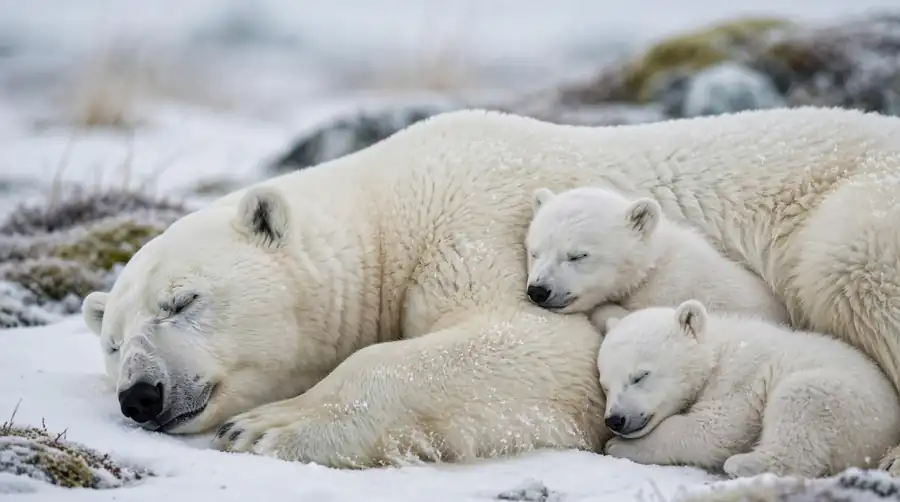
The first is advertising. Coca-Cola has used polar bears in its marketing since the 1920s, and the animated version from the early 1990s made a cartoon polar bear one of the most recognisable commercial images in the world — soft, rounded, affectionate, usually with its cubs.
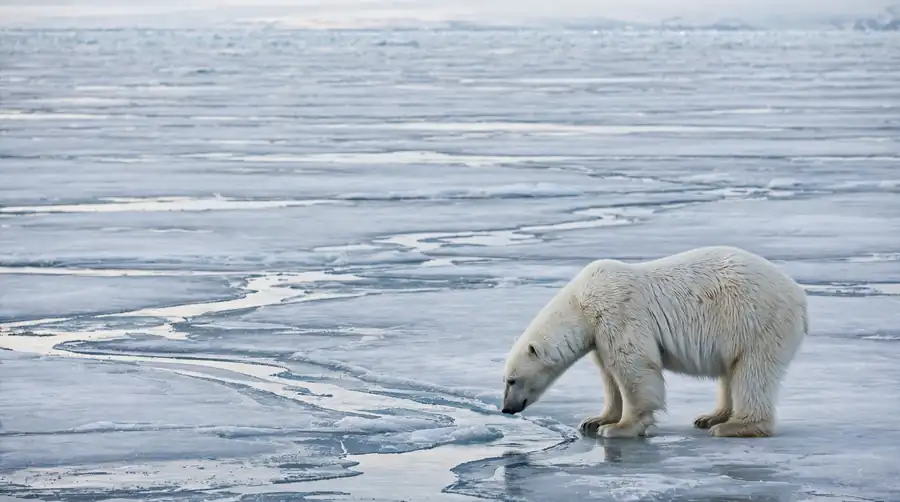
The second is climate change. Over the past two decades the polar bear became the central visual symbol of a warming world, and the specific composition that did it is this: one bear, alone, on a piece of ice that is clearly too small for it. You have seen that photograph dozens of times, on news sites, in documentaries, on campaign material.
So there is a real question to put to your dream before any symbolism. Which bear turned up — the warm one with the cubs, or the one on the shrinking floe? Because those are two entirely different images carrying two entirely different arguments, and your mind chose between them.
It is also worth saying plainly: if you have been carrying any amount of dread about the state of the world, this is the animal that dread has been trained on. That does not make the dream less meaningful. It makes it more legible.
What was the bear doing?
The colour and the species set the mood. The verb carries the content, and most pages skip straight past it to a list.
Before the table: dream imagery has no dictionary, whatever the sites with “dictionary” in the domain name imply. What follows is what each version most often tracks, offered as a starting point you are free to reject. And threatening-animal dreams are among the most commonly reported dream types worldwide, so this is an ordinary dream to have.
| In the dream | What it most often tracks |
|---|---|
| On a small piece of ice, alone | The learned image, almost always. Usually carries a shrinking-platform feeling rather than a threat — resources, time, or standing running out |
| Chasing you across snow or ice | The most common frightening version. Pressure with a deadline, in conditions you find unforgiving |
| Watching you from a distance, not approaching | Something known and unaddressed. Watching dreams tend to carry being seen rather than being hunted |
| Swimming | Worth noticing — this is the bear doing what it actually does. Often appears when someone is between two solid things |
| A mother with cubs | Frequently the advertising image surfacing. Where it is not, it usually concerns protection you are giving or wanting |
| Calm, close, allowing contact | The commercial bear almost by definition. Not a contradiction — just worth knowing which library it came from |
| Attacking, or you killing it | A confrontation already decided internally. People usually know the subject on waking |
| In a zoo or behind glass | Something powerful that has been contained, including possibly by you |
| Thin, or clearly starving | The climate image at its sharpest. Often depletion in yourself rather than in the world |
| In an impossible place — your street, your house, warm weather | Displacement. The dream has put a specialised thing somewhere it cannot survive |
If you only remember the whiteness and the size, that is normal. Emotional tone outlasts detail in dream recall by a long way.
Its ground is frozen water
Here is the fact that should be at the centre of every article on this subject and appears in none of them.
The polar bear’s habitat is sea ice. Not land, not sea — the frozen surface of the ocean. It hunts seals from the ice, travels on the ice, and in many regions can barely feed at all without it. Its scientific name is Ursus maritimus, the sea bear, and in the United States it is legally classified as a marine mammal.
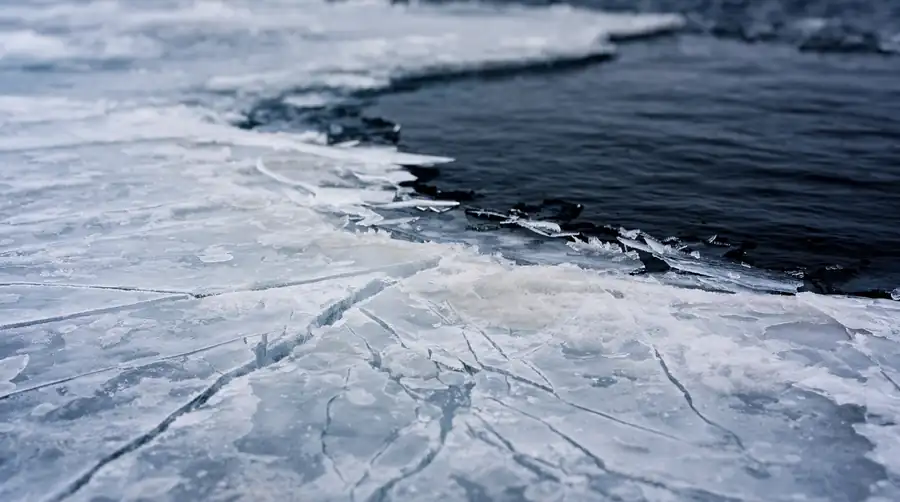
Which means its entire world is a phase state. The floor it stands on is water in a temporary condition. It is genuinely solid, genuinely load-bearing, genuinely capable of holding a four-hundred-kilogram animal — and it is the same substance as the sea underneath, arranged differently for a while.
No other large predator lives like that. Everything else stands on rock, soil or branch. The polar bear stands on a season.
It is a brown bear that specialised
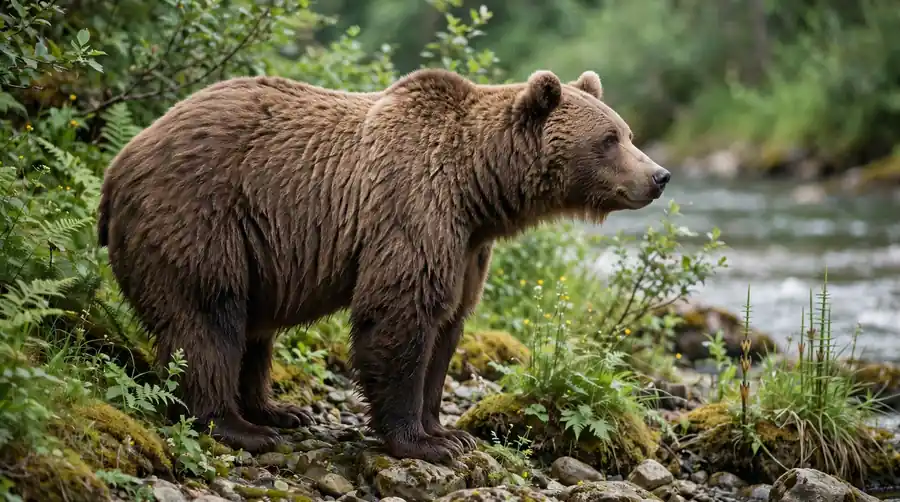
The polar bear is not an ancient, separate lineage. It came out of the brown bears, and on a geological scale it did so recently — estimates vary considerably, but we are talking about hundreds of thousands of years rather than tens of millions.
How close is it still? Close enough to interbreed. Polar bears and grizzlies produce fertile hybrids, and they have been documented in the wild as ranges overlap. Brown bear populations carry traces of polar bear ancestry in their genomes, and vice versa. The two species have been exchanging material for a long time.
So this is a brown bear that went out onto the ice and committed to it entirely — the body shape, the fat, the fur, the feet, the diet, the whole animal reorganised around hunting seals on a frozen ocean.
That is an extraordinary piece of engineering and it is also a bet. Everything that makes a polar bear superb on sea ice makes it poor at being a bear anywhere else. If your bear showed up in the waking world rather than in a dream, the meaning of encountering a black bear covers the live animal.
It is not white
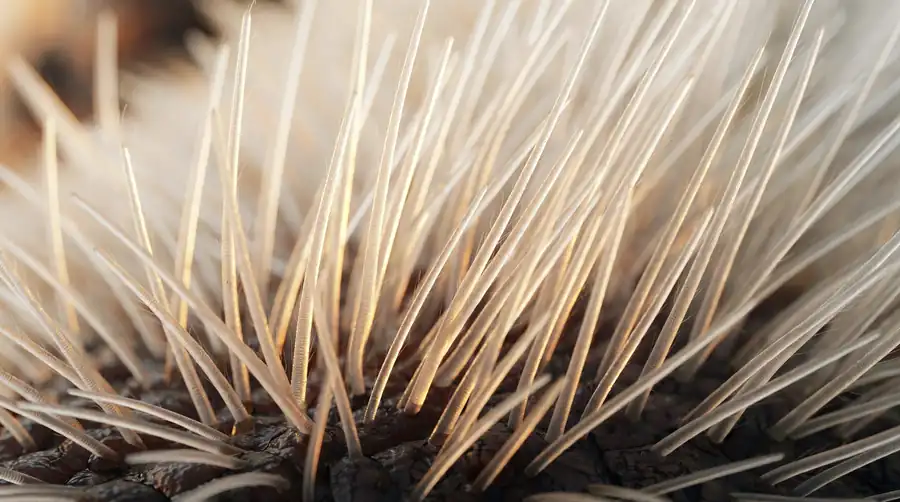
Pull back the fur on a polar bear and the skin underneath is black.
And the hair itself is not white either. It has no white pigment in it at all — the individual hairs are hollow and essentially colourless, and they look white for the same reason snow and foam and shattered glass look white: light bouncing around inside a transparent structure and coming back out scattered.
Which produces one of the better pieces of evidence in nature. In warm, humid zoos, algae sometimes colonises the inside of those hollow hairs, and the bear turns green. It has happened in several collections and it is exactly as strange as it sounds.
So the whitest-looking animal on earth is a black-skinned animal wearing colourless hair, and its famous purity is an optical effect of structure. There is no white there to find.
It can go months without eating
When the sea ice breaks up, the hunting platform disappears, and in places like Hudson Bay the bears come ashore and simply wait — living off the fat they laid down while the ice held. That fast can run for four months or more.
Pregnant females go furthest. A female who dens through winter, gives birth in the snow and nurses tiny cubs can go without food for something approaching eight months, producing milk the entire time from reserves alone.
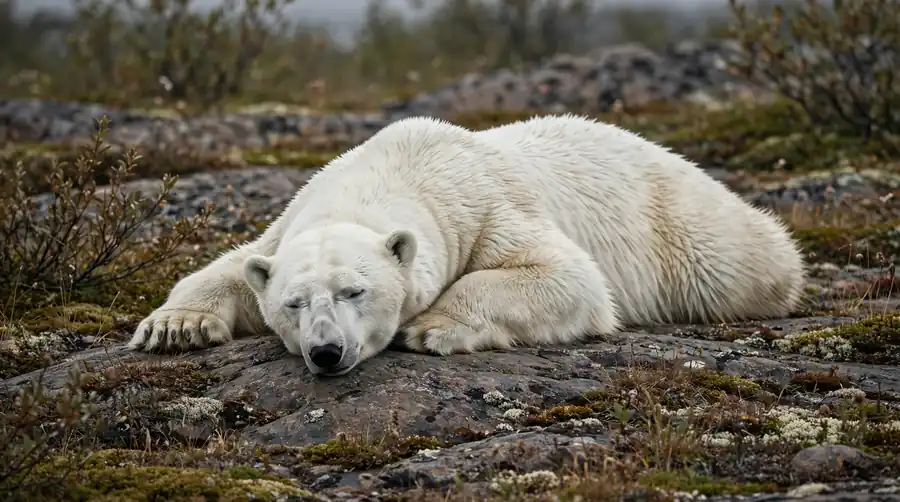
Worth adding an honest note, because the picture has been revised. It was once assumed that bears on land could offset the fast by eating what they found there. More recent work suggests terrestrial food does not come close to compensating, and that fasting bears lose weight steadily regardless. The waiting is not a quiet alternative strategy. It is a deficit being survived.
Four readings
1. The floor is real and conditional
This is the reading the whole article is built on, and it is more precise than anything on the competing pages.
The sea ice is not an illusion. It is not a trick, and the bear is not naive for trusting it. It holds. It has held for as long as the bear’s lineage has existed. And it is a phase of something that has another phase, and the arrangement depends on a temperature.
Most of what people stand on is like that, and the useful distinction is not solid versus unreliable. It is solid-while-conditions-hold. A job, a city, an institution, a body, a currency — all genuinely load-bearing, none of them rock.
If the dream gave you a bear on a piece of ice, the question is not whether your ground is real. It is which temperature yours depends on.
2. You dreamt the picture, and the picture has an argument in it
Your sleeping mind had a whole catalogue of large frightening animals available and reached for this one — which is unusual, because a polar bear is not a plausible threat to anybody reading this.
And the dominant image of this animal is not “danger”. It is loss. The composition that made the polar bear famous shows an animal stranded on a diminishing platform through no fault of its own, and that is a very specific feeling to borrow.
The false white belongs here too. Those pages calling the polar bear a symbol of purity are reading a colour the animal does not have — black skin, colourless hair, light doing the work. It is the same move as the white dove, a symbolism built on an appearance the animal does not actually have.
3. Specialising is a bet on conditions
A brown bear can live almost anywhere and eat almost anything. The polar bear gave that up to become superb at one thing in one place.
Nobody describes that as a mistake, because for most of its history it was clearly right. Specialisation is how you stop competing and start excelling. The cost only appears when the conditions move, and then it appears all at once — because every adaptation that made you excellent is now pointing at something that is not there.
There is a small mercy in the genetics, and it is honest to include it: the polar bear is still close enough to a brown bear to interbreed. Even the most committed specialisation did not fully close the door back. Whether that is comfort or complication probably depends on which you are facing.
4. The competence is mostly waiting
Every competing page frames the polar bear as a symbol of strength and survival, and pictures it hunting. For months of the year the actual behaviour is: come ashore, lie down, and metabolise yourself slowly while the ocean refreezes.
And the honest footnote matters here. The waiting is a deficit, not a clever alternative. The bear is losing weight the whole time. If you are in a waiting period and it feels like loss rather than like patience, that is because it is loss — which does not mean you are doing it wrong.
The Arctic is named after the bear
A small piece of etymology that is too good to leave out.
“Arctic” comes from the Greek word for bear, arktos — by way of the constellations, the Great and Little Bear, which stand over the north. The far north is “the bear region” because of stars, named long before anybody in Greece knew what lived up there.
Then the name turned out to be accurate. The place named after a bear in the sky contains the largest land carnivore on earth, which is a bear.
And it runs the other way too. “Antarctic” means opposite-the-bear, and the Antarctic has no bears at all. The name is correct by accident in one hemisphere and correct by negation in the other.
Nanuq
If you want a tradition about this animal rather than a slogan, there is one, and it belongs to the people who actually live alongside it.
In Inuit tradition the polar bear is nanuq, and the regard for it is specific rather than generic. It is treated as exceptionally intelligent and as a being deserving respect and careful conduct, and in some accounts it is understood to be close to human — in its own house, able to put off its skin and stand as a person.
That is a very different idea from “symbol of inner strength”. It is a relationship with obligations in it, held by communities with thousands of years of direct knowledge of the animal, and it varies between regions and groups in ways no single sentence covers.
Which is also why I will not hand you a one-line “Inuit meaning” of your dream. Anybody who does is selling you something they have not got.
The polar bear in the Tower of London
One historical detail, because it is real and almost nobody knows it.
In 1252 the King of Norway sent a white bear to Henry III of England, and it was kept at the Tower of London. Records from the period include an allowance for a muzzle and an iron chain, and for a long cord — so that the bear could be taken to the Thames to fish.
Picture it properly. A polar bear on a rope, in the river, in medieval London, catching fish while people watched from the bank.
It is also the oldest reminder available that this animal has been an image for Europeans far longer than it has been an experience. Nearly eight hundred years ago it was already a gift between kings, a spectacle, a thing to be looked at. The photograph on the floe is only the latest version of that.
If the dream keeps coming back
A frightening dream once is ordinary. The same one repeatedly, to the point where your sleep suffers or you are uneasy about going to bed, is a different thing — and it is a recognised and treatable problem rather than a message you are failing to decode.
There is more on that, and on why threat and pursuit dreams are so common in the first place, in the piece on black wolf dreams.
The question to sit with
It is a brown bear that moved onto the ocean. Its skin is black and its hair has no colour in it. It can go most of a year without eating. And the ground it depends on is water holding a shape, for now.
You did not dream that animal, because you have never met it. You dreamt the picture we made of it, and the picture is of something standing on a floor that is getting smaller.
So: what are you standing on that is solid, load-bearing, entirely real — and conditional on something you do not control?