
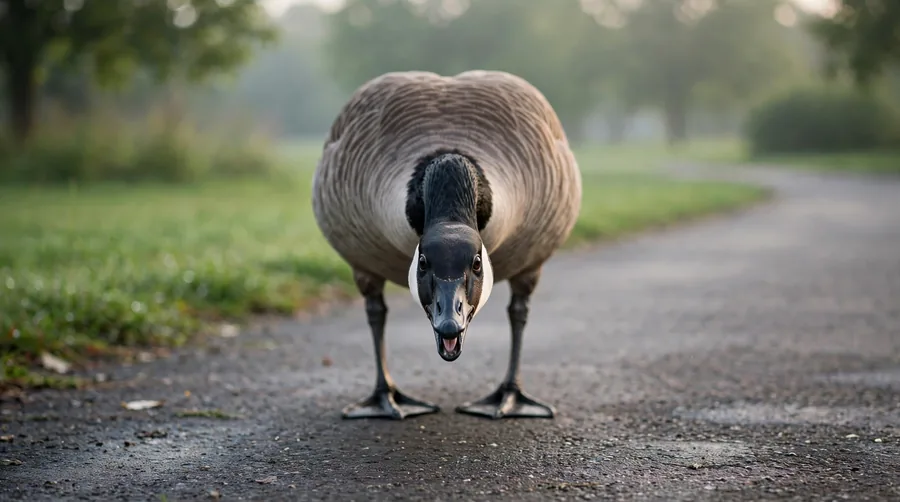
Let me correct the premise before anything else, because it changes the whole encounter.
The goose did not cross your path. You crossed its path, and it declined to move.
Geese work fixed routes between water, grazing and roosting, and they use them daily. If one walked out in front of you at its own pace, with no apparent interest in your schedule, that is because you were standing in a corridor it has used all season — and because it almost certainly had something behind it worth not running from.
Every page competing for this search will tell you the goose means loyalty, teamwork and following your own path. None of them mentions that the bird at the front of a V gets no help at all, and gives the position up.
If a goose is confronting you right now
Putting this first because some readers have arrived here with their heart going, and the correct response is counter-intuitive.
Escalation runs in a predictable order: head low and level, hissing, head pumping up and down, then wings out and a charge. The charge is usually a bluff, but a large goose moving at you is genuinely intimidating and most injuries come from people falling over while retreating.
So: do not turn and run. Do not flap at it, shout, or swing anything. Face the bird, keep eye contact, and back away slowly and steadily, staying square to it the whole time. If you have a bag or a jacket, hold it between you at waist height — not raised, just in the way. Wildlife rescue organisations give the same counsel; the Toronto Wildlife Centre’s page on geese attacking people walks through it step by step.
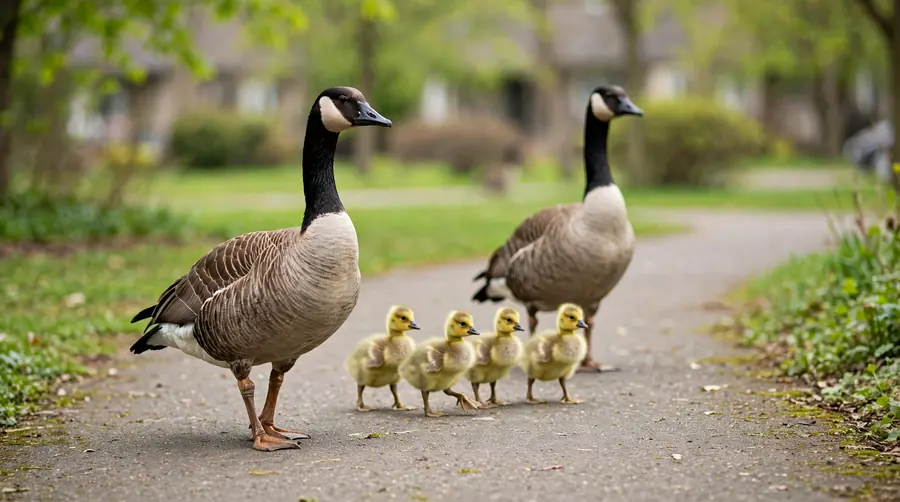
Keep dogs on a short lead and away. Keep children behind you. And if you can see goslings or a sitting bird anywhere nearby, that explains everything — go around, widely, and do not go back that way for a few weeks.
One practical note worth knowing: in the US, Canada geese are protected under the Migratory Bird Treaty Act, and in the UK wild birds are protected under the Wildlife and Countryside Act. Harassing one or interfering with a nest is not simply unkind, it is unlawful.
Why a goose crossing your path will not move
The aggression that gives geese their reputation is almost entirely parental, and it has a structure most birds do not have.
In the great majority of bird species the male contributes little once the eggs are laid. Geese are different: the pair stays together, the female incubates, and the gander stands guard the entire time — then both parents escort the goslings for months afterwards, often keeping them through the first migration.
Which reframes the encounter completely. The bird that would not get out of your way was not being arrogant or territorial in the abstract. It was holding a line in front of something, and it had decided that you were less dangerous than leaving that line unheld.
That is also why goose aggression is so seasonal. From roughly spring into early summer they are impossible; by late autumn the same birds will ignore you entirely.
Why the V works, and why nobody stays at the front
Here is the fact that should anchor every article about geese and appears in none of them.
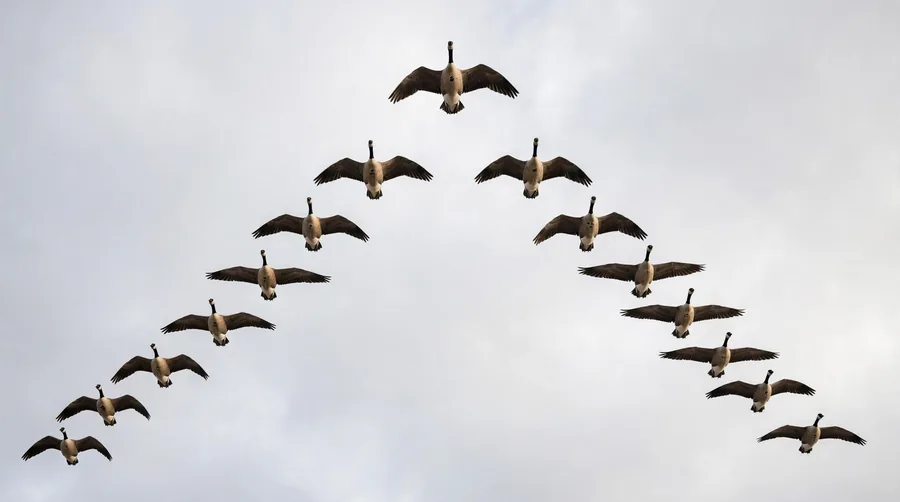
A flying bird throws air upward off each wingtip. If a second bird sits slightly behind and to the side, it can fly in that rising air and spend measurably less energy doing it. Stack the effect along a line and you get the V — not a formation for show, but a chain of birds each riding the wake of the one ahead.
The precision involved is remarkable. Research tracking birds in formation has found them timing their wingbeats to stay phased with the bird in front, so the upwash arrives exactly when it is useful. This is not loose following. It is coordination at the level of individual wing strokes.
Now the part that matters. The bird at the point of the V has nothing in front of it. It gets no upwash, no saving, no help. It is doing the hardest work in the flock while everyone behind it is being carried, at least a little.
And geese rotate it. The lead bird drops back and another takes the point. The front of the V is not a rank, a privilege or a status. It is a shift.
The route is taught, not inherited
Geese do not hatch knowing where to go. The migration route — the specific stopovers, the line of travel, the destination — is learned by young birds flying it alongside their parents.
That makes the route a piece of culture rather than a piece of genetics, and it has two consequences people rarely connect.
The first is that it can be lost. Where geese have been raised without migrating parents, or where conditions have made staying viable, the habit simply stops. Large numbers of Canada geese in North America and the UK are now resident year-round and never migrate at all. The old folk rule that geese overhead means the season is turning has quietly become unreliable.
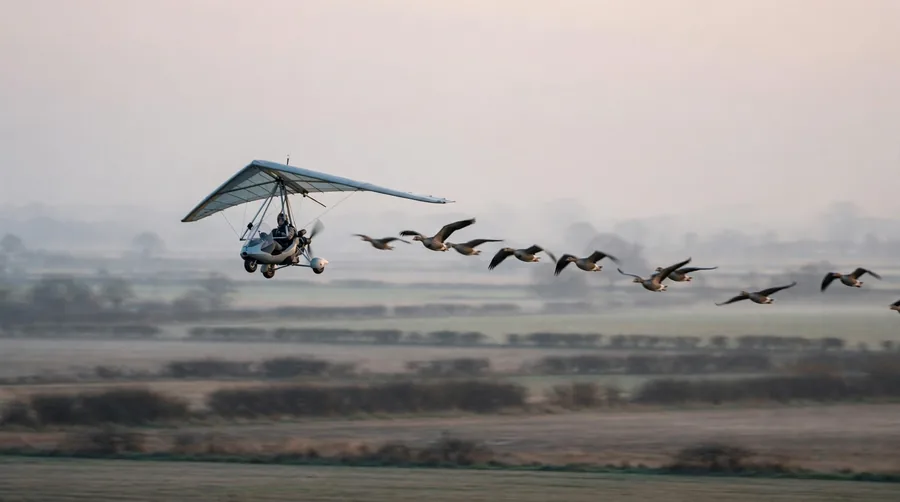
The second is stranger and better. In the 1990s, Bill Lishman demonstrated that if geese imprint on a person, they will follow that person’s microlight aircraft — and he used this to lead young Canada geese along a migration route by flying it with them. The work inspired the film Fly Away Home, and the technique was later adapted to teach routes to endangered cranes.
Sit with the shape of that. Human beings got into aircraft and flew a migration in front of the birds, because the knowledge was not in the birds and the only way to give it to them was to go first.
For more on reading birds in flight — formations, circling, and what the sky is actually doing — see the spiritual meaning of birds circling overhead.
Konrad Lorenz and the goslings that followed a man
Which brings us to the reason any of that was possible.
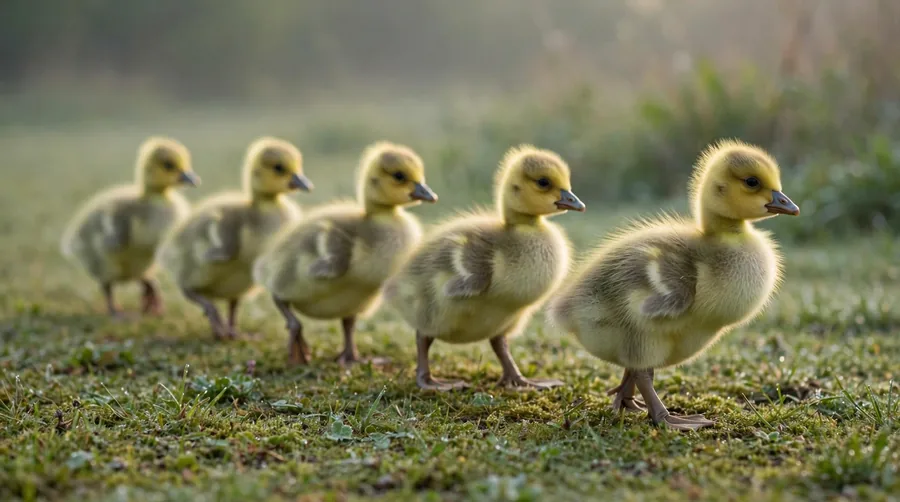
Konrad Lorenz worked with greylag geese and established something now basic to biology: a newly hatched gosling attaches to whatever it encounters during a short window after hatching, and that attachment is extremely difficult to undo. He hatched geese who followed him instead of a goose, and one — Martina — lived in his house. He shared the Nobel Prize in 1973.
The detail worth holding is that imprinting is not recognition. The gosling is not identifying a mother. It is bonding to whatever is present at the right moment, and a bearded Austrian scientist will do perfectly well.
That is a much harder and more interesting idea than “geese are loyal”. The attachment is real, lifelong in its effects, and determined by timing rather than by any judgement about what deserved it.
They pair for years, and they appear to grieve
Geese form long pair bonds, frequently lasting for life, and both birds stay involved in raising young — which is uncommon enough to be worth stating plainly.
What observers consistently report when a mate dies is harder to summarise without overclaiming. Bereaved geese have been described as withdrawing from the flock, calling repeatedly, losing weight, and in some cases remaining unpaired afterwards rather than re-mating in the following season.
I am going to be careful here, because this is exactly the sort of thing that gets inflated. We cannot ask a goose what it feels. What we can say is that the behaviour after a mate’s death is markedly different from normal behaviour, that it persists, and that it costs the bird something measurable.
If a lone goose is what crossed your path, that may be all it is — birds separate for ordinary reasons. But solitary geese are genuinely unusual, and the possibility is worth knowing.
Four readings
1. The front of the V is a shift, not a rank
Every competing page uses the V as a tidy image of teamwork. Almost none of them knows that the leader is the only bird getting no benefit, or that the position rotates.
That turns a greetings-card idea into something with teeth. In a goose flock, leading is the costly job, it is taken in turns, and the reward for doing it is being allowed to drop back and be carried for a while.
Hold that against most of what you have been told about leadership, where the front is where the advantages accumulate. If you are currently at the point of something and finding it exhausting while everyone behind seems comfortable — that is not a sign you are doing it wrong. That is the aerodynamics. The question is whether anyone is going to take a turn.
2. It would not move because it was holding something
This is the reading specific to your encounter, and it is kinder than the bird’s reputation.
A goose that stands its ground against something enormously larger is not displaying confidence. It is making a calculation in which retreating is the worse option, and the reason is almost always behind it, in the grass, too small to run.
Which is worth remembering the next time someone is unreasonably immovable about something that looks trivial from outside. People who will not yield on small ground are frequently standing in front of something you cannot see from where you are.
The same logic runs through other path-crossing encounters: the snake that would not move was using the path as a heater — read the spiritual meaning of a snake crossing your path.
3. Attachment is a matter of timing
The imprinting reading, and it is the least comfortable one here.
The gosling does not choose, assess or recognise. It bonds to what is there during a brief window, and the bond holds afterwards regardless of whether the thing it bonded to was appropriate, good for it, or even the right species.
Most people can find something in their own life that works roughly like this — an attachment formed early, in a narrow window, to whatever happened to be standing there. Recognising that it was timing rather than merit does not dissolve the bond. But it does explain why arguing with it has never worked.
4. Some knowledge is only ever handed over
The route is not in the goose. It is in the flock, and specifically in the birds that have flown it, and it survives only by being flown again in front of someone who has not.
Which means it is one generation from gone, every generation. Break the chain once and the knowledge does not degrade gradually — it is simply absent, and the birds stay put, and nobody remembers there was a route.
There is a lot of that about. Trades, recipes, languages, routes through a particular bureaucracy, how a specific family actually handles a crisis. None of it is written down and none of it is inherited. It has to be gone first, in front of someone, by somebody willing to take the point of the V.
The geese that saved Rome
If you want one piece of history about this animal, take this one, because it is the best thing in the record and nobody writing about goose symbolism uses it properly.
Around 390 BC, with Rome largely overrun by the Gauls, a force attempted to climb the Capitoline Hill at night. The dogs did not wake. According to Livy, the geese kept on the hill as sacred birds of Juno did — their noise roused Marcus Manlius and the garrison, and the assault was thrown back.
Rome remembered it. The geese were honoured afterwards, and the dogs were not.
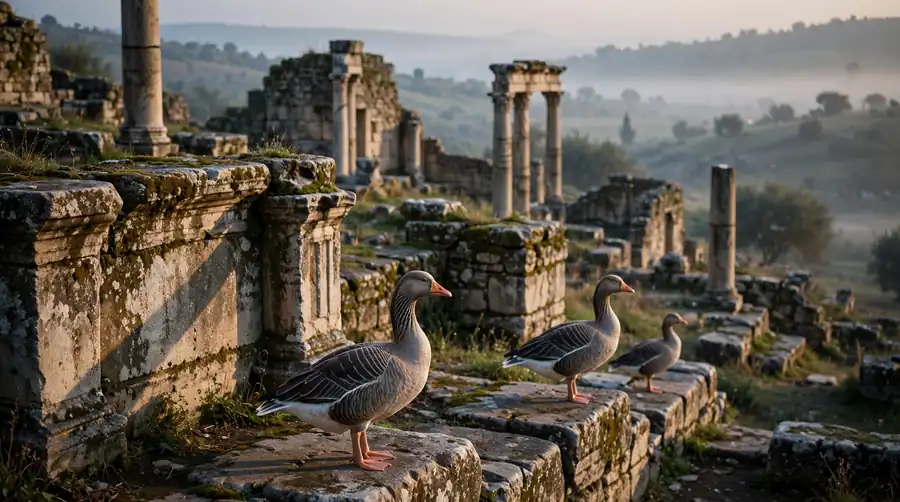
Notice what the geese were commended for. Not courage, not strength, not loyalty. Noticing, and then being extremely loud about it. The whole value of the animal in that story is that it would not keep quiet — which is exactly the trait that makes people find geese annoying.
Geese are still used as guard animals for this reason. They are alert, they are impossible to bribe, and they cannot be persuaded to let something go.
What the traditions actually say
There is real material here, and one claim worth examining carefully.
In Celtic Christianity the wild goose is used as an image of the Holy Spirit — restless, loud, untameable, as against the gentler dove. It is genuinely used that way today, notably by the Iona Community, and it is a striking idea: a Spirit that is disruptive rather than soothing. The dove side of the pairing — the gentle Spirit — is covered in what doves around your house mean. How far back the symbol actually goes is less clear than most sources imply, and I would describe it as a living tradition rather than an ancient one.
In Hinduism, the hamsa is the mount of Brahma and a symbol of discernment — the ability to separate what matters from what does not. It is usually translated as swan in English, but a good many scholars identify the bird as a bar-headed goose, which happens to be the species that crosses the Himalayas at extraordinary altitude.
Ancient Egypt associated geese with Geb and kept sacred geese in temple contexts. And if you came looking for a biblical reading: the goose is not in the Bible. Not once, in any translation. The dove, the raven, the eagle, the sparrow and the quail are all there. The goose is absent.
Mother Goose is also much younger than people assume — the name enters print with Charles Perrault’s Contes de ma mère l’Oye in 1697. And the goose that laid the golden eggs genuinely is Aesop, which is worth saying because a great many “ancient fables” are not.
A wild goose chase has nothing to do with geese
Small correction, and it is a good one.
A “wild goose chase” was originally a sixteenth-century horseback game. A lead rider set off across country and the others had to follow his line at intervals, strung out behind him — like geese in flight. The phrase describes the formation, not a futile pursuit of a bird.
Shakespeare uses it in Romeo and Juliet in roughly that sense. The modern meaning — a pointless errand after something you will never catch — drifted in later, once nobody played the game any more.
So the expression people use for hopeless, scattered effort originally described a group of riders holding a precise line behind a leader. It meant the opposite of what it now means, and the thing it was describing was the V.
One request: do not feed them bread
Bread is close to worthless to a goose. It fills them without feeding them, and heavy feeding in one place concentrates birds, fouls water, spreads disease and makes them bold with people — which is how a goose ends up being treated as a problem and dealt with accordingly.
Diets high in calories and low in nutrition have also been linked to deformities in growing waterfowl, which is reason enough on its own.
If you want to feed them, geese do well on lettuce, cracked corn, oats, peas and chopped greens. Better still, in most places, is not feeding them at all — they are grazers and they are perfectly capable of sorting themselves out.
The question to sit with
The bird at the front gets no help and hands the job on. The route exists only because someone flew it first. The bond was formed by whatever was standing there at the time. And the goose in front of you would not move because something small was behind it.
Rome did not honour its geese for being brave. It honoured them for being awake and refusing to be quiet about it.
So: where are you at the point of the V, carrying the drag for people who are not taking a turn — and who is next?