
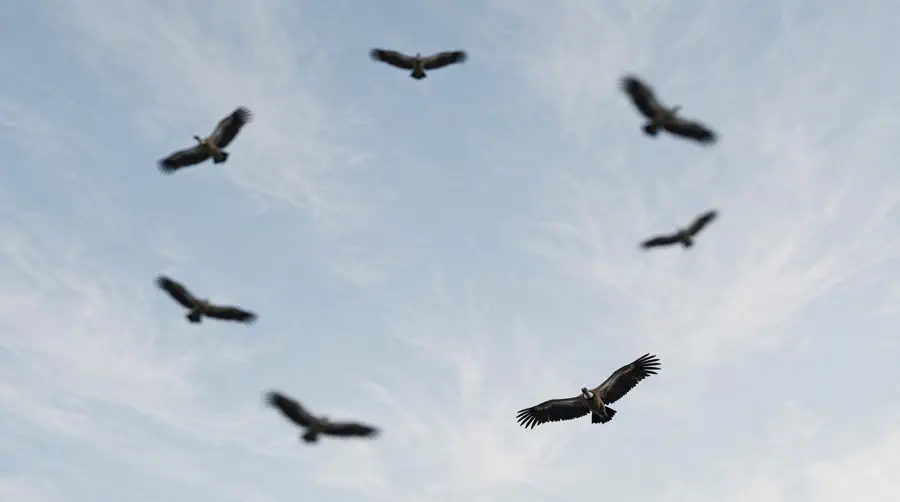
You looked up for no particular reason and they were going round. Not flying anywhere — circling, the same slow wheel over the same patch of sky, directly above you.
And you stood there watching for longer than you meant to, because something about birds turning in a circle over your head does not feel like nothing.
That instinct has a longer history than you would guess. Reading the behaviour of birds overhead was not a folk superstition in the ancient world — it was formal Roman state procedure, conducted by appointed officials, and no significant public business could legally proceed without it. Three words you use without thinking come directly from it. There is a section below.
Birds Circling Overhead: The Short Answer
Birds circling overhead are traditionally read as a cycle completing and a change gathering — energy pooling before something moves, rather than an event that has already happened.
Is it a bad omen? Almost never, and the reason is worth knowing: the ominous reputation comes almost entirely from vultures, which cannot predict anything because they only ever arrive after. The omen is not false so much as pointed the wrong way in time.
And the first useful question is not what it means. It is which bird it was, because the answer changes everything.
Which Bird Is Circling Over You?
Nobody writing about this will help you with the thing you actually need, which is identifying what you saw. Here is the triage, in the order you are most likely to have seen them.
Wings in a Shallow V, Rocking and Teetering
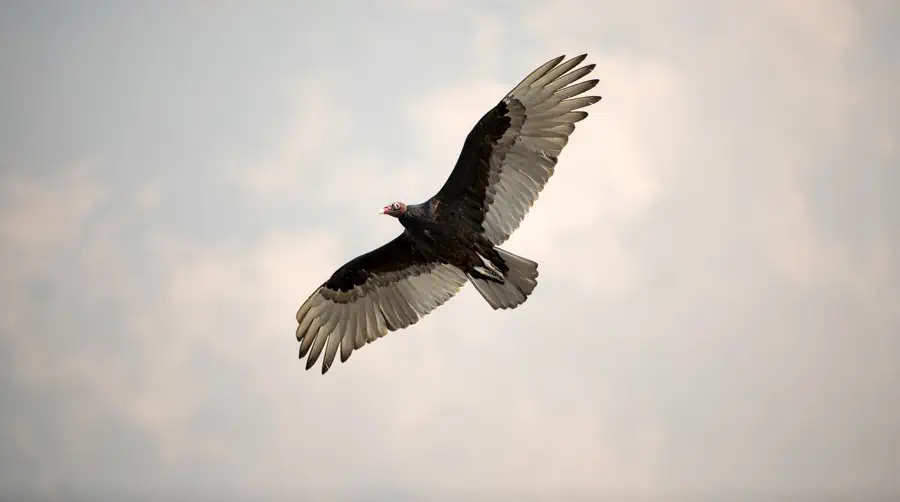
A vulture. This is the single most common answer and the one that unsettles people most. A turkey vulture holds its wings in a visible V rather than flat, never looks quite steady, and almost never flaps. Dark body, paler flight feathers, small bare head.
It also cannot be an omen, for reasons covered below.
Wings Flat and Steady, Broad and Solid, Occasional Flaps
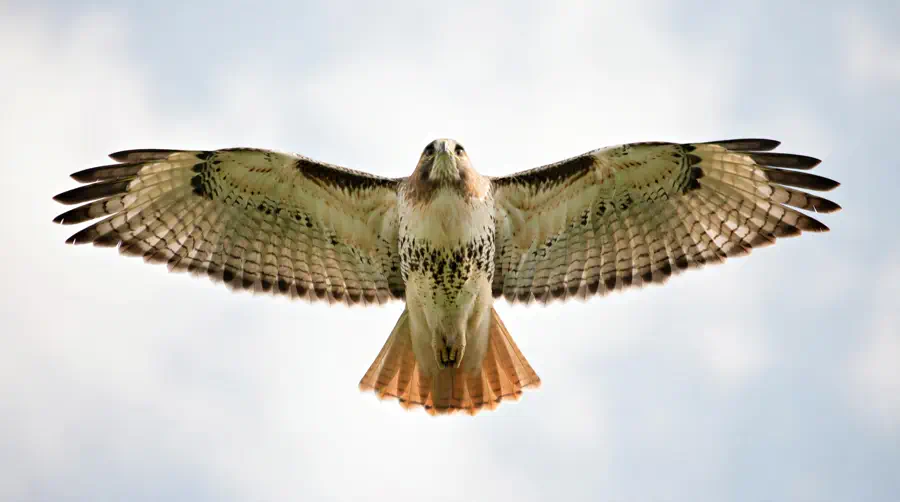
A hawk. Short-tailed, broad-winged, holds a level line. A red-tailed hawk shows a pale chest with a darker band across the belly when seen from below.
Dozens or Hundreds, High Up, All in the Same Patch of Sky
A migration flight. Birders call this a kettle, and it happens when a travelling group finds a good column of rising air and all pile into it to gain height together. It is most common in autumn and spring and it can involve hundreds of birds, mostly raptors.
If you saw this, you saw one of the genuinely great wildlife spectacles, and most people never notice it.
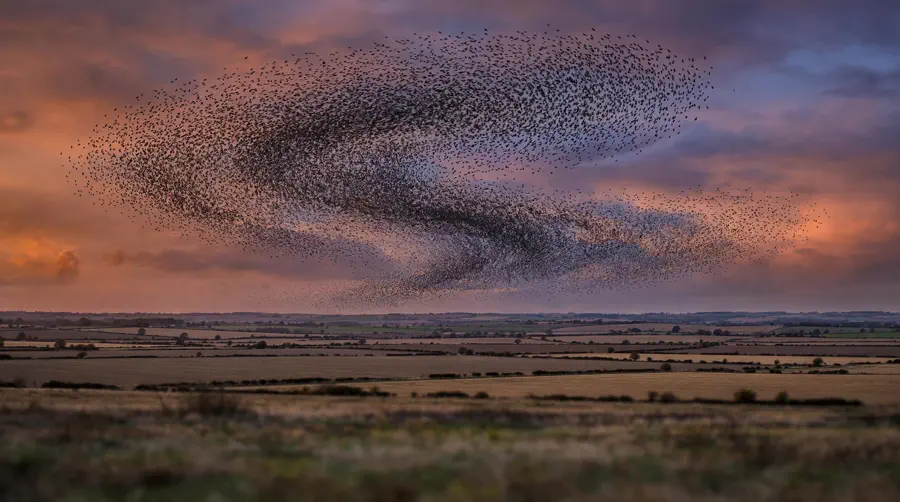
A Dense Mass That Changes Shape Like Smoke
Starlings. A murmuration, and there is a remarkable fact about it in the section further down.
Black Birds Circling One Spot, Calling Constantly
Crows or ravens mobbing something. They have found a hawk, an owl or a cat and are driving it out, diving at it and calling without stopping. The target is usually in the tree they are circling rather than in the air.
Small Birds, Low, Fast and Erratic Rather Than Smooth
Swifts, swallows or martins hunting insects. This is not soaring at all — it is active, flickering, constantly changing flight, and they are chasing prey you cannot see. If they are low, the insects are low, which in folk weather-lore means rain.
Gulls, Inland, Circling and Calling
Usually a food source — a ploughed field, a landfill, a school playing field at lunchtime. Gulls moving inland in numbers has a genuine association with incoming weather, since they leave exposed coastal water ahead of a storm.
Birds Circling a Chimney at Dusk and Then Vanishing Into It
Chimney swifts going to roost. They gather in a swirling column above the chimney as the light goes, then funnel down into it in a stream. It looks exactly like something supernatural and it is one of the best things you can watch in a town in late summer.
Reading Circling Birds Was Once the Law
This is the part that gives the whole subject a foundation, and it is absent from every page written about it.
In ancient Rome, interpreting the flight and behaviour of birds was not a private belief or a village custom. It was a state office. Officials called augurs were appointed to observe birds and report what the signs permitted, and their rulings had legal force. Magistrates could not convene an assembly, pass legislation, or begin a military campaign without first “taking the auspices.”
The procedure was formal to the point of being bureaucratic. The augur marked out a defined section of sky to be watched — a templum, which is where our word temple comes from — and then observed what birds did within it. Which direction they came from, which quadrant they flew through, whether they circled, and on which side they appeared all mattered.
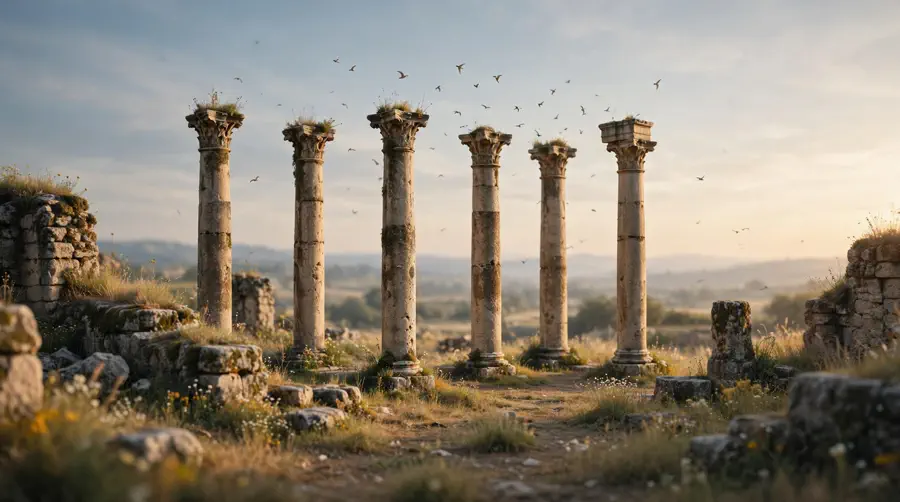
And the vocabulary survived. Three words you use without thinking about them come straight out of this practice:
Auspices comes from the Latin for bird, avis, joined to the verb meaning to look at. An auspex was, literally, a bird-watcher. When you do something “under the auspices of” an organisation, you are using the language of bird observation.
Auspicious therefore means, precisely, showing good bird-signs. Every time somebody calls an occasion auspicious they are reporting a favourable reading of birds.
And inaugurate comes from augur. To inaugurate a president, a building or a project is, etymologically, to install it by bird-omen. The United States holds a ceremony every four years named after the Roman practice of watching the sky for birds.
So when you looked up at birds circling over your head and felt that it meant something, you were not being fanciful. You were doing, informally and without training, the thing that an entire empire built a professional priesthood around. The instinct is extremely old and it is embedded in the language you think in.
Whether the birds are carrying information is a separate question, and the honest answer is at the end of this article. It is more interesting than yes or no.
Four Readings of Birds Circling Overhead
1. A Cycle Closing
The core reading, and it comes from the shape rather than the species. A circle is the one flight path that returns to where it started, so circling birds are read as something completing rather than something departing.
The traditional interpretation is about a phase ending — and notably not about what replaces it, which is why this sign is usually reported by people who can feel something finishing without yet knowing what comes next.
2. Gathering Before Moving
The kettle reading, and it is the most accurate of the four because it describes what is literally happening. Migrating birds circle in order to accumulate height before committing to a long glide. The circling is not travel. It is the preparation that makes travel possible.
Read as a message, that is the most useful thing on this page for anyone stuck in a stage that feels like going round in circles. Sometimes it is going round in circles. Sometimes it is climbing.
3. Something Is Down There
The honest reading, and the one that acknowledges why this sign carries weight. Circling birds very often do indicate something on the ground — carrion, a predator, a food source, a disturbance.
The reading follows naturally: attention is being drawn to a specific place, and you were not looking at it until something above it made you look up. Whether what is down there concerns you is a separate matter.
4. The Pattern With No Leader
This one is for anyone who saw a flock, and it rests on a genuinely beautiful piece of science.
A starling murmuration of thousands of birds has no leader and no plan. Research into how the shapes form found that each individual bird is not tracking the flock at all — it is responding to a small handful of its nearest neighbours, roughly seven of them, matching their speed and direction and keeping its distance.
That local rule, applied by every bird simultaneously, is the entire mechanism. The vast rolling shapes that look choreographed from the ground are what happens when thousands of individuals each pay close attention to only the few immediately around them.
As a reading, it is one of the best available anywhere in this subject: you are not required to see the whole shape in order to be part of making it. Attending properly to the handful of people actually near you is the entire contribution.
Is It a Bad Omen?
Almost certainly not, and the reason is specific enough to be useful.
The ominous reputation of circling birds in Western culture comes from two sources, and both are about vultures and corvids appearing where things had already died. Vultures over carrion. Crows and ravens following armies, which is a real behaviour and produced centuries of battlefield imagery.
Notice the direction of causality in both cases. The birds arrived afterwards. They did not foretell anything; they responded to something that had already happened, sometimes from a considerable distance, and people who saw them overhead and then found out what had occurred drew the obvious but reversed conclusion.
With vultures this is not even a matter of interpretation — it is anatomy. Turkey vultures are pure scavengers whose feet are not built for seizing prey, and they cannot take anything living. A bird that is physically incapable of killing cannot be a warning of death. It arrives after, every time, by necessity. Our guide to the wild turkey and the turkey vulture covers that bird properly, including how it finds the dead by smell.
So the correct version of the old omen is this: circling birds may well mean something is dead nearby. They have never meant something is about to be.
Worth adding that the circling itself is usually not about the ground at all. Soaring birds circle because they have found a column of warm rising air and are using it to gain height for free — a mechanism explained in full in our guide to seeing a hawk. A bird going round and round above you is quite often simply in a lift.
What Changes the Reading
Circling Directly Over Your House
Read as the message arriving at your home rather than on your path, so the interpretation shifts toward family and household.
Practically, houses are excellent thermal generators — a dark roof in sunshine warms faster than the ground around it and produces a reliable column of rising air directly above it. Soaring birds learn these and use them. If birds circle over your roof repeatedly on sunny days, your roof is a known staircase.
Circling Low
Read as more urgent and more personal than high circling, on the general principle that proximity intensifies a sign. Practically, low circling usually means either hunting or that there is no thermal to use, since a bird that has found lift goes up.
Circling in Silence
Read as the more significant version — most traditions treat a silent sign as more deliberate than a noisy one. And it is a genuine identification clue: soaring raptors and vultures are usually silent, while mobbing crows and hunting gulls are not. Silence points at the soaring birds.
Circling at Dusk
Read as the threshold hour and therefore the strongest timing for any bird sign. Practically it is pre-roost gathering — crows, starlings and swifts all assemble before settling for the night, and dusk circling is overwhelmingly likely to be birds about to go to bed rather than birds hunting.
One Bird, Alone
Read as the most personal form of the sign. A single soaring bird is also the most likely to be a hawk or a vulture working a thermal on its own, so check the wing posture — flat for a hawk, shallow V for a vulture.
Counting Them
People do count, and the counting traditions are real — though they come from an English rhyme about magpies rather than from anything about circling, and the rhyme counted birds seen rather than birds circling. Treat the number as the lightest layer of the reading. Three circling birds is usually three birds in one thermal.
It Happens Repeatedly in the Same Place
Repetition is read as emphasis across every sign tradition. Practically, repetition in one spot is the strongest possible indication of a reliable thermal — a car park, a south-facing slope, a dark roof, a stretch of bare field. The birds have learned the geography of the air above your area and are using the same feature every sunny day.
The One Thing Circling Birds Reliably Tell You
Here is the honest answer to whether birds overhead carry information, and it is better than either yes or no.
They do carry information. Just not about your future.
Circling vultures reliably indicate something dead within range of their sense of smell. Circling gulls over water reliably indicate fish near the surface, which is why fishermen have always watched them. Swallows feeding low reliably indicate insects flying low, which genuinely does correlate with falling pressure and incoming rain — the old weather-lore is not nonsense, it is just reading insects by proxy.
And then the best example, which closes the loop on everything above.
Glider pilots look for circling birds. A sailplane and a soaring hawk have exactly the same problem — staying airborne without an engine — and exactly the same solution, which is finding a column of rising air. Birds find thermals better than instruments do. So pilots scan for a circling raptor and fly toward it, because a bird turning tight circles is a visible marker on an invisible structure.
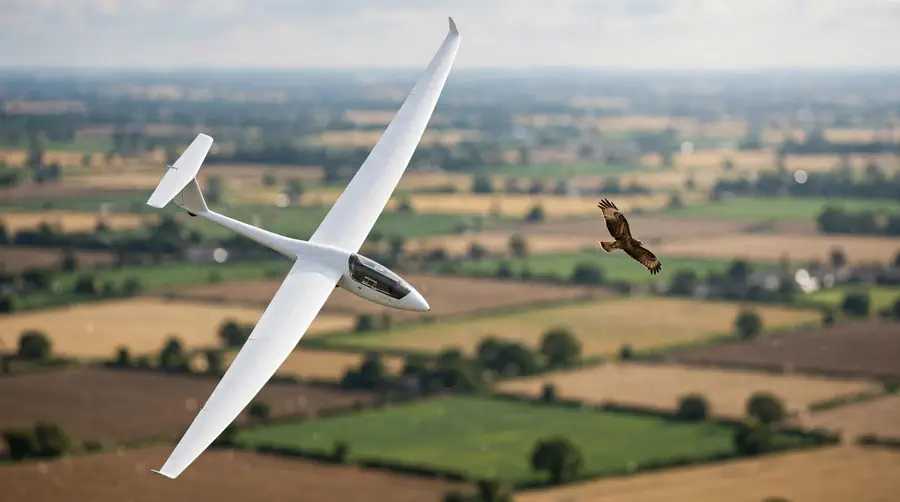
Which means this. The Romans watched circling birds to read something they could not see and made it a matter of law. Two thousand years later, people still watch circling birds to read something they cannot see, and their lives genuinely depend on getting it right. The practice never stopped. We only changed what we are reading it for — and in its modern form, it works.
There is something worth sitting with in that. The impulse that made you stop and look up is the same impulse, and it is pointed at something real. The birds are telling you about the air.
What to Do
Check the wings before anything else. Flat and steady is a hawk. A shallow V that rocks is a vulture. That one observation decides most of this page for you.
Note the time and the weather. Bright and after mid-morning means thermals, so the circling is probably about the air. Dusk means roosting. Overcast and low means hunting.
Count them roughly. One or two is a local bird working a thermal. Dozens or hundreds in autumn is a migration kettle, and it is worth telling someone about.
Look at what is directly underneath them, not just at them. If something is circling persistently over one spot, there is frequently a reason on the ground.
Then the reflective part. A circle is the only flight path that does not take you anywhere, and the birds using it are almost always climbing.
Where in your life are you currently going round in circles — and have you checked whether you are actually gaining height?
Frequently Asked Questions
What does it mean spiritually when birds circle overhead?
It is read as a cycle completing and energy gathering before a change — the circle being the one flight path that returns to where it started. The most accurate version of that reading is the migration one: birds circle to accumulate height before committing to a long glide, so the circling is preparation rather than travel.
Are birds circling overhead a bad omen?
No. The ominous reputation comes from vultures over carrion and from crows following armies — and in both cases the birds arrived after the event. Vultures in particular are pure scavengers physically incapable of taking live prey, so they cannot be a warning of death. Circling birds may mean something is already dead nearby. They have never meant something is about to be.
Why do birds fly in circles?
Most often because they have found a thermal — a column of warm rising air — and circling keeps them inside it while it carries them upward for almost no effort. Other causes are migration flights gathering height together, crows mobbing a predator, swifts and swallows chasing insects, gulls over a food source, and pre-roost assembly at dusk.
What does it mean when birds circle over your house?
Symbolically it shifts the reading toward home and family, since the sign arrived at your house rather than on your path. Practically, a dark roof in sunshine warms faster than the ground and generates a reliable thermal directly above it, so soaring birds learn individual roofs and reuse them. Repeated circling over your house usually means your roof is a known staircase.
Is reading bird signs an old practice?
Older and more official than most people realise. In ancient Rome it was a state office — augurs observed birds within a marked-out section of sky and their rulings had legal force, with magistrates unable to conduct public business without first taking the auspices. The words auspices, auspicious and inaugurate all come from that practice; an auspex was literally a bird-watcher.
For the bird that does the hardest work at the front of the formation, see what it means when a goose crosses your path.
One more flight pattern belongs to the road rather than the sky: a bird crossing in front of a traveller. If it was an owl in front of your car, the whole story — including why the bird was there at all — is in what it means when an owl flies in front of your car.