
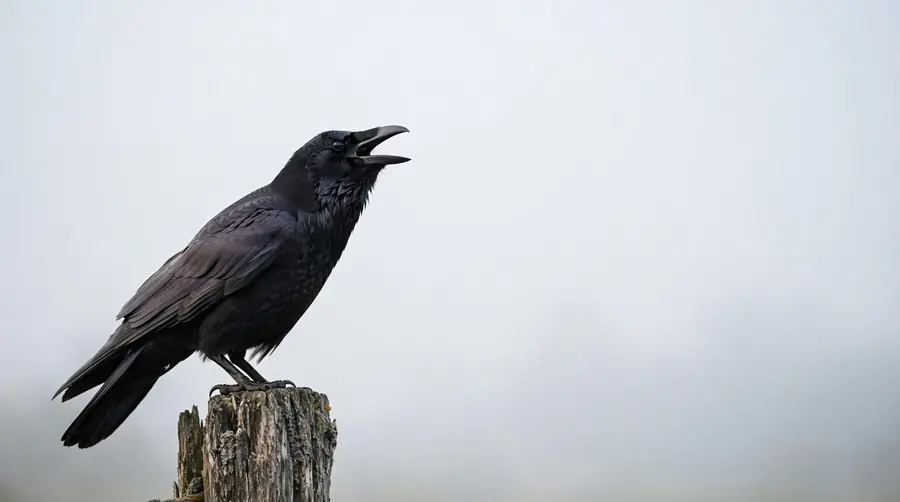
You counted them. That is the part that makes this feel significant, and it is the reason you are reading this instead of getting on with your morning.
Most people do not count bird calls. But a crow stopped somewhere near you, called a deliberate number of times, paused, and the count stuck in your head. Five, maybe three. And now you want to know whether that number meant something.
Here is the short answer, and it is more interesting than either a yes or a no. The number of caws does carry real information, because crows genuinely use different call patterns for different purposes. The traditional meanings and the actual bird behaviour line up more closely than you would expect, and in one case they say almost exactly the same thing.
Crow Caw Meanings by Number: Quick Reference
| Number of caws | Traditional spiritual meaning | What the bird is likely doing |
|---|---|---|
| 1 caw | A warning, or a call to pay attention | Contact call, locating other crows |
| 2 caws | Good news, union, or balance restored | Short contact or greeting sequence |
| 3 caws | A message from someone who has died, or confirmation | Standard assembly or contact call |
| 4 caws | Delay, difficulty, or an unresolved situation | Mild alarm or territorial notice |
| 5 caws | A strong warning. Danger, upheaval, or urgent change | Alarm or mobbing call, predator spotted |
| 6 caws | Loss of something, or an ending | Sustained alarm |
| 7 caws | A secret, a mystery, or spiritual insight | Sustained alarm or group recruitment |
| Non-stop | Something needs dealing with immediately | Active mobbing of a predator nearby |
Those are the readings most commonly used, and the sections below cover each one properly. But read the next section first, because it changes how much weight the count deserves.
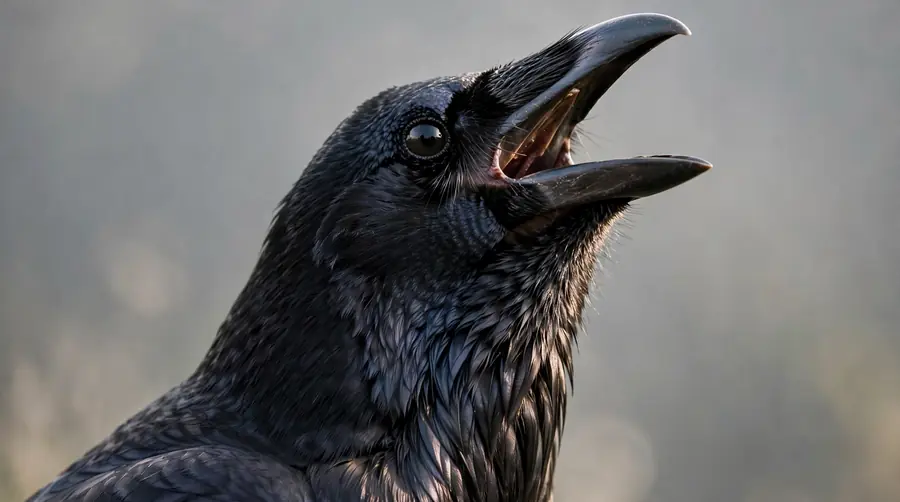
Why the Number of Caws Genuinely Does Mean Something
Crows are not making random noise. They are among the most vocally sophisticated birds alive, and ornithologists have documented dozens of distinct calls in the American crow alone.
Two patterns matter for what you heard.
Short sequences of roughly two to four caws, evenly spaced with pauses between them, are usually contact and assembly calls. The crow is saying where it is, calling to a mate, or gathering the family group. This is the everyday conversational caw and it is by far the most common thing you will hear.
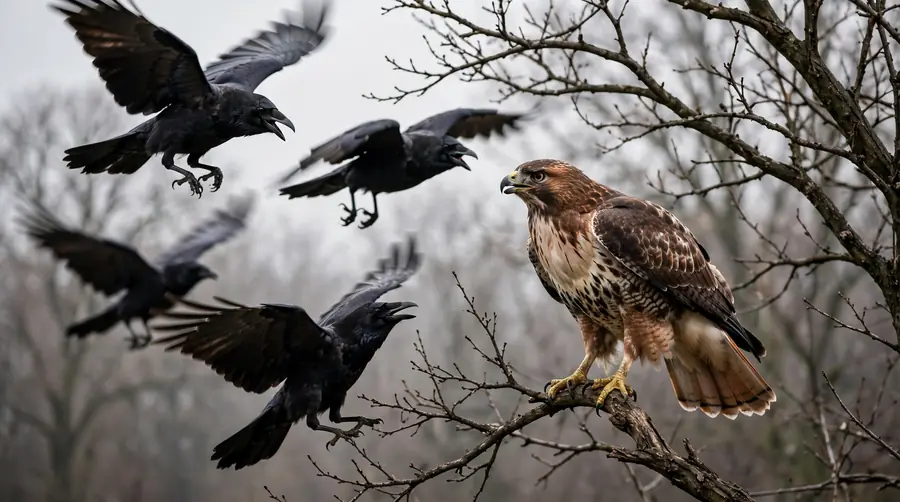
Long, rapid, harsh series, often five or more caws delivered in a burst with little space between them, are alarm calls. This is the mobbing call. The crow has spotted a predator, usually a hawk, an owl, a cat, or a person too close to a nest, and it is calling other crows in to harass it. If other crows arrive and join in, that is exactly what is happening.
Now hold that against the table above. The traditional reading of five caws is a strong warning. The biological function of a five-plus burst is literally a warning call. Those two things agreeing is not a coincidence. People listening to crows for thousands of years noticed that a long rapid burst meant something was wrong, and the folklore preserved an accurate observation inside a symbolic frame.
So when you ask whether the number means anything, the honest answer is yes, though not as prophecy. The count tells you what state the bird was in. The symbolic layer is what you choose to do with that.
One Caw: Spiritual Meaning
A single caw, especially one that is not followed by anything, is traditionally read as a warning or a summons to attention. In much of European folk belief a lone crow call carried an ominous edge, and the association with sorrow comes from the counting rhyme covered further down this page.
There is a softer and arguably more useful reading as well. One is the number of the individual, of focus, of a single thing. Many people take a single caw as a prompt to stop multitasking and look at the one matter they have been spreading themselves thin to avoid.
Behaviourally, one caw is usually a bird announcing its position. It is the least alarmed sound in the repertoire, which is worth knowing if the folklore reading unsettled you.
Two Caws: Spiritual Meaning
Two is the number of pairing, and the readings follow. Two caws are generally taken as favourable: good news arriving, a relationship strengthening, a conflict resolving, or two things that were separate coming into alignment.
Some traditions read two as a decision point instead, the sense of two options sitting in front of you. If you have been weighing something up, that is the version likely to fit.
Behaviourally, two evenly spaced caws are a classic contact call, and if you listen you will often hear a second crow answer from somewhere else. That exchange is the origin of the partnership symbolism, and it is genuinely what is happening.
Three Caws: Spiritual Meaning
Three is the most emotionally loaded count, and the reading most people are hoping to find.
Across a great many traditions three caws are read as a message from someone who has died. The crow is a messenger bird in Norse, Celtic and numerous Indigenous traditions, and three is the number of completion and of the threshold between worlds. People who have recently lost someone very often report a crow calling three times, and they very often read it as contact.
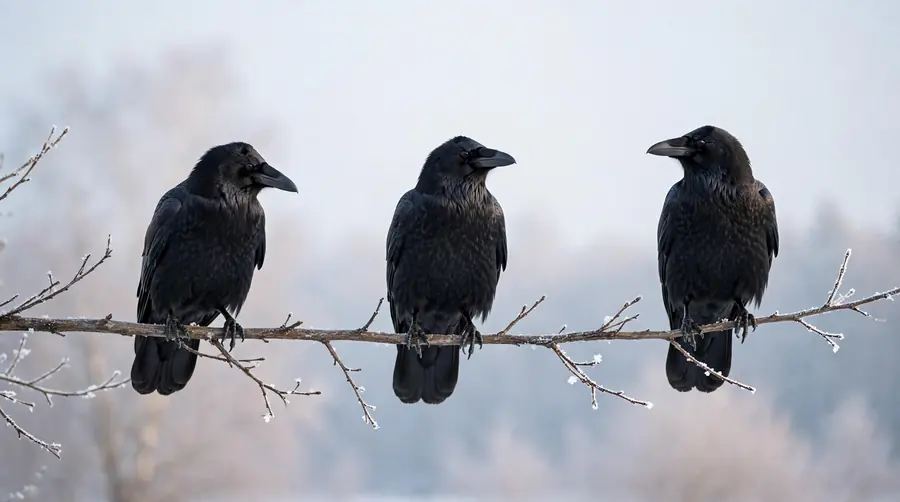
If that is why you are here, the belief is widespread and sincerely held, and nothing on this page is going to tell you that you imagined it.
A second common reading of three is confirmation. In omen traditions generally, a thing happening three times is treated as deliberate rather than accidental, which is why three caws are often interpreted as a yes, or as a message you have already received twice without noticing.
Behaviourally, three caws sit squarely in normal contact-call range. It is one of the most frequent patterns crows produce, which explains why so many people hear it. That does not make the moment less meaningful to the person it happened to.
Four Caws: Spiritual Meaning
Four tends to be read as the awkward number. The traditional meanings cluster around delay, obstruction, or a situation that is stuck: something you expected to have resolved by now and has not.
Some systems read four more positively, as stability and foundations, four walls and four directions. If your life currently feels frustrating rather than unsteady, take the delay reading. If it feels unsettled, the stability reading is the one being offered.
Worth noting: in Chinese, Japanese and Korean cultures the number four carries an unlucky association because the word for four sounds close to the word for death. If you are reading from within that cultural frame, four caws land heavier, and that reaction is cultural rather than universal.
Behaviourally, four caws sit at the boundary between a contact call and a mild alarm. Listen to the spacing. Even and unhurried means conversation. Tight and harsh means the bird has noticed something.
Five Caws: Spiritual Meaning
Five is the count people search for most, and it is the one where the traditional and the biological readings converge almost completely.
Traditionally, five caws are read as a strong warning. Not a death omen, but upheaval: a disruption arriving, a situation about to break open, or a danger that needs attending to rather than monitoring. Five is the number of change and of the unexpected in most numerological systems, and the five-caw reading inherits that restlessness.
And biologically, a burst of five or more rapid harsh caws is an alarm call. The bird has seen a predator. It is not warning you specifically, but it is unambiguously issuing a warning.
That overlap is the most interesting thing on this page. Of all the counts, five is the one where the folk tradition is describing something real. Our ancestors could not have known the ethology, but they correctly identified that a long rapid burst of crow calls meant trouble was present.
Practically, if you heard five or more, look up. There is a decent chance a hawk or an owl is sitting in a nearby tree, or a cat is on the move. People who go and look often find the thing the crow was shouting about, and seeing it tends to settle the unease more effectively than any interpretation.
Six, Seven and More Caws
Beyond five, the traditional readings get less standardised, because most counting systems were built around smaller numbers. These are the interpretations in general circulation.
Six caws are usually read as loss or an ending: something concluding, often something you have already been bracing for.
Seven caws carry the most mystical reading, because seven is the number of hidden knowledge across a wide range of traditions. Seven is generally interpreted as a secret surfacing, or as a prompt toward spiritual work rather than practical action.
Be honest with yourself about the counting, though. Most people cannot reliably count a rapid burst of calls, and at six or more you are almost certainly listening to sustained alarm calling rather than a precise numeric message. At that point the count has stopped being the signal.
Crows Cawing Non-Stop
Continuous cawing, especially from several birds at once, is read as something that requires immediate attention rather than reflection. Where a short sequence is a message, a sustained racket is treated as insistence.
Biologically this is the clearest case of all. Multiple crows calling continuously from the same area is mobbing behaviour. They have surrounded a predator and they will keep going until it leaves, sometimes for twenty minutes or more. If you walk out and scan the trees you will frequently spot a hawk or an owl sitting very still in the middle of it.
There is a real message in that, and it is not mystical. The crows are demonstrating something they are extremely good at: making so much noise about a threat that the threat decides it is not worth staying. Plenty of people find that a more useful lesson than any number.
Where the Caw-Counting Tradition Actually Comes From
This is worth knowing, because almost nobody who quotes these meanings knows their origin, and the real story is better than the vague one.
Most of the numbered meanings in circulation descend from an old English divination rhyme that begins “One for sorrow, two for joy, three for a girl, four for a boy, five for silver, six for gold, seven for a secret never to be told.” It was recorded in print by the late eighteenth century and it exists in dozens of regional variants.
Here is the part that matters: the rhyme is about magpies, not crows. It counted magpies seen, not caws heard. Over time, as it spread and as people encountered crows far more often than magpies in many regions, the numbers migrated across to crow calls.
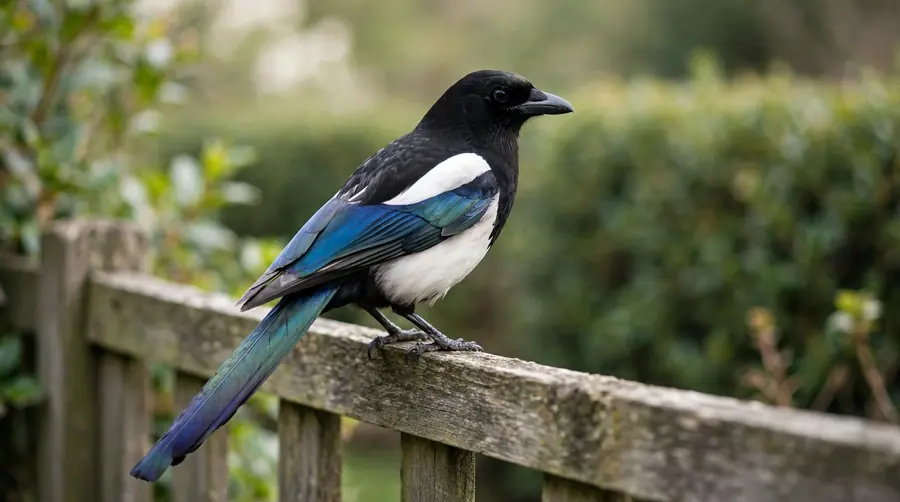
You can see the fingerprints clearly. One meaning sorrow, two meaning joy, and seven meaning a secret are all straight from the rhyme, and they are the three most consistently repeated crow-caw meanings online.
Does that make the readings worthless? No, and this is the honest position. It makes them a folk tradition with a traceable history rather than ancient universal wisdom. People have used them sincerely for generations, and a borrowed tradition is still a tradition. But you should know what you are working with, and anyone presenting these numbers as timeless secret knowledge either does not know or is not telling you.
Was the Crow Cawing at You Specifically?
People often describe the feeling that the bird was addressing them directly. That feeling may be more justified than you think.
Research at the University of Washington led by John Marzluff tested this by having researchers wear masks while handling crows. The crows learned the mask, scolded it on sight for years afterwards, and other crows who had never seen the original event learned to scold it too. Crows recognise individual human faces, remember how a person behaved, and pass that information through the local population. Whether it is scolding you or greeting you depends mostly on your history with the local birds, and on whether anyone in your household has ever fed them.
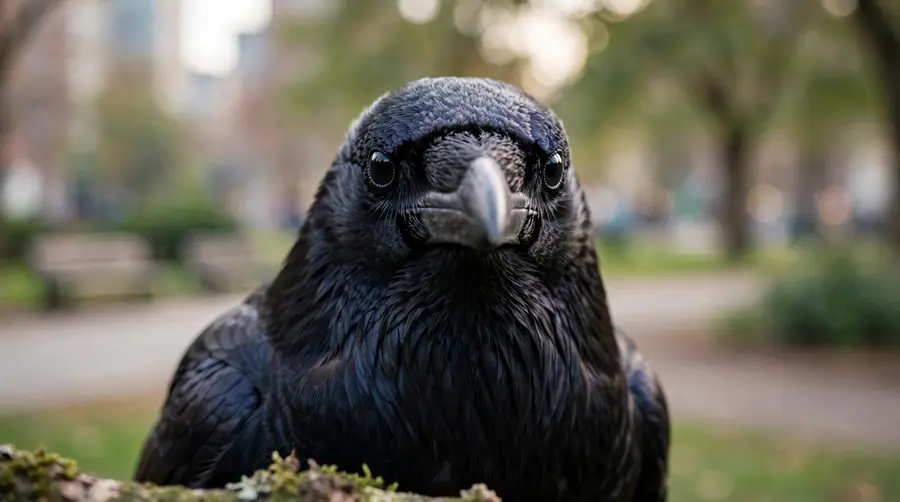
Symbolically, that is a message worth sitting with. The traditional reading of a crow calling directly at you is that you are being recognised and asked to pay attention. It turns out that is not far off.
Does the Time of Day Change the Meaning?
Morning cawing is traditionally read as the most favourable, associated with beginnings and news arriving. Practically, crows are most vocal at dawn as roosts break up and birds disperse for the day, so morning calling is also the most ordinary.
Evening cawing is read as completion or reflection. Behaviourally it is the reverse of the morning, with birds gathering back toward communal roosts.
Night cawing is the one people find genuinely unsettling, because crows are diurnal and should be quiet. It usually means something has disturbed a roost: a predator, a light, a noise. Traditionally it is read as the heaviest version of the warning. We cover that in detail in our guide to the spiritual meaning of crow cawing.
What to Do With the Count
Note the rhythm, not just the number. Evenly spaced with pauses means a calm bird. Rapid and harsh means an alarmed one. That single distinction tells you more than the count does.
Look for what it is looking at. If you heard five or more, scan the trees and rooflines for a hawk, an owl, or a cat. Finding it answers the question.
Write down your first thought. Not the count, the thought. In nearly every tradition that works with signs, the instinctive association that arrives before you start reasoning is treated as the message. Most people find they already knew what it was about.
And if the number you heard was five, treat it the way the crow intended it. Not as doom, but as a prompt to look up and check what is actually there.
Frequently Asked Questions
What does it mean when a crow caws 5 times?
Traditionally it is read as a strong warning: upheaval, disruption, or a situation that needs attention now rather than later. Biologically, a burst of five or more rapid harsh caws is an alarm or mobbing call, meaning the crow has spotted a predator nearby. Both readings point the same way, which makes five the most consistent count in the whole system.
What does 3 caws from a crow mean?
Three caws are most commonly read as a message from someone who has died, or as confirmation of something you already suspected. Three is the number of completion and of the threshold in many traditions. Behaviourally, three caws fall within normal contact-call range, which is why the pattern is heard so often.
Is a crow cawing a bad omen?
Not inherently. The crow’s ominous reputation in Western culture comes largely from its association with battlefields and carrion, not from any consistent tradition of it predicting misfortune. In Norse tradition crows and ravens were Odin’s intelligence gatherers, and in parts of Asia they are regarded as auspicious. Most modern readings treat a caw as information rather than a verdict.
Does the number of crows matter as well as the number of caws?
In the original tradition, the number of birds was the thing being counted, not the calls. The counting rhyme these meanings come from was about how many magpies you saw. So if anything, the bird count is the older reading and the caw count is the adaptation.
Why do crows caw at me every time I go outside?
Possibly because they know you. Documented research shows crows recognise individual human faces, remember them for years, and teach other crows to recognise them too. If you are near a nest in spring or summer, it is defensive scolding. If someone in your household has fed them, it may be the opposite.