
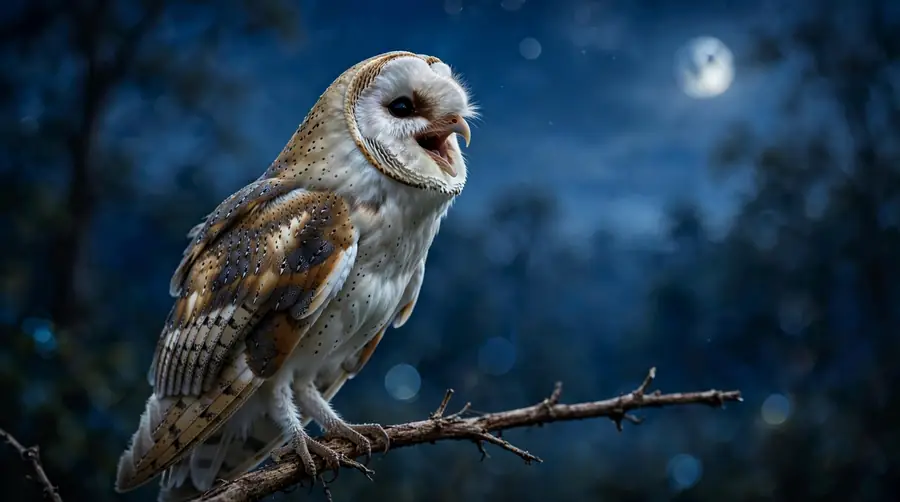
It is not a hoot. That is the first thing people say when they try to describe it. A hoot is soft and round and almost comforting. What you heard was a scream, drawn out and raw, close enough that you sat up in bed.
Then it came again, and you lay there in the dark wondering what it meant.
Here is something that will reframe the whole thing before we get to the symbolism. The sound you heard is almost certainly from one specific bird, and that bird is the reason owls got their reputation as omens of death in the first place. The folklore and the sound have the same root, and once you know which bird it was, the message gets much clearer.
Owl Screeching at Night: Spiritual Meaning in Short
An owl screeching at night traditionally means a truth is being forced into the open. Where a gentle hoot is read as wisdom offered quietly, a screech is read as urgency: something you have been avoiding, softening, or refusing to name is about to surface whether you are ready or not.
It is not a death omen, though that is the belief most people have heard. The screech is read as a warning in the useful sense of the word, a prompt to pay attention now rather than later. The tone of the sound is the message: this is not a whisper.
First: What Was Actually Screeching?
This matters more than you would think, because the species changes the reading, and because at least one of the likely culprits is not an owl at all.
The Barn Owl (the real screecher)
Here is the fact that surprises almost everyone: barn owls do not hoot. They cannot. Their main call is a harsh, drawn-out shriek, often described as a scream or a rasping hiss, and it carries a long way on a still night.
If what you heard was a genuine scream rather than a trill or a hoot, a barn owl is the most likely source across most of North America, Britain and Europe. They hunt over open ground, field edges, verges and rough grassland, and they nest in barns, outbuildings, church towers and hollow trees, which puts them close to houses far more often than people realise.
The Eastern Screech Owl (which does not really screech)
Despite the name, the eastern screech owl does not produce the scream most people are describing. Its usual call is a soft descending whinny or an even trill, closer to a small horse than a shriek. The name is misleading and it sends a lot of people looking in the wrong direction.
So if you searched for a screech owl because of the word “screech” and the recordings did not match what you heard, that is why.
Young Owls Begging
This is the single most common explanation for repeated, persistent screeching near a house, and hardly anyone mentions it.
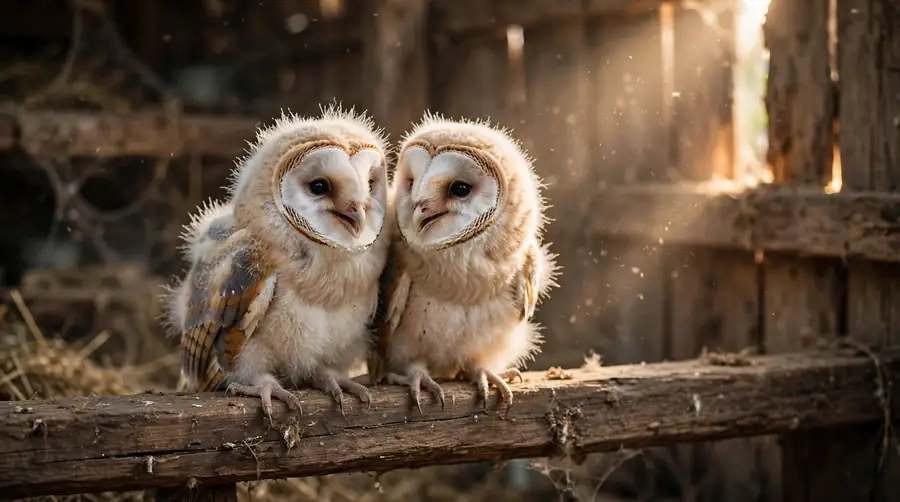
Juvenile owls, especially young barn owls and great horned owls, make raspy begging screeches to their parents. They do it for hours. They do it night after night. And they do it most intensively in the weeks after they leave the nest, which in much of the northern hemisphere falls somewhere between late spring and the end of summer.
If you have been hearing screeching every night for a week or two in summer, you very likely have a hungry adolescent owl nearby rather than a portent. Which, as symbolism goes, is its own kind of message.
When It Is Not an Owl at All
Two animals get mistaken for screeching owls constantly, and knowing them will save you a lot of unease.
A fox. The vixen’s scream during the winter breeding season is one of the most unsettling sounds in nature. People describe it as a woman screaming. If you heard it in December, January or February, a fox is more likely than an owl.
A rabbit or hare. A rabbit caught by a predator produces a short, piercing scream that is genuinely shocking the first time you hear it. It usually happens once, then stops. If you heard a single awful shriek that never repeated, this is often what it was, and the silence afterwards is the reason.
None of this makes the experience less meaningful. Signs in most traditions work through ordinary things. But knowing what you heard changes which reading applies, and that is worth five minutes of your attention.
Four Spiritual Meanings of an Owl Screeching at Night
1. A Truth That Will Not Stay Quiet
The owl is the bird of hidden knowledge in almost every tradition that has owls, because it sees and hunts in conditions where we are helpless. When that bird is silent, the symbolism is about watching. When it screams, the symbolism shifts to disclosure.
Read as a message, a screech points at something you already half know. Not a secret being revealed to you from outside, but one you have been declining to look at directly. People commonly report this sign during a period when they are managing a situation by not discussing it.
2. Urgency Rather Than Patience
There is a real and useful distinction between the two main owl sounds, and your ear already made it before your mind did. A hoot is territorial and conversational. It is a bird saying I am here at a comfortable volume. A screech is a bird under pressure: alarmed, defending, or demanding food.
So where hearing an owl hoot is traditionally read as guidance arriving in its own time, a screech is read as a deadline. Something has moved from “I will deal with that eventually” to “this needs handling.”
3. Something Is Being Protected
Owls screech defensively. An owl screaming near your house at night may be reacting to a cat, another owl, a hawk, or a person walking too close to where its young are sitting.
That gives this reading a specific shape. It is not read as a threat to you but as a signal that something nearby is being guarded fiercely. People often receive this reading when they themselves are in a protective position and have been doubting whether their reaction is proportionate. The owl’s answer is that noise is an acceptable way to defend what matters.
4. The End of a Pretence
The owl’s association with transition is ancient and it is usually misread as an association with death. The more accurate word is ending, and endings are mostly not deaths.
A screech at night is traditionally read as the closing of something you have been keeping alive artificially: a role you have outgrown, a friendship that runs on habit, a version of yourself you present to certain people. The sound is harsh because the ending is not going to be gradual.
White Owl Screeching at Night: Spiritual Meaning
If the owl you saw or heard was pale, this section is the most relevant one on the page, and there is a neat piece of logic behind it.
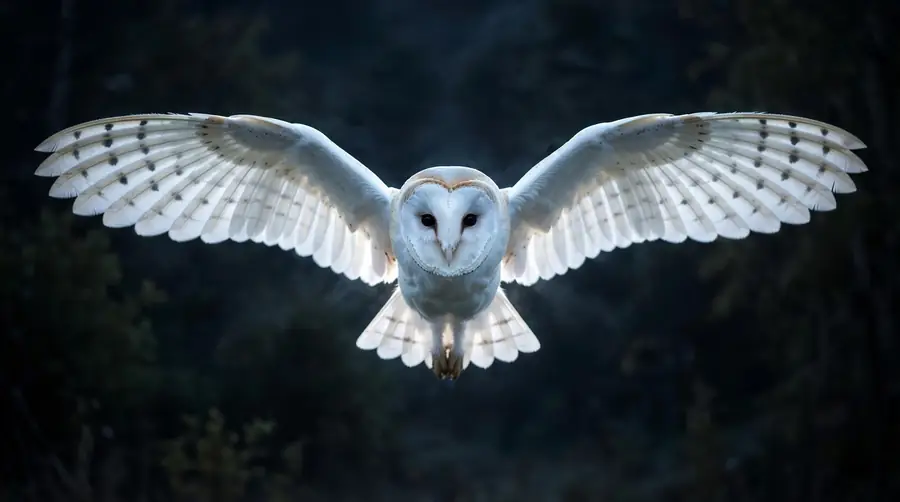
The classic “white owl” in most of the world is the barn owl. It has a white face, white underparts, and in flight at night it looks startlingly ghostly, pale and silent against a dark sky. It is also, as we covered above, the owl that actually screams.
So a white owl screeching at night is not two separate signs stacked together. It is one bird doing the thing it does, and nearly all the owl folklore you have ever heard traces back to this exact combination: a white shape, a human-sounding scream, and a bird that nests in churchyards and ruins.
Symbolically, white deepens the reading rather than darkening it. White is associated with clarity, purity and the spirit world across most traditions, so a white owl screeching is read as a message that is both urgent and important. Many people interpret it as contact or a visitation rather than a warning, particularly if they have recently lost someone. If that is why you are here, that reading is legitimate and widely held.
Is an Owl Screeching a Bad Omen or a Sign of Death?
This is the real question most people are carrying, so let us handle it properly rather than either dismissing it or feeding it.
The death-omen belief is genuinely ancient and genuinely widespread. In Roman tradition the screech owl was treated as an ill portent, and the deaths of several emperors were said to have been preceded by one. Shakespeare used the owl as a death signal more than once, which tells you how established the idea was in English folk belief by then. Versions of the same belief appear across Europe, parts of Africa, and in some Indigenous traditions in the Americas.
But look at why it attached to this bird, because the reasons are entirely practical and they explain everything.
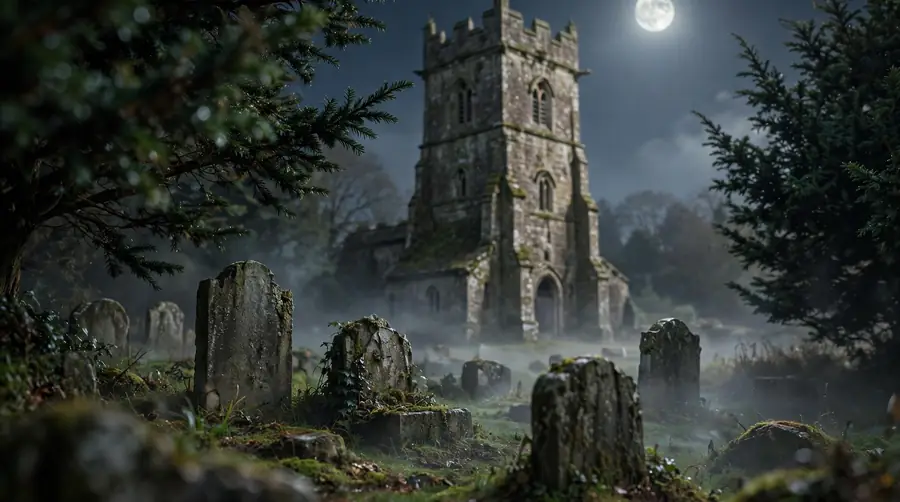
Barn owls scream in a way that sounds disturbingly human. They are white and silent in flight, which reads as ghostly to anyone glimpsing one at night. They nest in exactly the buildings that were already associated with death in rural Europe: church towers, belfries, ruins and graveyard trees. And they are active at the hours when people sat up with the dying.
A pale screaming thing that lives in a churchyard and appears at a deathbed vigil was always going to become an omen. That is not evidence of prophecy. It is a very understandable story about a bird that happened to overlap with grief.
The honest position is this. The belief is real and you are not foolish for knowing it. The bird is not predicting anything. And the modern reading, which most traditions have moved toward, is that a screech marks transition rather than death: an ending, a revelation, or a change arriving faster than you wanted.
When and Where You Heard It
Right Outside Your Window
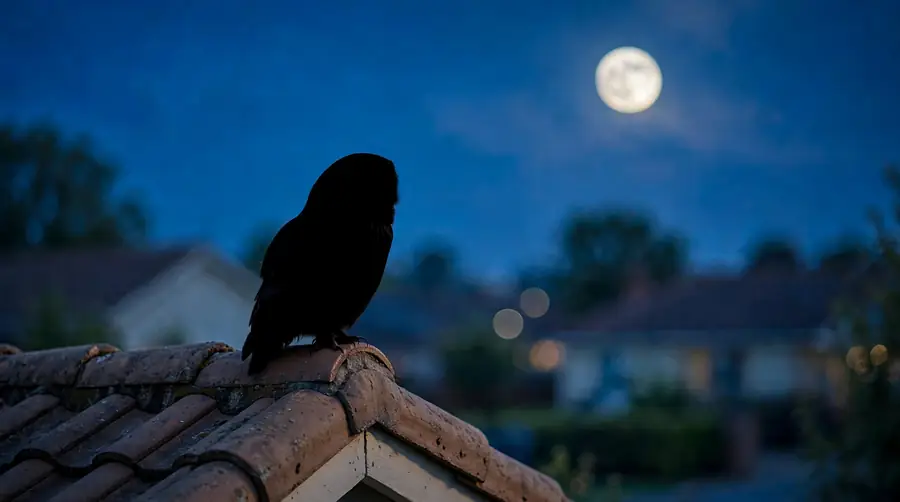
Treated as the most personal version of the sign, because proximity is read as directness. The traditional interpretation is that the message concerns your household rather than the wider world. Practically, a window often simply faces the tree or roofline an owl is using as a perch.
On or Above Your Roof
The roof represents shelter and protection over the whole family, so a screech from above the house is read as a message about the home as a unit rather than about you individually. Our guide to an owl at your house covers the location readings in more depth.
Three Times in a Row
Threes carry weight in nearly every omen tradition, and a call repeated three times is traditionally treated as confirmation rather than coincidence. The usual reading is that the message has already been sent twice in forms you did not notice.
Every Night for Weeks
Almost always fledglings, as covered above, and the seasonal timing will usually confirm it. Symbolically, a sign that keeps repeating is read the same way across traditions: it has not been acted on yet. Both explanations point in the same direction, which is to deal with the thing you keep deferring.
At 3am
The small hours carry their own symbolism, often called the hour when the boundary between worlds is thinnest. Practically, owl activity peaks in the hours around the middle of the night, and human sleep is lightest then, so you are most likely to be woken by it at precisely the hour folklore finds most significant. Both things can be true at once.
How Other Traditions Read the Screech
The owl is one of the most divided symbols in the world. It is wisdom in one culture and warning in the one next door.
In ancient Greece the owl belonged to Athena, goddess of wisdom, and an owl appearing before a battle was considered favourable. The little owl even carried her name in its species designation, Athene noctua.
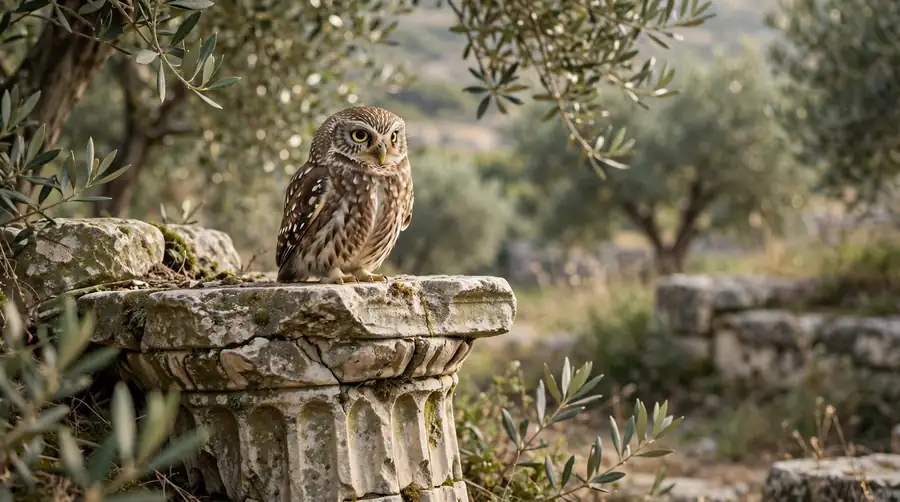
In Roman belief the same bird went the other way and became a portent of disaster, which is where most of the Western death association begins.
Across Native American nations the readings vary enormously and should not be flattened into one meaning. Some traditions treat the owl as a guardian or a bringer of knowledge; others treat it with real caution as a figure connected to the dead. Both exist, and which applies depends entirely on the nation.
In parts of Hindu tradition the owl is associated with Lakshmi, goddess of wealth, and is regarded as auspicious. In Japan the owl is widely seen as lucky and protective, helped along by a pun: the word fukurou can be read as “no hardship.”
What this tells you is useful. There is no universal owl meaning to discover. There is a bird that humans find uncanny, and a long record of people deciding what that feeling meant.
What to Do After Hearing an Owl Screech
Identify it if you can. Open a bird-call recording for barn owl, eastern screech owl and red fox, and see which one matches. Five minutes of listening answers the question that is actually keeping you awake.
Note the season. Summer screeching near a house usually means fledglings. Winter screaming often means fox. That single detail resolves most cases.
Leave it alone. Do not try to find the nest, shine lights at it, or move young birds. An owlet on the ground is usually not abandoned, and owls are legally protected in most countries, including under the Migratory Bird Treaty Act in the United States.
Then ask the honest question. Write down the first thing that came into your head when you heard it, before you started reasoning. In nearly every tradition that works with signs, the instinctive association is treated as the message and everything after it is treated as interference.
Most people who do that exercise find they already knew what the thing was. The owl did not deliver news. It interrupted the avoidance.
Frequently Asked Questions
What does it mean when an owl screeches at night?
Spiritually it is read as urgency and disclosure: a truth surfacing, an ending arriving quickly, or something nearby being defended. Biologically it usually means a barn owl calling, a juvenile owl begging for food, or an owl reacting to a disturbance. It is not a prediction of death.
Why do owls screech at night instead of hooting?
Because they are different sounds with different purposes, and in the barn owl’s case because it physically does not hoot. Hoots are mainly territorial and conversational. Screeches signal alarm, defence, or hunger, and are produced most often by barn owls and by hungry juveniles.
Is an owl screeching a sign of death?
It is an old and widespread belief, strongest in Roman and later European folklore, but it has a traceable practical origin: barn owls sound human when they scream, look pale and ghostly in flight, and nest in church towers and graveyard trees. Modern readings treat the screech as a sign of transition and revelation rather than death.
What does it mean if I hear an owl screeching every night?
Persistent nightly screeching in late spring or summer is nearly always fledgling owls begging from their parents, and it stops once they become independent. Symbolically, a repeating sign is read as one that has not been acted on.
What is the difference between an owl screech and an owl hoot spiritually?
A hoot is read as wisdom offered patiently, a presence making itself known without pressure. A screech is read as the same intelligence raising its voice: the message is now urgent, and the time for gradual realisation has passed.