
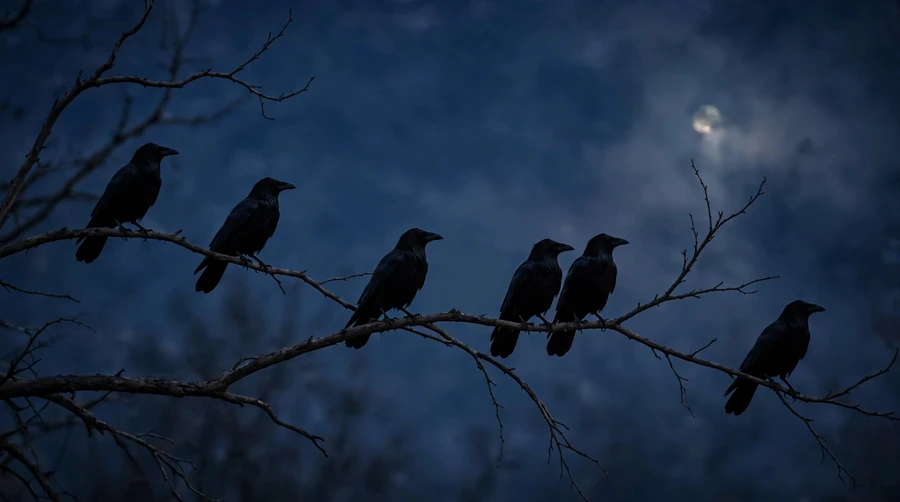
Crows are daytime birds. They roost at dusk and they stay quiet until first light, which is exactly why hearing them at two in the morning feels so wrong.
That wrongness is the whole thing. You have heard crows a thousand times in daylight without thinking about it. Hearing the same sound in the dark made you sit up, and now you want to know what it means.
There is a genuinely good answer, and part of it is this: when crows erupt at night, there is usually a specific reason, and in a surprising number of cases that reason is another bird you also probably associate with omens.
Hearing Crows at Night: Spiritual Meaning in Short
Hearing crows at night traditionally means a warning delivered at the wrong hour, which is read as making it more urgent rather than more sinister. The symbolism is not in the crow but in the timing: a daytime bird calling in darkness is interpreted as something surfacing that should have stayed hidden, or a message that could not wait until morning.
It is not a death omen, although that is the belief most people have heard. In practical terms, crows calling at night almost always means their roost has been disturbed, most often by a predator.
Is It Normal to Hear Crows at Night?
Less common than daytime calling, but not unusual, and not a sign that something is wrong with the world.
Crows are diurnal, meaning they are active in daylight and sleep at night. They do not hunt or forage in the dark. So a crow calling at 3am is not going about its business. It is reacting to something.
That is the single most useful thing to understand about this. Daytime crow noise is conversation. Night-time crow noise is almost always an event.
Why Crows Cry at Night: The Real Reasons
An Owl Is Nearby
This is the explanation worth knowing above all others, because it accounts for a large share of night-time crow commotion and because almost nobody mentions it.
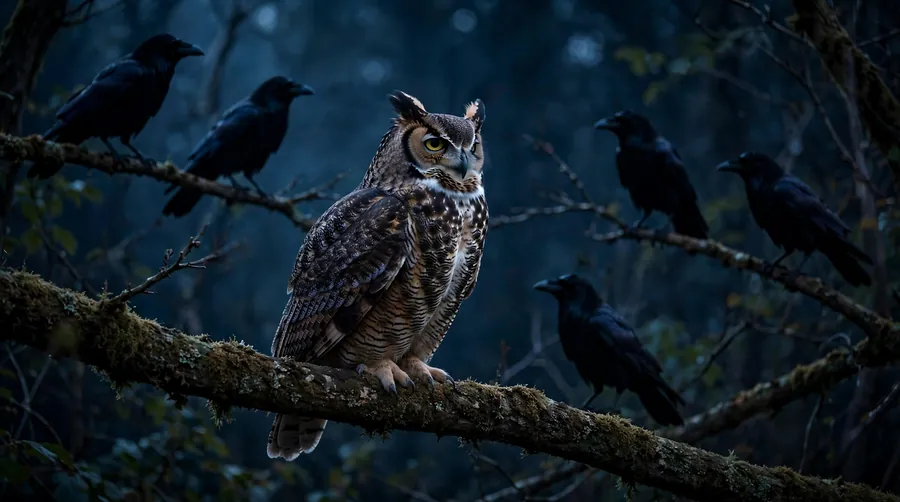
The great horned owl is the main nocturnal predator of roosting crows. It hunts at night, it is large enough to take an adult crow, and it is the single animal a sleeping crow has most reason to fear. When crows detect an owl near their roost after dark, they do not stay quiet. They erupt, calling and mobbing, often for a long time, because a silent owl nearby is a lethal problem and a loud confronted owl usually leaves.
So if you heard a sudden explosion of crow noise in the dark, there is a real chance an owl was sitting in a tree near your house. Many people who go out and look find exactly that.
Hold that next to the folklore for a moment. Two of the most persistent death-omen birds in Western tradition are the crow and the owl. And one of the most common reasons you would ever hear crows screaming at night is that the owl is there too. The two omens were often in the same tree, which is a rather satisfying explanation for why night bird noise acquired such a heavy reputation.
The Roost Was Disturbed
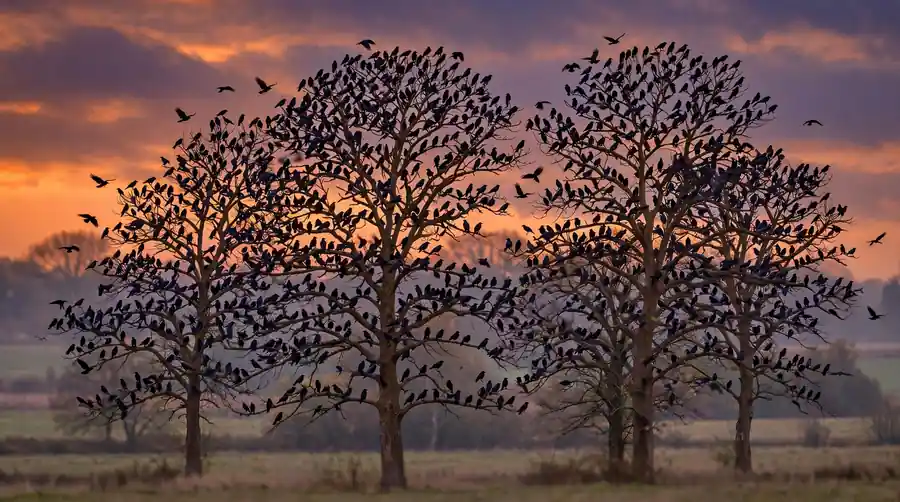
Crows do not sleep alone. Outside the breeding season they gather in communal roosts, and those roosts can be enormous, numbering in the thousands of birds in a single stand of trees.
A roost that size is a nervous system. Anything that disturbs one edge of it can set off a chain reaction: a raccoon climbing, a cat, a car door, fireworks, a branch coming down, someone walking a dog underneath. What you hear as an eerie unexplained racket is often a few hundred birds reacting to something entirely mundane at the other end of the trees.
Artificial Light
Crows in brightly lit urban areas are measurably more active after dark than rural crows. Street lighting, floodlights and illuminated car parks all extend the period in which a crow will move and call. If you live in a town or city and you hear crows at night more than your friends in the countryside do, that is why.
The Season
Communal roosts are largest in autumn and winter, when crows gather in their biggest concentrations. That is also when night disturbances are most likely to be audible, simply because there are more birds packed into one place.
If you have started hearing crows at night in the colder months and did not notice it in summer, the roost is the reason rather than anything having changed about your circumstances.
Four Spiritual Meanings of Hearing Crows at Night
1. Something Hidden Is Surfacing
Night is the symbolic home of what we cannot see, and the crow is the bird of intelligence and uncomfortable truth. Put them together and the traditional reading is disclosure: information you have been protected from, or protecting yourself from, coming into the open.
This is the most commonly reported reading, and it tends to arrive for people who already suspect something. Not a revelation out of nowhere, but confirmation of a suspicion they have been dismissing.
2. A Warning That Could Not Wait
Here the timing does the work. A message delivered during business hours is routine. A message delivered at 3am is treated across almost every omen tradition as urgent by definition, because the sender did not wait for a convenient moment.
Read this way, night crows are not telling you something new. They are telling you that something you already know about has moved up the queue.
3. Ancestors or the Recently Departed
The crow is a messenger between the living and the dead in a remarkable number of unrelated traditions, and night strengthens that association because the boundary is traditionally considered thinnest in darkness.
People who have recently lost someone very often report hearing crows at night and reading it as contact. If that is why you are here, the belief is widespread and sincerely held, particularly in Hindu tradition where the connection between crows and ancestors is explicit rather than implied. There is more on that below.
4. Protection Being Mounted
The least known reading and arguably the most accurate, because it matches what the birds are actually doing.
Crows calling at night are usually defending. They have identified a threat and they are making enough noise to drive it off. Read as a message, that is not an omen of harm coming to you. It is the opposite: a demonstration that danger nearby is being met with noise rather than silence, and sometimes an invitation to do the same about whatever is circling your own life.
Where the Night-Crow Superstition Comes From
The death association is real, it is old, and it has a traceable origin that has very little to do with prophecy.
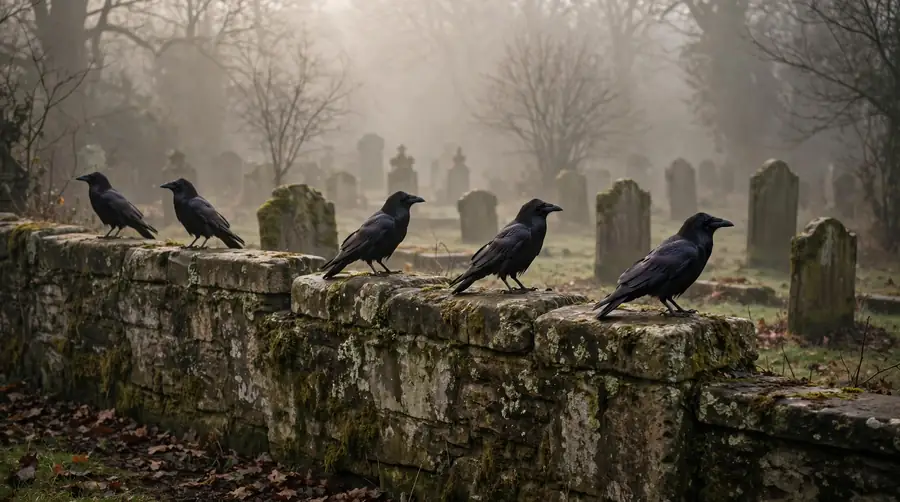
Crows and ravens follow death. They are carrion birds, and for most of European history that meant they gathered at battlefields, gallows and plague pits. People saw them in proximity to the dead constantly, and the association stuck. The birds were not predicting anything. They were arriving afterwards, because that is where the food was.
The night element adds a second layer, and it is a general principle rather than anything specific to crows. Across a huge range of folk traditions, an animal doing something at the wrong time is the omen trigger. A rooster crowing at night. A dog howling in daylight. A daytime bird calling in darkness. The tradition is really about disorder, about nature behaving out of sequence, and the crow simply happens to be a loud bird that occasionally does it.
So the honest position is this. The superstition is genuine and you are not foolish for knowing it. The bird is not forecasting a death. And the modern reading, which most traditions have settled into, treats night crow calls as urgency and disclosure rather than doom.
Hearing Crows at Night in Islam
This question comes up often enough to deserve a straight answer, and the straight answer may be reassuring.
Mainstream Islamic teaching discourages reading omens into the behaviour of animals and birds. The practice has a name in Arabic, tiyarah, referring to drawing fortune or misfortune from such signs, and it is widely treated as a pre-Islamic superstition that the faith set aside. The prophetic tradition is generally understood to reject the idea that a bird’s call can carry good or bad fortune.
Crows do appear in Islamic sources, including in narrations about the burial of Abel, and in classifications of birds. But their appearance in those texts is not the basis for an omen tradition.
So if you are Muslim and you have been unsettled by hearing crows at night, the relevant position in your own tradition is likely that the sound carries no fortune at all, and that reading a warning into it is the thing to avoid rather than the thing to interpret. I am not a religious scholar, and for anything touching your own practice a knowledgeable local scholar is a better source than any website, including this one.
Crows Cawing at Night in Hinduism
Hindu tradition has the most developed and most positive crow symbolism of any major tradition, and it is genuinely different from the Western version.
Crows are associated with the pitrs, the ancestors. During Pitru Paksha, the fortnight dedicated to ancestral rites, food is offered to crows in a practice sometimes called kakabali, on the understanding that the birds carry the offering to the departed. A crow accepting the food is taken as the ancestors accepting it. This is not a fringe belief; it is observed widely and annually.
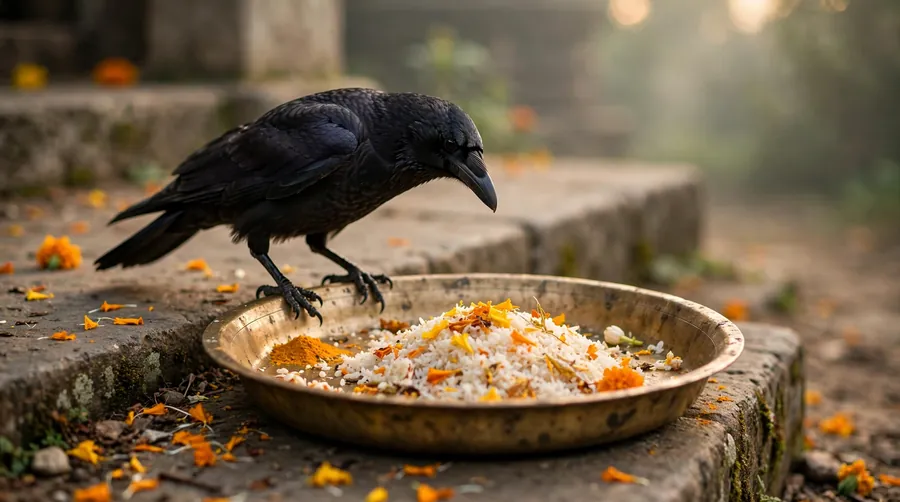
The crow is also linked to Shani, the deity associated with the planet Saturn, as his mount. Shani is connected to discipline, consequence and the working out of karma, which gives the crow a serious but not malevolent character.
There is a separate and much lighter folk belief in parts of India that a crow calling near the house signals a visitor or guest arriving.
Within this frame, hearing crows at night reads very differently. The crow is a messenger connected to those who have died, and the usual interpretation leans toward remembrance and acknowledgement rather than warning.
What the Bible Says About Crows and Ravens
If you are approaching this from a Christian perspective, the biblical material is more positive than most people expect, and there is no night-crow omen in scripture at all.
Ravens are the birds scripture actually names. In 1 Kings, ravens bring food to the prophet Elijah while he is hiding by a brook, which casts the bird as an instrument of provision. In Job and again in Luke, ravens appear as creatures God feeds, used as an argument that people should not be anxious about their needs. Noah sends out a raven before the dove.
Ravens were classified as unclean under Levitical dietary law, which is where the negative tint comes from, but that is a dietary category rather than a moral one.
What there is not, anywhere, is a verse about hearing a crow at night. If a page offers you one, treat it with suspicion. The honest Christian reading applies a principle rather than quoting a text, and the principle most often applied here is the Luke passage: the bird you are listening to is fed and accounted for, and so are you.
What Changes the Reading
One Crow Calling Alone
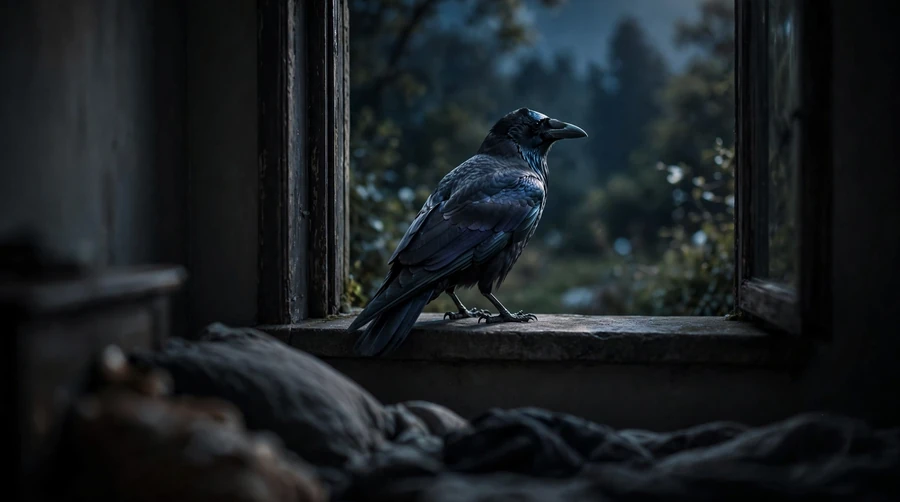
A single crow calling in the dark is read as the most personal version of the sign, a message directed rather than general. Practically, a lone call at night often comes from a bird separated from its roost.
Many Crows at Once
Read as something affecting a group rather than you alone: a family, a workplace, a community. Practically, this is a disturbed roost, and it is the most common scenario by a wide margin.
Every Night for Weeks
Almost certainly a roost near your home, probably seasonal, and likely to ease when the birds disperse for the breeding season. Symbolically, a sign that repeats is read consistently across traditions as a message that has not been acted on.
Right Outside Your Window
Proximity is read as directness, so this is treated as the most pointed version of the sign and the one concerning your household specifically. Practically, your window probably faces the tree the roost or the disturbance is in.
What to Do If You Hear Crows at Night
Look for the owl. If the noise was sudden and intense, step outside and scan the nearby trees and rooflines, or listen for hooting between the crow calls. Finding the cause resolves the unease faster than any interpretation. Our guide to hearing an owl at night covers that side of it.
Note whether it was one bird or many. That single detail separates a personal reading from a collective one, and it separates a lost bird from a disturbed roost.
Note the season. Autumn and winter noise is roost-related and usually temporary. Spring and summer noise near a nest is defensive and also temporary.
Then write down your first thought. Not your interpretation, the thought that arrived before you started interpreting. Across the traditions that work with signs, the instinctive association is treated as the message and everything after it is treated as noise.
Most people who do that find the crows did not deliver news. They interrupted a silence the person had been maintaining.
Frequently Asked Questions
What does it mean when you hear crows at night?
Spiritually it is read as urgency and disclosure: something hidden surfacing, or a warning that could not wait for morning. The symbolism comes from the timing rather than the bird, because a daytime creature calling in darkness represents things happening out of order. Practically, it usually means the roost has been disturbed, very often by an owl.
Is hearing crows at night a bad omen?
It is an old European superstition rather than a universal truth, and it has a practical origin: crows are carrion birds that gathered at battlefields and burial grounds, so people saw them near the dead constantly. In Hindu tradition the same sound is read positively, as connection to ancestors. The bird predicts nothing.
Why do crows caw at night when they are supposed to be asleep?
Because something woke them. Crows are diurnal and do not forage at night, so night calling is a reaction rather than normal activity. The most common causes are a predator near the roost, especially a great horned owl, a disturbance such as an animal or a loud noise, and artificial lighting in urban areas.
Does hearing crows at night mean someone will die?
No. That belief exists and it is widespread, but it rests on crows being seen near the dead rather than before deaths. If you are reading this after a loss, note that most traditions linking crows to the dead treat the call as presence and accompaniment, not as a further warning.
How many crows roost together at night?
Outside the breeding season, a great many. Communal winter roosts can hold thousands of birds in a single group of trees, which is why a disturbance at one edge can sound like the whole neighbourhood erupting.