
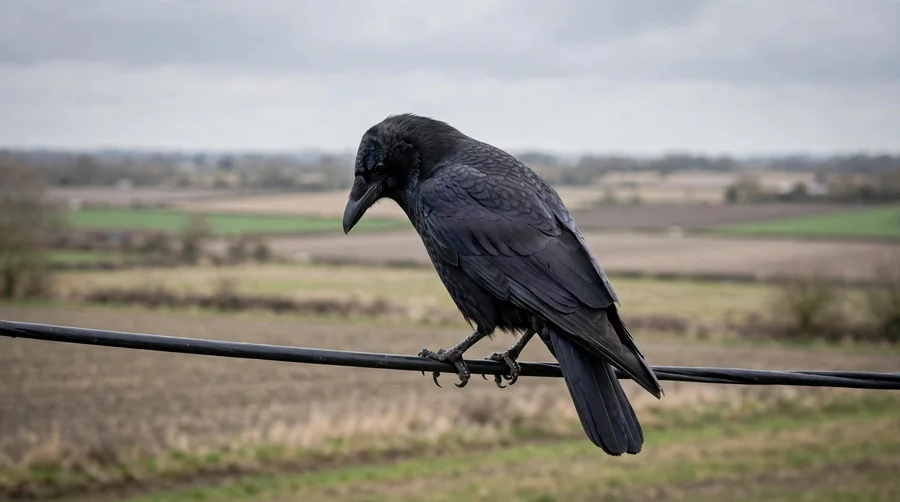
Start with the thing that makes the question worth asking. In most of North America, a crow on its own is not on its own.
American crows live in family groups, hold territories as pairs with grown offspring helping out, and gather at night in roosts that can run into thousands of birds. A single crow on a wire is usually one visible member of a structure you cannot see from where you are standing — and there is a decent chance it is the one whose job is to be visible.
And if you are in Britain, the answer is different, which is a distinction no page on this subject makes. More on that below.
“One for sorrow” is a magpie rhyme
If a line of verse is what put the unease in you, it is worth knowing it was never about crows.
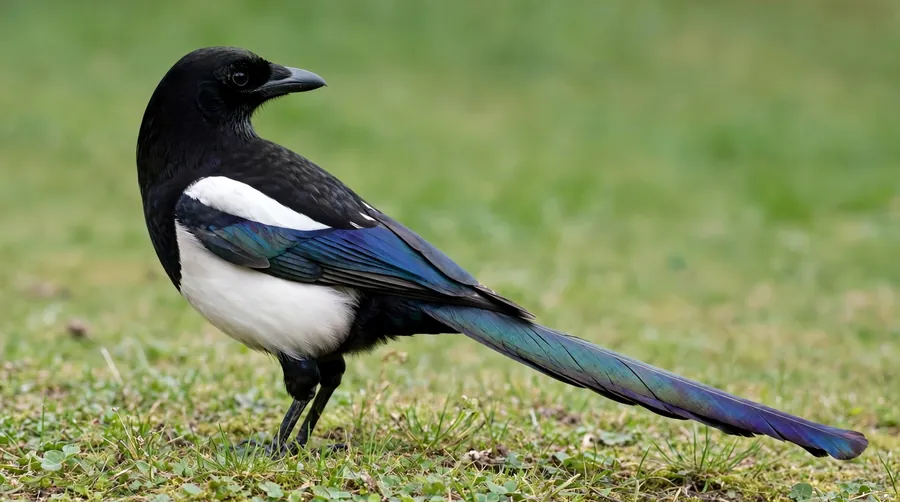
One for sorrow, two for joy, three for a girl, four for a boy. That is a magpie counting rhyme, recorded in British folklore collections from the late eighteenth century, and it exists because magpies in Britain are genuinely countable — they turn up alone or in twos, and the number varies in a way that invites interpretation.
The rhyme got transferred onto crows later, and mostly in places that have no European magpies to apply it to. The band Counting Crows took their name from it, which has probably done more than anything else to attach the counting idea to the wrong bird.
So the sorrow in “one for sorrow” is borrowed. It belongs to a different species, in a different country, under a tradition that counted that species because counting it was meaningful.
If you want the counting traditions properly — what the numbers are held to mean, where the readings come from, and how much weight they can honestly bear — that is covered separately in crow numbers and what they are said to mean. This page is about the bird.
It is probably the sentinel
Here is the fact I would most want you to take away, and it reframes the whole sighting.
When crows feed on the ground, they are vulnerable — heads down, in the open, not watching. So groups post lookouts. One or more birds sit up high, conspicuous, scanning, while the others get on with eating. The sentinel is not feeding. Its entire contribution is seeing things first and saying so.
Now think about what that does to your sighting. The bird on the telephone wire, the chimney, the top of the dead tree — the one you noticed, the one that appeared to be alone — is in exactly the position a sentinel occupies.
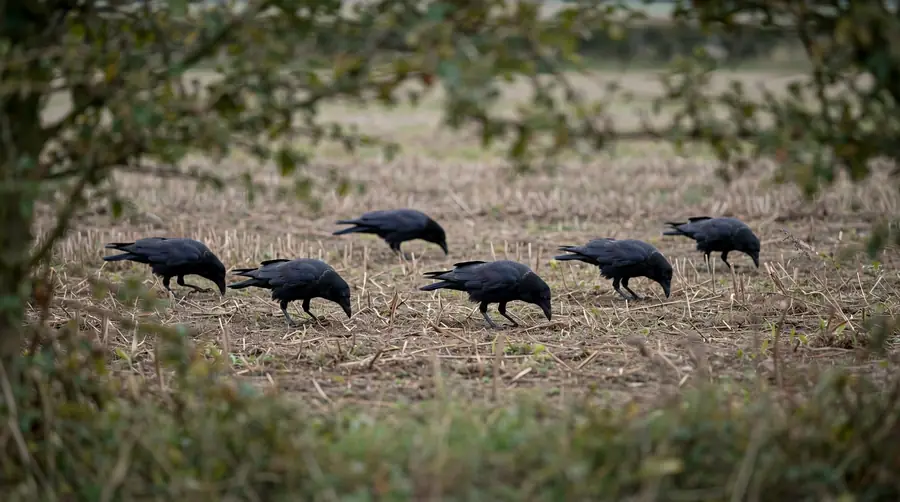
And the others are where you cannot see them: on the grass behind the hedge, in the stubble on the far side of the wall, under the trees.
Which means the loneliness in the image is doing something slightly dishonest. You are seeing one bird because one bird’s job is to be seen. The rest of them are busy, and being invisible is the point.
Check behind you
Two things to do if you want to test any of this, and both take ten seconds.
Look at what it is looking at. A sentinel is scanning. If it is fixed on one spot, follow the line — there is often a cat, a hawk or a person down there. If it is sweeping, it is on general duty and the group is nearby.
Then look at the ground, not the sky. Walk a few metres and change your angle on the nearest field, verge, lawn or car park. A feeding group of crows is startlingly easy to miss behind a hedge line and startlingly obvious once you have moved twenty feet.
People do this and find six crows they had not registered. It is the most reliably satisfying thing in this article.
In Britain, a lone crow is normal
This is the distinction nobody makes and it changes the answer completely depending on where you are reading from.
The American crow is a highly social bird. Family groups, cooperative breeding with helpers, communal roosts of thousands. Genuine solitude is uncommon.
The carrion crow, which is what “crow” means in most of Britain, is far less gregarious. Carrion crows hold territories as pairs and are routinely seen alone or in twos. A single carrion crow on a fence post is not an anomaly at all — it is the normal way to see one.
There is even an old English rule of thumb that encodes it: a crow in a crowd is a rook, and a rook on its own is a crow. Rooks are the colonial ones. If you are in Britain and you can see dozens, you are almost certainly not looking at crows.
So the meaning of “I saw one crow on its own” depends on your longitude. In Ohio it is probably a sentinel with a group out of sight. In Yorkshire it is probably just a crow, doing what carrion crows do, and the oddity is in the question rather than the bird.
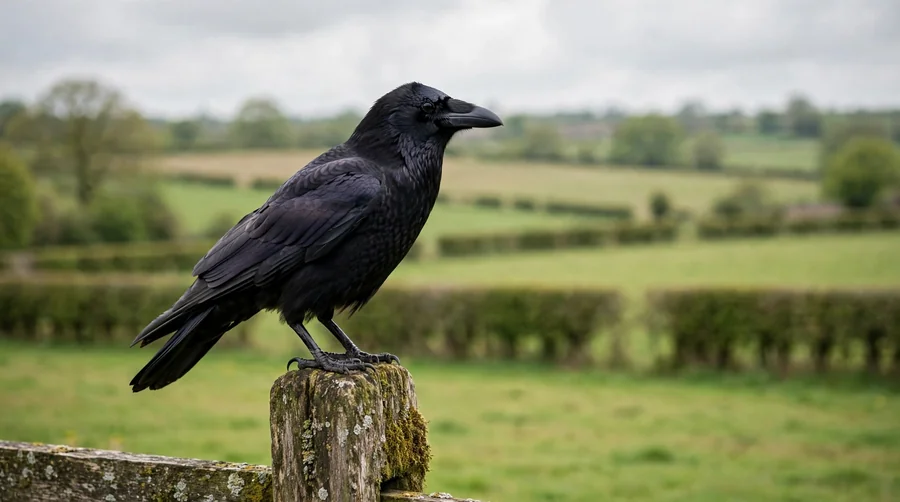
If you are unsure which bird you have, the identification table in crow cawing meaning separates crow, raven, rook and jackdaw on field marks.
The flock is where the failures are
And now the part that inverts the whole thing.
In crow society, the big flocks are not where the successful birds are. During the breeding season, the birds holding territories are paired adults — established, resident, with a patch they defend. The large loose groups are substantially made up of non-breeders: young birds, floaters, individuals that have not secured a territory.
So the crow you saw standing by itself on a spring morning, apparently excluded from everything, may well be the opposite. It may be an adult that has got what the flock is still competing for.
Being in the crowd is the condition of not yet having a place of your own. Being on your own, in April, on a boundary, is frequently the sign that you do.
Four readings
1. You are seeing the one that is meant to be seen
The sentinel reading, and it is the best one here. One bird is up high and conspicuous precisely so the others can be low and unnoticed. Your impression of a solitary crow is produced by a division of labour.
That is a recognisable shape once you look for it. The visible individual — the spokesperson, the name on the paper, the one who answers the phone — is frequently the one whose function is visibility, and the work is happening behind a hedge.
Which cuts both ways, and the second direction is the more useful one. If you are the one everybody can see, that may be the job rather than the achievement, and it is worth knowing which.
2. The same sight means different things in different places
One crow alone is mildly unusual in Boston and completely unremarkable in Bristol, because they are different species with different social arrangements wearing the same English word.
So the significance of what you saw depends on a fact about your geography, not a fact about your life. Every page telling you that one crow means sorrow, or change, or a message, is making a claim that cannot survive being asked “where?”
It is a decent general test. If an interpretation of an animal does not change when the animal changes continent, it was probably not about the animal.
3. The dread is borrowed from another bird
“One for sorrow” is a magpie rhyme from a country where the magpie is countable, applied to crows by people who did not have magpies to hand.
Which means the specific unease a lot of people feel about seeing a single crow is a transfer — an inherited feeling that arrived attached to the wrong animal and was never audited.
Most people are carrying a few of those. A reaction that is real, strong, and demonstrably about something else, passed along until the original subject was lost.
4. The solitude may be the achievement
The reading I would actually take from a single crow in spring. The flock is where the birds without territories are. The ones on their own are often the ones that have succeeded.
That is a complete inversion of the standard interpretation, and it is not a motivational flourish — it is how crow social structure works. Separation from the group, in that species and that season, is evidence of status rather than exclusion.
Worth sitting with if you have been reading your own separation from some group as a verdict on you. Sometimes the crowd is the waiting room.
What the traditions actually say about one
Brief, because the honest answer is thinner than the internet suggests.
There is no widespread, documented, cross-cultural tradition specifically about one crow. What exists is the magpie rhyme above, a general European association of crows with death that comes from scavenging rather than prophecy, and a large quantity of recent internet content assigning meanings to numbers one through nine.
Where there are real traditions, they are about the crow rather than the count. Odin’s two ravens are named Thought and Memory. In the Bible the raven is sent out before the dove and later feeds the prophet Elijah. In several Indigenous North American traditions — and these differ substantially between nations, which matters — the crow or raven is a transformer and a bringer of light rather than an omen of death.
None of that attaches to a number. The crow-specific religious and cultural material is handled properly in crow meaning in the Bible, Hinduism and other traditions, and the death-omen question in crow cawing meaning.
If the same crow keeps appearing
A different question, and a better one, because it probably is the same crow.
Crows are territorial and long-lived — commonly seven or eight years in the wild and considerably longer in some cases. A resident pair may hold the same patch for years. So the bird on your fence this month is very likely the bird that was there last month and last spring.
They also recognise individual human faces, remember them for years, and communicate that recognition to other crows. So repeated appearances are not coincidence and they are not necessarily random: a crow that has decided you are worth watching, or worth approaching, is behaving consistently rather than mysteriously.
The face-recognition research is remarkable and it is covered in full in crow cawing meaning. The short version: it knows which house it is, and it may know which person you are.
Other crow situations
| It was cawing at you, or at your window | Crow cawing meaning |
| You counted them, or counted the caws | Crow numbers and caw counts |
| They were calling after dark | Hearing crows at night |
| You found a dead crow | Dead crow meaning |
| Every other bird encounter | Bird signs and omens |
| It seemed to be following you | Crow following you — and the ten-second test |
The question to sit with
If you are in North America, the one you can see is probably the lookout, and the rest are eating behind a hedge. If you are in Britain, one crow is simply what a crow looks like. The sorrow in the rhyme belongs to magpies. And in spring, the bird on its own is often the one that has a territory while the flock is still queuing.
Almost nothing about a single crow is actually about being single.
So: what have you read as isolation that was really a position — and who else was out of sight at the time?
It was croaking, not cawing, and it looked big: Raven meaning — and raven versus crow.