

It was on the branch outside the kitchen window, and it was the only colour in the whole garden. Everything else was grey or white or bare, and there it was, that impossible red, sitting still long enough for you to properly see it.
And you thought of them. You could not help it.
Here is a question nobody writing about this seems to ask: why the cardinal? Of all the birds in North America, why did this one become the bird that means someone is near? Robins do not carry it. Blue jays do not, and they are just as bright. There is a specific answer, it is in the bird’s biology, and once you know it the belief makes a great deal more sense than you might expect.
Is a Red Cardinal a Sign From Heaven? The Short Answer
In the widely held modern belief, yes — a red cardinal is read as a visit from someone who has died, or as reassurance that they are near. The phrase most often attached to it is “when a cardinal appears, an angel is near.”
What makes the belief unusually sturdy is that three facts about this particular bird line up with it almost exactly. Cardinals do not migrate, they hold the same territory for life, and in a winter landscape they are the single most visible living thing. So the cardinal you keep seeing is genuinely the same bird, genuinely always there, and genuinely impossible to miss — at precisely the time of year when grief is heaviest.
Why It Is the Cardinal and Not Some Other Bird
This is the part that is missing from everything else written on the subject, and it is the heart of this page.
Cardinals do not migrate. Not at all, anywhere in their range. Almost every other brightly coloured North American songbird leaves — orioles, tanagers, buntings, warblers, the lot. They go south in autumn and the landscape empties of colour.
The cardinal stays. It stays through November, through the snow, through January. And because it does not migrate, it also does not change address: a cardinal pair holds the same territory year-round, often for years, frequently for life.
Then the third fact, which is the obvious one. Against bare branches and snow, a male cardinal is the most arresting object in the visual field. There is nothing else that red in a winter garden. You do not notice a cardinal in December. You cannot avoid noticing it.
Now put those three together with one more thing, which is about us rather than the bird.
Winter is when grief is at its worst. It holds the funerals of autumn deaths, the first Christmas without someone, the anniversaries, the short dark days. It is also the season when people are indoors most, sitting still most, and looking out of windows most.

So the tradition did not pick the cardinal arbitrarily out of hundreds of birds. The cardinal was effectively the only candidate: the one brilliant, loyal, year-round, unmissable bird available to a grieving person standing at a kitchen window in February.
That does not explain the belief away. If anything it does the opposite. Of all the birds that could have been chosen to mean someone is still here, the one that got chosen is the one that never leaves and never moves house.
“He Keeps Coming Back” — You Are Right
A specific thing people say about cardinals, far more than about other birds, is that it is the same one. That it comes back. That it knows where to find them.
That is not wishful thinking. It is an accurate observation.
Because cardinals are non-migratory and territorial, the cardinal at your feeder this morning is, in all likelihood, the identical individual that was there last week, last month and last winter. He has a territory and your garden is inside it. He will be there next year too, if he lives, and cardinals can live a surprisingly long time for a small bird — well into their teens in some recorded cases, though most do not get near that.
Many other garden birds are a rotating cast of strangers that look alike. The cardinal is a neighbour.
So when people say a cardinal has been visiting them since someone died, and that it feels like a relationship rather than a sighting, the bird is in fact behaving exactly as described. Whatever you make of the meaning, the pattern you noticed is real.
Where the “Sign From Heaven” Belief Comes From
Worth being straight about, because the honest version is more interesting than the vague version and it does not take anything away.
The cardinal-as-messenger belief in its current form is modern and largely American. It is not an ancient inherited tradition. It spread through the twentieth century and accelerated enormously through memorial cards, garden ornaments, sympathy gifts and then the internet. The phrase “when cardinals appear, angels are near” is a contemporary saying, not an old one.
It does draw on older threads. Red has carried associations with blood, life and vitality in Christian symbolism for centuries. The bird’s English name comes directly from the scarlet robes of Catholic cardinals, so the association with clergy and the sacred is built into what we call it. And some Indigenous traditions, including Cherokee material, connect the cardinal with the sun, with courtship and with good fortune — though the specifics differ by nation and should not be flattened into one claim.
But the version people hold today, the one that brought you here, is recent.
Here is why that does not matter as much as you might think. Every tradition was new once. The ones that survive are the ones that keep working, and this one has spread across a continent in a few generations entirely because of what it does for people. It is not propped up by an institution. Nobody is enforcing it. It has grown because grieving people keep finding it true to their experience.
A belief that is spreading on nothing but its own usefulness to the bereaved is not a weak tradition. It is a tradition in the middle of being made.
A Cardinal at Your Window
This is the version that affects people most, and it needs both answers.
A cardinal sitting on a sill or a branch outside the glass, looking in, is read as the most direct form of the sign — the messenger coming to the boundary between outside and in. It is the single most reported version of this experience, and it is the one people remember for years.
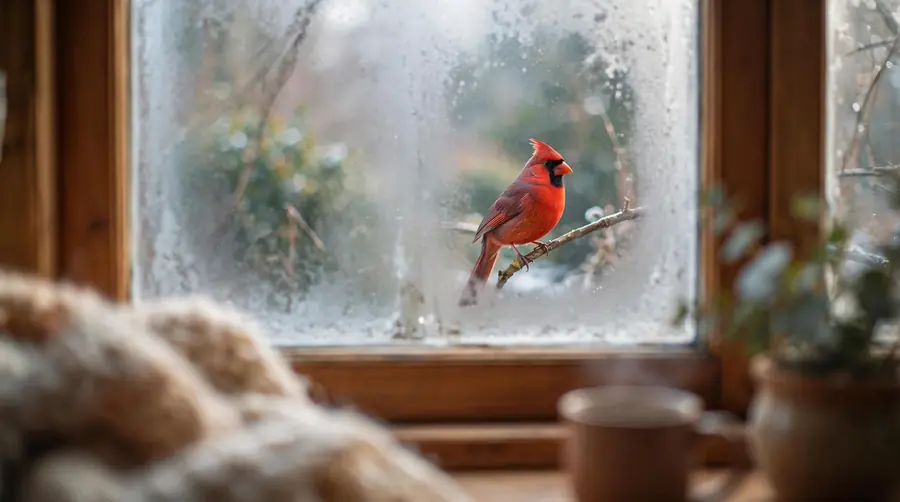
A cardinal repeatedly flying at the glass, tapping, or fighting the window is something different, and I would rather tell you than let you wonder.
Cardinals are notorious for this. They are strongly territorial, and a male who sees his reflection sees a rival male inside his territory who will not leave. So he attacks it. He will do it for days or weeks, at the same window, at a car mirror, at a patio door, exhausting himself against an opponent that cannot be driven off. It peaks in spring during the breeding season and it is one of the most common calls bird organisations receive.
The reason to tell you is not to deflate anything. It is that the bird is hurting itself, and you can stop it. Reflections only form when the outside is brighter than the inside, so the fix has to go on the outside of the glass — netting, soap, paper, window film, anything that breaks up the mirror. Closing the curtains does nothing.
And if you want the reading alongside the fact: a creature fighting its own reflection, unable to recognise itself, is not short of symbolic weight. Several traditions would have something to say about being shown that.
The Female Cardinal, and the Pair That Sing to Each Other
If the bird you saw was not red but a soft buff-brown with warm red edges on the wings, crest and tail, you saw a female — and she is badly served everywhere, which is a shame, because she is the more remarkable of the two.
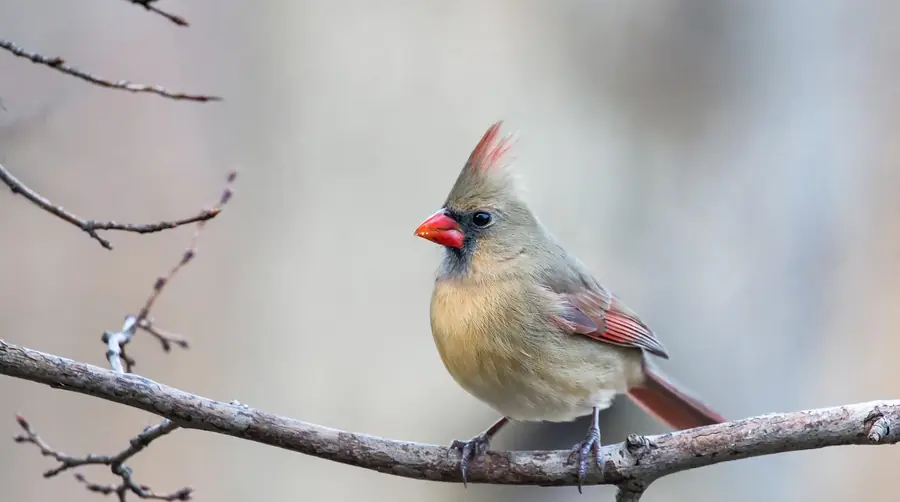
Female cardinals sing. In the great majority of North American songbirds, only the male sings. The female cardinal sings a full song, often from the nest, and her song can be longer and more complex than his.
And then the thing that makes this worth knowing if you are grieving.
Cardinal pairs counter-sing. One bird gives a phrase and the other answers it with the same phrase, back and forth, matching each other. They hold a conversation in shared song, and they do it across distance when they cannot see one another.
Two birds, separated, calling the same tune to each other until they are answered.
They also feed each other. During nesting the male brings food to the female and passes it beak to beak — that photograph you have seen of two cardinals apparently kissing is a male feeding his mate. The female builds the nest; both feed the young.
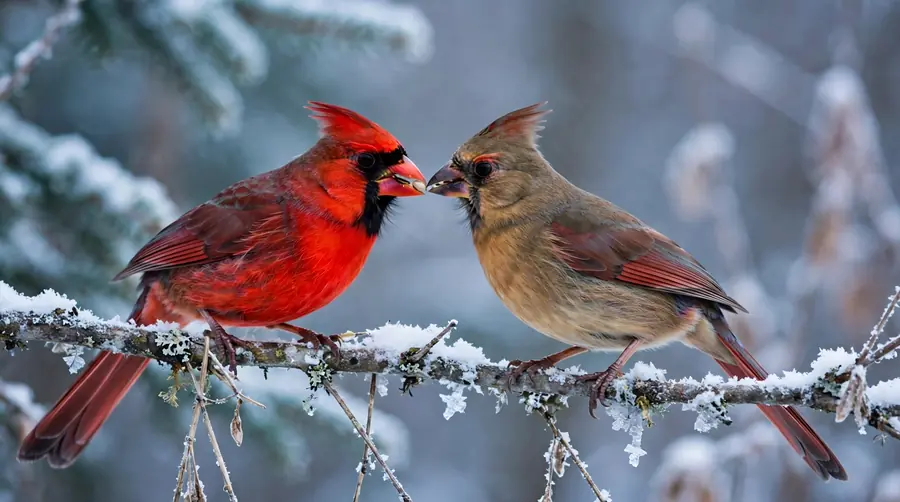
So if your sign was a pair of cardinals, the reading available is considerably better than romance. It is two creatures who hold one territory together year-round, do not separate seasonally the way migratory birds do, answer each other’s songs phrase for phrase, and hand each other food.
Four Readings of a Cardinal Visit
1. Someone Is Near
The dominant reading and the reason this page exists. A cardinal appearing at a significant moment is read as presence — not a warning, not a prediction, simply the sense of being accompanied.
Worth noting that in this tradition the cardinal is almost never ominous. There is no version of this belief in which a cardinal brings bad news.
2. Colour Where There Should Not Be Any
The winter reading, and the most honest about what the encounter actually is. A cardinal in a dead landscape is a fact about persistence: something vivid, in the middle of a season that has nothing vivid in it, behaving normally.
Read as a message, it is not “this will pass.” It is closer to “something is still bright while it is going on.”
3. Made of Where He Has Been
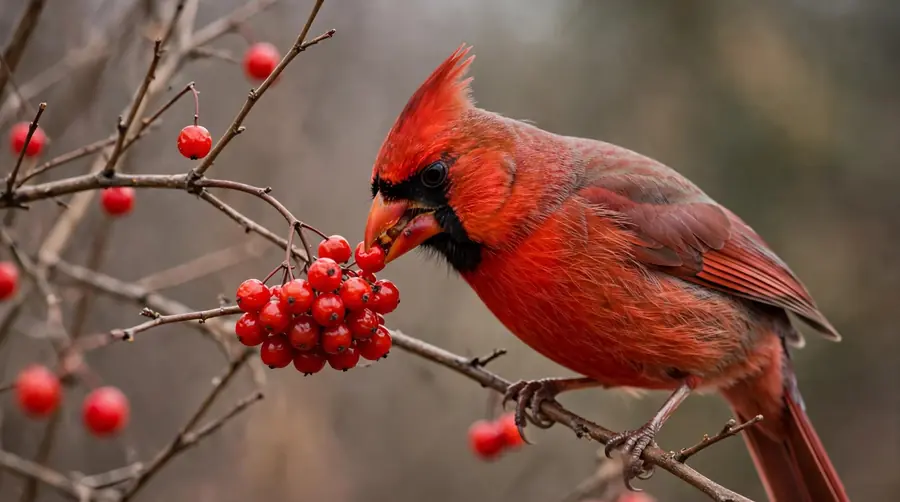
A detail almost nobody knows. A cardinal cannot manufacture his own red. The pigments that produce it are carotenoids, which the bird has to eat — in berries, fruit and seeds — and then deposit in its growing feathers. A male on a poor diet comes out duller. A brilliant one has fed well.
Which means the red you were looking at is literally made from the food of the place he lives. If he lives in your garden, he is partly made of your garden.
As a reading, that is unusually gentle: what shows on the outside was built out of where you have been and what sustained you.
4. Staying Put
From the non-migration fact. Every bright bird around him leaves and he does not. He takes the hard season in the same place rather than going somewhere easier.
Traditionally this is the reading given to people who are in the middle of something they cannot leave — a carer, a grieving parent, someone holding a family together. The cardinal’s answer is not escape. It is that staying is survivable and it is a strategy, not a failure.
Is There a Cardinal in the Bible?
People search this, so here is the straight answer: no, and there cannot be.
Northern cardinals are a New World species. They live in North and Central America and nowhere else naturally. They did not exist anywhere near the lands where scripture was written, and no biblical writer ever saw one. If a page offers you a Bible verse about cardinals, it has been invented.
What the Bible does contain, and what is genuinely the closest thing to what you are looking for, is about a much plainer bird. In the gospel of Matthew, Jesus says that not one sparrow falls to the ground outside the Father’s care, and that you are worth more than many sparrows.
The point of that passage is that the most ordinary, least valuable, most overlooked bird imaginable is still individually noticed. Which is, if you are honest about it, a stronger comfort than anything a cardinal-specific verse could have offered — and it is really there, which the cardinal verses are not.
What Changes the Reading
On a Birthday or Anniversary
The version people find most convincing, and the one treated as strongest across the tradition. The honest companion fact is that these are also the days you are most likely to be home, still, watching, and thinking of the person — so the bird and your attention arrive at the same moment. Both things are true, and the second does not cancel the first.
Right After a Death
Read as the clearest form of the sign. This is also when a great many people start feeding birds, or start noticing a garden they had not looked at properly in years, which is worth knowing without it diminishing anything. The mourning dove is the other bird most often reported as a sign after a loss. A dragonfly is another creature many people report as a sign after a loss.
A Cardinal That Keeps Returning
Read as insistence and as an established relationship rather than a single message. Practically, it is a territorial resident and you are inside his patch, which is why it is the same bird. See the section above.
In Summer Rather Than Winter
Still read the same way, but worth knowing the contrast is weaker — in July he is one of many bright things, and in January he is the only one. The winter sighting is the one the whole tradition is built on.
A Dead Cardinal
Hard to find and hard to see. It is generally read as the end of a chapter rather than as a bad omen, and in this tradition specifically there is no established reading of a dead cardinal as a warning about a person. Window collisions are the most common cause, which is worth knowing if it was found near glass — and is a second reason to treat the window section above seriously.
Finding a Cardinal Feather
Read as a message left behind, and a red one is striking enough that people keep them. One practical note: in the United States, cardinals are protected under the Migratory Bird Treaty Act, which makes it illegal to possess their feathers even when you simply found one on the ground. Photograph it and leave it where it is.
What to Do
If a cardinal is attacking your window, break up the reflection from outside. This is the only item on this page that is genuinely urgent, because the bird is injuring itself.
Keep cats in at dawn and dusk if you can. That is when cardinals feed and they feed low.
Frequently Asked Questions
Is a red cardinal a sign from heaven?
In the widely held modern belief, yes — a cardinal is read as a visit from someone who has died or as reassurance that they are near, captured in the saying “when a cardinal appears, an angel is near.” The belief is recent and largely American rather than ancient, but it has spread entirely on the strength of what it does for grieving people.
Why do cardinals represent lost loved ones?
Because of three facts about the bird. Cardinals do not migrate, so they are present through winter when almost every other bright bird has gone. They hold the same territory for years, often for life, so the one you see really is the same individual. And against snow they are the most visible living thing in the landscape. Winter is also when grief is heaviest and people are indoors looking out of windows.
What does it mean when a cardinal comes to your window?
A cardinal sitting outside the glass is read as the most direct form of the sign, arriving at the boundary of your home. But a cardinal repeatedly flying at or tapping the window is attacking its own reflection, which it mistakes for a rival male in its territory. That one needs fixing from outside the glass, because the bird is hurting itself.
What does a female cardinal mean?
She is read the same way as the male, with added associations of nurture and of a message carried quietly. The remarkable thing about her is that female cardinals sing, which is unusual among North American songbirds, and that pairs counter-sing — one bird gives a phrase and the other answers with the same phrase, back and forth, even when they cannot see each other.
Is there a Bible verse about cardinals?
No. Cardinals are a New World species that no biblical writer could have seen, so any verse offered about them is invented. The closest real passage is in Matthew, where not one sparrow falls outside the Father’s care and you are worth more than many sparrows — the point being that the most ordinary bird imaginable is still individually noticed.