
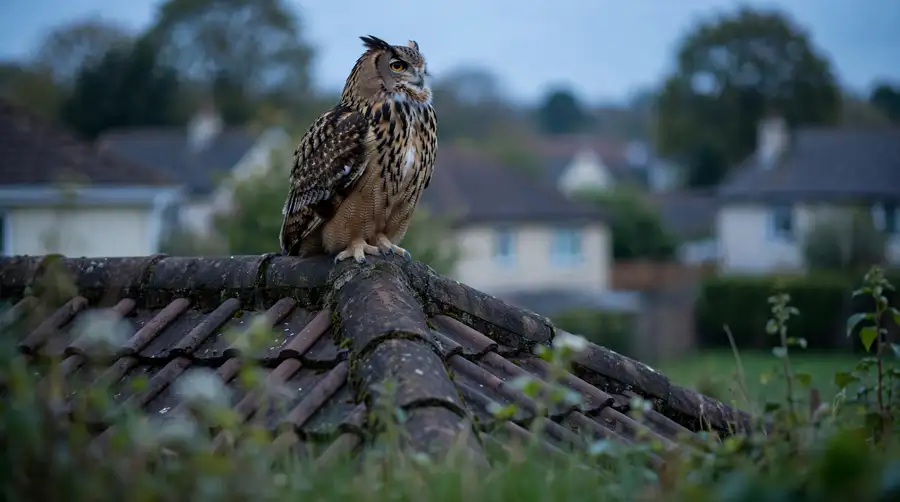
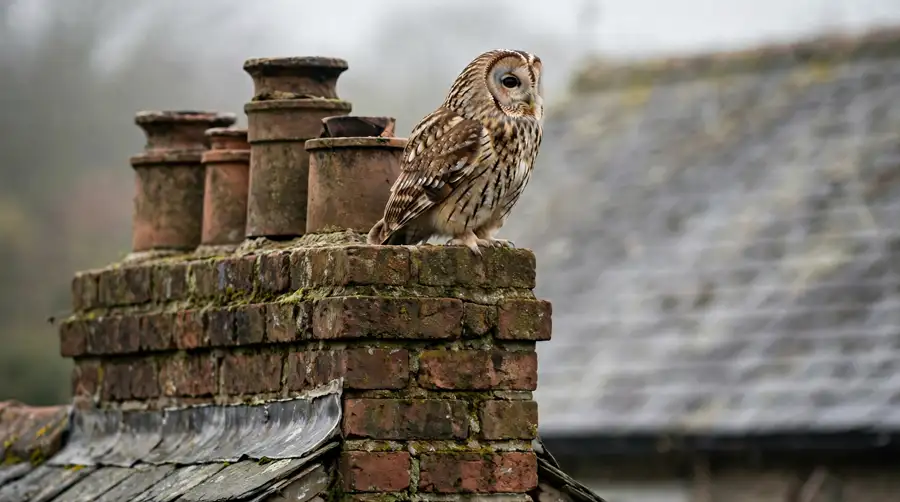
You heard it before you saw it. Something moved on the roof — not the scrabble of a squirrel, something heavier and slower, with a scratch of claws on tile. And when you went out and looked up, there it was on the ridge, perfectly still, looking down at you.
I will be straight with you about why that unsettles people, because the honest answer is more useful than reassurance. Of all the places an owl can be, the roof is the one European folklore treated most seriously. Hearing an owl in a wood was a sound. An owl settling on the house itself was, in the Roman tradition that most of our owl superstition descends from, a matter for ritual cleansing.
So the unease is inherited rather than invented. It is also, as it turns out, pointed at the wrong thing entirely — because there is a very specific and rather flattering reason an owl has chosen your roof, and it has to do with what you have been doing in your garden.
Owl on Your Roof: The Short Answer
An owl on the roof is traditionally read as oversight — something positioned above the household, watching over it. Because the roof is the household’s highest point and its boundary with the sky, the placement is read as being about the home as a whole rather than about you individually.
Whether that oversight is protective or ominous is exactly where traditions split, and the section below lays out honestly which is which.
Practically, your roof is the best hunting perch in the neighbourhood, and the owl is there because your garden is full of rodents. It will not damage anything. The only real concern is the chimney, and the risk there is to the owl.
Your Roof Is a Hunting Tower Over a Rodent Farm
Here is the spine of the whole thing, and no page on this subject puts it together.
Many owls hunt by perch-and-pounce. They do not patrol on the wing like a harrier — they sit somewhere high with a clear view over open ground, wait, listen, and drop onto what they detect. The whole method depends on finding a good perch, and a good perch means height plus an unobstructed view plus something worth watching underneath it.
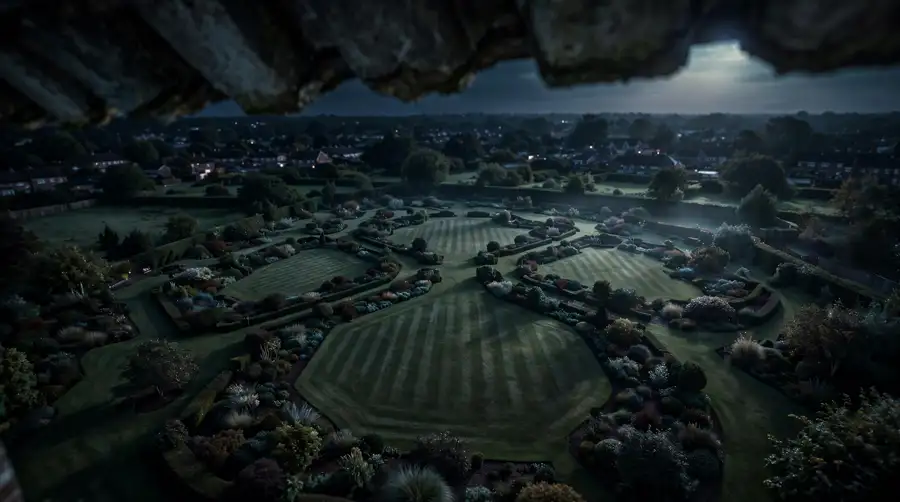
Now look at a suburban house from an owl’s point of view.
The roof ridge is frequently the highest point for a hundred metres with a clear line of sight in every direction. Better than a tree, because a tree has branches and leaves in the way and moves in the wind. A ridge, a chimney stack, a gable end or a TV aerial is a rigid, stable, elevated platform with a completely open view. From an owl’s perspective it is a purpose-built hunting tower that somebody has kindly erected.
And then there is what is underneath it.
A mown lawn with planted borders is excellent rodent habitat. Short grass is easy for mice and voles to move through, the bed edges and shrub bases provide cover, compost heaps are warm and full of food, and sheds and decking give shelter. A garden is a rodent landscape with a short-grass hunting arena in the middle of it.
And if you feed birds, the chain is even more direct. Spilled seed under a feeder does not stop attracting animals when the sun goes down. It brings in mice and voles at night, reliably, in the same spot, every night. You have been running a rodent feeding station on a fixed schedule.
So the owl on your roof is not an arbitrary visitation. It is a predator that has identified the best observation post over the most productive hunting ground in the immediate area — and both the post and the hunting ground were built by you.
Which gives the symbolic reading a foundation most placements do not have. The owl did not come to your house by chance and it did not come to the house next door. It assessed the available options and your home came out on top. Whatever else you take from it, you were chosen on merit.
Why It Sounded So Close, and So Large
Two things people consistently report about this encounter, and both have good explanations.
It sounded enormous. An owl on the roof is in direct physical contact with your house, so the sound of its movement travels into the structure rather than only through the air. Talons on tile or metal transmits straight through the roof covering, into the rafters, and into the ceiling of the room you are lying in. A bird weighing perhaps a kilogram can sound like something considerably larger because you are hearing it through the building rather than across the garden.
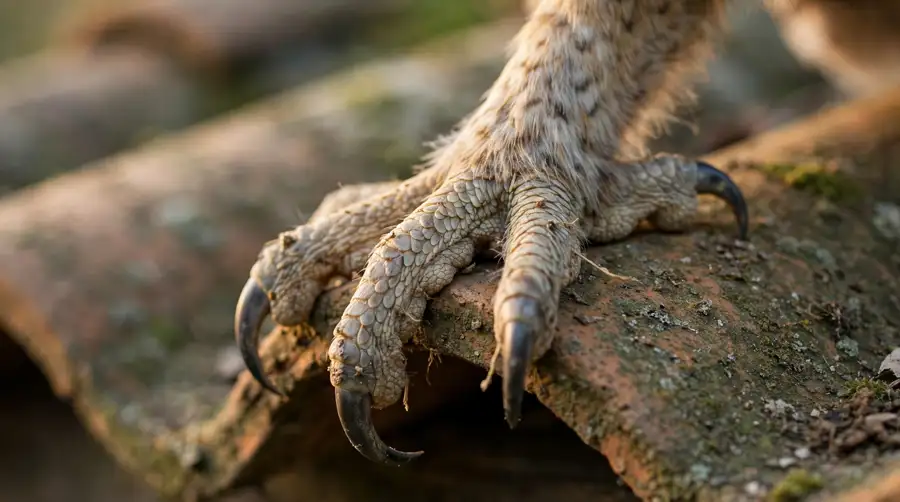
And the call seemed to be right in the room. Same mechanism. A hoot from a tree thirty metres away and a hoot from the ridge above your bedroom are nothing alike indoors, even at similar volumes outside, because the second one is coupled to the structure you are inside.
There is a third thing worth knowing, which is that owls do genuinely walk on roofs. They are better at it than you would expect and will shuffle along a ridge or a gutter, which produces a slow, deliberate, oddly unhurried sound that people find much more alarming than flapping. Nothing is wrong. It is a bird adjusting its position.
Four Readings of an Owl on the Roof
1. Something Positioned Above the Household
The core reading, and it is specific to this placement. In sign traditions the part of the house matters: a doorstep is about arrival, a window is about something looking in, and a roof is about something being over you.
So the reading is not personal in the way a bird at the window is. It concerns the household as a unit — the family, the home, the thing the roof is keeping the weather off. People most often report this sign during a period when they are responsible for a household rather than just living in one.
2. The Vantage Point
From the hunting perch. The owl’s method is not pursuit — it is positioning. It wins by being in the right place, high enough and still enough for long enough, and then acting once.
Read as a message, that is the most practical thing this encounter offers: the problem in front of you may be a position problem rather than an effort problem. The owl is not working harder than the mouse. It is simply somewhere better.
3. You Built What Attracted It
From the section above, and it is the reading with the most bite.
You put up a feeder for the birds. The spilled seed brought the mice. The mice brought the owl. Every step was reasonable and none of it was the plan, and the result is a predator on your roof at two in the morning.
The traditional interpretation of a sign you have unknowingly caused is about consequence rather than fault: something you set in motion for good reasons has produced an outcome you did not foresee, and the outcome is neither a punishment nor a mistake. It is just further down the chain than you were looking.
4. Silence Directly Above You
Owls fly almost silently, and it is engineered — a comb-like fringe on the leading edge of the flight feathers breaks up the airflow before it becomes noisy turbulence, the trailing edge is soft rather than crisp, and the surfaces carry a sound-absorbing down.
Which means something worth sitting with: if the owl has been using your roof for weeks, it has arrived and left dozens of times without you hearing a single wingbeat. You noticed it on one night, by accident, because it happened to call or shift its feet.
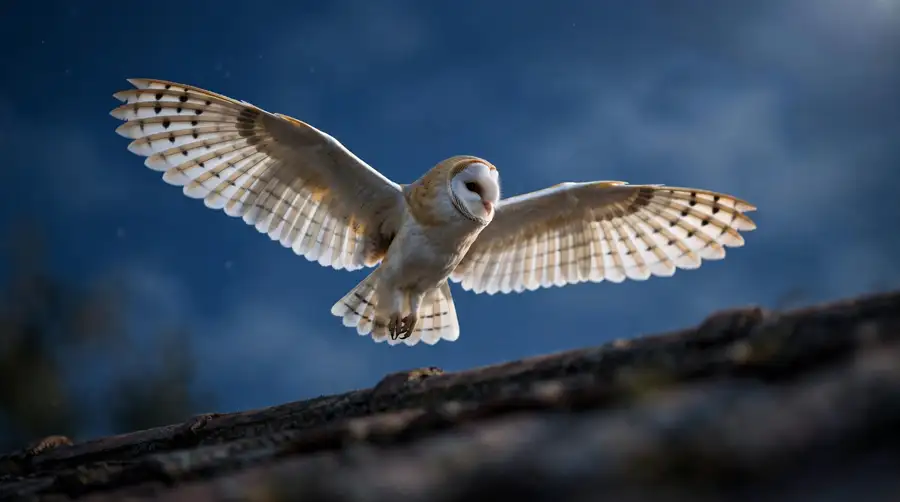
Read as a sign, the reading is that the thing you have just noticed has probably been going on for some time. Our guide to owl hooting at night covers the silent-flight material in full, including why the hoot is the one moment the owl chooses to be audible.
Is an Owl on the Roof a Death Omen?
This is the question most people arrive with, so here is the honest version rather than the comfortable one.
Yes, in one specific tradition, and it is the tradition we inherited. Roman belief treated the owl as deeply inauspicious, and treated an owl on or in a building as the serious form of it — not merely a bad sound but something requiring purification of the house. Roman writers recorded owl calls as funereal and owls settling on buildings as portents. That material passed into European folklore, from there into the broader Western imagination, and from there into every film that wants a house to feel cursed.
Similar roof-specific beliefs exist elsewhere, including in parts of Africa and South Asia, where an owl settling on a house is read as a warning for the household.
So if the roof placement felt heavier to you than a bird in a tree would have, you were accurately reading an old tradition rather than imagining things. That is worth acknowledging.
Now the other half, which is equally true.
The same bird was sacred to Athena. In Greece the owl was the companion of the goddess of wisdom, and it was not a minor association — the owl appeared on Athenian silver coinage that circulated across the entire ancient Mediterranean. Greece put the owl on its money. Rome, which adopted the same goddess under the name Minerva and kept the owl as her attribute, nonetheless read a hooting owl as a death notice.
Same bird, same goddess, two neighbouring cultures, opposite conclusions.
And the readings elsewhere go the other way again. In Japan owls are widely considered lucky and owl charms are common. In Hinduism the owl is the mount of Lakshmi, goddess of wealth and fortune. Across various Native American traditions the owl appears as both a figure connected to the dead and as a protector, varying substantially between nations.
Here is the conclusion I would draw, and it is the same one the evidence forces. When two cultures a few hundred miles apart look at the identical bird and one puts it on the currency while the other purifies the house, the bird is not carrying the meaning. We are. And the version you inherited is not the original, not the majority view, and not the only one available to you.
What the owl is actually doing on your roof is hunting mice. That part is not in dispute in any tradition.
The One Real Problem: Chimneys
Everything else about an owl on your roof is harmless. This part is not, and the risk runs in the direction people do not expect.
Several owl species are cavity nesters. They look for holes — hollow trees, barn lofts, broken walls, nest boxes — and a chimney reads convincingly as a cavity. Barn owls and small owls in particular will investigate one, and an open or uncapped flue is an invitation.
The trouble is that a modern flue is a smooth vertical tube. An owl that drops in can very easily find it cannot climb back out, and a bird trapped in a chimney will not survive long. It is also then stuck inside your house, which is bad for everyone.
Two practical notes. If you have an unused and uncapped chimney, a cap or a mesh guard solves this permanently and is cheap. And if you can hear scratching or calling coming from inside the chimney rather than from the roof, do not light a fire, do not try to reach in, and call a wildlife rescue or a chimney specialist — in many places owls are legally protected and a nesting bird must not be disturbed.
Worth adding the reassuring part: an owl sitting on a chimney pot in winter may simply be warming its feet, since a working chimney is the warmest perch on the building. That is not an omen either. It is central heating.
Will It Damage the Roof?
No, and it is worth being clear because this is the question that brings a lot of people to search in the first place.
Owls do not chew, gnaw, dig, or strip material. They do not nest in roof structures the way starlings, squirrels and rats do — they have no interest in getting under your tiles, and they cannot make an opening where one does not exist. A perching bird weighing around a kilogram does nothing to a roof.
What you will get is mess. A regularly used perch collects white streaking down the tiles or wall below it, and that is unsightly rather than damaging. If it bothers you, it will wash off, and the perch will be abandoned when the hunting moves on anyway.
And if something genuinely is getting into your roof space — scratching inside the eaves, scurrying in the loft, gnawing — that is not the owl. That is almost certainly rodents or squirrels, and the owl on the ridge is the one animal in this situation that is on your side.
What It Leaves Behind
This is the best thing in this article if you are the sort of person who likes evidence, and almost nobody realises it is available to them.
Owls cannot digest fur, feather or bone. They swallow prey whole or in large pieces, extract what they can, and then regurgitate the remainder as a compact dry pellet, usually at the roost or perch. If an owl has been using your roof regularly, pellets will be accumulating in the gutter, on a flat section, or on the ground directly below the perch.
They look like dry grey-brown lozenges of matted fur, a few centimetres long, and they are not unpleasant. And if you break one open — dry, with gloves, on newspaper — you will find intact skulls. Mouse and vole skulls come out whole, teeth still in the jaw, small enough to sit on a fingertip.
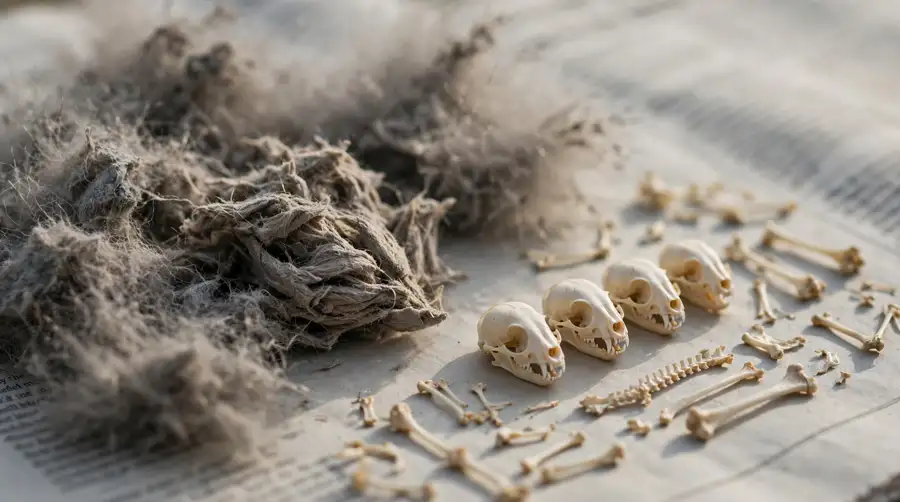
Which means you can establish, from your own gutter, exactly what has been living in your garden and what has been eating it. School science classes do this. It is genuinely one of the more remarkable things you can do with half an hour and a cocktail stick.
There is also a reading in it, and a good one. The owl leaves a precise record of what it has taken, in a form that can be read later by anyone who looks. Very little else in nature keeps accounts like that.
What Changes the Reading
On the Ridge or a Gable, Silent
The classic version, and it is a hunting perch. Read as watchfulness and oversight. Silence is the normal state for a hunting owl, so a silent bird is a working bird rather than a significant one.
On the Chimney, Calling
Read as the most emphatic version of the sign — the highest point of the house, and the bird announcing itself from it.
Practically, a chimney stack is the best acoustic platform on the building, with nothing between the bird and the horizon in any direction. An owl calling from your chimney has selected your house as a loudspeaker.
Looking Down at You
The version people remember, and read as the most personal. Worth knowing that an owl’s eyes are fixed in their sockets and cannot swivel, so to look at anything it must turn its entire head. The deliberate, mechanical head-turn that feels so pointed is simply the only way an owl can look at something.
Several Nights Running
On the Roof in Daylight
Unusual, and treated as more significant across traditions. Practically, a daytime owl on a roof is more likely to be a disturbed bird that has been flushed from a roost, a juvenile that has not yet worked out where to hide, or an unwell animal. If it stays all day, looks hunched or scruffy, or lets you approach closely, that is a bird in trouble rather than a message — call a wildlife rescue.
Crows or Magpies Screaming at It
If the owl is still there at dawn, this will happen. Mobbing is how most people ever actually see an owl, and the noise is extraordinary. Our guide to hearing crows at night explains the behaviour, including why crow noise after dark usually means an owl is nearby.
What to Do
Cap an unused chimney. The only genuine action item on this page. Cheap, permanent, and it protects the bird.
Leave it alone. Do not shine a light at it, do not try to get a photograph with a flash, and do not play owl calls at it — a recorded call makes a territorial bird believe a rival has arrived and burns energy it cannot spare. Watching costs the owl nothing; interfering does.
Check the gutter for pellets in daylight. See the section above. If you want to know what is really going on in your garden at night, this is how you find out.
Consider whether you are feeding its food. If you have a bird feeder, the spilled seed is bringing rodents, and the rodents are bringing the owl. Sweeping up underneath the feeder changes the whole chain — though you may find, once you understand it, that you would rather keep the owl.
And if it is in the chimney rather than on it, call someone. Do not light a fire.
Then the reflective part, which this placement gives more neatly than most. An owl assessed every perch in your neighbourhood and concluded that the best position, over the most productive ground, was the top of your house — and the ground was productive because of things you did without intending them.
What have you built, without planning to, that something has now arrived to take advantage of?
Frequently Asked Questions
What does it mean when an owl sits on your roof?
It is read as oversight — something positioned above the household, watching over it — and because the roof is the home’s highest point the reading concerns the household as a whole rather than you individually. Practically, your roof is the best hunting perch available: high, rigid, with a clear view over a garden full of rodents.
Is an owl on the roof a bad omen?
In Roman tradition yes, and that is the tradition Western folklore inherited — an owl on a building was treated as serious enough to require purifying the house. But the same bird was sacred to Athena and appeared on Athenian coinage as a symbol of wisdom, and owls are considered lucky in Japan and associated with Lakshmi in Hinduism. When neighbouring cultures reach opposite conclusions about one bird, the meaning is ours rather than the bird’s.
Why is there an owl on my roof?
Because it is hunting. Many owls hunt by sitting high with a clear view and dropping onto prey, and a roof ridge or chimney is often the highest unobstructed perch for a hundred metres — better than a tree, which has branches in the way and moves. Mown lawns with planted borders are excellent rodent habitat, and if you feed birds the spilled seed brings mice at night.
Can an owl damage my roof?
No. Owls do not gnaw, dig or strip material and cannot make an opening where none exists, and they do not nest in roof structures the way squirrels and rats do. You may get white streaking below a regular perch, which washes off. If something is getting inside your roof space, that is rodents — and the owl is the one animal in the situation working in your favour.
What if the owl gets into the chimney?
That is the one real risk, and it is a risk to the owl. Several owl species are cavity nesters and a flue reads as a cavity, but a smooth vertical tube is something a bird often cannot climb back out of. Do not light a fire and do not reach in — call a wildlife rescue or chimney specialist, since owls are legally protected in many places. Capping an unused chimney prevents it permanently.