
Odin had two ravens and two wolves. Most people treat that as poetic arrangement — the god of war accumulating suitably grim companions.
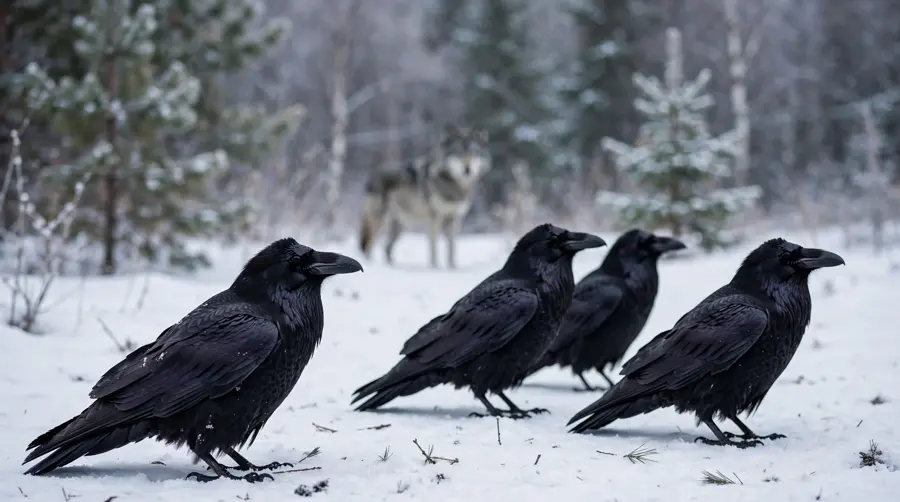
It is not. Ravens and wolves genuinely associate in the wild, closely enough that biologists call the raven the wolf-bird. The ravens follow the pack, attend the kills, and the relationship appears to run both ways.
Which means the raven’s reputation as a bird of death is not superstition built on a black feather. It is an accurate observation about an animal that works with predators — and once you see why, the whole symbolic apparatus reorganises itself.
Raven or crow?
Deal with this first, because a large share of “I saw a raven” sightings are crows, and the two birds mean quite different things.
| Feature | Raven | Crow |
|---|---|---|
| Size | Buzzard-sized. Genuinely large, and it registers as large | Pigeon-plus. Normal bird size |
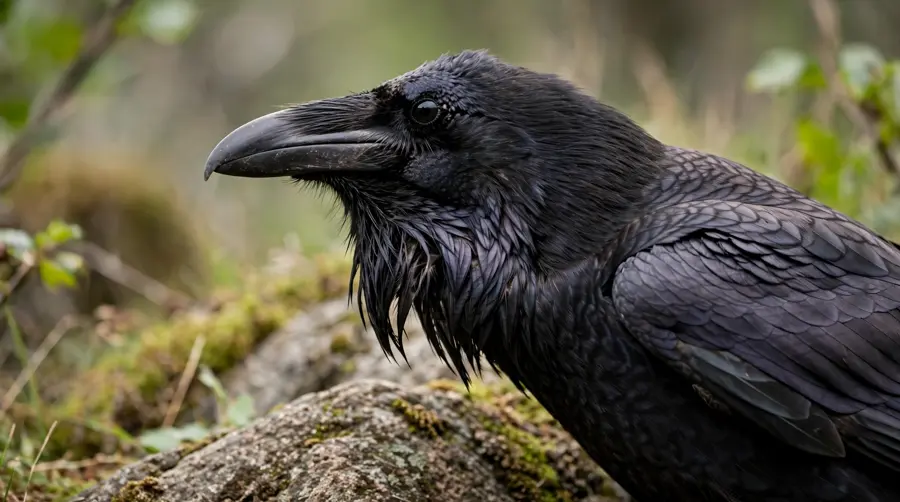
| Bill | Heavy, deep, with a curved upper edge. Looks like a tool | Slimmer, straighter |
| Throat | Shaggy, ragged hackles — visible as a loose beard when calling | Smooth |
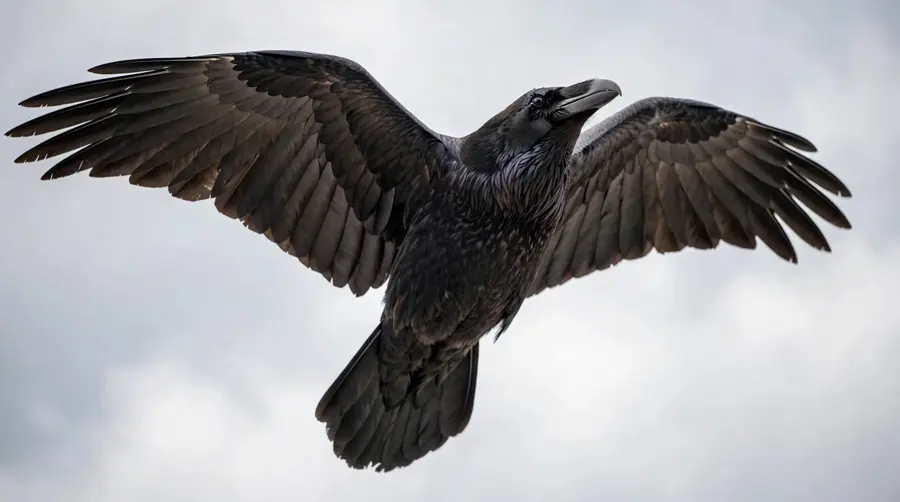
| Tail in flight | Wedge or diamond — comes to a point | Fan — squared or rounded across the end |
| Voice | A deep, resonant, almost wooden pruk-pruk. Croaking rather than harsh | A flat, hard, higher caw |
| Flight | Soars, glides, rides thermals, tumbles and rolls | Steady purposeful flapping, little soaring |
| Company | Usually one or two | Often more, and rooks are colonial |
If you remember one thing, make it the tail. A raven’s tail comes to a point; a crow’s does not. It is the only feature that works at a distance, in silhouette, with no size reference available — and size is deceptive on an empty sky.
Second best is the voice. A raven does not caw. The sound is lower, rounder and oddly resonant, like a knock on hollow wood, and once you have heard it properly you will never mistake it again.
And if it was soaring and rolling and playing in the wind, it was a raven. Crows commute. Ravens fly for the sake of it.
The wolf-bird
Here is the mechanism, and it is the key to everything else on this page.
A raven cannot open a large carcass. It has a formidable bill for a bird, but a dead deer or elk is sealed inside a hide that a raven simply cannot get through. So a raven that finds a big dead animal is looking at a locked larder.
Wolves can open it. And they leave a great deal behind.
So ravens attend wolves. They follow travelling packs, they appear at kills within minutes, and they have been observed responding to wolf howls by moving toward the sound. Bernd Heinrich, who spent years on this, found the association so consistent that the nickname stuck: the wolf-bird.
And there is reason to think it is not one-sided. Ravens are airborne, they range widely, and they find carcasses before wolves do — so the suggestion has long been that a conspicuous gathering of ravens leads wolves to food, and that the birds effectively recruit the animals that can do the opening. That part is a hypothesis rather than a settled finding, and I will not overstate it. The dependence of ravens on large carnivores to breach carcasses is not in doubt.
Which reframes the death symbolism completely. The raven is not drawn to death in the abstract. It is drawn to things that kill, because things that kill open doors.
Odin had two of each
Now put the mythology back next to the biology.
Odin keeps two ravens, Huginn and Muninn — Thought and Memory — who fly out across the world each day and return to tell him what they saw. He also keeps two wolves, Geri and Freki. He is called the raven-god, and Scandinavian chieftains fought under a raven banner.
So the figure at the centre of Norse religion is attended by the exact pairing that exists in the field: ravens and wolves, together, in the places where things die.
That is not a coincidence and it is not mysticism. It is people who lived in forests with wolves in them, watching carefully, and building a god out of what they actually saw on the ground after a kill.
And the ravens’ names are worth noticing. Not Blood and Bone. Thought and Memory. Whoever named them was paying attention to what the bird is good at, which brings us to the part most people have never heard.
It is one of the largest songbirds on earth
A technicality that stops being a technicality once you sit with it.
Ravens are passerines — perching birds, the group that contains sparrows, finches, warblers and thrushes. More specifically they are oscines: songbirds. The common raven is among the largest passerines in the world, with a wingspan that can approach five feet.
So the bird we have made into an emblem of graveyards and executions is, taxonomically, a very large songbird. Same order as a wren. And it behaves like one in the respects that matter: enormous vocal range, strong pair bonds, and a startling amount of what can only honestly be called playing.
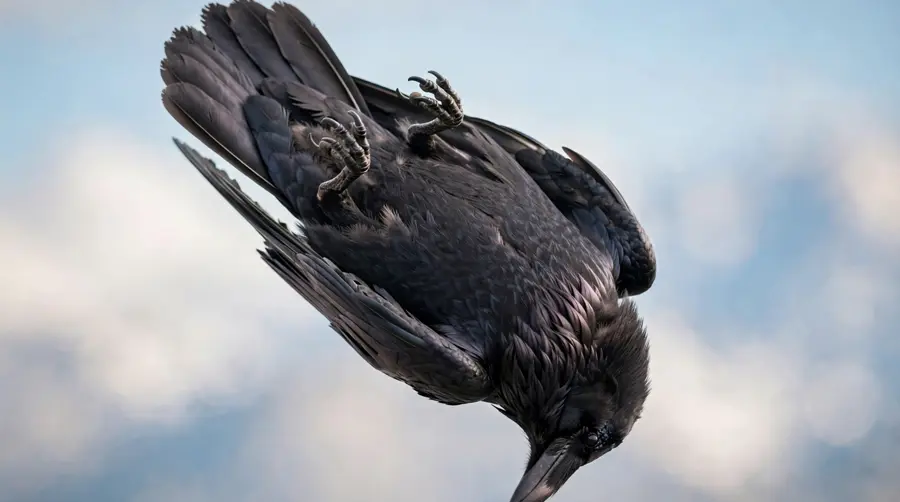
Ravens have been filmed sliding repeatedly down snow-covered slopes and roofs, climbing back up, and doing it again. They tumble and roll in flight for no evident purpose. They hang upside down. They carry objects around and pass them to each other.
Put that beside the gothic reputation. The bird on the gravestone, in life, snowboards.
They point, and they plan
Two findings that genuinely changed how researchers talk about this bird.
Ravens point. Researchers studying wild ravens documented them using the bill to indicate and to show — picking up an object and holding it out to a specific partner, or gesturing toward something to direct that partner’s attention to it. Before that, this kind of referential gesture had been described only in humans and great apes.
That matters more than it sounds. Pointing at a third thing, in order to put it into somebody else’s attention, is the foundation that language is built on. Human infants do it before they can speak. A wild bird doing it is not a party trick.
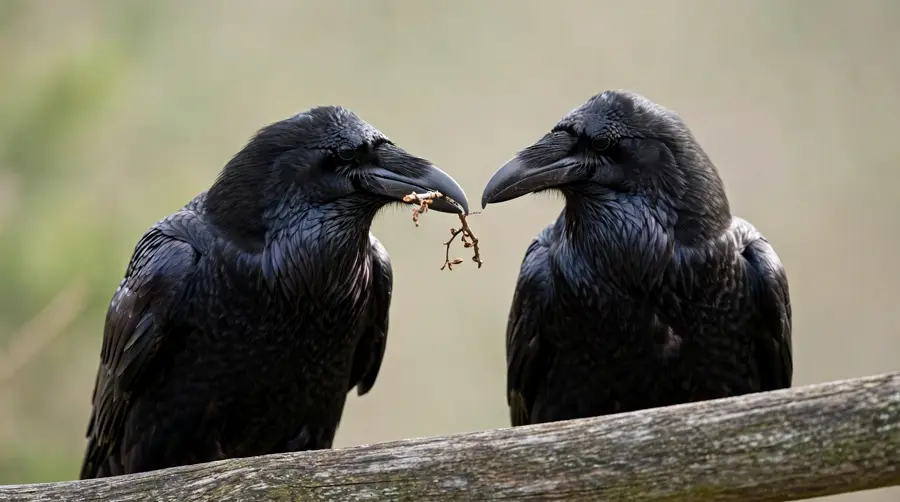
And ravens plan. In experiments testing whether animals can prepare for a future need rather than a present one, ravens selected and saved tools for use the following day, and chose to forgo an immediate small reward in favour of a token that would buy a better one later. They performed comparably with apes.
They also track who has treated them fairly. Ravens remember individuals who cheated them in exchanges and decline to deal with them again.
Thought and Memory, in other words. Whoever named Odin’s birds a thousand years ago got there first.
Four readings
1. It did not bring the death. It has a working relationship with whatever did.
The raven cannot open a carcass and so cannot create its own opportunity. Everything it eats at scale was opened by something stronger, and its entire strategy is to be near that something and to be useful to it.
So the bird of ill omen is not an agent of death. It is a specialist in arriving where power has already acted, and it has made a living out of the gap between what it can see and what it can reach.
That is a recognisable position and not a shameful one. A great many useful people work it: the ones who cannot open the thing themselves, who know exactly where it is, and who have learned to be indispensable to whoever can.
2. It can put something into another mind
The pointing reading. A raven can take an object, hold it out to one particular other raven, and direct that individual’s attention to a third thing.
That is the whole basis of communication — not making a noise, but getting something specific from inside your head into someone else’s by indicating a thing you can both see.
Worth holding next to how much human talking is not that. A bird is out there managing deliberate reference while a great deal of conversation is noise aimed in the general direction of a room.
3. It prepares for a tomorrow it cannot see
Ravens will save a tool for a use that does not yet exist and refuse a small certain reward for a better one that has not arrived.
Which is the capacity people find hardest, and it is sitting in a bird. Not optimism and not discipline in any moral sense — just the ability to treat a future condition as real enough to act on now.
If a raven is your encounter and you want something to do with it, that is the one I would take. Something you are putting off is a tool for tomorrow, and the bird on the fence post would have already picked it up.
4. The gothic raven is younger than your house
The funereal raven — the one on the bust, croaking nevermore — is largely a nineteenth-century creation, and the animal underneath it is a playful, gesturing, forward-planning songbird that slides down roofs for entertainment.
Both things are true at once, and only one of them is about the bird.
Which is worth checking against anything you have inherited a strong feeling about. Some of those feelings are very old and well-founded. Some of them arrived in 1845 with a poem.
Raven who stole the light
The most substantial raven tradition anywhere is not European, and it is the opposite of a death omen.
Among the Haida, Tlingit and Tsimshian peoples of the Pacific Northwest, Raven is a transformer and a trickster and, crucially, the one who brought light into the world. The narratives differ between and within these nations — they are not one story and should not be summarised as one — but the shape recurs: the world was dark, the light was being kept by somebody who would not share it, and Raven got hold of it by deception and released it.
Raven is not noble in these accounts. He is greedy, vain and frequently self-serving, and the good he does is often a by-product of trying to get something to eat. That is a far more interesting figure than either a bad omen or a wise guide.
I am not going to compress any of it further, because these are living traditions belonging to specific nations and a paragraph of summary is already close to the limit of what I can do responsibly. If this is the material you came for, it is worth reading from Haida, Tlingit and Tsimshian sources rather than from a symbolism site.
What I will say is this: the raven that steals the sun and the raven that waits at the gallows are the same species, read by two sets of people who were looking at it in different company.

Where the gothic raven came from
Three sources, and the dates are later than almost everyone assumes.
Poe, 1845. “The Raven” did more to fix the bird’s modern reputation than a thousand years of folklore. Before it, the raven in English had a mixed press — ominous, certainly, but also biblical, heraldic and faintly comic. After it, the raven was a figure of grief with a one-word vocabulary.
The Tower of London ravens. The Crown keeps ravens at the Tower, there is an official Ravenmaster, and the legend says that if the ravens leave, the kingdom will fall. It is a wonderful story and it is probably not old. Researchers looking for the legend in earlier sources have not found it before the nineteenth century, and the version crediting Charles II with the decree appears to be later invention still. The ravens are real and the tradition is maintained seriously; the ancient prophecy attached to it is not ancient.
“An unkindness of ravens.” This and “a murder of crows” come from late-medieval lists of collective nouns — the Book of St Albans and its relatives — which were substantially a courtly literary game rather than a record of how anyone spoke. They were invented to be clever. They have since been repeated so often that they sound like deep tradition, and they are closer to a fifteenth-century parlour amusement.
None of which makes the raven less interesting. It makes the interest better placed — on the bird, rather than on three pieces of literature wearing its feathers.
And in the Bible the raven goes first
Worth stating because the raven’s biblical press is much better than its reputation suggests.
The dove got the olive branch and the better publicity. The raven got sent out first and later ran a delivery service for a prophet.
Noah sends out a raven before he sends the dove — Genesis 8:7. The ravens feed the prophet Elijah in the wilderness, bringing him bread and meat, in 1 Kings 17. And in Luke 12:24 the ravens are the example held up of creatures provided for without sowing or reaping.
The fuller treatment of the religious material across traditions is in crow and raven meaning in the Bible, Hinduism and other traditions.
So is a raven a bad omen?
No, and the reasoning is specific rather than reassuring.
The European death association is real, old and explicable: ravens attended gallows, battlefields and wolf kills, arriving after the event because that is when the food appeared. A population that saw ravens turn up reliably in the wake of death drew the obvious inference and drew it backwards. The raven did not foretell the battle. It had a working arrangement with whatever caused it.
Set against that: the largest raven tradition in the world has Raven bringing light into a dark world. The Norse named their ravens Thought and Memory. Scripture sends the raven out first and then feeds a prophet with it. And the bird itself points, plans, remembers who cheated it, and plays.
If you are going to take a verdict from the weight of the material rather than from one poem, the raven comes out well.
Other corvid encounters
| It was cawing rather than croaking, or at your window | Crow cawing meaning |
| There was only one | One crow meaning |
| It seemed to follow you | Crow following you |
| You counted them | Crow numbers and caw counts |
| You found a dead one | Dead crow meaning |
| Every other bird encounter | Bird signs and omens |
The question to sit with
It cannot open the carcass. It can find it, and it can be present and useful to the animal that can, and it has built an entire existence on that arrangement — closely enough that a religion put ravens and wolves at the side of the same god.
And it points at things. And it saves tools for tomorrow. And it slides down roofs.
So: what can you see clearly and not open yourself — and who is already nearby who could?
For the other side of the partnership, see what it means when a wolf crosses your path.