
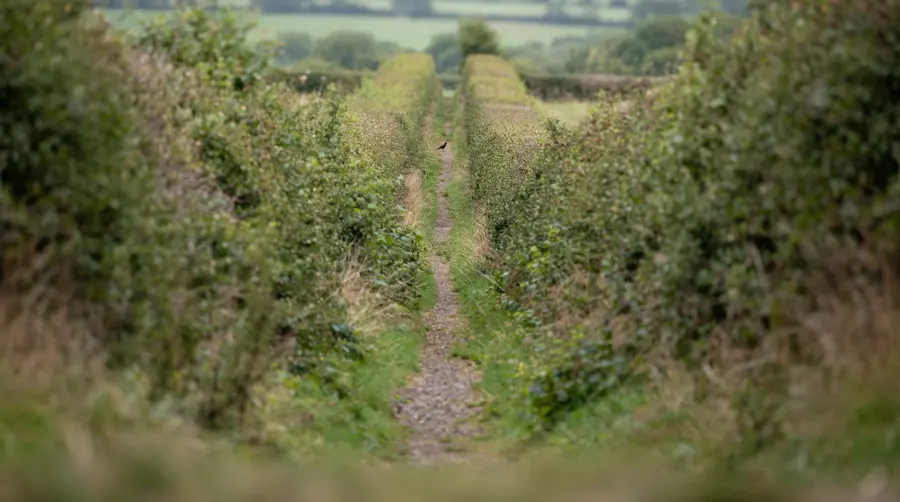
Before anything about messages, here is the explanation that covers most of these and almost nobody mentions.
It probably was not following you. You were pushing it.
A bird perched on a path ahead of you waits until you get close, flies thirty or forty feet further on, and lands again. You keep walking. It happens again. And again. Four or five repetitions and the experience is indistinguishable from being accompanied — or, depending on your mood, from being led somewhere.
Nothing is following anything. You are walking down a corridor and repeatedly flushing the same bird along it.
The ten-second test
You can settle this yourself, and it is the most useful thing on this page.
Turn around and walk back the way you came.
If you were flushing it, the bird stays where it is, or drifts back to where it started. It had a spot, you kept arriving at it, and now you have gone the other way and the problem has solved itself.
If it genuinely follows — if it changes direction with you, keeps your pace, and stays with you over a reversal — then something else is going on, and the rest of this page is about what.
Most people who try this find the bird does not come. That is not a disappointment. It is a clean answer to a question that was bothering you, obtained for nothing.
What it actually was
Five explanations, in rough order of likelihood. The detail that separates them is where the bird was relative to you and whether it was making noise.
| What happened | What it was |
|---|---|
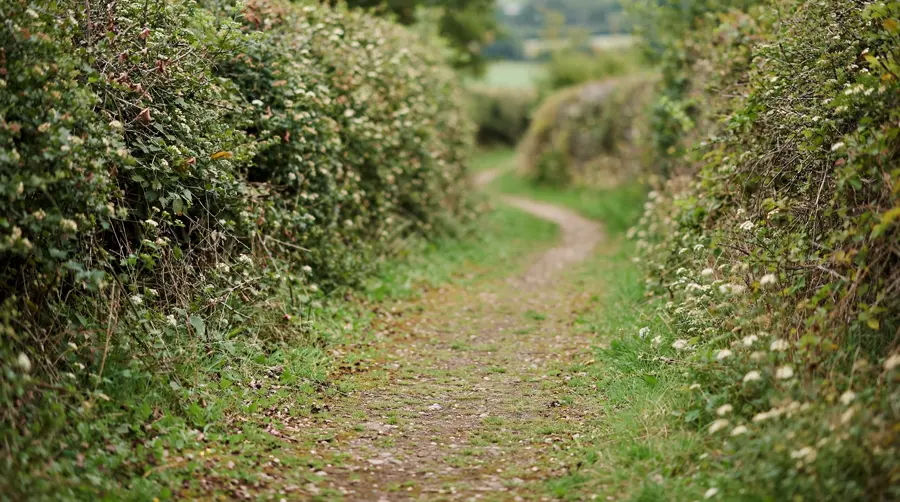
| It kept landing ahead of you on a path, wall or hedge line, quietly, and you kept catching up | You were flushing it. Not following — being displaced |
| It came from behind and above, calling hard and repeatedly, sometimes with others joining | Escorting. You are near a nest and you are being removed. Spring and early summer |
| It got in front of you and waited, looking at you, in a car park or a street | Food. It has learned the shape of a person who feeds crows, and you fit |
| Scruffy-looking bird, late summer, clumsy, intensely curious, would not leave | A fledged juvenile. They are nosy, bad at everything, and will follow a wheelbarrow |
| It genuinely tracked you across a reversal, repeatedly, over days | Rare, and the interesting case. See the last section |
The second row is the one people most often misread, so it gets its own section.
If it came from behind and it was loud, you were being escorted out
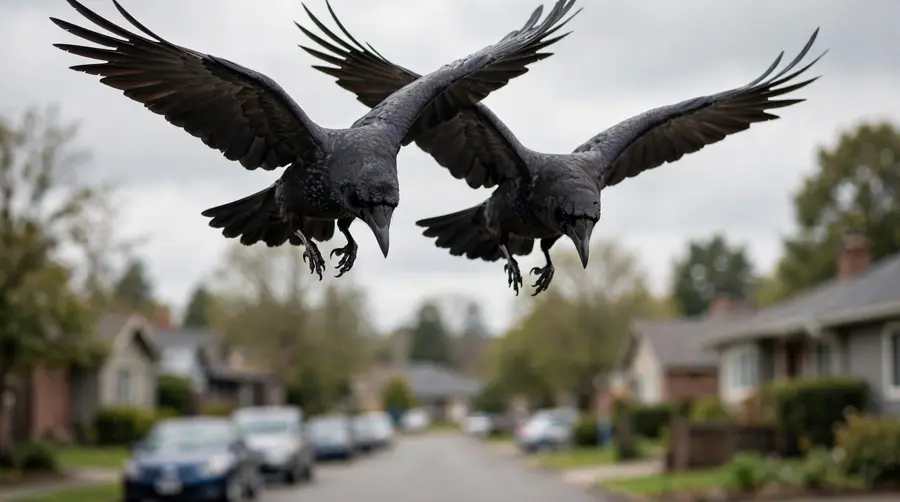
Crows do not only mob predators in place. They escort them — following a cat, a fox, a hawk or a person right to the edge of the territory, calling continuously, sometimes diving close enough to feel.
That is genuinely following you. It is also the opposite of attention in the sense people hope for. You are not being accompanied. You are being seen off.
The giveaways are all present if you look: it comes from behind or above rather than waiting ahead, it calls constantly rather than quietly watching, it may be joined by one or two others, and it stops at a particular line and turns back. That line is the territory boundary and it is the same line every time.
It is also seasonal and it ends. Crows escort hardest when there are eggs or young in the nest — spring into early summer — and the same birds will ignore you entirely by October. If this is happening on your daily walk, the practical answer is to change your route for three or four weeks rather than to fight about it.
And do not retaliate. Crows remember faces and they tell other crows, which turns a seasonal inconvenience into a long-term arrangement.
If it got in front and waited, somebody fed it
Urban crows are exceptionally good at learning what a food source looks like, and the category they learn is not “that person” but “a person of roughly that description doing roughly that thing”.
Which means a crow can approach you expectantly having never met you. You are wearing the uniform of somebody who once produced chips.
They also follow activity that reliably produces food rather than people as such — a dog walker, a mower, someone carrying a takeaway, a gardener turning soil. Crows have been following ploughs for as long as there have been ploughs, and a person digging a border is a very small plough.
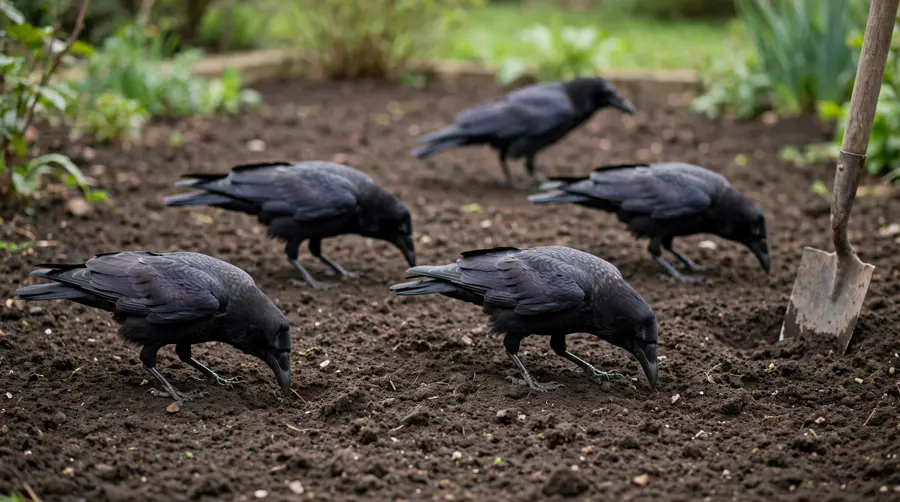
So the attention can be entirely real and entirely not about you. It is about the category you have been filed under, by a bird, on the basis of somebody else’s sandwich.
Four readings
1. You were the pressure, not the destination
The flush reading, and it is the one that applies to most people reading this. The bird moved because you arrived. It landed ahead because ahead was away from you. Then you walked at it again.
From inside the experience it feels like a relationship — something keeping pace with you, choosing to stay. From outside it is one animal repeatedly displacing another along a line.
That happens between people too, and the shape is recognisable: somebody keeps appearing just ahead of you, apparently invested, and the real description is that you keep walking toward where they were standing.
2. Loud attention from behind is removal, not interest
The escorting reading. Being followed and shouted at feels like being singled out, and it is — but for ejection rather than for anything else.
What makes it worth knowing is the boundary. The crow stops at a fixed line and turns back, because its interest in you was never about you; it was about a distance from a nest. Cross the line and the whole thing evaporates.
Some hostility works exactly like that. It appears personal, it is loud, it follows you — and it has a perimeter, and the perimeter is about something behind the person doing the shouting.
3. If it is real, someone put you in the budget
The food reading. A crow that approaches and waits has a model of the world in which people of your description produce food, and that model was built by somebody — a previous tenant, a neighbour, a person at the bus stop, possibly you without noticing.
You have been categorised, accurately, on evidence you were not present for.
Which is worth holding whenever you are treated as something you have not been. Somebody taught that expectation to somebody, and the person who taught it is usually not in the room.
4. Followed and led are the same event in two moods
This is the sharpest one and it falls straight out of the flush mechanic.
The identical sequence — bird lands ahead, you approach, bird moves on, repeat — gets reported two completely different ways. An anxious person says a crow was following them. A hopeful person says a crow was leading them somewhere. Same bird, same path, same thirty-foot hops.
The bird’s behaviour contains no information about which of those it is. All of that came from you.
Which is not a reason to dismiss the experience — it is the most informative part of it. If the same event could have read as guidance and instead read as pursuit, that is worth knowing, and it is about the week you are having rather than the bird.
What the traditions say about being followed
Less than you would think, and it is worth saying so plainly.
There is no substantial, documented, cross-cultural tradition specifically about a crow following a person. What exists is a general European association of crows with death — which comes from scavenging after the fact rather than from prophecy — and a large volume of recent internet content built on the assumption that following must mean message.
The genuine material is about the bird rather than the behaviour. Odin’s ravens are named Thought and Memory and their job is to go out, look, and come back with information. In the Bible the raven is sent out ahead of the dove and later feeds a prophet in the wilderness. In several Indigenous North American traditions — and these differ substantially between nations — crow and raven figures are transformers and bringers of light rather than omens.
Notice that in almost all of it, the crow’s role is going and returning with something. Nobody in the old material has it trailing behind a person. That framing is modern.
The religious and cultural readings in full are in crow meaning in the Bible, Hinduism and other traditions, and the death-omen question in crow cawing meaning.
And if it really is tracking you
If you have done the direction test and it came with you — repeatedly, over days, across reversals — then you have the rare and genuinely interesting version, and there is a real explanation.
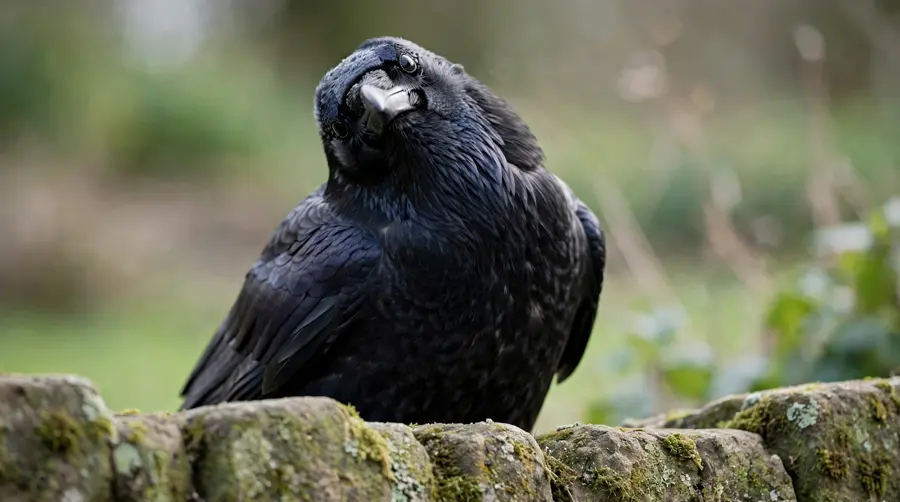
Crows recognise individual human faces, remember them for years, and transmit that recognition to other crows. A bird that has decided you are worth tracking is not behaving randomly; it has identified you specifically and is acting on a judgement it formed earlier.
The judgement goes either way. Crows remember people who threatened them and people who fed them, and they follow both — one hoping, one objecting. Which of those you are getting is usually obvious from the volume.
The research behind this is remarkable and it is the full subject of crow cawing meaning, including the experiments that showed crows passing on the identity of a specific face to birds that had never encountered it.
One practical note. If you would rather it stopped: stop producing anything it wants, stay boring, and do not react. If you would rather it continued, be consistent and expect to acquire more crows than you bargained for. They talk.
Other crow situations
| It was cawing at you, or at your window | Crow cawing meaning |
| There was only one of them | One crow meaning |
| You counted them, or counted the caws | Crow numbers and caw counts |
| They were calling after dark | Hearing crows at night |
| You found a dead crow | Dead crow meaning |
| Every other bird encounter | Bird signs and omens |
The question to sit with
Walk back the way you came. If it stays where it is, you were the pressure and it was getting out of the way. If it comes with you, it knows who you are and it has already decided something about you.
Either answer is better than the question, and both of them are available in about ten seconds.
So: the thing you have been reading as pursuit — have you tried changing direction to see whether it follows?
It was croaking, not cawing, and it looked big: Raven meaning — and raven versus crow.