
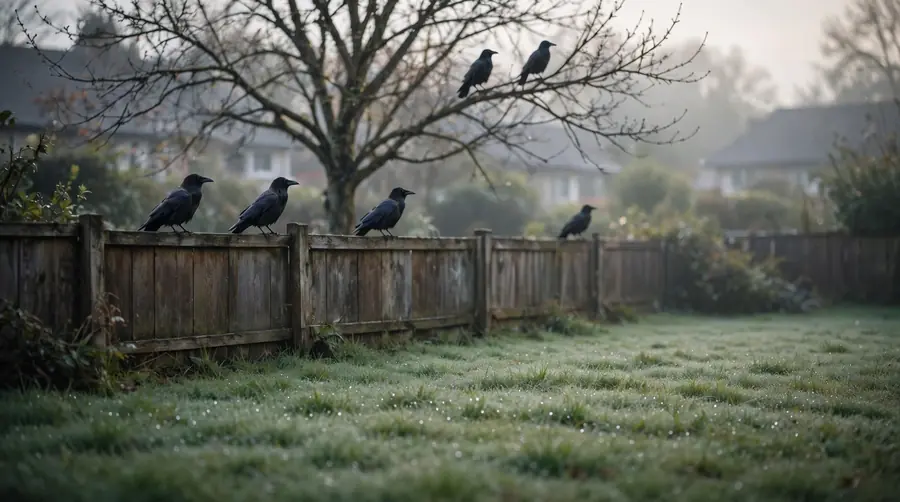
You found it on the lawn, or under a window, or at the bottom of the drive. And then — if it has not started already — the noise begins.
Crows arrive. Not one or two but a dozen, maybe more, and they circle and land in the surrounding trees and call continuously, loudly, for a long time, all of them facing roughly the direction of the body. People find that part far more unsettling than the dead bird itself, and they are right to notice it, because it is the most remarkable thing happening in your garden.
Those crows are not mourning. They are holding something much closer to an investigation, and there is a specific piece of research that explains exactly what they are doing and why it matters that you handle this carefully.
Dead Crow in Your Yard: The Short Answer
A dead crow is traditionally read as the end of a message rather than the start of one. The crow is the messenger bird across most traditions, so a dead one is interpreted as a cycle closing, a warning that has run its course, or bad luck spent rather than arriving. In several folk records it is read as the breaking of something rather than its beginning.
Because it happened in your yard, the reading points at the household rather than at you personally.
Practically: the gathering crows are learning, not grieving. You should remove the body, there are two good reasons to wear gloves, and in some places and seasons it is worth reporting.
Why All the Other Crows Came
This is the heart of it, and no page about dead crows mentions it.
Crows gather around their dead. It has been studied directly — researchers at the University of Washington ran a series of experiments presenting crows with dead crows and watching precisely what the flock did — and the behaviour has a popular name, the crow funeral, which turns out to be slightly the wrong word for it.
What the gathering actually is: a danger-learning event.
When crows find a dead crow, they do not quietly attend it. They mob the area, calling hard, and they study the scene — the place, and anything near it. The function appears to be working out what killed it, so that whatever did can be recognised and avoided in future.
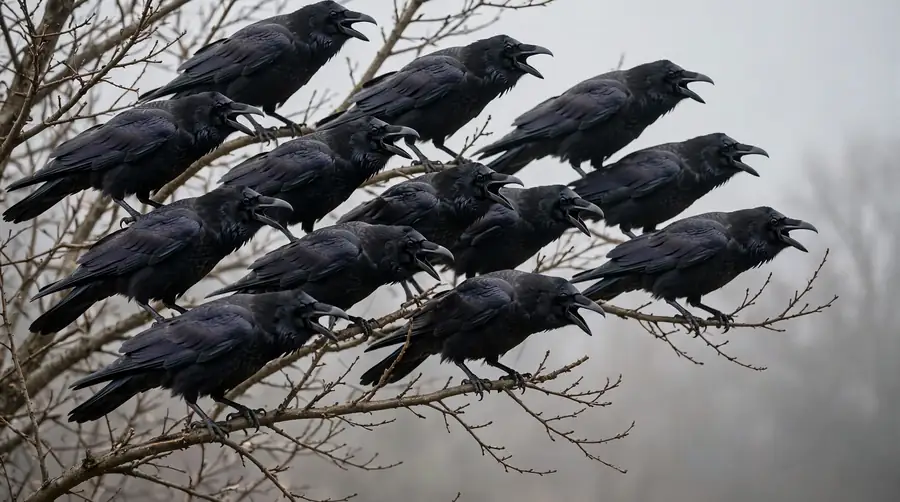
And it works. In the experiments, crows that had seen a dead crow in a particular spot subsequently avoided that spot. They avoided food left there. And — this is the part that matters to you — they learned to associate the danger with whoever was standing there holding it, and continued to scold that person on later encounters.
So the noise in your garden is not a wake. It is closer to a safety briefing, and the subject under discussion is your lawn.
Which gives this encounter a symbolic reading nothing on the internet currently offers, and a better one than the standard material. The crows did not come to grieve. They came to find out what happened and tell each other. They treat a death as information to be shared rather than only as a loss to be felt, and they do it within minutes.
They Are Learning Your Face
This follows directly, it is well established, and it is the one piece of practical advice on this page that will make you laugh and then make you careful.
Crows recognise individual human faces. The same research group demonstrated it by capturing crows while wearing a particular mask, then walking through the same area in that mask afterwards: the crows scolded the mask on sight, for years. Crows that had never been captured did it too, having learned from the ones that had. The grudge spread through the population and was passed to offspring.
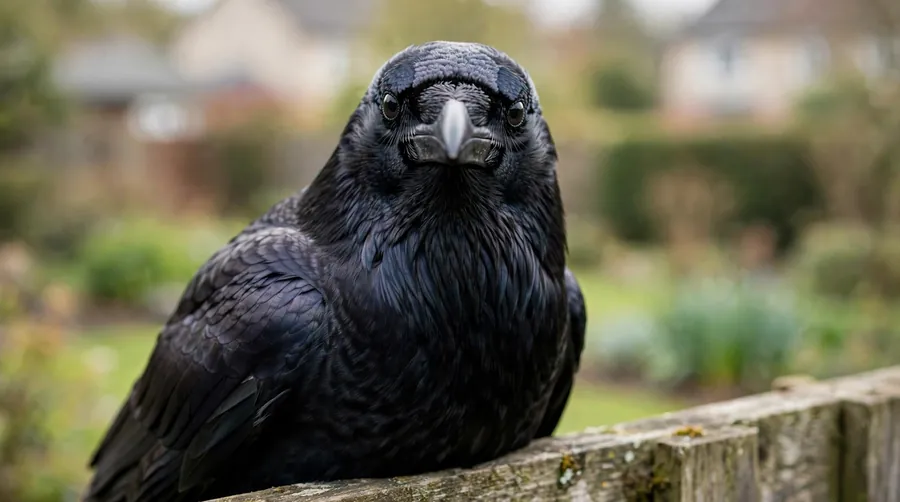
The mask experiments are worth the full telling — what the researchers did and what the crows remembered is covered in our guide to crow cawing and the number of caws.
Now combine that with the section above. There is a dead crow on your lawn, a flock of crows is watching the scene intently and specifically learning what to associate with danger, and you are about to walk out there and pick it up.
So, genuinely, a practical suggestion: do it discreetly. Wait until the crows have dispersed if you can. Do it early, or late, or from a doorway rather than standing in the open with the body held up. A hat and sunglasses are not a joke — they are the simplest way to avoid being the face that got associated with a dead crow.
If you have ever wondered why a particular crow seems to dislike you, this is one of the two or three ways it happens.
Why It Died in Your Yard
There are five likely answers and it is worth knowing which, because one of them has implications.
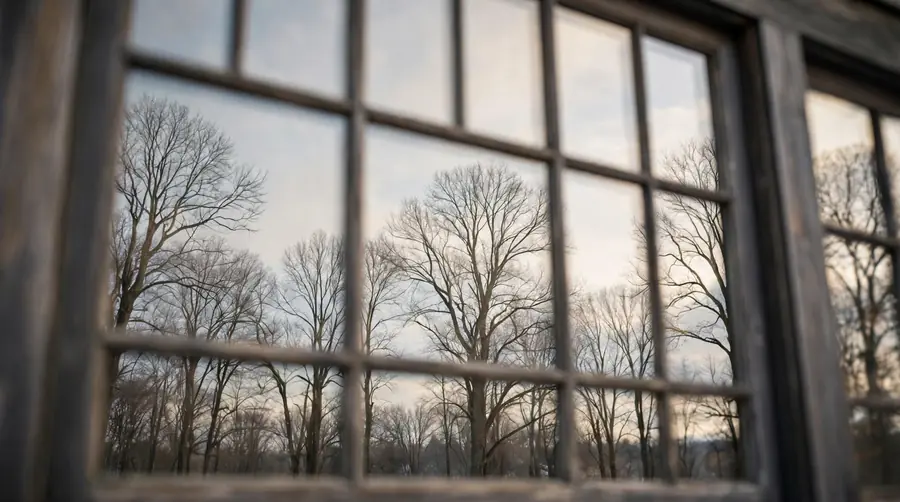
It hit a window. The single most common cause of garden bird deaths. If the body is within a few metres of glass, especially a large window reflecting trees or sky, that is almost certainly what happened. Crows are large and clever but a reflection is a reflection.
A predator caught it. If there are scattered feathers rather than an intact body, or the body is partly eaten, something took it — most likely a hawk. Crows mob hawks relentlessly and occasionally lose.
Disease. Crows are unusually susceptible to several diseases, and the implications of that are important enough to have their own section below.
Poison, second-hand. This is the one nobody considers. Crows scavenge, and a crow that eats a rodent killed by anticoagulant rat poison takes in the poison too. Second-generation rodenticides accumulate in the bodies of poisoned animals, and scavengers and predators that eat several of them accumulate the dose. If you or a neighbour have been using rodent bait, that is a plausible cause of an otherwise unexplained intact dead crow.
It was simply old or unlucky. Crows live a long time for garden birds — well over a decade is possible — and birds do die of ordinary causes. Not every dead animal has a story.
When a Dead Crow Is Worth Reporting
This section exists because it is genuinely useful and because not one page competing for this search mentions it.
Crows are exceptionally susceptible to West Nile virus — far more so than most birds, to the point that an infected crow is very unlikely to survive. That sensitivity made them valuable: during the spread of West Nile virus across North America, dead crow reports were used by public health authorities as an early-warning system, because crows started dying in an area before human cases appeared.
A dead crow was, for a period, a piece of public health infrastructure.
Some states and local health departments still accept or request dead bird reports during mosquito season, and the reporting arrangements vary by region and year. It takes two minutes to search for your state or county’s dead bird reporting page and find out.
The other situation worth acting on: several dead birds in a short period. One dead crow is ordinary. Three or four, or a mix of species, or dead birds with no obvious injury, is a pattern — and avian influenza guidance in most countries asks the public to report groups of dead wild birds rather than individuals. Again, a quick search for your country’s reporting line will tell you the current threshold.
None of this means your crow was diseased. It very probably hit a window. But a single search is a small price for being the person who noticed something.
How to Remove It Safely
Straightforward, and there are two separate reasons to wear gloves.
Do not handle it with bare hands. Dead birds carry parasites that leave the body looking for a new host, and the disease possibilities above are reason enough on their own. Use disposable gloves, or invert a plastic bag over your hand like a glove, pick it up, and turn the bag the right way out around it. Double-bag it.
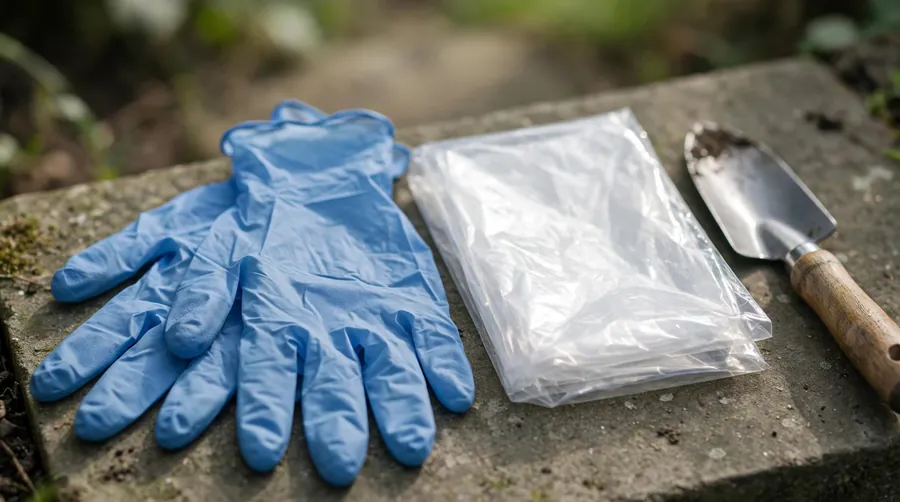
Keep pets well away, before and after. A dog that rolls on or chews a carcass brings everything indoors.
Then household waste, or burial. Bagged into the bin is acceptable in most places. If you would rather bury it, go reasonably deep, away from vegetable beds and water, and do not bury it if you suspect poisoning — a buried poisoned carcass can still be dug up and eaten by something else.
Wash your hands properly afterwards, gloves or not.
And the one additional step this particular bird warrants, from the section above: do it when the flock is not watching.
Four Readings of a Dead Crow in Your Yard
1. The Messenger Has Stopped
The core reading and the one the folk record genuinely supports. The crow is the messenger and the watcher across an extraordinary range of traditions — the bird that carries news, attends battlefields, speaks for the gods. A dead one is therefore read not as a new warning but as a message that has been delivered and finished.
Several folk traditions take this further and read a dead crow as bad luck spent — the omen itself having run out rather than arrived. For a bird as heavily associated with ill fortune as the crow, its death inverts the sign rather than intensifying it.
Which is why, counter-intuitively, this is one of the few dead-animal findings that is traditionally read as a relief.
2. Information Over Grief
From the gathering. The crows’ response to a death is to assemble, investigate, and transmit what they learn — immediately, loudly, and to everyone within earshot.
Read as a message, that is unusually practical: the useful response to a loss may be to find out exactly what happened and make sure the people around you know it, rather than to absorb it privately. The crows do not sit with it. They file a report.
3. Something Ended at Your House
The placement reading. A doorstep is about arrival, a roof is about oversight, and a yard is the household’s own ground — so a dead crow in it is read as something concluding within your domestic life rather than on your path.
The traditional interpretation is not about the household being targeted. It is about a chapter in the household’s life having closed, and the sign arriving on the family’s own territory because that is where the change belongs.
4. The Thing You Were Afraid Of, Already Over
The sharpest of the four. The crow has spent centuries being the animal people dreaded seeing — the bird of battlefields, gallows and plague pits. And here it is on your lawn, small, finished, and entirely harmless.
Traditionally that is read as a prompt about proportion: the thing that frightened you turns out to be mortal, and quite a lot smaller than its reputation. If you have been dreading something, this is the reading most likely aimed at you.
What Changes the Reading
Other Crows Gathering and Calling
The version almost everyone experiences, and read as the most emphatic — a sign witnessed and acknowledged by the bird’s own kind. See the danger-learning section above for what is really going on, and the face-recognition section for why it affects how you should handle it.
No Other Crows at All
Read as the quieter and more personal version. Practically, the flock may simply not have found it yet — crows do not maintain a constant watch over every square metre of their range, and a bird that died overnight under a hedge can go undiscovered for a day.
Near a Window
Read as something striking the boundary of the home. Practically, it is a collision, and worth acting on — breaking up the reflection on the outside of the glass with decals, screens or film prevents the next one. Closing the curtains does nothing, because reflections form when the outside is brighter than the inside.
On the Doorstep Specifically
The threshold placement, read as more pointed than the open lawn. Practically, a bird on a doorstep is quite often a cat’s doing — cats carry prey to the place they consider home base and frequently leave it at an entrance. If there is a cat in the neighbourhood, that is your explanation.
More Than One
Symbolically read as emphasis. Practically, this is the one version that genuinely warrants a phone call rather than an interpretation — see the reporting section. Multiple dead birds in a short period is a pattern, not a sign.
A Dead Raven Rather Than a Crow
Worth checking, because the symbolism differs and so does the legal position in some places. Ravens are substantially larger, with heavier bills, shaggy throat feathers and a wedge-shaped tail rather than a fan. If it was unusually big, it may not have been a crow at all.
The Dead Crow Across Traditions
The crow’s reputation is heavy and the dead crow’s is surprisingly light, which is the opposite of what most people expect.
The crow as messenger runs through an enormous number of traditions. In Norse material Odin keeps two ravens who fly over the world and report back to him. In Celtic material corvids attend battlefields and are associated with goddesses of war and fate. In Hindu tradition crows are connected to the ancestors and are fed deliberately during the rites for the dead. In Japanese tradition a large crow is a divine messenger and appears as a national symbol.
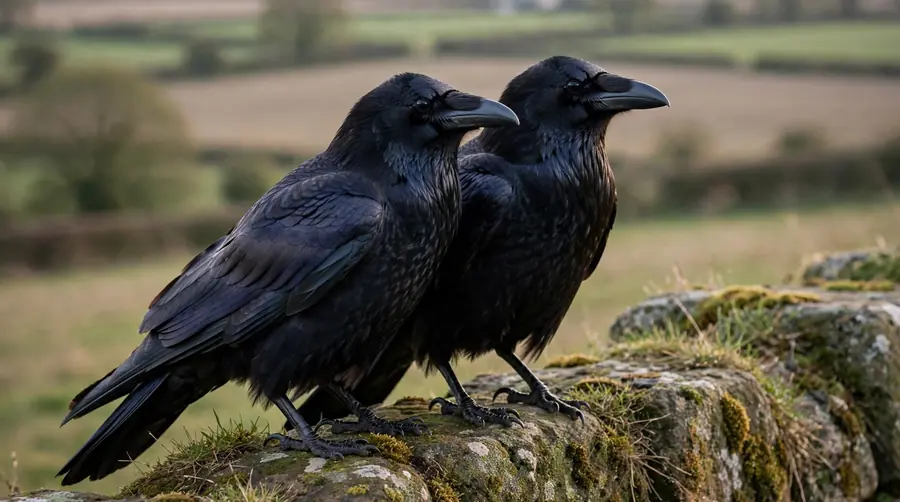
What those traditions share is that the crow carries rather than causes. It is the courier, not the news.
Which is precisely why a dead one reads as it does. Folk records from Celtic, British and Japanese sources point the same way: a dead crow is a cycle ending rather than beginning, the message delivered, the ill luck discharged. It is not a second death omen stacked on top of the first.
And the honest note, because the site this is on would rather be accurate than dramatic: there is no substantial tradition anywhere that reads a dead crow as a warning of a death in the household. The European crow-and-death association is about living crows appearing near the dying and the dead, which they did because they are scavengers who gathered at battlefields, gallows and plague pits. They turned up afterwards. Our guide to hearing crows at night goes into where that reputation came from in detail.
A dead crow has no job in that tradition at all. It is a bird that died in your garden.
For the general meaning of finding a dead crow anywhere, see our guide to the dead crow’s spiritual meaning.
What to Do
Remove it with gloves, discreetly, when the flock has gone. Both halves of that sentence matter and both are explained above.
Look at where it is lying before you move it. Within a few metres of a large window means a collision, and that is fixable. Scattered feathers means a predator. An intact body in the open with no obvious cause is the one worth thinking about.
Spend two minutes checking your local dead bird reporting guidance if it is mosquito season, or if there has been more than one.
Reconsider rodent poison if you use it. Crows scavenge, so they are among the animals most exposed to second-hand rodenticide, along with owls and hawks. If you want the crows in your garden — and they eat a remarkable quantity of insects and carrion you would otherwise have to deal with — poison works against you.
And treat the window glass if that is what happened. Decals or film on the outside. The next bird is the one you can actually do something about.
Then, if you want the reflective part, it comes from the crows rather than from the body. A dozen of them arrived within minutes, made a great deal of noise, worked out what had happened, and left having told each other and remembered the place and the faces involved.
When something goes wrong near you, do you find out what happened and tell the people who need to know — or do you quietly take it in and say nothing?
Frequently Asked Questions
What does a dead crow in your yard mean spiritually?
It is read as the end of a message rather than the start of one. The crow is the messenger bird across most traditions, so a dead one signals a cycle closing or ill luck already spent — and because it happened on your own ground, the reading points at the household. Notably, no substantial tradition reads a dead crow as a warning of a death.
Why are all the crows gathering and screaming at it?
They are learning rather than mourning. Research on crows presented with dead crows found the gathering functions as a danger-learning event: the flock investigates the scene to work out what killed the bird, then avoids that place afterwards. It is closer to a safety briefing than a funeral, and your lawn is the subject.
Should I move a dead crow myself?
Yes, but with gloves or an inverted plastic bag, double-bagged, keeping pets away and washing your hands afterwards — dead birds carry parasites that leave the body looking for a host. And do it discreetly, because crows recognise individual human faces and the same research showed they learn to associate danger with whoever was present at a dead crow.
Do I need to report a dead crow?
Sometimes. Crows are extremely susceptible to West Nile virus, and dead crow reports were used as a public health early-warning system during its spread across North America because crows die before human cases appear. Some health departments still accept reports in mosquito season. Several dead birds in a short period is also worth reporting under avian influenza guidance.
Why did the crow die in my yard?
Most likely a window collision, especially if it is lying within a few metres of large glass. Other common causes are predation by a hawk, which leaves scattered feathers, disease, and secondary poisoning from eating a rodent killed by rat bait. Crows can live well over a decade, so ordinary death is also possible.