
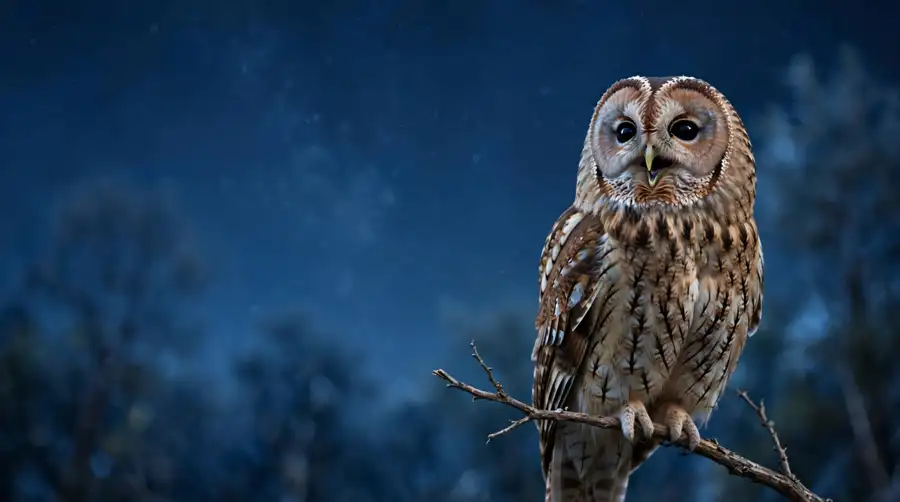
You woke up and it was out there. That low, soft, carrying sound — not loud, not close, but somehow filling the whole dark outside the window. You lay still and listened, and after a few seconds it came again.
Every page about this will tell you the owl means wisdom and intuition, and several will tell you what two hoots mean versus three.
Here is what none of them will tell you. If you heard the full classic owl sound — the one everybody knows, the sharp note followed by the long quavering call — you were not listening to one owl. You were listening to two, answering each other across the dark. The most famous owl sound in the English language is a conversation, and it has been misheard as a solo for at least four hundred years.
If you are not certain the sound was an owl at all, work through the identification table in our guide to hearing howling at night.
Owl Hooting at Night: The Short Answer
An owl hooting at night is traditionally read as a call to pay attention to what you already know — wisdom you are not acting on, rather than wisdom you need to acquire. The hoot is treated as a summons rather than a warning in most traditions, and the death-omen reading is narrower and later than people assume.
Practically, the owl is advertising. A hoot is a territorial announcement and a contact call between mates, it peaks in autumn and late winter, and the number of notes tells you the species rather than the message.
The Classic Owl Sound Is Two Owls
This is the fact the whole topic should be built on, and it is absent from every page written about it.
Everyone in the English-speaking world knows the owl sound as “twit twoo.” It is in children’s books, Halloween soundtracks, and the ambient audio of every film scene set in a wood at night.
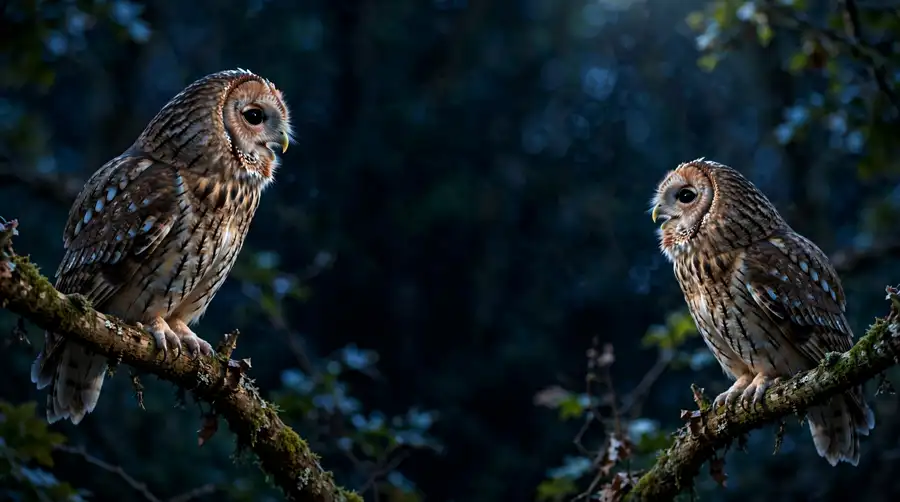
It is not one bird’s call. It is a duet between a mated pair of tawny owls. The female produces the sharp, abrupt ke-wick — the “twit.” The male answers with the long, breathy, quavering hoooo… hu-hoooooo — the “twoo.” Two birds, two voices, calling back and forth, often from separate trees some distance apart.
The misunderstanding is old enough to be literature. Shakespeare wrote the sound into a song in Love’s Labour’s Lost — “Then nightly sings the staring owl, Tu-whit, tu-who” — as a single bird singing. He was writing down what everybody heard, and everybody has been hearing it wrong ever since.
So if you lay in the dark and heard both parts of that sound, the thing you were actually listening to was a pair of owls maintaining contact with each other through the night. Not one bird calling into emptiness. Two birds confirming the other was still there.
Read as a sign, that inverts the entire feeling of the experience. The hoot in the dark registers to human ears as the loneliest noise in nature, which is exactly why it has been pressed into service for every haunted house in cinema. What it actually is, in the great majority of cases, is a bond being kept up out loud.
Which Owl Did You Hear?
Worth settling, because the answer changes what the sound was for — and because a surprising number of people have not heard an owl at all.
A Deep, Soft, Rhythmic Four or Five Notes
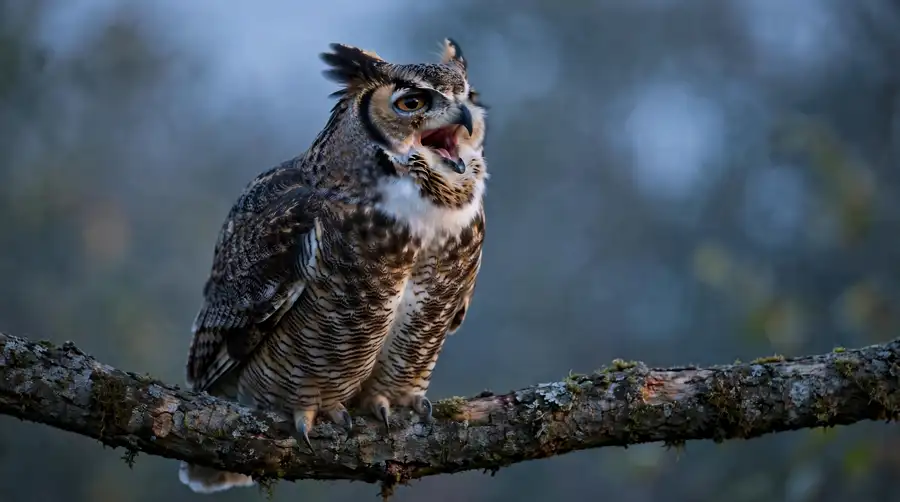
A great horned owl, if you are in North America. The classic American hoot: low, resonant, and patterned, usually rendered as hoo-hoo-hoooo, hoo-hoo. Deeper than you expect and quieter than you expect, and it carries a long way for how soft it sounds up close.
A Rhythm That Sounds Like a Question
A barred owl. The standard mnemonic is “Who cooks for you? Who cooks for you-all?” and it is startling how exactly the rhythm fits. Eight or nine notes, ending on a drawn-out slurred note that falls away.
Barred owls also produce an extraordinary range of other noises — barking, cackling, and pair duets that sound genuinely unhinged. If you heard something in the night that sounded like two animals having an argument in a language you did not recognise, it was probably these.
A Sharp Note and a Long Quavering Answer
A pair of tawny owls, if you are in Britain or Europe. See the section above — that is the duet, and you heard two birds.
A Rising, Shrill, Terrible Scream
A barn owl — and this is worth knowing because barn owls cannot hoot at all. They have no hooting call in their repertoire. They shriek, and the shriek is the actual origin of most of the owl death-omen tradition in Europe. If what you heard was closer to a scream than a hoot, our guide to owl screeching at night is the one you want.
A Soft, Mournful, Descending Coo
Not an owl. This is a mourning dove, and it is one of the most misidentified sounds in North America — people hear it and report an owl constantly. The giveaway is the time: doves call in daylight and especially at dawn and dusk, while owls are calling in full dark. If you heard your “owl” at four in the afternoon, it was a dove.
And the reading changes completely, in a way worth knowing — that call is a male dove advertising for a mate. Our guide to the mourning dove covers it.
A Descending Horse-Like Whinny or a Soft Trill
An eastern screech owl, which despite the name does not screech and does not hoot either. It produces a soft descending whinny and an even trill, and it is much smaller than people expect for the noise it makes.
Does the Number of Hoots Mean Anything?
People count, and there is a whole genre of writing assigning a meaning to two hoots versus three versus seven. So here is the honest answer, and it is more useful than the numerology.
The number of notes identifies the species. That is what it is for. It is not a message length and the owl is not choosing it.
A great horned owl hoots in a set pattern of four or five notes because that is the great horned owl’s call — it will produce the same number tonight, tomorrow and next year. A barred owl gives eight or nine because that is the barred owl phrase. A tawny male’s hoot is one long note, a pause, then a quavering run. These are species signatures, as fixed as a bird’s plumage. The same is true of a ladybug’s spots.
So counting is genuinely worth doing. It just answers a different question than the folklore thought. You were not being told how many months, or receiving a numbered warning. You were being told, quite precisely, which bird is outside.
Two notes in particular, since it is the most asked. Three hoots has acquired a specific reputation as a death omen in modern retellings. No owl selects three. If you heard three distinct notes you most likely heard part of a great horned owl’s sequence, or the first phrase of a longer call, or two birds overlapping. The number carried no intent, because nothing in the bird’s anatomy can vary it that way.
Which does not mean the moment meant nothing to you. It means the information in it was about the species, and whatever else you take from it is yours rather than the owl’s.
Four Readings of an Owl Hooting at Night
1. Knowing Rather Than Learning
The core reading, and it is more specific than “wisdom.” The owl is not associated with acquiring knowledge — it is associated with already having it. Athena’s owl did not represent study. It represented the thing that sees in the dark.
So the traditional interpretation is usually uncomfortable rather than flattering: there is something you have worked out and have not admitted to yourself, and the call is read as a prompt to stop pretending you need more information before acting.
2. Choosing to Be Heard
This is the best reading available on the topic and it comes from a genuinely remarkable piece of anatomy.
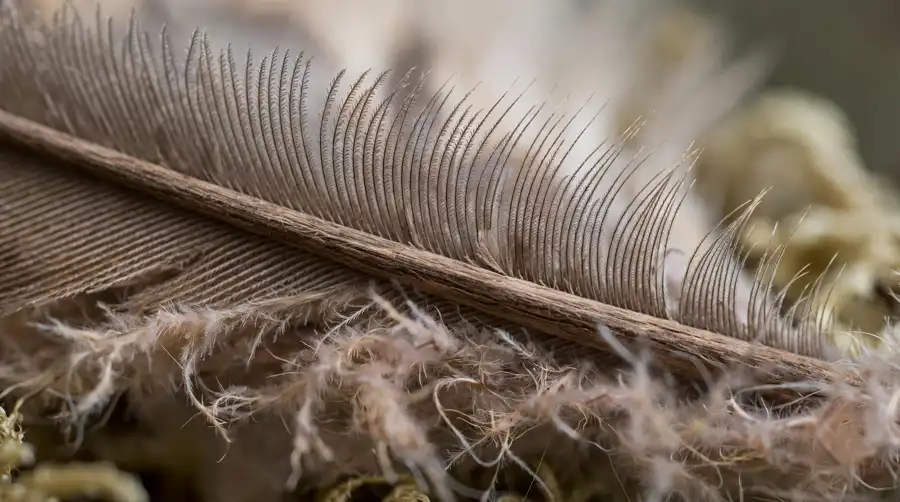
Owls fly almost silently, and it is engineered rather than incidental. The leading edge of the flight feathers carries a comb-like fringe that breaks up the airflow before it can form noisy turbulence. The trailing edge is soft and frayed rather than crisp. And the feather surfaces are covered in a velvety down that absorbs what sound remains. A large owl can cross a room-width of air above a mouse and the mouse hears nothing.
Now hold that against the hoot. This is an animal built, feather by feather, for not being detected — and it has a call that carries across a mile of woodland.
Which means the owl has something almost nothing else has: complete control over whether it is perceived. It announces itself across enormous distance when it wants a mate or a boundary respected, and then crosses the last thirty feet of its hunt in total silence.
Read as a message, that is the sharpest thing this bird offers. The hoot is not noise. It is the owl deciding to be audible. And the question it puts to you is when you are choosing to be heard, and whether you are choosing it at all or simply making noise by default.
3. A Boundary Being Stated
What the hoot is actually for. A male owl hooting is making a territorial declaration — this ground is held, I am in it, I am in good enough condition to say so loudly.
Owls settle most territorial disputes by voice rather than by fighting, which is the point. The hooting is how the conflict is avoided. Two birds call across the boundary, each assesses the other, and neither has to risk an injury that would end its hunting life.
Read as a sign, the reading is about saying where your edge is clearly enough that nobody has to find it the hard way.
4. Hearing What Others Cannot
The owl’s hearing is as extreme as its silence. The flat facial disc works as a sound-collecting dish, funnelling noise toward the ears, and the bird can adjust those feathers to focus it. In several species the two ear openings are set at different heights, which gives the owl vertical as well as horizontal sound location — it can place a noise up and down, not just left and right.
The result is that some owls can locate and catch a mouse moving under snow, in complete darkness, by sound alone.
So the bird broadcasting into the night is also the bird with the most precise hearing in the wood. It is advertising in the exact medium it is most sensitive to — which is a reading about listening as much as speaking, and about the fact that the best listener present is the one making the noise.
Why You Are Hearing It Now
Timing explains far more of these encounters than symbolism does, and the seasonal pattern is sharp.
Autumn is peak hooting season, and there is a specific reason. That year’s young owls reach independence and are driven out of their parents’ territory, and they go looking for ground of their own. Simultaneously the adults reassert their boundaries against the wandering juveniles. The result is a surge of territorial calling through roughly September to November.
Which is worth noticing, because that is also when people most report hearing owls — and it maps precisely onto the owl’s association with Halloween. The bird is not more spiritually active in late October. There are simply more young owls homeless in late October than at any other point in the year, and more adults telling them so.
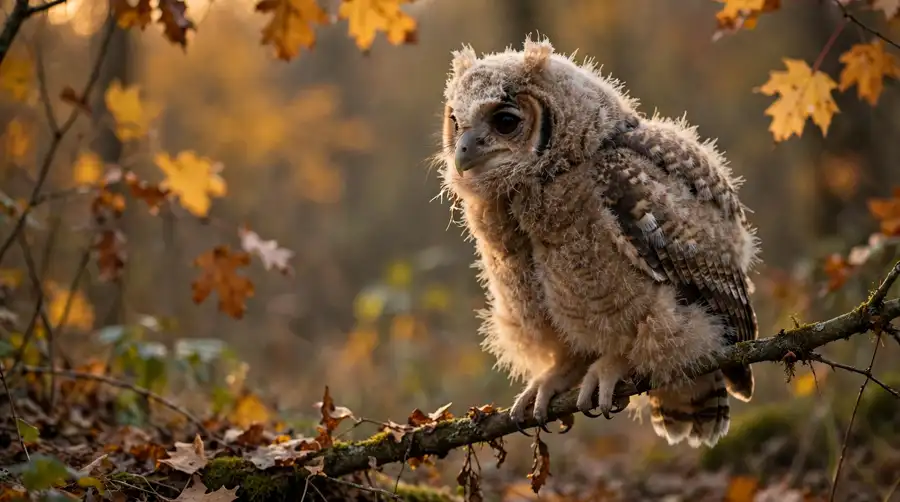
Late winter is the second peak, this time for courtship. Great horned owls nest extraordinarily early, often sitting on eggs while snow is still on the ground, so their calling ramps up in December and January. A pair duetting in deep midwinter is a pair setting up a nest.
And summer is the quiet season. If you are hearing persistent owl noise in July, it is often young birds begging — a rasping, repetitive, insistent sound quite unlike a hoot, which can go on for hours and drives people to look up what is wrong with the owl outside their window.
What Changes the Reading
Hooting Right Outside Your Window
Read as the most personal and most urgent version of the sign, on the general principle that proximity intensifies a message.
Practically, owls choose calling perches for how far the sound will carry — a bare branch, a roof ridge, a chimney, a telephone pole. If one is using a tree by your house repeatedly, it has worked out that the spot broadcasts well. Your house is in a good acoustic position, which is a less romantic explanation and a more reassuring one. For the full reading of this placement, see our guide to an owl on the roof.
Hooting Three Nights in a Row
Repetition is read as emphasis across every sign tradition — the message resent because it was not received. Practically, an owl holds a territory for years and uses the same perches, so three nights in a row means you live inside one bird’s patch and it is doing its nightly rounds. That is not a lesser answer. It means you have a resident.
Hooting During the Day
Treated as unusual and therefore significant in most traditions. It is also genuinely less rare than people think — owls do call in daylight, particularly during breeding season and particularly when disturbed. But check the mourning dove entry above first, because daytime is when that misidentification almost always happens.
Hooting and Then Sudden Silence
Unnerving, and there is usually a reason. An owl stops calling when it detects something — including you, if you opened a window or stepped outside. It may also have switched from advertising to hunting, which means going quiet by definition.
Crows Going Berserk at It in the Morning
If the owl you heard overnight is found at dawn by crows, you will know about it. Crows mob owls relentlessly, and it is how most people ever actually see one. Our guide to hearing crows at night covers that behaviour, including why crow noise after dark often means an owl is nearby.
Athena’s Owl, and Rome’s Omen
The owl is the clearest example in the animal world of two neighbouring cultures reaching opposite conclusions about the same bird, and the contrast is worth knowing because it explains the mess the modern reading is in.
Greece made it wisdom. The little owl was the bird of Athena, goddess of wisdom and of the city that bore her name, and the association was not vague — it was on the money. The Athenian silver coin carried Athena’s head on one face and her owl on the other, and those coins circulated across the ancient Mediterranean for centuries. There was even a proverb, “owls to Athens,” meaning to bring something to a place that already has more than enough of it.
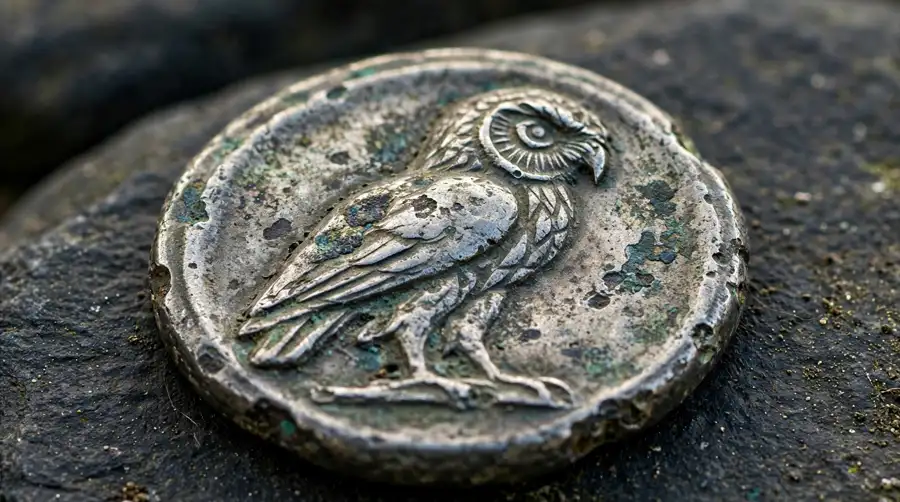
The owl was, quite literally, the currency of the ancient world’s most famous democracy.
Rome made it death. The Romans adopted Athena as Minerva and kept the owl as her attribute — and simultaneously regarded a hooting owl as one of the worst omens available. Roman writers recorded owl calls as funereal and as portents preceding the deaths of prominent men, and an owl getting into a building was cause for ritual cleansing.
Same bird. Same goddess, under two names. Wisdom in Athens, a death notice in Rome, within a few hundred miles and a few hundred years.
It is the Roman version that travelled into European folklore and then into the horror soundtrack, which is why the hoot sounds ominous to you and not scholarly. But it was never the only reading, and it was never the original one.
Elsewhere the picture is better. In Hinduism the owl is the vahana — the mount — of Lakshmi, goddess of wealth and fortune, which gives it an association with prosperity, though the tradition is not uniformly positive. In Japan owls are widely treated as lucky, helped by the fact that the word for owl can be written with characters suggesting the absence of hardship, and owl charms are common. And across various Native American traditions the owl appears both as a figure connected to death and the spirits of the dead and as a protector, varying substantially between nations in ways that should not be flattened into one claim.
What to Do
Do not play recorded owl calls to get a response. This is the one with real stakes and almost nobody knows it. Playing a call makes a territorial bird believe a rival has arrived, and it will burn energy it cannot spare responding to an intruder that does not exist. Done repeatedly it can draw birds off nests and disrupt breeding. Birding organisations advise against it firmly, and in some protected areas it is prohibited outright. Listening is free and does no harm; broadcasting is not.
Do not go looking with a torch. Owls are not harmed by being seen, but a bright light in the face of a bird whose entire livelihood depends on night vision is a genuine disturbance, and disturbing nesting owls is illegal in many places.
Note three things while it is fresh. The month, the rhythm of the notes, and whether anything answered. Those three decide which of the readings above is actually yours, and they fade by morning.
Then go back to bed and listen properly. Most people never knowingly hear a wild owl in their lives, and you have one working the ground your house sits on.
And if you want the question this bird actually puts, it is the one from the second reading. The owl is built from the ground up for not being heard, and it chose to make that sound.
What are you currently being loud about by accident, and what have you gone quiet about on purpose?
Frequently Asked Questions
What does it mean when an owl hoots at night?
Traditionally it is read as a call to act on something you already know rather than a warning of harm — the owl is associated with having knowledge rather than acquiring it. Practically, a hoot is a territorial declaration and a contact call between mates, and it peaks in autumn when that year’s young are dispersing and adults are reasserting boundaries.
Does the number of hoots mean something?
Yes, but not what the folklore claims — the number of notes identifies the species. A great horned owl always gives four or five, a barred owl eight or nine in its “who cooks for you-all” phrase. These are fixed species signatures, so the owl is not choosing a count and three hoots is not a death omen. Counting tells you which bird is outside.
Is an owl hooting a bad omen?
It depends entirely which tradition you ask, and two neighbouring ones flatly disagree. Greece made the owl the bird of Athena and put it on its coinage as a symbol of wisdom. Rome kept the same goddess and treated a hooting owl as a serious death omen. The Roman reading is the one that reached European folklore and the horror soundtrack, but it was never the original.
Is the “twit twoo” sound really one owl?
No — it is two. The familiar sound is a duet between a mated pair of tawny owls, with the female giving the sharp “ke-wick” and the male answering with the long quavering hoot. Shakespeare wrote it down as a single bird singing in Love’s Labour’s Lost, so the mistake is at least four centuries old.
Why do I hear owls so much in October?
Because autumn is dispersal season. That year’s young owls are driven out of their parents’ territory and go searching for their own, while the adults call to reassert boundaries against them — producing a surge of territorial hooting through roughly September to November. The owl’s Halloween association is built on juvenile dispersal rather than on anything about the season.