
Where you are reading this from changes the question entirely, so let me split it at the start.
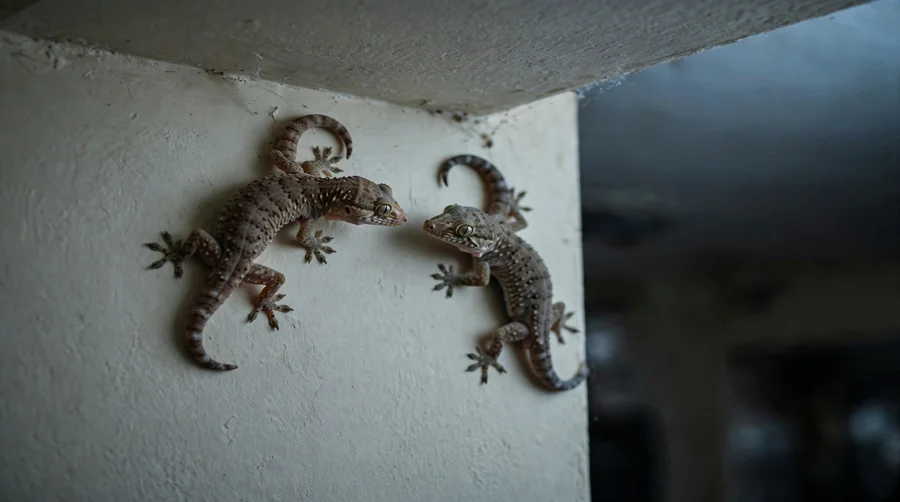
If you live in India, Southeast Asia, the Gulf, East Africa, the Caribbean or the warm parts of the Americas, a house gecko is not a visitor. It is a resident, there are probably several, and they have been there longer than you have. If you live in the UK, northern Europe or most of the United States, a lizard indoors is genuinely unusual, and the most useful thing I can tell you is that it will die in there within days unless you get it out.
Both groups are being badly served. The English-language pages on this subject do not mention the enormous and highly specific tradition that actually governs this belief for hundreds of millions of people. The Indian astrology pages cover that tradition in detail and never mention the animal. This article does both.
What you probably saw
| What it looked like | What it was |
|---|---|
| Pale pinkish-grey or translucent, soft-looking, sticky-footed, on a wall or ceiling, active at night near a light | A house gecko. The commonest answer worldwide by an enormous margin |
| Larger, grey-blue, loud barking call, tropical Asia | A tokay gecko. Named after the sound it makes |
| Small, brown or green, able to change between the two, with a pink or red throat fan, southeastern US | A green anole, or a brown anole |
| Shiny, smooth, almost snake-like, fast, with short legs — possibly a bright blue tail | A skink. The blue tail means a juvenile |
| Small, brown, grey or greenish, basking on a sunny wall, southern Europe | A wall lizard |
| Found it slow, cold and barely moving indoors in winter | Any of the above, chilled. It is ectothermic and it is in trouble |
Almost none of the pages competing for this search will tell you which animal you are looking at, and several will cheerfully discuss chameleons, which are not in anyone’s kitchen.
Can it survive in there? Mostly no
House geckos in warm climates do genuinely live indoors, permanently and successfully, because the insects they eat come indoors too. Those animals are fine and need nothing from you.
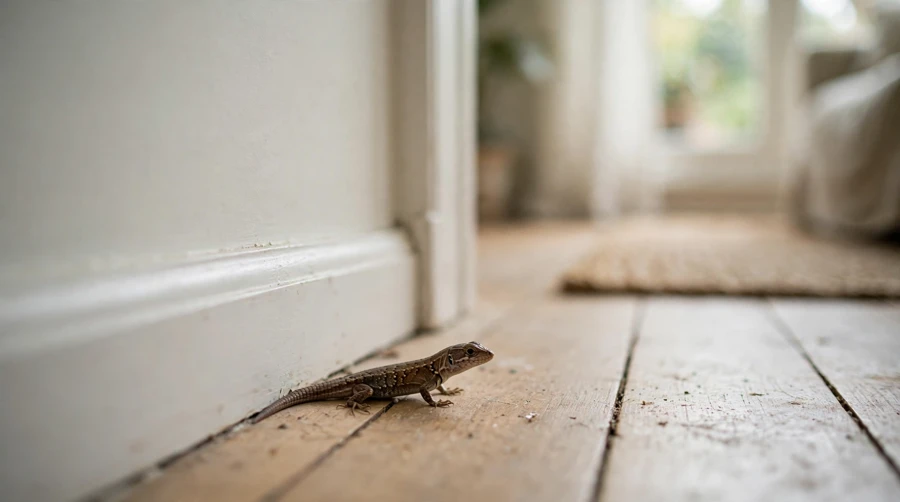
Everything else is a different story. A lizard that has wandered into a heated, dry, insect-poor house in a cool climate is in a slow emergency. It has no water, very little to eat, and nowhere to warm itself properly or cool down. Dehydration is usually what gets them, and it does not take long.
So if you are in a temperate country and there is a lizard behind your sofa, the kind response is not to decide what it means. It is to put it outside today.
How to get it out without hurting it
Shut the doors to the rest of the house, open the door or window to outside, and give it a clear run along a wall — lizards follow edges rather than crossing open floor. Often that is all it takes.
If you need to catch it, drop a light cloth or tea towel over it and gather it up gently, or coax it into a box with a sheet of card. Work slowly and low to the ground, because a dropped lizard can be injured.
Never pick a lizard up by its tail. This is the one thing that matters most and the reason is in the section below — the tail is designed to come off in your hand, and it is a real cost to the animal.
Release it somewhere sheltered — under a hedge, a log pile, a warm wall with cover — not in the middle of a lawn where a cat or a bird will have it immediately. And if it is winter and cold outside, choose a shed, garage or outbuilding rather than open ground. If the animal behind your sofa turns out to be a snake rather than a lizard, the advice is different — read what finding a snake in the house means and how to handle it safely. Other arthropods slip indoors through the same gaps, too — a scorpion in the house is another small visitor that comes in after dark.
It came in because of your lights
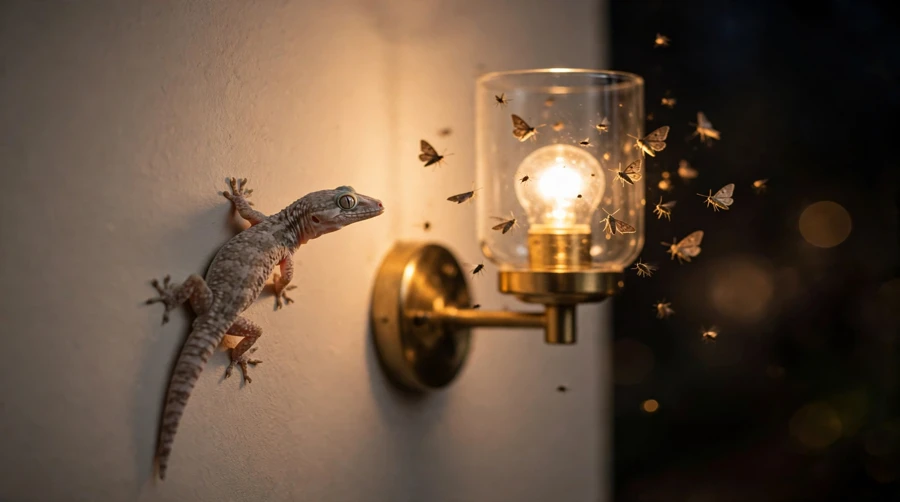
Here is the first thing that reframes the encounter. House geckos are not drawn to houses. They are drawn to the insects, and the insects are drawn to the lamps.
Watch where they sit and the whole thing becomes obvious: on the wall beside the porch light, around the window, near the kitchen bulb. They are stationed at a food source we installed and keep running every night for free.
This is not a minor behavioural note. The common house gecko is one of the most widely distributed reptiles on earth, carried around the world in cargo and then established wherever there are buildings — and the mechanism of that success is artificial light. We built a global network of insect traps and a small lizard learned to hunt it.
So the animal in your house did not come for you, and it did not come because of your week. It came because of your electricity bill.
Why it was on the ceiling — and why it fell
A gecko can hang from a ceiling by a single toe, and the mechanism is stranger than suction or glue. Its toe pads are covered in millions of microscopic hairs, each splitting into finer tips, and those tips get close enough to the surface to be held by van der Waals forces — the faint attraction between molecules in near contact.
It works on glass. It works upside down. The pads are also self-cleaning, which is why a gecko does not need to wash its feet to keep climbing. The mechanism was demonstrated experimentally in 2002, when researchers showed that a single gecko seta adheres by van der Waals forces alone.
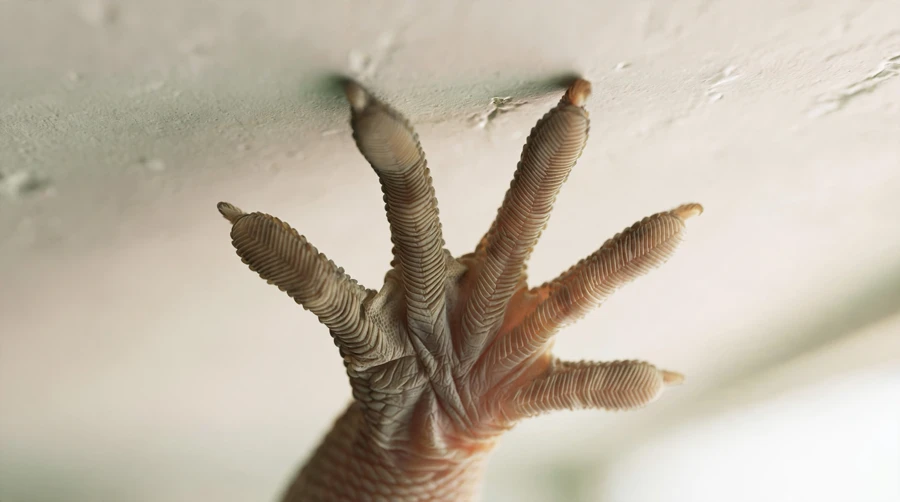
And because the whole system depends on intimate contact, it fails in specific, boring ways. Dust, grease, condensation, fresh paint and wet surfaces all break the contact. So do sudden movements, and so does being shoved by another gecko.
That last one matters enormously for the section further down. Male house geckos are territorial and they fight on walls and ceilings, and a scuffle over a lighting fixture is one of the commonest reasons a gecko comes off a ceiling. If a lizard fell on you, the overwhelmingly likely cause is a grip failure or an argument with another lizard above your head. You were not selected. You were underneath.
The tail is the real story
Every page on this subject says the lizard means renewal and regeneration. Almost none of them knows how it actually works, and the real mechanism is far better than the slogan.
Many lizards can shed their tail to escape — caudal autotomy. The detail that matters is that this is not tearing. The tail vertebrae contain pre-formed fracture planes: built-in weak points, with the muscles and blood vessels arranged to separate cleanly along them. The capacity to lose that part was constructed in advance, before any predator ever showed up.
Then the discarded tail thrashes, sometimes for several minutes. That is its job. It is not a twitching leftover; it is a decoy designed to hold attention while the animal that owned it walks away.
And it regrows — but not as the same thing. The replacement is supported by a rod of cartilage rather than the original segmented bone, and it is usually a different shape, a different colour, and often stubbier. A lizard with a regrown tail is visibly a lizard that has been through something.
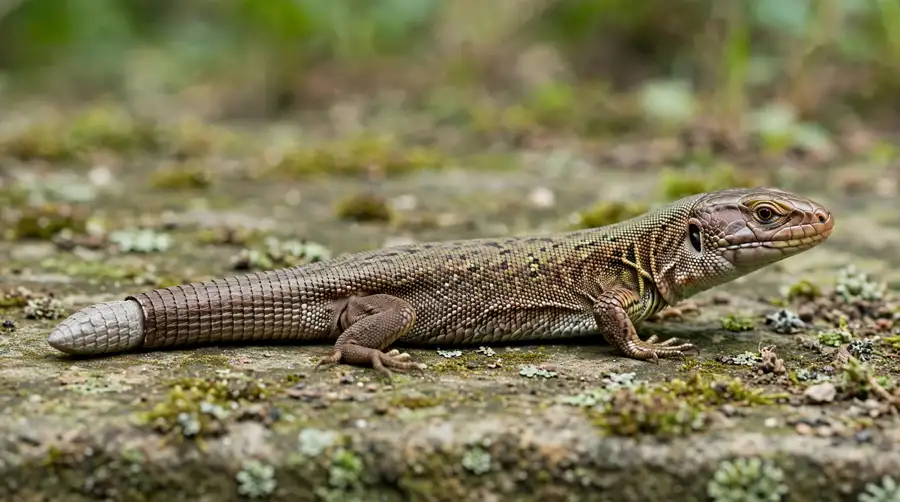
The cost is real too. The tail stores fat, helps with balance and climbing, and matters in social and mating competition. Losing it is survivable and it is not free.
The chirp is a male telling other males to leave
Most lizards are silent. Geckos are one of the few groups that call, which is why they are the lizards people hear as well as see — and the tokay gecko is literally named after its own call.
The chirping and clicking is largely male advertisement and territorial challenge: a claim on a patch of wall and the insects that come to it. In the tradition described below, the sound is read for meaning. Biologically, it is a boundary dispute.
Which is worth knowing before anything else. The sound is real, it is communication, and it is not addressed to you.
Gowli Shastra: the tradition nobody writing in English mentions
If you searched this because a lizard fell on you and you are uneasy, this is the section you came for, and the English-language spiritual sites will not have given it to you. They tend to offer Egyptian protection symbolism and vague references to Native American belief, and skip the single largest living body of lizard divination in the world.
It goes by several names depending on language and region: Gowli Shastra, Gowli Pathana Shastra, Gauli Shastra, Gowli Panchangam, and in Tamil and Malayalam contexts Palli Dosham or Balli Paatu Dosham. In Hindi the event is chipkali girna — the lizard falling.
It is a genuinely systematic divination scheme rather than a loose superstition. It maps the human body into a long list of locations — different sources give different counts, with sixty-five sometimes cited — and assigns a specific outcome to a lizard landing on each one. Material of this kind appears in printed panchangams and is associated with the astrological text Muhurta Martanda, and in Kerala the practice extends to reading the lizard’s call and even the kind of lizard seen on a given day.
A crucial structural feature, and the sources agree on it: the reading is mirrored by sex. Broadly, for a man the right side of the body carries the favourable readings and the left the unfavourable; for a woman it is reversed. So the same event on the same shoulder means opposite things to two people standing side by side.
Here is a small sample of commonly listed readings, given so you can see the shape of the system:
| Where it lands | A commonly given reading |
|---|---|
| Head | Conflict or quarrel; in some versions, a serious warning |
| Hair | Danger or the threat of loss |
| Forehead | Travel, or meeting a relative |
| Right shoulder (man) | Gain, courage, success |
| Left shoulder (man) | Loss, difficulty, worry |
| Chest | Gain of wealth in many versions; loss in others |
| Back | News of a death, or bad news arriving |
| Knee | Obstruction, blocked plans |
| Feet | Travel, or a journey about to begin |
I want to be straightforward about the limits of that table. Versions differ substantially — between languages, between regions, between printed almanacs — and for several body parts you will find two sources giving directly opposite outcomes. Anyone presenting a single definitive chart is presenting one lineage of a varied tradition as though it were the whole thing.
The tradition also contains its own remedies, which is the part I would most want someone anxious to know. A lizard falling is treated as something that can be cleared rather than a fixed sentence — commonly by bathing, by prayer, by visiting a temple, by charity or by specific observances. The belief system that names the problem supplies the release.
And there is a famous place attached to exactly this. At the Varadharaja Perumal temple in Kanchipuram, in Tamil Nadu, there are gold and silver lizard figures set into a shrine ceiling, and pilgrims touch them in the belief that doing so removes the effect of a lizard having fallen on them. A whole temple feature exists because of this one event.

I am describing a living tradition here, not endorsing it as a method of prediction, and I think the honest position is also the kindest one. If the thought has been sitting on you since it happened: the gecko was on a ceiling whose grip had failed, or it had just lost a fight with another gecko, and you were standing underneath. It did not choose you, and in the tradition’s own terms the thing is remediable anyway.
Four readings
1. The break point was built in advance
This is the best idea in the article and it belongs to the fracture planes. The lizard does not improvise its escape under pressure — it was born with the weak points already machined into the bone, waiting.
Which is a very different picture of letting go than the one usually sold. It suggests that the capacity to give something up cleanly is not courage summoned in the moment. It is structure, prepared long before, by someone who assumed the moment would come.
People who can walk away from a job, a house, an argument or a relationship without being torn apart are usually not braver. They had the planes already in place.
2. What grows back is not the same tissue
Every competing page says regeneration and stops there, as though the tail comes back identical. It does not. It comes back on cartilage instead of bone, shorter, differently coloured, visibly a repair.
That is the honest version of recovery and it is much more use than the cheerful one. The function returns. The original does not. You can climb again and the thing you climb with is not what you had before.
Anyone who has come back from something serious already knows this and may be relieved to hear it said plainly. Working again is not the same as being restored, and it is not a failure to regenerate properly. It is how regeneration actually looks. The same gap between what an animal’s body actually tells you and what it gets taken to mean shows up in colour too.
3. The decoy’s job is to be noticed
The detached tail thrashes for minutes. It is not dying noisily — it is working, holding the predator’s whole attention while the animal it belonged to leaves quietly.
Your job in that moment is the unglamorous one. Leave while everyone is watching the tail.
4. It is not a message, it is a service
House geckos eat mosquitoes, moths, ants, cockroaches and spiders, in quantity, every night, for nothing. In much of the world that includes the mosquitoes that carry dengue and malaria.
So across a large part of the planet, the animal most intensively read as an omen is simultaneously doing unpaid pest control against disease. It is hard to think of a wider gap between what a creature is taken to mean and what it is actually doing.
If you want a reading from the lizard on your wall, that is the one I would take. Some presences in your life are not signalling anything. They are just quietly removing things that would have harmed you.
Lizards in the Bible — including one verse that fits exactly
Unlike most animals people ask me about, the lizard is genuinely in scripture, and specifically.
Leviticus 11 lists unclean creeping things and names several by kind — in modern translations the gecko, the monitor lizard, the wall lizard, the skink and the chameleon. That is an unusually precise piece of zoology for an ancient text, and it tells you these animals were familiar enough to be distinguished from each other.
But the verse worth knowing is Proverbs 30:28. It sits in a short list of four small creatures the writer calls exceedingly wise, and in most modern translations it reads: a lizard can be caught with the hand, yet it is found in kings’ palaces.
Read that again with your own situation in mind. Three thousand years ago somebody noticed that the small, grabbable, unimpressive lizard nevertheless gets into the finest houses in the kingdom — and filed it under wisdom rather than under bad luck.
One honest note: the King James Version renders that verse as “spider” rather than lizard, and the Hebrew term is debated. Most modern translations go with lizard or gecko. If you want to quote it, say which translation you are using.
So is it good luck or bad luck?
Good, and I will commit to that rather than shrug, because the shrug is what every other page offers.
Across the world’s traditions the lizard in the house is far more often protective than threatening — a guardian figure in parts of North Africa and the Mediterranean, a sign of a well-functioning home in much of Southeast Asia, a creature of wisdom in Proverbs. The specifically unlucky readings cluster around one narrow event, a lizard falling on a person, and even that tradition supplies remedies for it.
And the practical answer agrees with the symbolic one. A house with geckos has fewer mosquitoes in it. That is not luck, but it is the closest thing to a blessing an animal can actually deliver.
The question to sit with
The lizard came for the insects at your light. It held the ceiling by molecular attraction until the surface let it down. It carries a part of itself that is built to detach at prepared seams and grow back as something visibly different.
None of that is a message. All of it is a better description of survival than the word regeneration manages on its own.
So: where have you already built the fracture planes, and what are you still carrying as though it could not come away cleanly?