
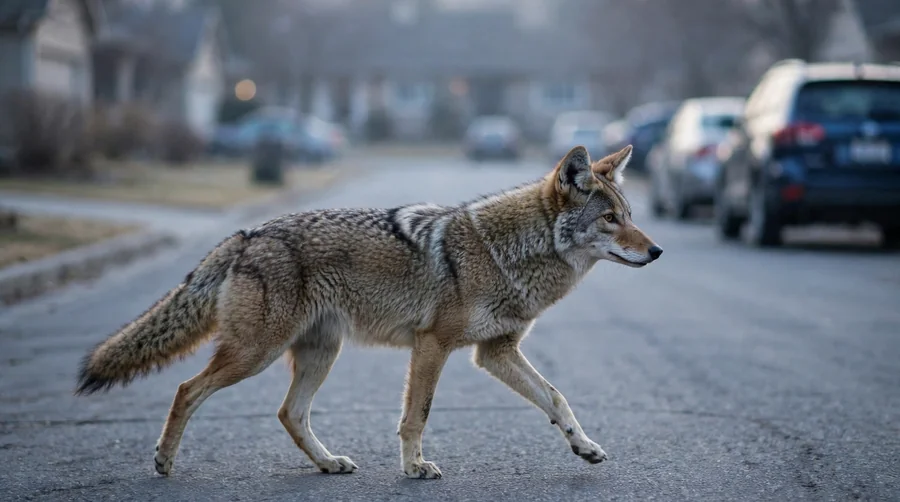
There is a reason you are seeing coyotes, and it is not a message. It is an absence.
A hundred and fifty years ago the coyote was an animal of the western plains and the southwest. It is now in every state but Hawaii, across Canada, through Central America and into Panama, and in the middle of Chicago, Los Angeles and New York. Something opened up and it walked in.
What opened up was the space where the wolves had been. We removed them, and the coyote inherited a continent.
Was it a coyote?
Worth checking, because three of the likely candidates are commonly confused and the eastern ones are bigger than people expect.
| What you saw | What it was |
|---|---|
| Lean, long legs, large pointed ears, narrow muzzle, bushy tail carried low or straight out | A coyote. The low tail is the single best field mark |
| Much heavier, broad head, short rounded ears, tail carried level or high | A wolf, if you are in wolf country. Most of the lower 48 is not |
| Coyote-shaped but noticeably large and heavy, in the northeast or eastern Canada | An eastern coyote. Genuinely bigger — see below for why |
| Smaller, rusty red, white tail tip, black stockings | A red fox |
| Tail carried curled up over the back | A dog. Coyotes do not carry the tail up while trotting |
And the question behind the question: a coyote out in daylight is not sick. Coyotes are flexible about timing and shift toward night mainly where people pressure them. Daytime movement is normal, especially in spring when there are pups to feed. Concern is warranted for condition and behaviour — staggering, obvious injury, severe mange, or an animal that approaches you rather than leaving.
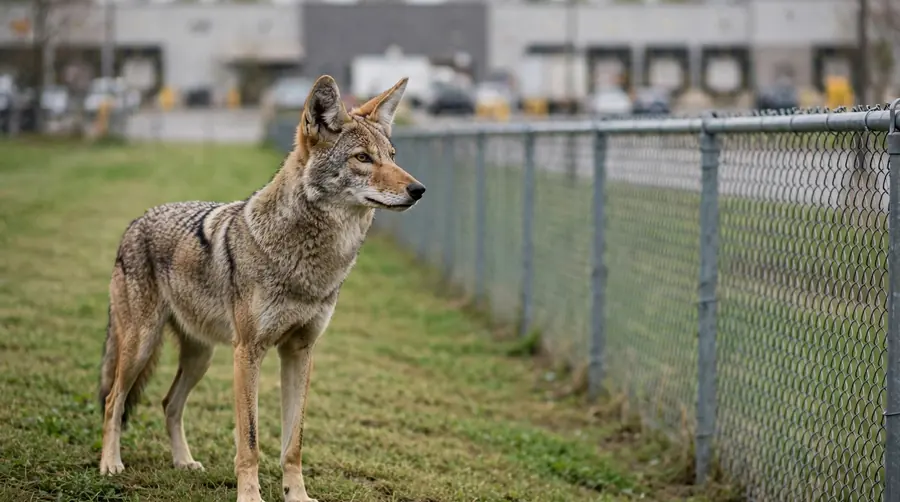
Why it crossed in front of you
Coyotes are edge animals. They work the seams between things — the line where woodland meets field, the drainage ditch, the railway embankment, the strip behind the retail park, the golf course, the cemetery, the culvert under the road.
Those seams are exactly where we build paths, because they are the easiest ground to walk. So a coyote crossing your route is two creatures using the same corridor for the same reason, and the coyote has been using it longer.
Urban coyotes in particular hold small, intensely known territories and move through them on established lines. Research tracking city coyotes consistently finds animals that live close to large numbers of people and are almost never seen by them. If one crossed your path, the remarkable part was your timing, not its presence.
The route-came-first argument runs through other encounters too: what a fox crossing your path means spiritually and the raccoon’s spiritual meaning.
There are coyotes here because we removed the wolves
This is the fact the whole article turns on and it is absent from every page competing for this search.
Wolves kill coyotes. Not occasionally — systematically. Where wolf packs hold territory, coyote numbers are suppressed, and the pattern has been watched in reverse at Yellowstone, where coyote densities fell after wolves were reintroduced.
Across the nineteenth and twentieth centuries, wolves were eliminated from almost the entire United States. At the same time forests were cleared into farmland and edge habitat multiplied — which is coyote habitat. The predator that controlled them was taken away and the landscape was rearranged in their favour.
So the coyote in your street is not an invader and not a sign of anything going wrong in the wild. It is the direct result of a decision made before you were born, and arguably the most successful carnivore range expansion in recorded history.
We did not make room for the coyote on purpose. We made room by removing something else, and it was paying attention.
The other half of the story is the wolf’s own disappearance: what a wolf crossing your path means spiritually.
The eastern coyote is part wolf
It gets better, and stranger.
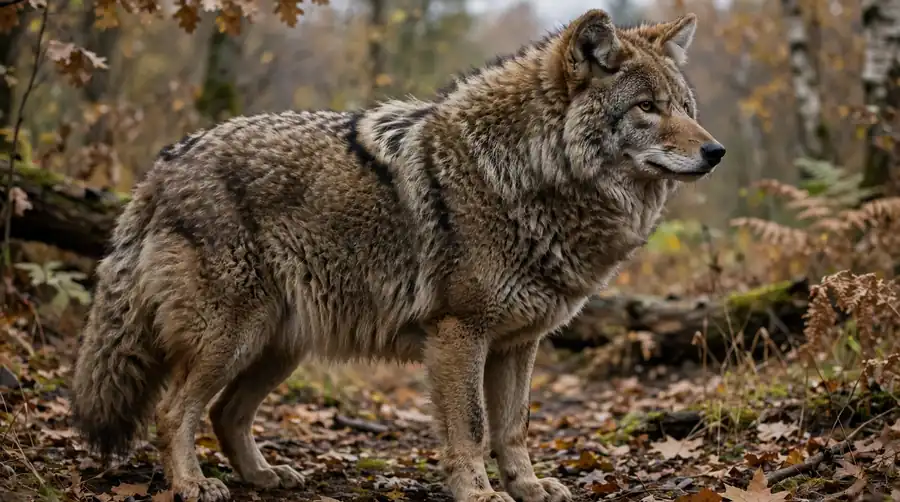
As coyotes spread east, they travelled through the Great Lakes region and met the remnants of the wolf populations that had not quite been wiped out. They interbred. Coyotes in the northeast carry a substantial amount of eastern wolf ancestry, along with a smaller amount of domestic dog — and they are bigger and heavier than their western relatives as a result.
You will see these animals called “coywolves”. Many researchers dislike the term, because it implies a tidy fifty-fifty hybrid when the reality is a coyote-dominant mixture that varies by region, and because they are not a separate species. The ancestry is real; the nickname oversells it.
But hold the shape of what happened. The animal that moved into the gap left by the wolf did it partly by absorbing the wolf on the way through. Some of what was removed is still here, carried inside the thing that replaced it.
Killing them makes more of them
Here is the part that should be better known than it is, because enormous amounts of public money have been spent ignoring it.
Coyote populations compensate for being killed. When adults are removed from an area, the picture researchers describe is consistent: litter sizes go up, more females breed rather than deferring, pup survival improves because there is less competition, and transient animals move in from outside to fill the vacancy.
The historical evidence is hard to argue with. The coyote’s great expansion across North America happened during the most sustained predator-eradication campaign in the continent’s history. Decades of bounties, poisoning, trapping and shooting — millions of animals — and the species ended the period in more places than it began it.
Which is why wildlife agencies increasingly talk about coexistence and hazing rather than removal. Not out of sentiment. Because removal demonstrably does not work, and a cleared territory refills within weeks with younger, bolder animals.
If one is around your home
The goal is not removal. It is keeping the animal wary, because a wary coyote is harmless and a food-conditioned one is a problem.
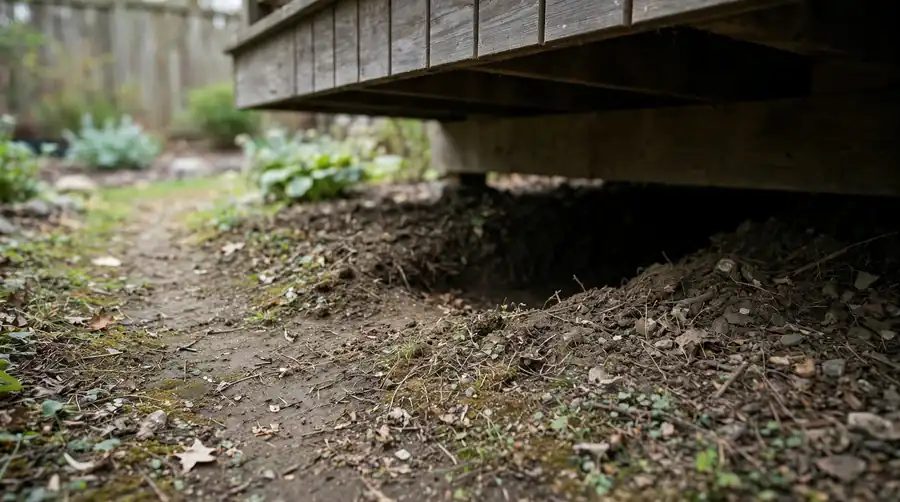
Never feed them, deliberately or by accident. Secure bins, feed pets indoors, pick up fallen fruit, and clear spilled birdseed — the seed draws rodents and the rodents draw coyotes. Close off space under decks and sheds before the spring denning season.
Keep cats indoors and dogs leashed, especially at dawn and dusk. This single habit prevents nearly every bad outcome people worry about, and small dogs off-lead at night in coyote country is the specific risk.
If one approaches rather than leaving, haze it: make yourself large and loud, shout, clap, wave your arms, stand your ground rather than running. You are not trying to hurt it. You are reminding it that people are unpredictable and not worth being near. Attacks on humans are genuinely rare, and the ones that happen overwhelmingly involve animals that had been fed.
Report any coyote that seems unafraid of people, or that is behaving oddly, to your state or provincial wildlife agency. That is the real exception and it is worth acting on.
For the official line on all of the above, Colorado Parks and Wildlife’s Living with Coyotes page lays out the same coexistence, hazing and denning guidance.
Four readings
1. The opportunity was a subtraction somewhere else
Every page on this subject tells you the coyote means adaptability. True, and far too comfortable. The coyote did not succeed by being flexible in the abstract. It succeeded because something enormous was taken out of the way.
That is how most openings actually work, and it is rarely the story people tell about them afterwards. A role becomes available because someone left. A market opens because a bigger operator collapsed. A space in a family or a friendship group becomes yours because the person who held it is gone.
Noticing that is not cynicism and it does not diminish what you did with the opening. It just means the honest question about any sudden expansion is: what was removed, and by whom?
2. The replacement carries the replaced
The eastern coyote reading, and it is the one I would keep.
The coyote did not simply take the wolf’s territory. It passed through what was left of the wolves and took some of them into itself, and the animals in the northeast are larger because of it. The thing that filled the gap is partly made of the thing that was lost.
Which is a more accurate account of succession than replacement ever is. The new manager runs the department using half the old one’s habits. The next generation keeps the phrases. What takes over is never purely itself — it is an alloy, and the part that came from before is usually the part that makes it bigger.
3. Pressure made more of it
Remove coyotes and the survivors breed harder, more females reproduce, more pups live, and outsiders arrive. The response to being attacked is, measurably, more coyotes.
I would be careful about applying that one too cheerfully to human difficulty, because “what doesn’t kill you makes you stronger” is often false and sometimes cruel. But the specific mechanism is worth having, because it is not about toughness at all. It is about a system that responds to loss by releasing a constraint it was previously holding.
Some things in your life are being suppressed by something else, and will not need encouragement to grow — only the removal of whatever is sitting on them.
4. The famous deceiver is strictly faithful
The coyote is the trickster of a hundred traditions and the byword for an unreliable operator. So here is what the genetics say about its private life.
Coyotes pair up and hold territory together, and in a long-running study of urban coyotes, genetic testing of litter after litter found no evidence of infidelity at all. Not low rates. None detected, across many years and many families. Both parents raise the pups, and pairs frequently stay together until one dies.
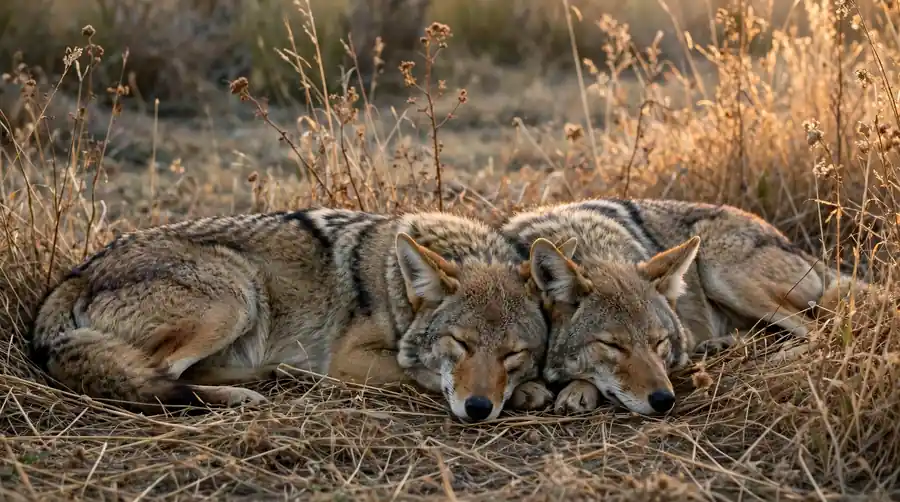
Set that against the reputation. The animal we use as shorthand for the one who will let you down turns out to be, on the available evidence, among the most reliably monogamous carnivores anyone has checked.
Which is the reading I would actually take from a coyote crossing your path. The reputation and the conduct are two separate things, and the reputation is usually assembled by people who have something to lose.
The trickster who cannot be killed
Coyote appears as a trickster, transformer and creator figure in the traditions of many Indigenous nations across North America — among them Navajo, Apache, Crow, Maidu, Miwok and Chinook. The figure differs substantially between them and is not one shared character, and anyone offering you “the Native American meaning of the coyote” is flattening dozens of distinct traditions into a sentence.
But there is one motif worth pointing at, carefully, as an observation rather than a claim about anyone’s belief. In a great many of these story cycles, Coyote is killed — crushed, drowned, burned, torn apart — and simply turns up again in the next story, unbothered.
Then read the wildlife management literature. Millions killed across a century of organised eradication, and the species ended with a larger range than it started with.
I am not suggesting anybody knew about compensatory reproduction. I am suggesting that peoples who lived alongside this animal for thousands of years and watched it closely arrived at a characterisation — the one who dies and comes back — that turned out to describe the population dynamics with some precision.
Coyote is a Mexican word, and there is no coyote in the Bible
Two quick corrections, since the pages above gesture at “cultures” without naming any.
The word is not English and not Spanish in origin. It comes from coyotl in Nahuatl, the language of the Aztec empire, and reached English through Mexican Spanish in the nineteenth century. The animal was named by the people who had always lived with it, and the name travelled north with the colonists who met it later.
And if you came looking for a biblical reading: there is none. The coyote is a North American animal and was entirely unknown to the ancient Near East, so it appears nowhere in scripture — in any translation. Jackals, wolves and foxes are all there. The coyote could not be. One competing page advertises “the biblical meaning of seeing a coyote crossing your path”, and whatever is on it is invented.
And if you heard them rather than saw one
Different question, and it has a much better answer than you would expect — because you almost certainly misjudged both the number and the distance.
Briefly: a coyote chorus is acoustically very difficult to count, and what sounds like a pack is usually two animals. On a clear, still night, sound also carries far further than people assume, so an animal that seems to be at the fence can be a mile away.
Both of those have a full treatment, with the physics and the triage table for working out what you actually heard, in the piece on hearing howling at night.
The question to sit with
It was walking a seam between two things, which is where we build paths too. It is here because something larger was removed, and it carries a piece of that larger thing in its blood. A century of killing it produced more of it. And the animal everybody calls a deceiver appears to be entirely faithful to one mate for life.
Nothing about it is a message. All of it is a record of what we did.
So: what has recently become possible for you — and what had to be taken out of the way first?