
Here is something true about foxes that no page competing for this search mentions, and it is the strangest fact in this entire series.
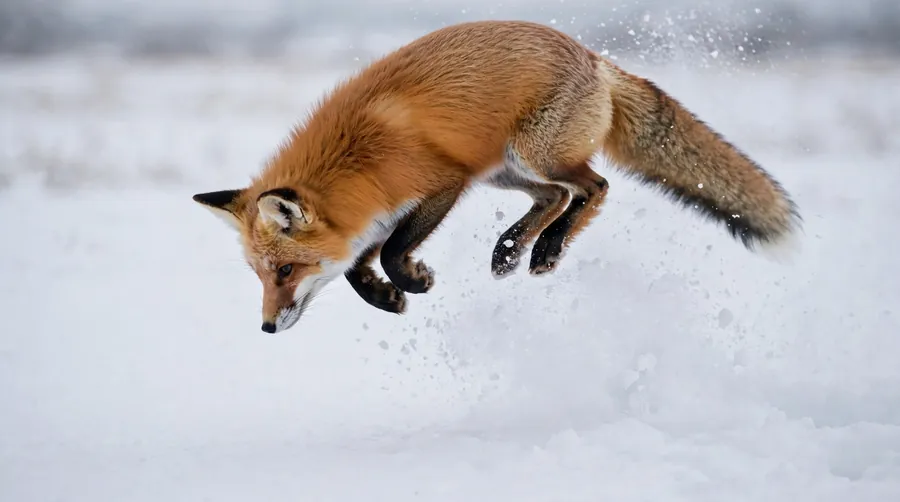
When a fox hunts something it cannot see — a mouse under snow, a vole deep in grass — it does that high, arcing pounce you have watched in wildlife footage. Researchers recorded hundreds of those jumps and found that the fox overwhelmingly aims north-east. Not at the prey. North-east.
And the jumps in that direction succeed far more often than the ones in any other. Which means the animal that crossed your path may be using the Earth’s magnetic field to work out how far away something is — and nobody has yet proved how.
Was it a fox, and was it sick?
Two quick things before the meaning, because one of them is the question people are really asking.
| What you saw | What it was |
|---|---|
| Rusty orange-red, white chest and chin, black stockings, white tail tip | A red fox. The white tail tip is the clincher |
| Grizzled grey with a rusty neck, black stripe along the tail, climbing a tree | A grey fox — the only canid that habitually climbs trees |
| Small, enormous ears, pale sandy coat, arid country | A kit fox, swift fox or fennec depending on where you are |
| Thin, patchy, bald tail, raw-looking skin | A red fox with sarcoptic mange. Treatable — see below |
| Looked like a fox but blunter, stockier, dog-like | Possibly a coyote, if you are in North America |
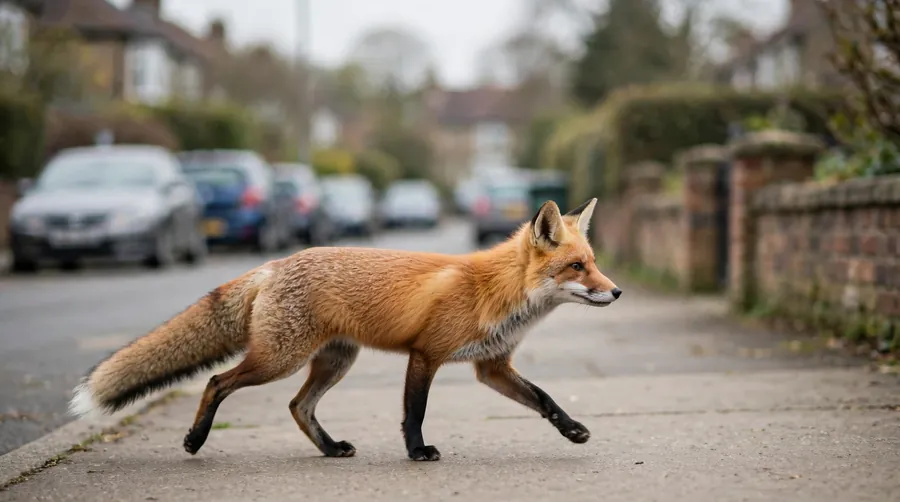
Now the real question. A fox out in daylight is not sick. Foxes are most active around dusk and dawn, but daytime activity is entirely normal — particularly in towns, where foxes have adjusted to human hours, and particularly in spring when there are cubs to feed. A fox trotting across a car park at two in the afternoon is just a fox with somewhere to be.
What does warrant concern is condition rather than timing: heavy fur loss with grey crusted skin, extreme thinness, obvious injury, or disorientation. Mange is the common one, it is miserable, and it is treatable — in the UK the fox charities and the RSPCA will advise, and in North America a wildlife rehabilitator or animal control will. Reporting a mangy fox is a genuinely useful thing to do.
And one small point about the encounter itself. Foxes work regular routes through their territory, and urban foxes have small territories they know in extraordinary detail. The fox did not come to find you — as the snake crossing your path page puts it, the route existed before you did. You were standing on a road it uses most nights.
And if you heard it before you saw it, the fox scream can sound uncannily like a human voice — the night-sounds page covers that side of things.
The fox jumps north-east
Back to the thing worth the whole article.
A team of researchers logged around six hundred mousing jumps by wild red foxes and looked for a pattern in the direction of the pounce. They found one, and it was strong: a heavy bias toward magnetic north, tilted slightly east of it. The foxes were not facing where the ground was best or where the wind was coming from. They were facing a bearing.
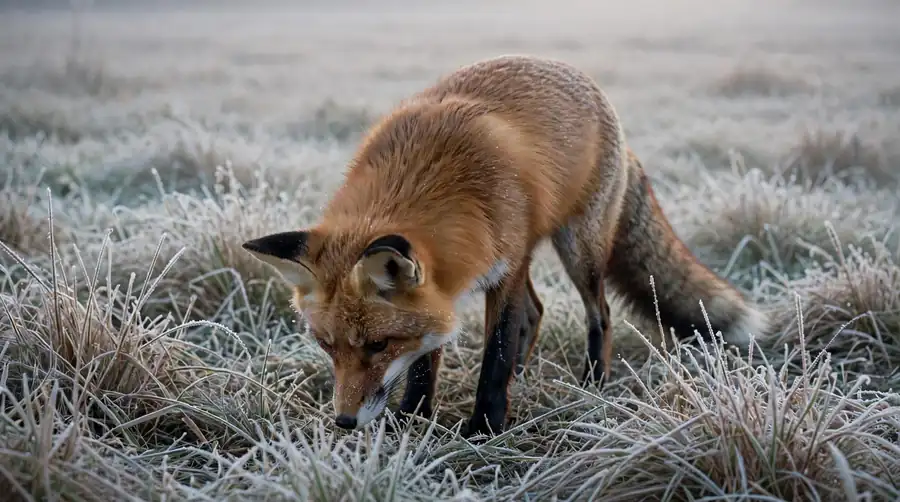
The success rates followed. Jumps on that north-easterly line connected far more often than jumps in other directions, and the effect was clearest exactly where you would expect it to matter — in high grass and deep snow, where the fox cannot see the animal it is trying to land on.
The explanation the researchers proposed is a rangefinder. A fox hears the mouse. It cannot see it, so it does not know the distance. If the fox can sense the angle of the magnetic field, then by shifting until the sound and that fixed angle line up in a particular relationship, it would get a consistent estimate of range — the same distance, every time, from a reference that never moves.
I want to be precise about what is known here. The directional bias and the difference in success rates are measurements. The rangefinder mechanism is a hypothesis, it is not confirmed, and it has not been demonstrated in the lab. But if it holds, the fox would be the first animal known to use the magnetic field to judge distance rather than direction, which is a genuinely new thing to be able to do.
And it only does it when it cannot see
This is the detail that makes the finding more than a curiosity, and it is the part I would ask you not to skip.
When the fox can see its prey — short grass, open ground, clear sight of the animal — the directional preference largely disappears. It simply hunts. No bearing, no alignment, no ritual.
The whole north-easterly business is reserved for the shots it has to take blind.
So the procedure is not how the fox hunts. It is what the fox does when the usual method is unavailable, and it is deployed selectively and dropped the moment it is not needed. That is a much more interesting animal than a clever one.
A dog that answered the question like a cat
Foxes are canids. Same family as wolves, coyotes, jackals, domestic dogs. And they have gone almost completely the other way.
Wolves are social, cooperative, and run prey down in groups. Foxes hunt alone, stalk, freeze, and pounce. They play with what they catch. They cache food and remember where. The grey fox climbs trees using hooked, semi-retractable claws, which no other dog does.
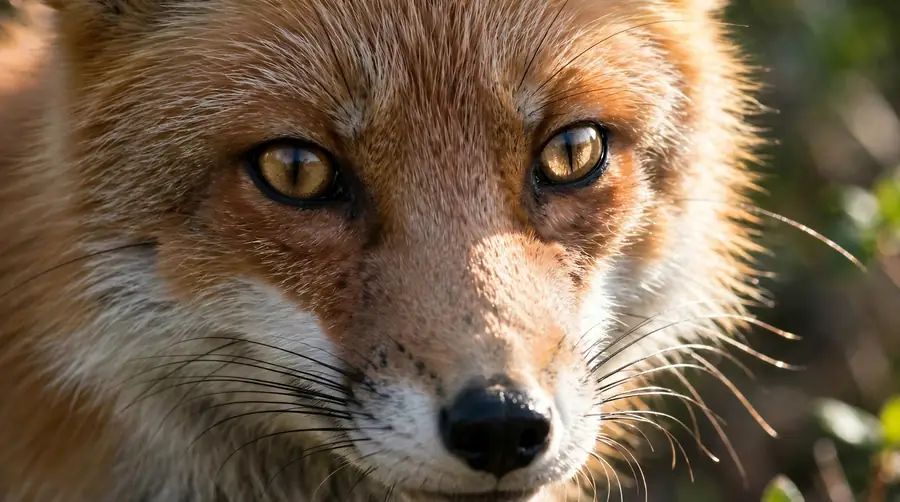
Look at the eyes and it becomes obvious. A red fox has vertically slit pupils — the signature of an ambush predator, and unusual among dogs, who mostly have round ones. The fox’s eye is built for the same job as a cat’s.
Even the legs are strange. Foxes have whiskers on their forelegs — carpal vibrissae — which almost no dog has and cats do. Small sensors low down, for feeling out what you are standing in rather than looking at it.
Same lineage as the wolf, same basic equipment, and an entirely opposite answer to the problem of how to eat.
Four readings
1. It aims itself, not the target
Every competing page tells you the fox means cleverness and strategy, by which they mean trickery. Here is what the fox actually appears to do, and it is better.
It does not aim at the mouse. It aims itself, against something fixed and external that has nothing to do with the mouse at all, and then commits. The reference point is not the problem. The reference point is the field.
People who are good in uncertainty tend to work like this and tend not to be able to explain it. They are not reading the situation more cleverly than you. They have a fixed thing they orient against — a principle, a standard, a line they do not cross — and they set themselves by that and then move, rather than trying to compute the situation from inside it.
2. The procedure is for when you cannot see
This is the sharpest thing on the page. The alignment disappears when the fox can see its prey. It is a technique for blind shots only.
Which is exactly backwards from how most people use their procedures. We apply the checklist, the framework, the ritual to the things we already understand — where it is comfortable and makes us feel organised — and then abandon all of it in the moment we genuinely cannot see what we are doing, because that is when we panic and improvise.
The fox has it the right way round. Hunt normally when you can see. Bring out the method when you cannot.
3. Same equipment, opposite answer
The fox and the wolf are built from the same parts and have solved survival in directly contradictory ways — one by joining, one by going alone and borrowing a cat’s whole approach.
Neither is the correct canid. There are far more foxes in the world than wolves, and there are foxes living in cities that wolves could never occupy. The solitary, improvising, cat-shaped answer has outlasted the cooperative one by a wide margin.
Worth holding if you have been told that your way of working is the wrong version of something. Sometimes it is not a worse execution of the standard strategy. It is a different strategy that happens to look like a failure of the first one.
4. Select for one thing and the rest arrives uninvited
From 1959, at a research institute in Novosibirsk, Dmitri Belyayev and his colleagues bred silver foxes for a single trait: tolerance of people. Nothing else. Only the calmest animals in each generation were allowed to breed.
Within a few decades they had foxes that sought out human company — and that also had floppy ears, curled tails, white patches on their faces, shorter snouts, altered breeding seasons and new vocalisations. None of that was selected for. It came along attached to the thing that was.
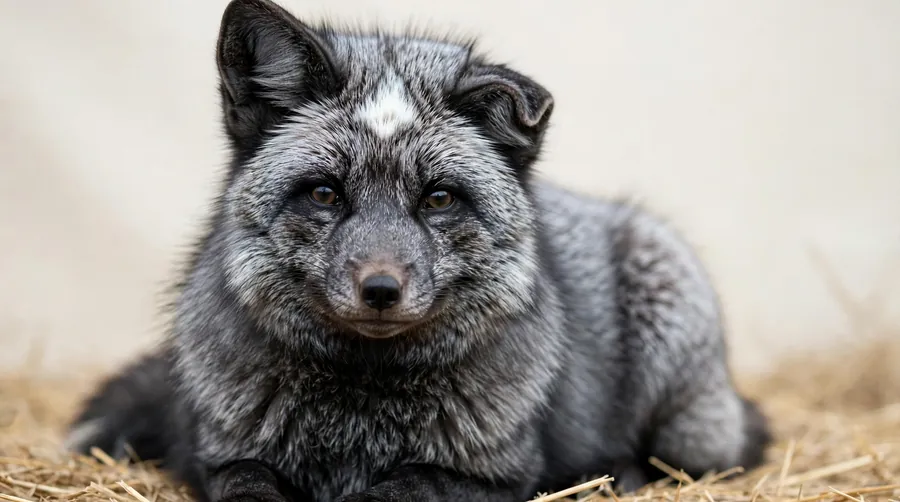
An honest caveat, because this story gets told too cleanly: later researchers have argued that the founding foxes came from fur farms and were already somewhat used to people, which complicates how much the experiment proves. The core observation stands — traits travel in bundles — but the tidy version of the story oversells it.
The reading is uncomfortable and useful. You cannot usually acquire one quality in isolation. Choose for calm and you may get softness you did not want. Choose for toughness and something else hardens too.
Reynard: how the fox became “cunning”, and renamed itself
If you want to know where the clever-fox idea actually comes from, it is not ancient and it is not universal. It has a source.
From the twelfth century, a cycle of satirical tales spread across Europe about Reynard the Fox — a trickster who outwits a court of animals representing kings, nobles and clergy. The stories were enormously popular for centuries, and they did more to fix the fox’s reputation in European minds than any amount of watching actual foxes.
And here is the detail that proves how popular they were. The older French word for a fox was goupil. The character became so famous that his name replaced the animal’s name: modern French for fox is renard. The species is now called after a fictional individual.
So when the pages above tell you the fox symbolises cunning across cultures, what they are largely describing is the long afterlife of a medieval satire — one so successful it edited the dictionary.
Kitsune: the fox that is not the god
Japan has the deepest fox tradition anywhere, and it is routinely described wrongly in English, including in the pages competing for this search.

The kitsune is associated with Inari, the deity of rice, agriculture and prosperity — and the foxes are the messengers, not the god. The fox statues in their thousands at Inari shrines, often with a key or a scroll in the mouth, are attendants. Calling the fox “the Japanese fox god” is a mistake and a common one.
The tradition is also much stranger and richer than “clever”. Kitsune grow additional tails with age, up to nine, and the oldest are white or golden. They are shapeshifters, often appearing as women. Kitsunetsuki — fox possession — was a recognised folk illness with described symptoms. And a sun shower, or an unexplained line of lights at night, is a kitsune no yomeiri: a fox wedding.
Note what the fox is doing in all of that. Not stealing and not deceiving for gain. Moving between categories — animal and person, visible and hidden, this world and the other one. A messenger is something that crosses.
In the Bible the fox ruins vineyards
Foxes are genuinely in scripture, repeatedly, and the picture is nothing like the clever trickster.
Then there is the one people half-remember. In Matthew 8:20 and Luke 9:58, “foxes have holes, and birds of the air have nests, but the Son of Man has nowhere to lay his head.” The fox there is simply an animal with a home, used to make a point about someone who has not got one.
And in Luke 13:32 Jesus calls Herod “that fox” — which is worth knowing because it is plainly an insult, and not one about intelligence. It means a petty, destructive, grubbing little ruler. If you were hoping for scriptural support that the fox stands for admirable cleverness, it is not there.
One honest note. The three hundred foxes Samson ties torches to in Judges 15 may well be jackals; the Hebrew term covers both, and jackals are social animals that could plausibly be caught in numbers, which foxes could not.
Two things we got from foxes and use daily
Aesop’s fox, unlike a great many “ancient fables”, is genuinely ancient. And two of his fox stories are still in your vocabulary.
The fox who cannot reach the grapes and declares them sour anyway gave English “sour grapes” — a phrase most people use without knowing it is a fox. And the fox who flatters the crow into dropping its cheese is the standard parable for being talked out of something by someone praising you.
Both are about self-deception more than trickery. In the grapes, the fox lies to itself. That is the more useful fox: not the one who fools you, the one who has quietly rearranged what it wants to match what it can get.
So is it good luck or bad?
Mixed, genuinely, and I will not pretend otherwise — but the mix is not random and it splits along a line worth seeing.
Where the fox is a competitor for food — the vineyard, the henhouse, the biblical hill farm — it is a pest and an omen of loss. Where the fox is a messenger or an intermediary, as at the Inari shrines, it is auspicious and treated with respect. Same animal, two economies, and the verdict follows the economy rather than the creature.
Which means the honest answer to your question is that it depends on what you have got to lose. And if you are reading this because a fox walked across a road in front of you and you have no vines and no chickens, there is no tradition anywhere that makes that a bad sign.
The question to sit with
It was on a route it uses most nights. It hunts by lining itself up against a field it cannot see, and only when it cannot see its prey either. It is a dog that decided to be a cat. And its reputation for cleverness comes mostly from a medieval cartoon so popular it took over the animal’s name.
The fox does not aim at the thing it wants. It aims itself, at something fixed, and then goes.
So: what are you orienting against at the moment — and is it something that holds still?