
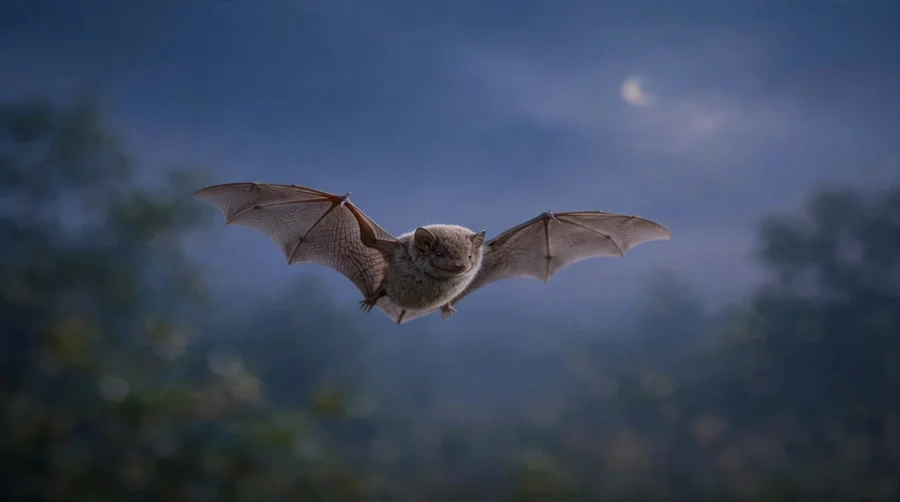
It came out of nowhere. One second the room was normal and the next there was something flying in fast silent circles near the ceiling, far quicker than you expected, and your whole body reacted before you had worked out what it was.
Then it was behind the curtain, or in the hallway, or gone, and you are standing there with your heart going.
Two things before anything else. There is one specific situation involving a bat indoors where you should ring a doctor, and it takes thirty seconds to check whether it applies to you — so that section is first, below. And then the symbolic answer, which is almost certainly not what you have been told, because the animal flying around your living room is not a creature of blindness. It is the only mammal on earth that finds its way by listening.
Bat in the House: The Short Answer
Spiritually, a bat in the house is read as a threshold being crossed — the end of one phase and the start of another, and specifically the need to navigate something you cannot see clearly yet.
Is it a bad omen? In European and much Indian tradition, historically yes. In Chinese tradition, emphatically no — the bat is one of the standard emblems of good fortune and appears all over traditional decorative art for exactly that reason. The two traditions reach opposite conclusions about the identical animal, which tells you most of what you need to know about how reliable either reading is.
Practically, it is almost certainly a lost juvenile, and it is almost certainly autumn.
Read This First: The One Situation That Matters
I am putting this at the top rather than burying it, because none of the other pages about this mention it at all and it is the only part of this article with real consequences. It is short and it probably does not apply to you.
Bats can carry rabies. Most do not, and you cannot catch it from a bat flying past you, from being in the same room as one, or from its droppings. The risk comes from a bite or a scratch.
The complication is that bat teeth are very small, and a bite can fail to wake a sleeping person or leave a mark you would notice. Which is why health authorities treat a small number of specific situations as possible exposures even with no obvious bite:
You woke up and there was a bat in the room. A bat was in a room with an unattended young child. A bat was in a room with someone who was asleep, intoxicated, or otherwise unable to say whether they were touched. Or anyone had direct contact with it.
If any of those describe your situation, contact a doctor or your local health service and tell them a bat was in the room. And if the bat is still in the house, do not release it — contain it in a room if you can, because it may be able to be tested, which can save someone a course of treatment.
The reason to act rather than wait is simple and worth stating plainly: treatment after exposure is extremely effective, and the window for it is generous but not unlimited. This is an easy problem if you make a phone call and a serious one if you ignore it. One call settles it.
And the general rule, which covers everything else: never handle a bat with bare hands. Not to help it, not to move it, not to look at it. Gloves, a box, a towel.
That is the whole of it. If none of those situations apply to you, the bat was simply lost, and you can read the rest of this with nothing hanging over it.
Why There Is a Bat in Your House
There are real answers, and the timing is the most telling part.
It is probably a young bat on one of its first flights. Late summer and early autumn is when that year’s pups become independent and start flying properly, and inexperienced bats blunder into places experienced bats avoid. Open windows, chimneys, gaps under eaves, attic vents, a door left open on a warm evening. The bat in your living room is most likely a few weeks into being able to fly at all.
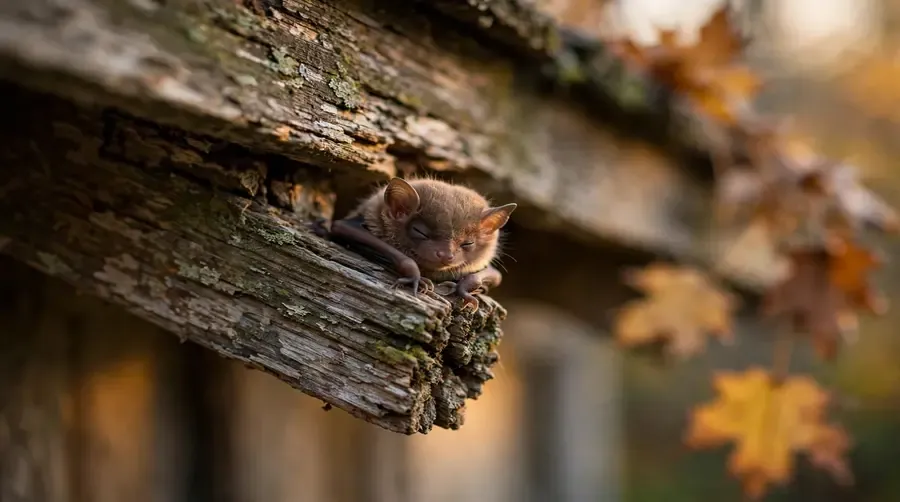
Autumn is also when bats are moving. As the season turns they leave summer roosts, travel to hibernation sites, and investigate cavities and crevices on the way. A house is, from the outside, a very promising cavity. This is the reason searches about bats indoors climb sharply every October — it is not the season being spooky, it is the bats genuinely being on the move.
Or one dropped in from a roost you did not know you had. If it happens more than once, you may have bats in the attic or a wall cavity, and one has found its way through a gap into the living space. That is a different problem and needs a professional rather than a window left open — and in many countries bats and their roosts are legally protected, so it is not a problem you are allowed to solve with a broom.
Why It Keeps Circling Near the Ceiling
This is the behaviour people find most frightening, and it has a mundane explanation that helps enormously.
It is looking for a way out at a height it can use. Many bats cannot launch easily from flat ground — their wings are long and their legs are not built for a standing take-off, so they prefer to drop from a height to get airborne. A bat on your floor is not resting. It is stuck.
So the circling is a search pattern, conducted at the only altitude that is any use to it. It is not coming at you. There is nothing in it that wants anything to do with you.
It Is Not Blind. It Is Listening.
Here is the fact that should be the centre of every article about this and is in none of them.
“Blind as a bat” is simply wrong. Bats have working eyes, and the large fruit bats have excellent vision. But the insect-eating bat that got into your house does something far stranger than seeing. It shouts, and listens to the shape of what comes back.
Echolocation is not a vague sense of obstacles. A bat using it can detect an object as fine as a single strand of wire, judge the distance, size, texture and direction of travel of a moving insect, and catch it in the dark at speed. The calls are mostly above the range of human hearing, which is why the room was silent while all of this was happening.
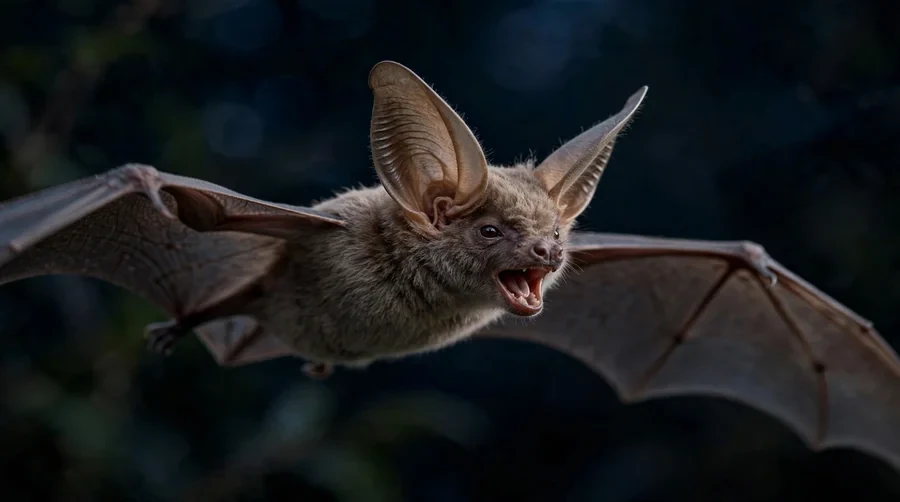
So think about what was actually taking place in your living room. An animal that had never been inside your house before was flying at speed through an unfamiliar space in poor light, and it was not blundering. It was building a working map of your room out of sound, in real time, while you stood there unable to see much of anything.
For a few seconds, the bat understood the shape of that room considerably better than you did.
Now read the symbolism back, and notice that it inverts the entire tradition. The bat has been treated for centuries as a creature of darkness and blindness and therefore of fear. It is the opposite. It is the animal that demonstrates that darkness is only a problem if sight is your only instrument.
Which gives this encounter a reading nothing else in animal symbolism quite matches. Not “you are in the dark.” Something closer to: you are being asked to navigate by a sense other than the one you normally trust, and it can be done, and the creature that came to show you is extremely good at it.
Four Readings of a Bat in the House
1. Navigating Without Sight
The core reading, and the one the biology earns outright. A situation where you do not have the information you would normally want, and will have to proceed on a different kind of input — instinct, listening, what comes back when you put something out.
Note the active part of it. Echolocation does not work passively. The bat has to emit the call first and then interpret the return. Waiting quietly in the dark is not the bat’s method; the bat speaks into the dark and reads the answer.
2. A Threshold, Because It Came Inside
Bats are creatures of the boundary hour. They come out at dusk, the point most traditions treat as the thinnest part of the day, and they live in caves, roof spaces and ruins — places that are neither indoors nor out. The owl carries the same night-animal reputation for similar reasons.
One entering your home is therefore read as a boundary being crossed, and because it happened at your house rather than on a path, the interpretation points at domestic life, family and the state of the place you live.
3. Death and Return, With an Actual Basis
The rebirth reading gets attached to bats constantly and usually without reason given. There is a real one.
Bats in temperate regions hibernate, and they do it thoroughly — body temperature falling close to the surrounding air, heart rate and breathing dropping to almost nothing. A hibernating bat found in winter looks and feels dead. Then in spring it is not.
That is a genuine basis for a death-and-return symbolism rather than an invented one, and it is also why the autumn sighting carries the reading most strongly: you met it on its way into the long disappearance. Ladybirds do the same thing, overwintering indoors in clusters for the same reason, as the ladybug article explains.
4. Something Useful That Looks Alarming
Insect-eating bats consume extraordinary quantities of insects — mosquitoes, midges, moths and crop pests — every single night. They are among the most agriculturally valuable wild animals there are, and a great many populations are in serious decline.
So the thing that frightened you in your hallway is a declining, protected, intensely beneficial animal that has been eating the insects around your house all summer for free.
Read as a sign, that is the straightforward one: your alarm response and the actual nature of the thing are badly out of alignment, and it is worth asking where else that is true.
Is a Bat in the House a Bad Omen?
The honest answer is that it depends entirely on which half of the world you ask, and the gap between them is enormous.
The European Reading, and Where It Came From
Western folklore is largely negative, and the reasons are traceable rather than mysterious.
Bats are nocturnal, they roost in caves and ruins and church towers, and they are the only mammal that flies — a category violation that medieval thinking found genuinely troubling. But the decisive factor was visual. Medieval and renaissance religious art gave angels feathered wings and devils bat wings. That convention was repeated for centuries until the leathery wing was simply the shorthand for the demonic.
The vampire association is much later than people assume. Bram Stoker’s novel is from 1897, and the whole connection only became available to Europeans after they encountered actual blood-feeding bats in the Americas and brought the name home.
Which is worth putting in proportion. Of roughly fourteen hundred bat species in the world, three feed on blood, and all three live in Latin America. The entire vampire reputation of every bat on earth rests on three species that no European folklore tradition had ever seen.
The Indian Reading
A large share of people searching this question are in India, where a bat entering the house is traditionally taken seriously and generally read as unwelcome — associated with illness in the family, financial trouble or disturbed energy in the home, and discussed in Vastu terms as stagnation.
I am not a Vastu practitioner and will not pretend to interpret it for you; someone local to that tradition is a far better source than this page. What I can offer is the fact that sits alongside it: the practical explanation above — a juvenile bat, in autumn, looking for an exit at a usable height — is the same in Chennai as it is in Chicago. And the tradition immediately below reaches the opposite conclusion from the same animal.
The Chinese Reading, Which Is the Exact Opposite
This is the single best answer to the omen question and most readers have never heard it.
In Chinese tradition the bat is a symbol of good fortune. The reason is a pun: the word for bat contains a sound identical to the word meaning blessing or good fortune. Because of that, bats became one of the standard auspicious motifs in Chinese decorative art, and you will find them on porcelain, embroidery, furniture, textiles and architectural carving, going back centuries.
And they are often shown in fives, representing the Five Blessings — long life, wealth, health, love of virtue, and a peaceful natural death at the end of a full life.
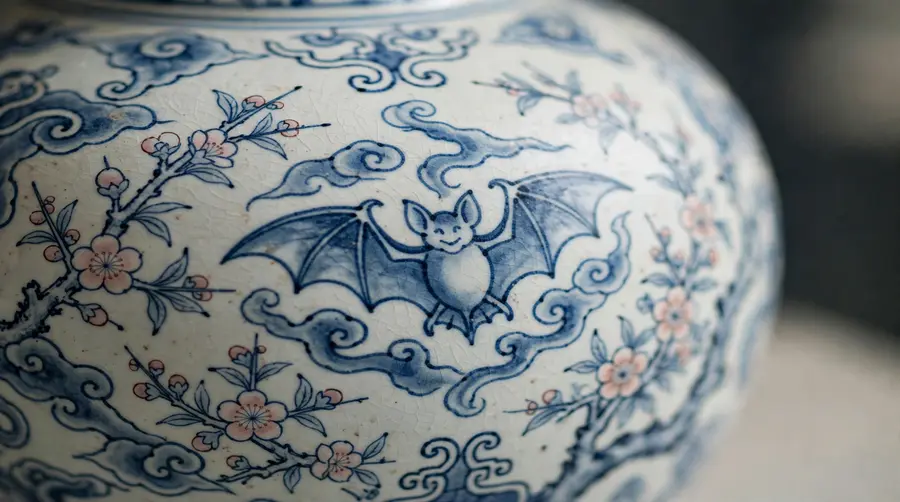
So in one of the world’s oldest continuous artistic traditions, a bat is not a warning. It is a decoration you would deliberately put on a wedding gift.
I would not tell you that one tradition is correct and another is wrong. But when two unrelated cultures look at the same small flying mammal and one sees a demon while the other sees a blessing you would embroider onto a bridal robe, the sensible conclusion is that the bat is not carrying the meaning. We are. And if you get to choose which inherited reading to apply to an animal that ate several thousand mosquitoes last week, the choice is not difficult.
For completeness, the record is not uniformly positive outside Europe either — Maya tradition includes a genuinely fearsome bat figure associated with night and death. The point is not that bats are universally lucky. It is that they are not universally anything.
If It Was Flying Around You Outside
A different and much more common experience, and it has a genuinely charming explanation.
Standing out at dusk, a bat starts making passes around you — close, repeatedly, apparently interested. It feels pointed.
It is not interested in you at all. You are warm, you breathe out carbon dioxide, and you are therefore surrounded by a small cloud of midges and mosquitoes that have come for exactly those reasons. The bat is hunting that cloud.
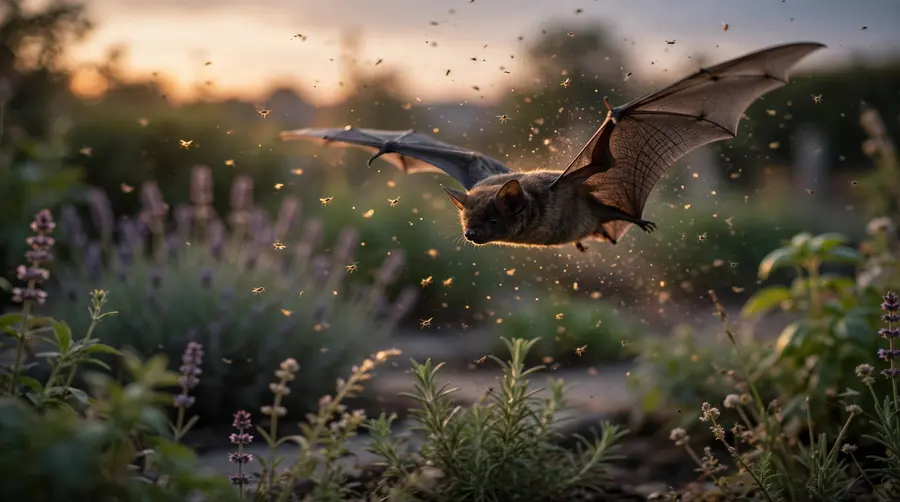
You were not being circled. You were being used as bait, by an animal that was eating the things biting you.
Read as a sign, that is a better reading than most traditions manage: something you took as being aimed at you was actually attending to a problem you had not noticed you were generating.
What Changes the Reading
A Bat in the Bedroom
Read as the most personal placement, pointing at rest, privacy and what you carry when nobody is watching. But go back to the second section of this article first, because this is the one placement with a practical question attached to it. Like hearing crows at night, it is a night encounter people tend to take as an omen.
A Bat in the Chimney or Attic
Read as something established rather than something passing through, and traditionally as a matter that has been going on longer than you realised. Practically, that is a roost, not a visitor, and it needs a bat professional — in many countries disturbing a roost is illegal even when the bats are not in it.
A Bat That Lets You Get Close
Treated across traditions as remarkable and significant. Treat it practically as a warning sign instead: a bat that is on the ground, active in daylight, or unwilling to move away is more likely to be ill. Do not touch it, keep pets and children away, and call a bat rescue or animal control.
More Than One, or the Same Thing Repeatedly
Repetition is read as emphasis across nearly every sign tradition — the message resent because it was not received. Practically, repetition means a roost in the structure. The symbolic and the practical reading agree here: something ongoing that you have not yet properly addressed.
A Dead Bat
Generally read as the close of a transition rather than an omen about a person. Do not handle it with bare hands, for the reasons already given — use a shovel or an inverted bag, and keep pets away from it.
In October
Worth naming because of what the month does to people. If this happened in late October you will find the encounter reads as far more loaded than it would in June, and the honest position is that the only thing October changed is the bats being on the move toward hibernation. The season supplied the atmosphere; the bat supplied a lost juvenile.
How to Get It Out Safely
Assuming none of the situations in section two apply, this usually takes about ten minutes and does not require touching anything.
Shut the internal doors so it is confined to one room, and get pets and children out of it.
Open every window and external door in that room as wide as they go, and turn the lights off or down. Bats navigate out toward the cooler, open, darker air. A single small open window in a brightly lit room is the hardest version of the puzzle you can set it.

Then leave the room and wait. This is the part people skip and it is the part that works. Most bats find their own way out within fifteen or twenty minutes if nobody is in there generating panic. Do not swat at it, do not throw anything, do not chase it with a towel — a bat being pursued flies erratically and is far more likely to end up somewhere difficult.
If it has landed and settled, you can cover it with a box or a container, slide a piece of card underneath, carry it outside and set it on a wall, a tree trunk or a fence post — somewhere high, because of the take-off problem. Thick gloves, always. Never bare hands.
If it is still there after a couple of hours, or you find it in daylight, call a local bat rescue group. They exist in most countries, they are usually volunteers, they are delighted to be called, and bats are protected in much of the world.
And then the reflective part, which this encounter supplies more neatly than most. Something came into your house in the dark, moving fast through a space it had never been in, and it was not lost in the way you would have been. It was listening its way through.
Where are you currently trying to see your way through something that you are going to have to hear your way through instead?
Frequently Asked Questions
What is the spiritual meaning of a bat in the house?
It is read as a threshold being crossed and as a prompt to navigate something you cannot see clearly yet. The reading is grounded in echolocation: a bat finds its way by emitting sound and interpreting what returns, so the message is not that you are in the dark but that sight is not the only instrument available.
Is a bat in the house a bad omen?
It depends which tradition you ask, and they flatly contradict each other. European folklore is negative, largely because medieval art gave devils bat wings and angels feathered ones. Chinese tradition treats the bat as an emblem of good fortune, because the word for bat sounds like the word for blessing, and bats appear in groups of five on auspicious decorative art representing the Five Blessings.
Why did a bat come into my house?
Most likely it is a juvenile on one of its first flights, since late summer and early autumn is when young bats become independent and blunder into places. Autumn is also when bats leave summer roosts and investigate cavities on the way to hibernation sites. If it keeps happening, you probably have a roost in the attic or a wall.
What does it mean when a bat flies around you?
Practically, nothing about you — you are warm and you exhale carbon dioxide, so you are surrounded by midges and mosquitoes, and the bat is hunting them. You were being used as bait by an animal eating the insects that were biting you. Symbolically that reads rather well: something you took personally was attending to a problem you had not noticed you were causing.
Do I need to see a doctor if a bat was in my house?
Usually not, but there are specific exceptions, because bat teeth are small enough that a bite may go unnoticed. Contact a doctor if you woke up with a bat in the room, if a bat was in a room with an unattended young child or someone asleep or unable to report contact, or if anyone touched it. If the bat is still present in those cases, confine it rather than releasing it so it can potentially be tested.