
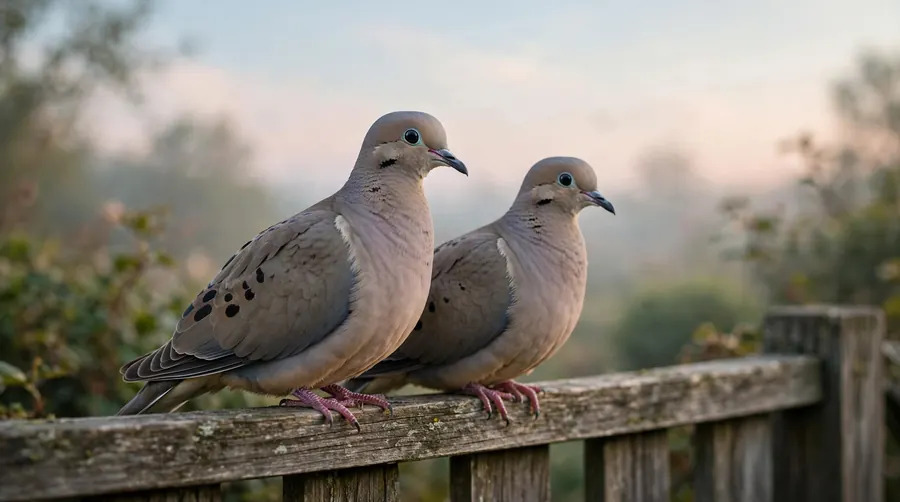
Two of them on the fence most mornings. One on the gutter, one on the wire above the drive. That soft falling coo at six in the morning that you did not notice for the first week and now hear every single day.
They are not passing through. They have picked your house, and after a while that starts to feel like it means something.
Before the symbolism, one thing worth knowing, because it changes how the whole encounter sounds. That mournful call — the one that gives the mourning dove its name, the one people hear as grief, the one that has been read as a sign of death for generations — is a male advertising for a mate. The saddest sound in your garden is a love song. The bird is named after our misunderstanding of it.
Doves Around Your House: The Short Answer
Doves around the house are traditionally read as a sign of peace entering the home, and more specifically of a message arriving — most often interpreted as contact from someone who has died, or as reassurance during a hard stretch.
Two doves together is read as partnership and shared provision rather than romance alone, and there is a good reason for that which almost nobody mentions. And the practical answer is that your property has what a dove needs: seed on the ground, open water, grit, and somewhere flat to build a very bad nest.
Why They Have Chosen Your House Specifically
Doves are creatures of strong habit, and once a pair decides a place is safe they will come back to the same spot repeatedly, often across years. So this is not a random visit, and the reasons are specific.
You have spilled seed. Doves are ground feeders. They are the birds underneath the feeder rather than on it, hoovering up what the finches knock down. If you feed birds at all, you are running a dove canteen whether you meant to or not.
You have grit. Doves swallow seed whole and need small stones to grind it, so gravel drives, paths and bare patches are genuinely attractive to them. The dove standing in the middle of your driveway is shopping.
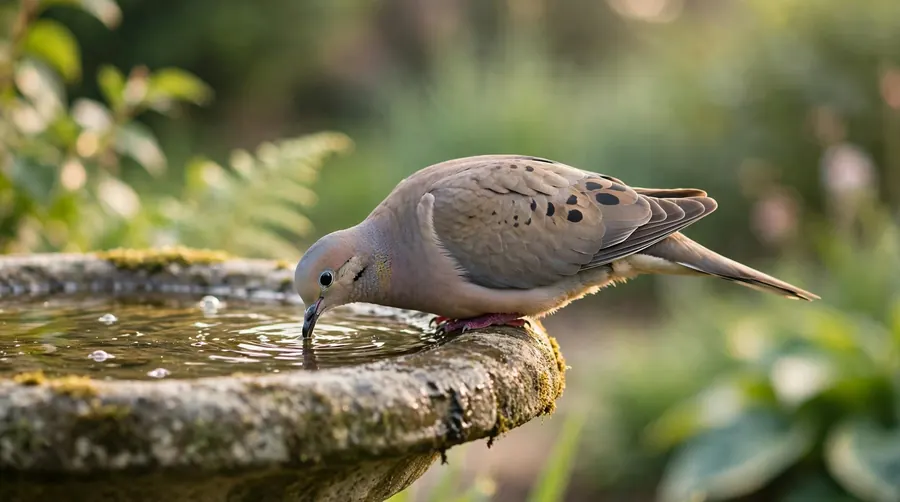
You have water. And doves drink in a way almost no other bird does: they put their bill in and suck the water up continuously, like drinking through a straw, instead of taking a sip and tipping the head back. If you have ever watched one drink for a long unbroken moment without lifting its head, that is what you were seeing.
You have a flat ledge. This is the big one, and it explains most “a dove is on my porch and will not leave” situations. Mourning doves nest on almost any flat surface: porch light fittings, gutters, window ledges, hanging baskets, the top of an air conditioner, a shelf in an open shed. If a dove is sitting in the same place for days and seems unbothered by you, there is very likely an egg under it.
And they do it again and again. Mourning doves raise several broods in a single season, sometimes starting the next while the last is barely fledged. That is why they appear to have moved in for months. In a sense they have.
The Mourning Call Is a Love Song
The mourning dove’s call is not actually a sound of grief — it is an unmated male advertising for a mate. For the full reading, including what two mourning doves mean and what finding a feather signifies, see our guide to the mourning dove’s spiritual meaning.
Four Spiritual Meanings of Doves Near Your Home
1. Peace Arriving, Not Peace Achieved
The dove has meant peace in the West since Noah’s dove came back with an olive leaf, and that story is worth reading carefully, because the detail matters. The dove was sent out and came back with evidence that the water was going down. The flood was not over. The message was that it was ending.
So the reading is not that everything is now calm. It is that something has turned. People most often report doves settling around the house in the late stage of a difficult period rather than after it.
2. A Message, and a Messenger
Doves are the archetypal carriers. Homing pigeons, which are the same family, have carried messages across battlefields and continents for thousands of years and will fly enormous distances to get home.
Read as a sign, that makes the dove a bird of delivery and return rather than announcement. The traditional interpretation is that something is on its way to you, or that something you sent out is coming back.
3. Divine Presence
In Christian tradition the dove is the form the Holy Spirit takes at the baptism of Jesus, which is reported in all four gospels. That single image is the reason doves read as the nearness of God rather than merely as nice birds, and it is why a dove at the house is so often taken as reassurance rather than warning.
For readers in that tradition this is usually the reading that lands hardest, and it does not require the bird to have done anything unusual to carry it.
4. Home and the Domestic Life
Because this encounter happens at your house rather than on a path or in the wild, the reading tilts toward household matters: family, partnership, the atmosphere of the place you live.
Doves choosing your roof is traditionally read as a comment on the house itself, and the standard interpretation is favourable: they settle where they feel safe.
Two Doves Together
Most people see a pair, and the usual reading is love, partnership and devotion. True, but there are two layers underneath it that are much better than the surface version.
They Both Feed the Young From Their Own Bodies
This is the fact that should be in every article about two doves and is in none of them.
Doves and pigeons produce crop milk — a thick nutritive secretion from the lining of the crop, which they feed to their young in the first days of life. Only a very small number of birds do this at all. And in doves, both the male and the female produce it.
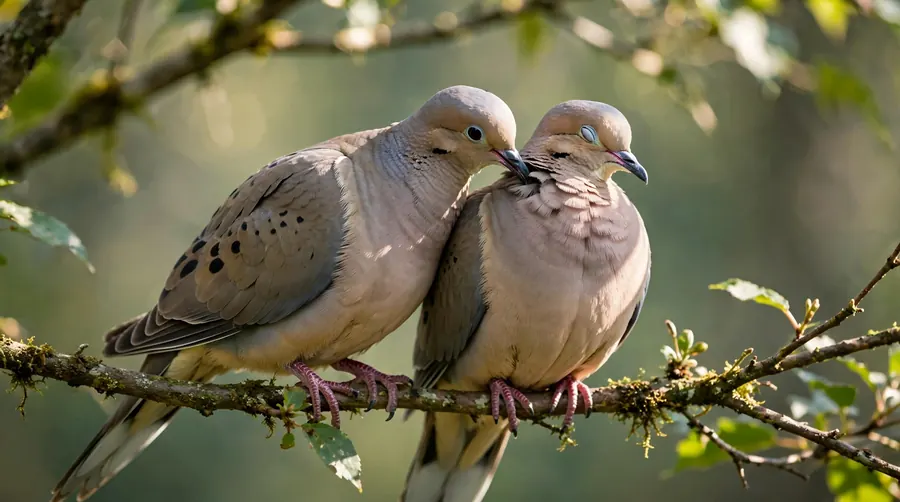
Both parents also take turns incubating, typically splitting the day between them, so the eggs are almost never left alone.
So two doves is not a symbol of romantic feeling. It is a symbol of shared provision — two creatures physically producing nourishment from their own bodies for the same dependent thing, and dividing the sitting between them. If you are reading a pair of doves as a message about a relationship, that is the standard to measure it against, and it is a demanding one.
A Pair of Doves Was the Offering of the Poor
Little known, and genuinely moving if you are in a hard season.
Under the law set out in Leviticus, someone who could not afford a lamb for an offering was permitted to bring two turtledoves or two young pigeons instead. It was the provision made specifically for people with nothing much to give.
And in the gospel of Luke, when Mary and Joseph bring the infant Jesus to the temple, that is exactly what they bring — a pair of turtledoves. The text is quietly telling you they were poor.
So in the scriptural frame, two doves are the offering of those who have little, counted as fully acceptable. For a reader going through a thin stretch, that is a more useful reading than romance, and it is sitting right there in the source material.
If Someone You Love Has Died
A large share of people searching this are grieving, so this gets said plainly and gently.
Doves are one of the most commonly reported signs after a death, alongside cardinals and robins, and the reading across nearly every tradition is the same: presence rather than warning. Not a message that something bad is coming. A message that someone is near.
Two things worth holding together, and they do not cancel each other.
The first is that there are practical reasons doves turn up when they do, and grief changes what you notice. In the weeks after a loss people spend more time at home, more time still, more time looking out of windows. The doves were very possibly always there.
The second is that this does not make the experience less real. Noticing is not nothing. A sign is a meeting between something in the world and something in you, and the fact that your attention opened at that moment is part of the event rather than a flaw in it.
And if it is the call that is reaching you, go back to the section above. You are hearing an animal looking for the one it has not found yet, in the open, repeatedly, without embarrassment. People have taken comfort from that sound for a very long time while getting it exactly backwards, and the true version is kinder.
If It Was Pure White, It Is Probably Not Wild
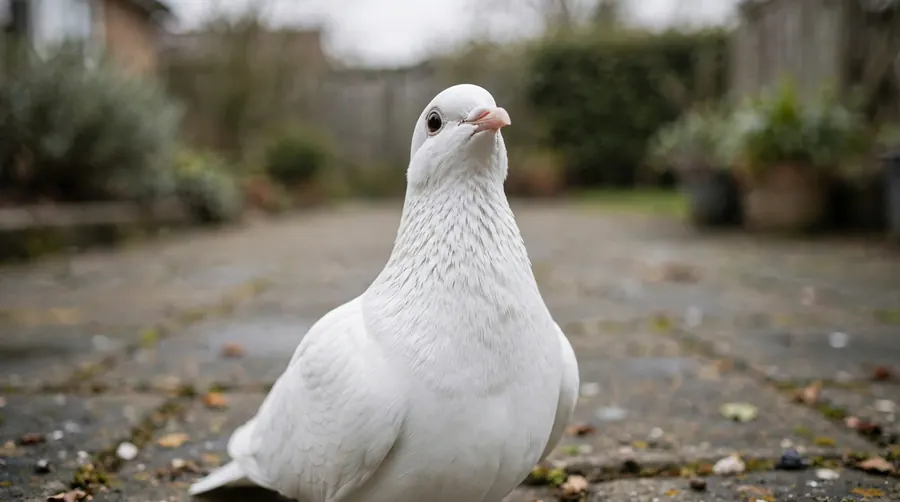
If the dove you are seeing is pure white, it is worth knowing that there is no wild white dove — it is a domestic bird, and a tame one in your garden is usually lost rather than visiting. What a dove’s colour actually means covers how to identify it and what to do.
The Nest That Should Not Work
One more thing about these birds, and it is the reading I would choose if I had to pick one.
Mourning doves build genuinely terrible nests. A loose, flat, sparse platform of twigs, sometimes so thin you can see the eggs through it from below. Other birds build cups and domes and woven baskets. The dove builds a rumour of a nest.
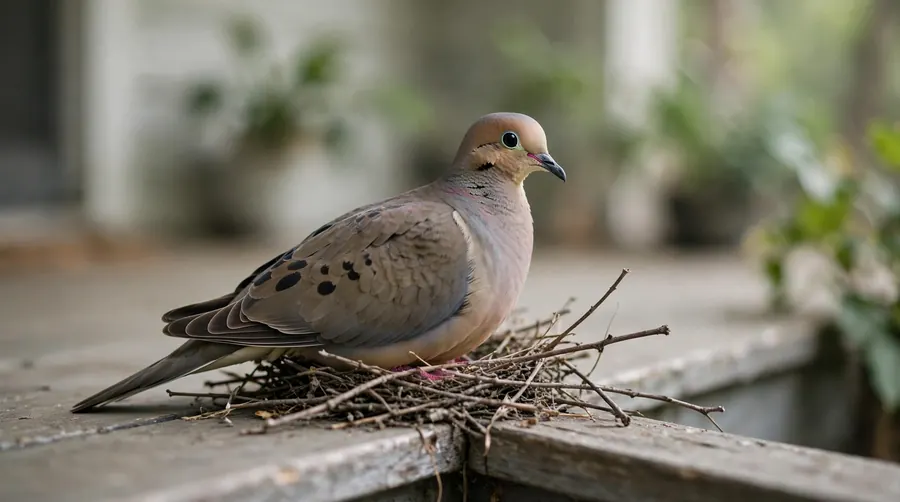
And the mourning dove is one of the most abundant and successful birds on the continent.
The reason is that they simply keep going. Brood after brood, season after season, rebuilding on the same inadequate platform or starting over somewhere nearby. They do not build well. They build again.
Read as a message about your home, which is where this encounter is happening, that is worth more than any of the grander symbolism. The dove at your house is not a symbol of perfection. It is a symbol of persistence — of the thing that works not because it was built well but because it was built again.
What Changes the Reading
A Single Dove Alone
Read as a personal message rather than one about a relationship, and often as a prompt toward self-compassion. A single dove is also worth watching: if it is calling repeatedly, it is likely an unmated male, and the reading tilts toward longing and the search rather than arrival.
A Dove on Your Porch or Doorstep
The threshold placement, read as a message about something entering your life or waiting to. Practically, check the porch light fitting and any ledge above the door — this is prime nesting real estate and a dove that stays put is very likely sitting on eggs.
A Dove at Your Window
Read as the most attention-seeking version of the sign, because the bird has come to the boundary between your inner life and the world. In folk tradition a bird at the window is often read as a message demanding to be noticed — though the practical note is that doves will also peck at their own reflection.
Doves on the Roof or Chimney
The highest point, read as watchfulness and protection over the household. Practically, roofs and chimneys are warm, high and safe from cats, which is why doves like them.
A Sudden Burst of Whistling Wings
That sharp whistling flutter when a dove takes off in a hurry is made by its wing feathers, and it is startling by design — it warns other doves. Read as a sign, it is the alert version: pay attention, something is moving.
A Dead Dove
Hard to come across and generally read as the ending of a period of peace, or of a particular relationship or arrangement. The practical response is to bury it simply and check whether a window strike or a cat is the cause, since both are common.
The Dove Across Traditions
Few animals are so consistently well regarded.
The Hebrew Bible gives the founding image: Noah’s dove returning with an olive leaf, the sign that the waters were receding. Peace as evidence, not as feeling.
The New Testament gives the dove its weight as divine presence, descending at the baptism of Jesus. This is why the dove reads as the nearness of God in the Christian imagination.
Long before either, in the ancient Near East and Greece, doves were sacred to the love goddesses — Ishtar, Astarte, Aphrodite. The bird of love before it was the bird of peace.
In Islamic tradition doves and pigeons are regarded warmly and are a familiar sight around mosques, where feeding them is an act of charity.
And in American folk tradition, the mourning dove specifically became the bird of bereavement and remembrance — the one whose call sounds like grief, and which people have long taken as a sign that the dead are near.
What to Do
If there is a nest, leave it. Mourning dove nestlings fledge quickly — a matter of weeks. The parents will not abandon the nest because you walked past it.
If a fledgling is on the ground, that is usually normal. Young doves leave the nest before they can fly well. The parents continue to feed them on the ground. Only intervene if there is a cat or immediate danger.
Put water out rather than food. Water helps everything in your garden and causes none of the problems that bird feeders do.
Then the reflective part, which for this encounter is unusually specific. You have a pair of birds at your house that split the sitting, both make food out of themselves for their young, build something inadequate, and rebuild it again next month.
Whatever you are building at home, that is the question. Not whether it is impressive. Whether you are willing to rebuild it.
Frequently Asked Questions
Why are doves hanging around my house?
Practically, because your property has what they need: seed spilled on the ground, open water, grit from gravel or paths, and a flat ledge to nest on. Doves have strong site loyalty and will return to the same spot for years. Spiritually it is read as peace entering the home and as a message arriving, often interpreted as presence from someone who has died.
What does it mean when you see 2 doves together?
It is read as partnership and devotion, but the stronger reading is shared provision: both the male and the female produce crop milk to feed their young, and both take turns incubating. In the biblical frame a pair of doves also carries a particular meaning, since two turtledoves were the offering permitted to those who could not afford a lamb.
Is a dove a sign from a deceased loved one?
Doves are among the most commonly reported signs after a death, and essentially every tradition reads them as presence rather than warning. The mourning dove’s grieving call is the reason, though that call is in fact a male advertising for a mate — a more hopeful sound than the folklore assumed.
What does it mean when a dove sits on my porch?
The threshold reading is about something entering your life or waiting to. Practically, check the porch light fitting, the gutter and any ledge above the door — mourning doves nest on flat surfaces and a dove that stays put for days is very likely sitting on eggs.
Is it good luck to have doves around your house?
Yes. The dove carries almost no negative symbolism in any major tradition, appearing as peace in the Hebrew Bible, as divine presence in the gospels, and as the sacred bird of the love goddesses long before either. Doves settling at a house is read as a comment on the house: they stay where they feel safe.