
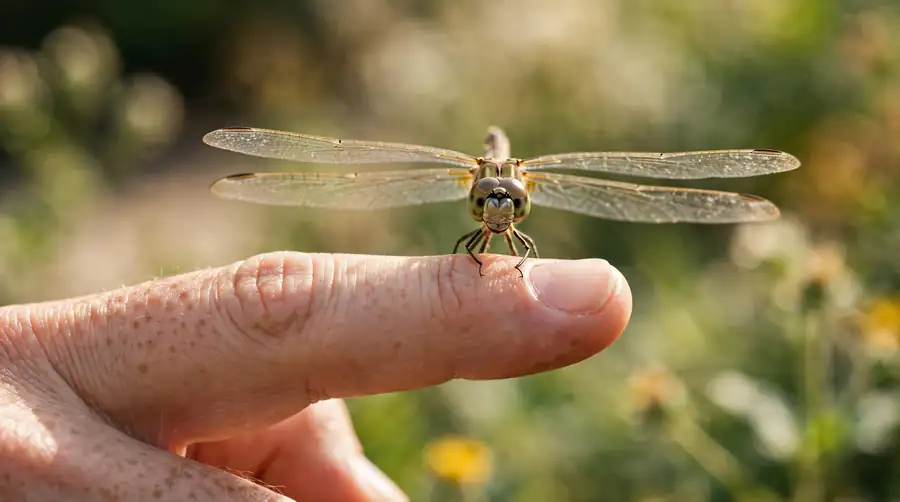
It landed on your shoulder, or your knee, or the back of your hand, and then it did the thing that makes people remember it: it stayed. Dragonflies are not supposed to let you get near them. This one sat there, wings held out flat, that ridiculous head swivelling, and it did not leave when you moved.
Every page you will read about this says transformation. They are right, and they are also missing the only part of it that matters.
Because here is what the dragonfly on your hand actually is. It spent the overwhelming majority of its life underwater, in the dark, as something you would not recognise — months for some species, several years for others. The flying part, the part you are looking at, lasts a few weeks. You are not watching a creature that transformed. You are watching the brief bright end of a long submerged life.
Dragonfly Landing on You: The Short Answer
A dragonfly landing on you is read as transformation arriving personally — change that has already happened rather than change that is coming, and a message delivered directly because the insect made contact rather than passing by.
It is also one of the most commonly reported signs after a death, and there is a specific and verifiable reason for that which has nothing to do with vague symbolism. And the practical answer for why it landed on you is probably warmth, or that you made a good hunting perch.
Years in the Dark, Weeks in the Light
This is the fact the entire topic should be built on, and I have not found a single page about dragonfly symbolism that uses it properly.
A dragonfly begins as an egg laid in water. What hatches is a nymph — a squat, wingless, mud-coloured underwater predator with an extendable hinged jaw that fires out to grab prey. It looks nothing whatsoever like the adult. Nobody looking at one would guess what it becomes.
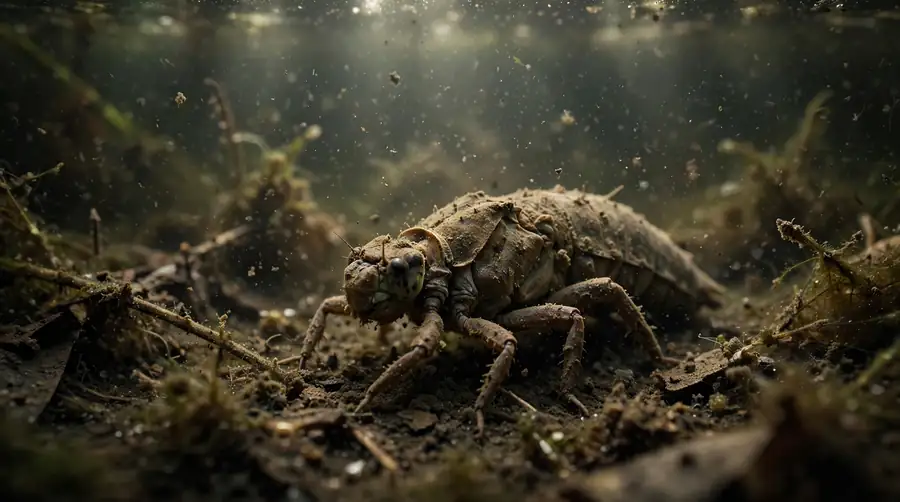
And it lives like that for a long time. Depending on species and climate, the underwater stage lasts anywhere from a few months to several years, moulting repeatedly, hunting in silt and weed, never seeing the sky except as a surface above it.
Then one day it climbs out. Up a reed stem, out of the water, into air it has never breathed. Its skin splits along the back and the adult hauls itself free, pale and crumpled, and over the next hours it pumps fluid into its wings until they harden into the things you saw.
The adult then lives, in most cases, a handful of weeks.
Sit with the proportion of that for a second, because it changes the reading completely. When people say the dragonfly means transformation, they are pointing at the moment of change. The more useful truth is in the ratio: years in the dark, weeks in the light.
The flying is real. It is also the short part, and it only exists because of the long part. The dragonfly did not become beautiful quickly. It spent almost its entire existence as something submerged and unrecognisable, doing nothing that looked like progress, and the thing it became was being assembled the whole time.
If you are somewhere in a long stretch that does not look like anything from the outside, that is the reading, and it is a better one than any competitor on this topic will give you.
And It Cannot Go Back
Two details that sharpen it further.
The emergence is irreversible. The adult cannot return to the water it came from and cannot undo what it has become. And unlike the nymph, which moulted again and again, the adult never moults at all. It emerges once, into its final form, and that is the only version of itself it will ever have.
One change. No rehearsal. No reversal.
The cast-off skin is left behind, split open and still gripping the reed. If you have ever found a strange empty brown husk clinging to a stem at the edge of a pond, that was it — the thing the dragonfly stopped being, still holding on in exactly the position it was in when it let go.
Why It Landed on You
Real reasons, and the last one is genuinely surprising.
You were warm. Dragonflies need their flight muscles at temperature to hunt properly, and they bask to get there. A sun-warmed arm, leg or shoulder is an excellent basking surface, and on a cool morning a dragonfly will tolerate a great deal of proximity rather than give up the heat.
You made a good perch. Many dragonfly species hunt by sitting on a prominent lookout, scanning, launching at prey and returning to the same spot. If you were standing still in the open, you were the tallest convenient thing available. It was using you as a watchtower.
Or you looked like water. This is the one nobody mentions. Dragonflies locate water by detecting polarised light — the particular way light reflects off a flat liquid surface. It is an elegant system and it is also easily fooled. Dragonflies have been documented hovering over, and even laying eggs on, shiny car bonnets, polished gravestones, dark glass and solar panels, because those surfaces reflect light the same way a pond does.
So if you were wearing something dark and glossy, or standing near a car or a window, the dragonfly may have been investigating what it read as water. And if one keeps returning to the same spot in your garden, check what is shiny there.
Four Readings of a Dragonfly Landing on You
1. The Long Part Is Already Behind You
The core reading, built on the proportion above, and it is the opposite of how transformation symbolism is usually sold. Not “change is coming.” Something closer to: the underwater years were the work, and they are done, and what is left is the part that flies.
People most often report this sign at the end of a long difficult period rather than the start of a good one — after an illness, a divorce, a degree, a long stretch of caring for someone. The dragonfly is not promising a transformation. It is pointing out that one has occurred.
2. Every Direction at Once
Dragonflies have four wings that operate independently of each other, which is unusual and is the source of their extraordinary flight. They can hover, accelerate instantly, turn on the spot, fly sideways, and — almost uniquely among insects — fly backwards.
So the reading is agility rather than speed: the ability to go in a direction you had not committed to, including back the way you came.
There is a lovely tension in it, too. The dragonfly can reverse in the air and cannot reverse in its life. It is free to move any way it likes and it is never going back underwater.
3. Something Is Seeing More Than You Are
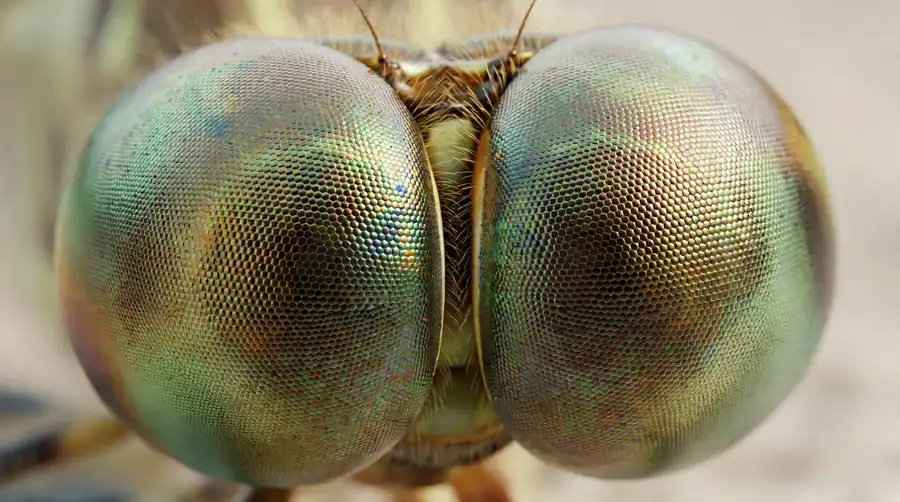
The dragonfly’s eyes are among the most remarkable in the animal world. They are enormous relative to its head, wrap around to give nearly complete all-round vision, and are built from tens of thousands of individual facets in the larger species.
And the colour vision is genuinely hard to get your head around. Human colour sight is built on three types of light-sensitive protein. Dragonflies have been found to carry many times that number, including receptors sensitive to ultraviolet. Whatever it is seeing, it is not a brighter version of what you see — it is a dimension of colour that is simply closed to you.
Read as a sign, that is unusually direct: something was sitting on your hand perceiving a layer of the world you cannot access. You do not have to believe anything supernatural for that to be literally true.
4. Delicate and Entirely Lethal
The dragonfly looks like a piece of jewellery and is one of the most effective predators on earth. Studies of hunting dragonflies have recorded success rates upward of ninety per cent — a figure that would be remarkable for a lion.
It achieves that by interception rather than pursuit. It does not chase its prey; it calculates where the prey is going to be and arrives there. That requires predicting another animal’s future position in three dimensions while moving, and it is studied by researchers interested in how any nervous system does such a thing.
They eat mosquitoes and midges in enormous numbers, incidentally, which makes the thing on your arm an ally.
Read as a message: do not confuse delicacy with weakness, and do not chase. Work out where the thing is going and be there.
If This Happened After Someone Died
Dragonflies are one of the most frequently reported signs after a bereavement, and unlike most such associations this one has a traceable source rather than a vague tradition. If you came here because of a loss, this is the section worth reading.
There is a well-known story, used widely in bereavement support and especially with children, that goes roughly like this.
Under the surface of a pond live a colony of small creatures. They live in the mud and the dim water and it is the whole of the world as far as they know. From time to time one of them climbs up a stem toward the light and does not come back. The ones below cannot follow and cannot see where it went, and they agree among themselves to come back and explain if it is ever their turn.
Then one does climb. It breaks the surface, its body changes, and it finds itself in the air and in the sun with wings it did not know it had. It remembers the promise, and it tries. And it cannot get back through. It cannot return, and it cannot make itself understood to the ones still below, and the only thing it can do is move over the surface of the water and be there.
That story is the reason dragonflies appear on memorial cards and bereavement books and children’s grief resources. It was written down in the early 1980s and has been handed around hospices and funerals ever since, which is why so many people associate the insect with loss without knowing where the association came from.
And the thing that makes it more than a nice metaphor is that it is simply accurate. All of it. The nymph does live submerged for years. It does climb a stem. The change does happen out of the water and it is irreversible. It genuinely cannot go back. Nothing in the parable was invented to make the point — the point is just what dragonflies do.
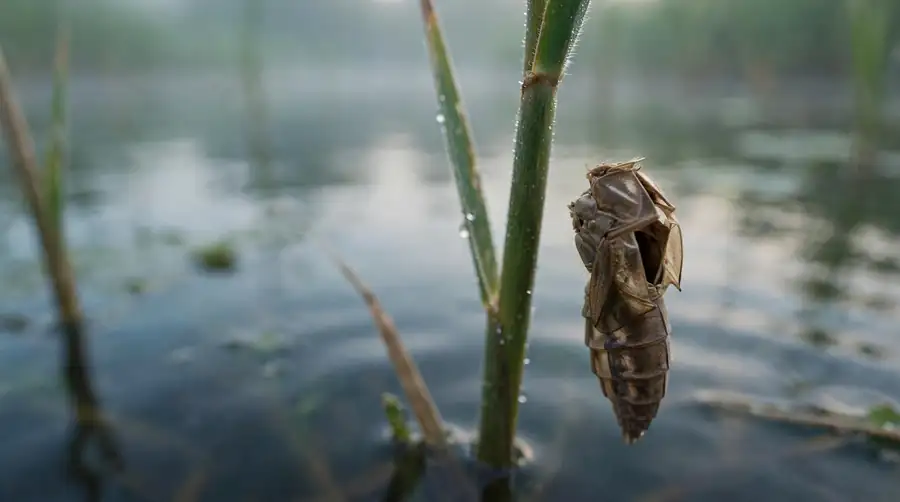
I am not going to tell you whether the dragonfly on your hand was a message. Nobody honest can tell you that. But if you are looking for the reason this particular insect carries that meaning for so many people, that is it, and it is a better reason than most signs have.
If birds have been part of it too, our guides to the mourning dove and the red cardinal as a sign from heaven cover the same ground from the other direction.
Blue Dragonflies, and the Colour That Has to Be Earned
If yours was that electric blue, there is something worth knowing about it.
In a great many dragonfly species, the vivid blue is not something the insect emerges with. A newly emerged adult is typically dull — brownish, olive, yellowish, washed out. As it matures over the following days and weeks, many males develop pruinescence: a fine pale waxy bloom that spreads across the body and produces that chalky, powdery blue.
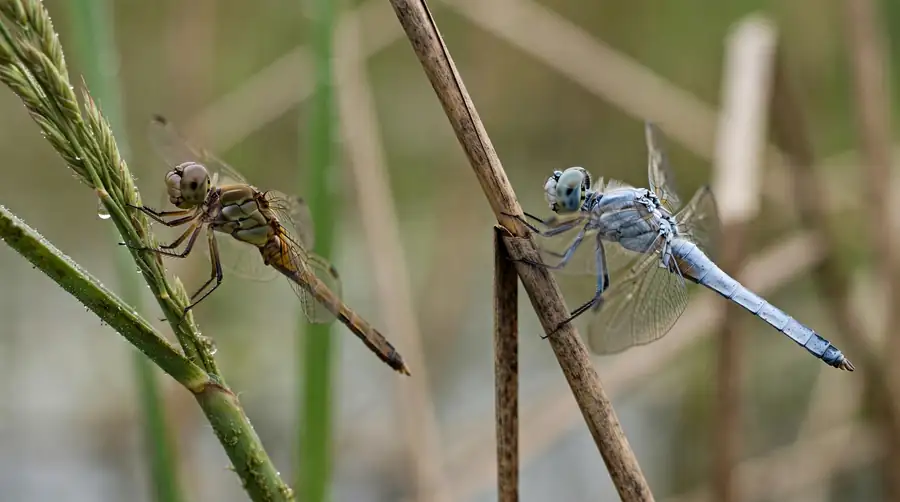
So the blue is a maturity marker. It is not the colour it was born with and it is not the colour it had last week. A brilliant blue dragonfly is a fully mature one, usually a male, wearing something it developed over its short adult life.
Which is a good reading on its own: the colour came last, after everything else, and it is the final thing to arrive.
The other colours, briefly. Red dragonflies are read as passion and vitality and are often darter species. Green is read as healing and growth, and in many species the green individuals are females or immature males. Yellow and gold are read as optimism, and are very often simply young adults that have not developed their mature colouring yet. Black is read as the shadow reading and as mystery. And iridescent or shifting colour is usually structural — produced by the microscopic architecture of the surface rather than by pigment — which means it changes with the angle you look from, and is not a fixed property of the animal at all.
If a Dragonfly Keeps Appearing
Repetition is read as emphasis in essentially every sign tradition: the message was sent again because it was not received the first time. For a dragonfly specifically, the repeat sighting is treated as more significant than the single one.
And there are three real explanations, which do not cancel the reading.
It is the same individual, and it lives there. Many male dragonflies hold a territory along a stretch of pond edge or a particular sunny clearing and patrol it for days, driving off rivals. If you walk the same route, you will meet the same dragonfly repeatedly, and it will be in roughly the same place each time.
You have something that reads as water. See the polarised-light point above. A car, a dark water butt, a glossy table, a greenhouse roof.
Or it is the season. Dragonfly emergence is often synchronised, so large numbers appear within days of each other. A week where you cannot stop seeing dragonflies is frequently a week when a lot of them have just climbed out of the same pond.
And one fact for anyone who feels a repeated sighting means distance or travel, because it is extraordinary and almost nobody knows it. One dragonfly species, a small yellowish wanderer found across much of the world, is believed to make the longest migration of any insect on earth — a multi-generational circuit that appears to carry it back and forth across the Indian Ocean, a round trip of many thousands of kilometres. Further than the monarch butterfly, by an insect most people would not look at twice.
What Changes the Reading
On Your Hand or Finger
The most commonly reported and read as the most direct: hands are what you act and make with, so the reading concerns work and what you are building.
On Your Head or Shoulder
Read as thought, perspective and what you are carrying. The shoulder placement in particular is often reported as feeling like company rather than a message, and it is also the most likely spot for a dragonfly using you as a hunting perch.
It Stayed for a Long Time
Read as the strongest version of the sign, and the one people remember for years. Practically, it was almost certainly basking — and the cooler the air, the longer it will stay, because it cannot fly well until it is warm.
It Hovered in Front of Your Face
Unnerving and read as a direct address. Practically, a dragonfly hovering in front of a person is usually either inspecting a large warm object or hunting the insects you have attracted — the same thing bats do at dusk. It cannot sting you and it cannot bite you in any way that matters.
A Dead Dragonfly
Read as a cycle completing rather than as an omen, which is unusually appropriate here: adult dragonflies live weeks, so finding one at the end of summer is simply the ordinary conclusion of a life that mostly happened out of sight.
A Damselfly Instead
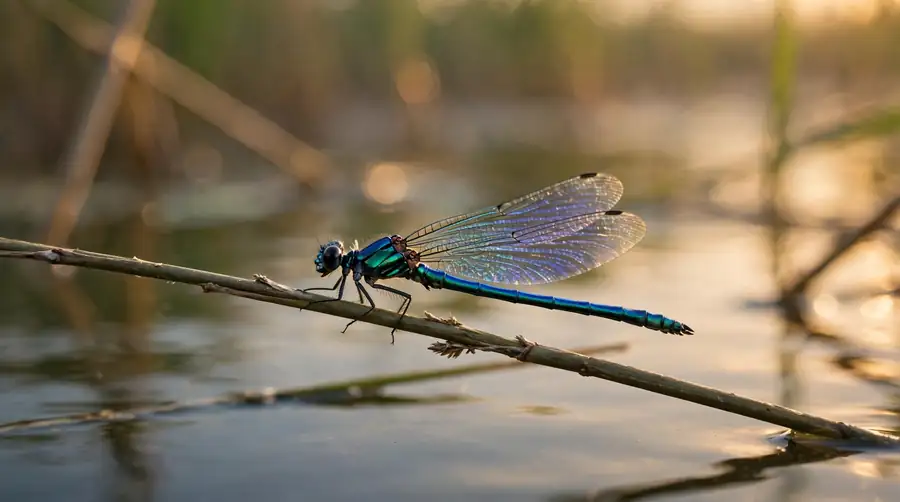
Worth knowing you may not have met a dragonfly at all. Damselflies are the slender, more delicate relatives, and the easy test is the wings at rest: a dragonfly holds them out flat to the sides, a damselfly folds them back along its body. Damselflies also have a gap between their eyes where a dragonfly’s nearly meet. Same life story, same symbolism, slightly smaller and much more fragile-looking.
The Dragonfly Across Traditions
The honest version of this has a twist in it, because the modern meaning is almost the reverse of the old European one.
Japan gives the dragonfly its highest status anywhere. It is a symbol of courage, strength and victory, associated with samurai, who wore dragonfly motifs on armour and sword fittings. One old name for it translates as something close to “victory insect.” Japan itself was poetically called the Dragonfly Island. The warrior association rests on the belief that the dragonfly only ever flies forward and never retreats — which is charming, and which the reading above shows to be false, since they fly backwards perfectly well. The symbol outlived the observation.
Across various Native American traditions the dragonfly is associated with water, swiftness, and in some accounts with renewal and recovery after illness. As always the specifics differ considerably between nations and should not be presented as a single shared belief.
And then Europe, which was hostile to this insect for centuries. The folk names tell you everything: devil’s darning needle, horse-stinger, ear-cutter, snake doctor. The darning-needle names come from a belief that dragonflies would sew up the eyes, ears or mouths of children who misbehaved. In Sweden there was a belief that the devil used them to weigh souls. In parts of the American South they were thought to follow snakes and stitch them back together when injured.
All of it untrue — dragonflies cannot sting, do not sew, and are entirely harmless to people. But it is worth knowing, because it means the beautiful modern reading of the dragonfly as transformation and comfort is recent. For most of European history this was an insect children were told to fear.
Which is itself a reading, if you want one. The thing now most associated with rebirth and messages from the dead spent several centuries being called the devil’s darning needle. Reputations are not fixed, including the one you are currently stuck with.
What to Do
Stay still and let it stay. It will leave when it is warm enough or when it spots something to hunt. There is nothing to be afraid of — no sting, no bite worth the name.
Do not try to hold it. Dragonfly wings are easily damaged and a damaged wing is fatal for an animal that lives by flight. If you must move one, let it walk onto a leaf.
Look at the eyes while you have the chance. You will almost certainly never be this close to them again, and they are the most extraordinary thing about the animal.
If you want more of them, put in a pond. Even a small one. Dragonflies need standing water for the years their life actually happens in, and nothing you can do for wildlife in a garden pays back faster.
Then the reflective part, which this encounter gives more precisely than most. The thing on your hand spent years in the dark becoming something it had no way of knowing about, and then had a few weeks of flying.
Which part are you in? And if you are honest about the answer, are you treating the long submerged part as wasted time, when it is quite clearly where the wings get made?
Frequently Asked Questions
What does it mean spiritually when a dragonfly lands on you?
It is read as transformation arriving personally, and specifically as change that has already happened rather than change that is coming. The reason is the dragonfly’s life: it spends months or years underwater as an unrecognisable nymph and only a few weeks as the flying adult, so the proportion of its life is years in the dark and weeks in the light.
Why do dragonflies mean a message from the departed?
Because of a parable written in the early 1980s and used widely in bereavement support, in which creatures below a pond’s surface cannot follow or understand the one that climbs a stem and does not return — and the one that emerged cannot get back to explain. The association spread through hospices and memorial cards, and the reason it works is that every part of it is biologically accurate.
Why did a dragonfly land on me?
Most likely you were warm — dragonflies bask to get their flight muscles up to temperature — or you made a good tall perch for a species that hunts from a lookout. They also locate water by detecting polarised light reflection, so dark glossy surfaces can read as water to them, which is why they investigate car bonnets and windows.
What does a blue dragonfly mean spiritually?
Blue is read as clarity, calm and spiritual connection. The fact worth knowing is that in many species the blue is not present at emergence — it develops as a fine waxy bloom while the adult matures, mostly in males. So a brilliant blue dragonfly is a fully mature one wearing a colour it earned rather than one it was born with.
What does it mean if a dragonfly keeps appearing?
Repetition is traditionally read as emphasis — the message resent because it was missed. Practically, male dragonflies hold territories and patrol the same stretch for days, so a repeated sighting on the same route is very likely the same individual. Synchronised emergence also means large numbers can appear within days of each other.