
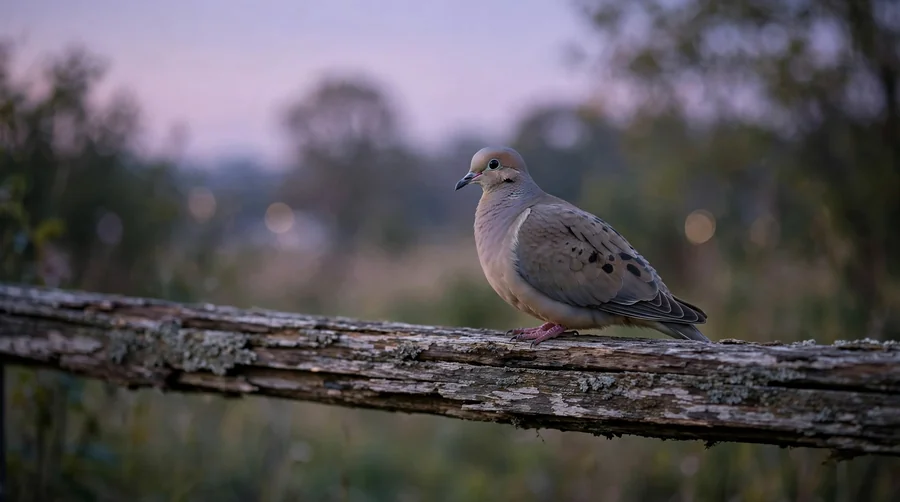
It is the sound of late afternoon in summer. Four soft notes falling away from each other, hollow and unhurried, coming from somewhere you cannot quite place. If you grew up with it you probably never questioned what it was. If you have only just started hearing it, you may have assumed it was an owl.
And if someone you love has died recently, you have almost certainly been told it means they are near.
There is something you should know about that sound, and it is not what the name of the bird suggests. Two completely independent sources — what the bird is actually doing, and what the oldest written tradition says about it — agree with each other and disagree with the folklore. Both of them say the same thing, and it is considerably better than grief.
Mourning Dove Spiritual Meaning: The Short Answer
The mourning dove is read as a bird of comfort, peace and messages from those who have died — one of the most frequently reported signs after a loss, alongside the cardinal.
Two mourning doves together are read as devotion and shared provision, which is unusually well earned in this species. And the call that gave the bird its name is not a sound of mourning at all. It is a male advertising for a mate, and in the Song of Songs the same bird’s voice is the proof that winter is over.
What the Call Actually Is
The mourning dove was named in the nineteenth century for the sound it makes: a soft, hollow, descending coo-ah, coo, coo, coo. It is one of the most melancholy noises in the natural world, and it is so convincingly sad that an entire layer of American folk belief grew out of it. Hearing a mourning dove has been linked to death, to loss, to a soul passing.
That call has a name among people who study these birds. It is the perch-coo, and it is given by an unmated male from a prominent, exposed position — a wire, a dead branch, a roof ridge — where the sound will carry as far as possible.
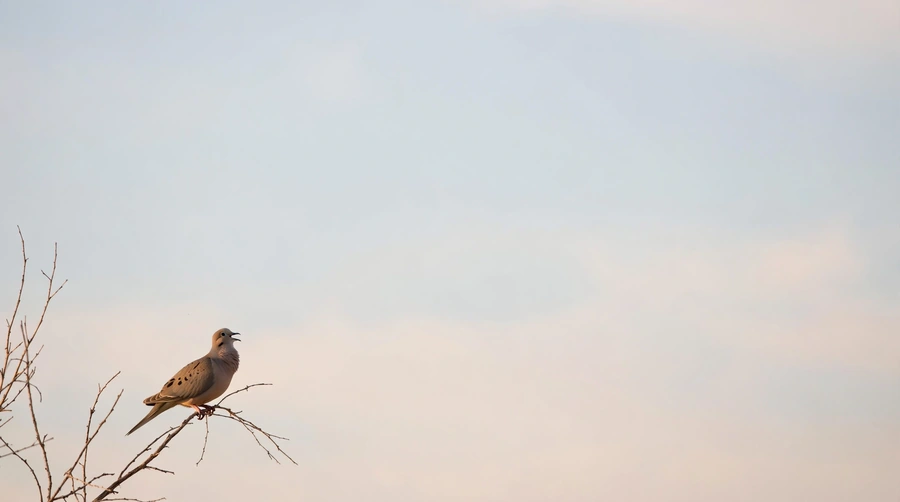
He is advertising. He is announcing that he is here, that he holds this spot, and that he is available. It is the dove equivalent of standing on a rooftop and singing for someone to come.
There is a second, quieter coo you have probably never consciously heard, because it is not meant to travel. A paired male gives a softer version at a chosen nest site to call his mate over to inspect it. Two different coos, two different purposes. The one that reaches you across the neighbourhood, the one that sounds like grief, is specifically the unaccompanied one.
So the saddest sound in your garden is a bird that has not found anyone yet, calling out in the open, repeatedly, every day, without any embarrassment about it.
One more thing, which explains a great deal of confusion. The perch-coo is among the most commonly misidentified bird sounds in North America — people hear it and report an owl. If you have been hearing an “owl” in the middle of a summer afternoon, this is almost certainly your bird. If you are sure it was an owl rather than a dove, see our guide to owl hooting at night.
In Scripture, the Same Call Means Winter Is Over
Here is the second source, and it arrives at the same place from a completely different direction.
The Song of Songs contains one of the few passages in all of scripture that describes a bird’s call as a signal. It runs, in the older translation: “For, lo, the winter is past, the rain is over and gone; the flowers appear on the earth; the time of the singing of birds is come, and the voice of the turtle is heard in our land.”
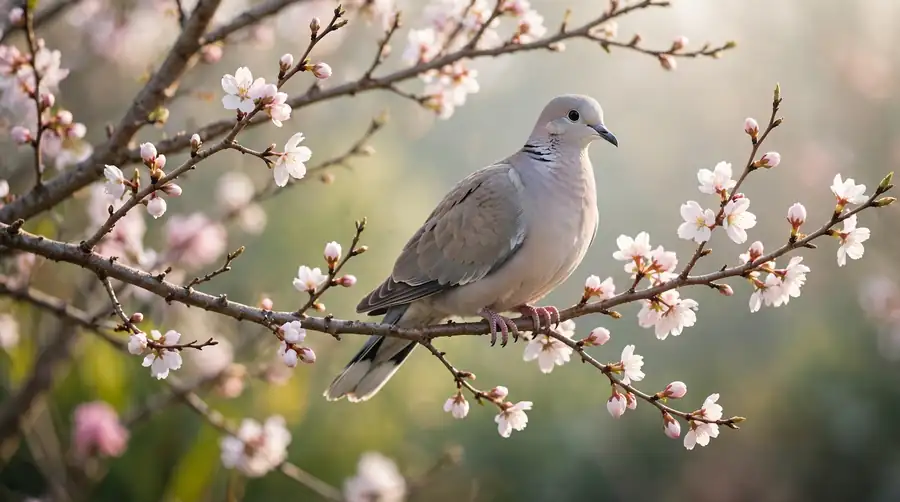
The “turtle” there is the turtledove. The word comes from the Latin turtur, which is simply an attempt to write down the sound the bird makes — the same naming impulse that produced “cuckoo.” People across many languages have named this family of birds after their voice.
And in that passage the dove’s call does one job: it is evidence that winter has ended. The turtledove is migratory in that part of the world, so its voice returning meant, reliably and literally, that the cold season was finished and the year had turned.
Put the two sources beside each other. The biology says the call is a bird looking for love. The oldest written tradition says the call is proof that winter is over. Neither of them says grief.
The grief reading is real, and it is old, and people have taken genuine comfort from it for generations. But it came from the sound alone, filtered through human ears, and the bird has been carrying a reputation it never asked for. Nineteenth-century naturalists gave it the name. The dove has been doing two centuries of unpaid work as a symbol of sorrow.
If You Are Here Because Someone Died
A large share of people reading this are grieving, so this part is written plainly and without decoration.
Mourning doves are among the most commonly reported signs after a death, and the reading across essentially every tradition is the same: presence, not warning. Nobody interprets a mourning dove as a sign that something bad is coming. It is consistently read as someone being near, or as permission to be at peace.
Three things, and they all hold at once.
The first is that there are ordinary reasons the dove is there, and grief changes what you notice. In the weeks after a loss people are home more, still more, quiet more, looking out of windows more. The doves were very likely always on that wire.
The second is that this does not make the experience less real. Noticing is not nothing. A sign has always been a meeting between something in the world and something in the person, and the fact that your attention opened at that particular moment is part of the event rather than a flaw in it.
The third is the one I would want you to keep. If it is the call that has been reaching you, then what you have been hearing as sorrow is a creature still looking for the one it has not found, saying so out loud, from the most exposed perch it could find, over and over, every day. People have drawn comfort from that sound for a very long time while getting it precisely backwards. The true version is kinder than the folklore.
If the cardinal is the other bird you have been seeing, our guide to what a red cardinal means covers the same territory from the other side — and if it was a dragonfly, our guide to a dragonfly landing on you does the same.
Four Meanings of the Mourning Dove
1. Comfort Without Resolution
The reading this bird is actually best at, and the one that distinguishes it from the dove of peace generally.
A white dove with an olive branch says the trouble is over. The mourning dove says something different and more useful: it is still here, calling in the same tone every evening, through whatever is happening. The comfort it offers is companionship in the middle of a thing rather than the end of it.
2. Something Still Being Looked For
Built directly on the perch-coo. An unmated bird calling from an exposed place is a creature that has not given up and is not hiding the fact that it wants something.
Read as a message, this is the one that most often lands for people in a long wait — for a partner, a result, a reconciliation, a child. The traditional interpretation is not that it will arrive. It is that continuing to ask out loud is not undignified.
3. The Turning of a Season
From the Song of Songs reading. The dove’s voice as the signal that the cold part is finished.
Note that this is a reading about timing rather than about effort: the winter does not end because anyone worked at it. The dove is not the cause. It is the evidence.
4. Gentleness That Is Not Weakness
The mourning dove is soft-coloured, soft-voiced, non-territorial toward humans and completely harmless. It is also one of the most abundant and successful birds on the continent, which it has managed under more pressure than almost any other species. The section below on hunting makes that point properly.
Read as a sign, it is the standard rebuke to the idea that softness and survival are opposites.
Two Mourning Doves Together
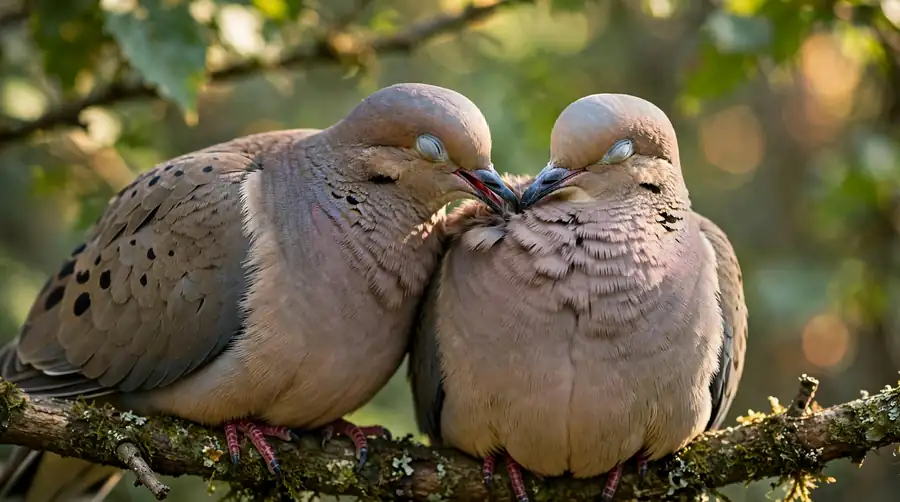
The pair is read as devotion, partnership and shared life. With this species that is not a loose metaphor, and the specifics are better than the symbolism.
The Appointment They Keep
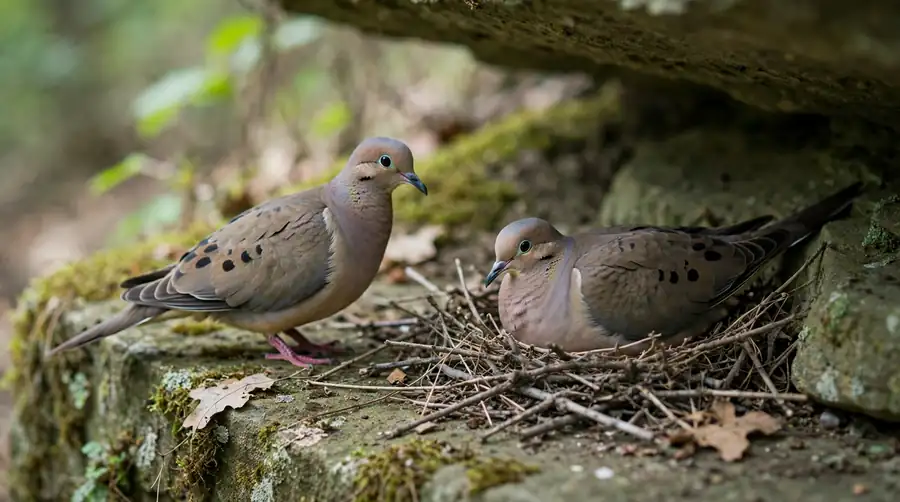
Both parents incubate. Not loosely, not occasionally — they split the day between them and swap over at roughly the same times, so the male takes a long shift through the middle of the day and the female covers the rest, including the night.
Which means that twice a day, every day, for the full two weeks of incubation, two birds meet at the same place at about the same time to hand over. The eggs are essentially never left alone.
If you are reading a pair of doves as a message about a relationship, that is a far more exacting standard than romance. It is a kept appointment, repeated, unglamorously, until the job is done.
They Both Make Food Out of Themselves
Doves and pigeons produce crop milk, a thick nutritive secretion from the lining of the crop, and they feed it to their young for the first days of life. Only a very few birds in the world do this at all.
And in doves, both the male and the female produce it. Two parents, both physically manufacturing food from their own bodies for the same dependent thing. The symbolism of two doves is shared provision in the most literal sense available in nature.
The Preening and the Beak-Clasping
Paired doves preen each other around the head and neck — the places a bird cannot reach alone — and engage in a behaviour sometimes called billing, where they clasp beaks briefly before mating. If you have watched two doves sitting in contact on a branch, grooming each other’s necks, you were watching the pair bond being maintained rather than a display.
But Do They Actually Mourn a Lost Mate?
This is where I will be straight with you, because it is exactly the point at which most pages on this subject start inventing things.
You will read that mourning doves grieve their partners, refuse to re-pair, and die of broken hearts. There is no good evidence for any of that. What is true is that they form strong pair bonds that often last through multiple broods and sometimes across seasons, that both birds invest heavily in the young, and that a surviving bird will generally find a new mate.
People do sometimes report a dove staying near a dead partner, and that is worth taking seriously as an observation rather than dismissing. But it has not been studied in doves the way responses to death have been studied in crows and some other birds, and claiming more than that would be making it up.
The honest version is still a good symbol. Not a bird that grieves forever. A bird that commits completely, for as long as the work takes, and then goes on living.
Finding a Mourning Dove Feather
Mourning dove feathers are soft grey and buff, often with a dark spot or a pale edge, and finding one is traditionally read as a message left behind — a small, deliberate, physical thing dropped where you would come across it.
But there is a fact about these feathers specifically that changes what a scatter of them means, and it is genuinely reassuring.
Mourning doves have remarkably loosely attached feathers. Under stress — particularly when something grabs them — the feathers release very easily, and a predator frequently ends up holding nothing but a mouthful of plumage while the bird gets away. It is a real escape mechanism, and it is why dove feathers turn up in loose piles so often.
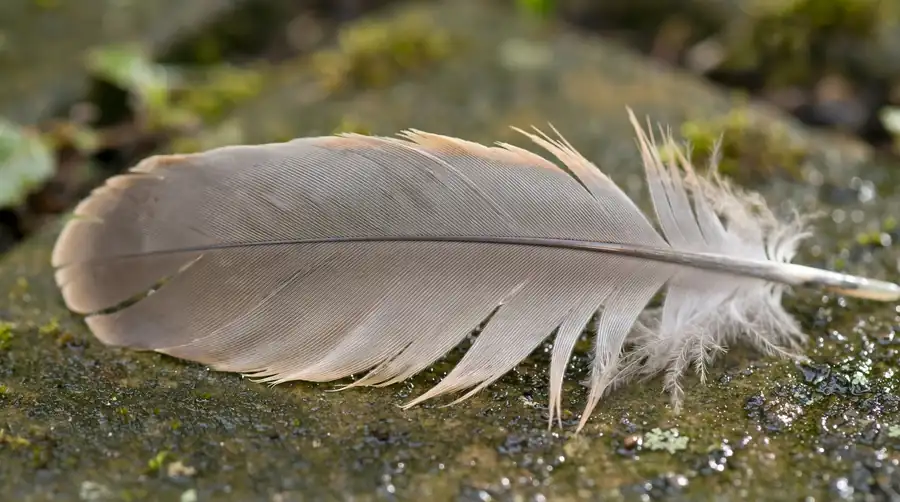
So if you found a patch of dove feathers with no body, the likeliest story is not a death. It is an escape.
Which gives that find a reading no other page offers. Something was taken, and it was not the bird. The feathers are what it paid to get out.
One practical note worth knowing, and almost nobody mentions it. In the United States, the Migratory Bird Treaty Act makes it illegal to possess the feathers of most native migratory birds, including mourning doves, even ones you simply found on the ground. The law exists to remove any market for them. If you want to keep the moment, photograph the feather and leave it where it is — which is arguably the more fitting response to a sign anyway.
The Most Hunted Bird of Peace
This section is uncomfortable and I have thought about whether to include it. It belongs here, because it is the single most striking fact about this animal and because it makes the gentleness reading mean something.
The mourning dove is both one of the most abundant birds in North America and the most heavily hunted game bird on the continent, with tens of millions taken every year across the states where the season is open.
The bird that American culture uses as a symbol of peace, that gets released at funerals, that people hear as the voice of the departed, is also the bird shot in the greatest numbers.
And the population holds. It holds because of the strategy described above: nest after nest, brood after brood, on flimsy platforms of twigs, from early spring until late in the year, for as long as the weather allows. They do not survive by being formidable. They survive by continuing.
If you want the real symbolism of the mourning dove rather than the greetings-card version, it is that. A soft, defenceless, relentlessly persecuted bird that is nonetheless everywhere, because it keeps starting again.
What Changes the Reading
Hearing It at Dawn or Dusk
Doves are most vocal at the two edges of the day, which is also when most traditions place the thinnest boundary between worlds. Read as the classic timing for this sign. A dusk call in particular is read as reflective and backward-looking; a dawn call as announcement and beginning.
A Single Dove, Calling
An unmated male. Read as the “still looking” message in its purest form, and the most personal version of the sign.
A Single Dove, Silent
Read as presence without request — simply company. Many people report this one as the most comforting version, and it is the one most often described as feeling like being sat with.
A Dove That Lets You Get Close
Read as unusual intimacy and often as the moment people date a sign from. Practically, mourning doves are among the most tolerant garden birds and a sitting one may well be on eggs, so check the ledge above it before deciding it chose you.
The Whistling Wings
That sharp whistling flutter when a dove bursts off a branch is made by the wing feathers themselves, and it functions as an alarm signal to other doves. It is the one mourning dove sound that carries urgency, and it is read accordingly.
A Dead Mourning Dove
Generally read as the close of a period of peace or of a particular relationship rather than as an omen of death. Window collisions are the most common cause, so if it was found near glass that is almost certainly what happened, and it is worth marking the window.
What to Do
Put water out. Doves need it daily and drink in an unusual way — bill submerged, sucking continuously like a straw, head never raised. It is worth watching once you know.
Scatter seed on the ground, not in a feeder. Doves are ground feeders and cannot use most hanging feeders properly.
If there is a nest, leave it and wait. Nestlings fledge in roughly two weeks, so even a nest on a porch light is a short arrangement. In many places disturbing an active nest is illegal.
Leave found feathers where they are. See the section above for why, including the legal part.
And then, if you came here for the reason most people do: go outside at dusk and listen to it properly, now that you know what it is. It is not a bird in mourning. It is a bird on the most exposed branch it could find, asking, out loud, again.
Frequently Asked Questions
What is the spiritual meaning of a mourning dove?
It is read as comfort, peace and presence — one of the most commonly reported signs after a death, alongside the cardinal. The distinctive reading is comfort in the middle of something rather than its resolution, because the dove keeps calling in the same tone through whatever is happening.
What does it mean when you hear a mourning dove cooing?
That call is the perch-coo, given by an unmated male from an exposed perch to advertise for a mate — so it is a love song rather than a lament, despite the name. In the Song of Songs the turtledove’s voice signals that winter has ended. Both the biology and the oldest written tradition read it as hope rather than grief.
What do two mourning doves mean spiritually?
Devotion and shared provision, and it is literal in this species. Both parents produce crop milk from their own bodies to feed the young, and both incubate, swapping over at about the same times each day so the eggs are almost never left alone. The symbol is a kept appointment rather than romance.
What does finding a mourning dove feather mean?
Traditionally a message left behind. Worth knowing that mourning dove feathers detach extremely easily as an escape mechanism, so a scatter of feathers with no body usually means the bird got away rather than that it died — something was taken, and it was not the bird. In the US it is illegal to keep them, so photograph it and leave it.
Do mourning doves mate for life?
They form strong pair bonds that frequently last through several broods and sometimes across seasons, with both birds sharing incubation and feeding. But the claims that they grieve forever or refuse to re-pair have no good evidence behind them — a surviving bird generally finds a new mate.