
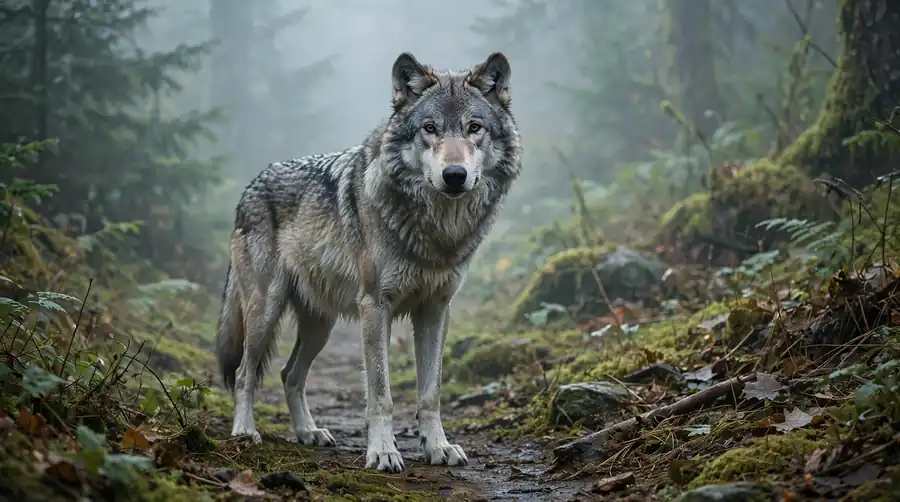
It came out of the treeline ahead of you and stopped. Not startled, not running. It turned its head and held your eyes for a few seconds that felt considerably longer, and then it went on across and into the brush on the other side.
You have probably been told that this means trusting your instincts. Nearly every page on the subject says so.
What none of them tell you is that of all the animals that could have looked at you, the wolf is the one for which a direct stare is not a neutral act. Among wolves, eye contact is a statement with specific meaning. So if it held your gaze, it was not simply looking at you. In its own language, it was saying something.
Wolf Crossing Your Path: The Short Answer
A wolf crossing your path is traditionally read as a sign about instinct and direction: a prompt to trust what you already sense rather than what you have been told, and often a question about whether you are on your own path or someone else’s.
If the animal was a fox rather than a wolf, read what a fox crossing your path means spiritually.
A wolf staring at you is read as the stronger and more personal form, because sustained eye contact is a deliberate signal in wolf social language rather than idle curiosity. And one thing worth knowing before anything else: a wild wolf that sees a person almost always leaves. If it stopped and stared, that is genuinely unusual, and there are three possible reasons for it.
Why a Wolf’s Stare Is Different
This is the centre of the whole encounter, and it is the part the general symbolism pages cannot reach because they are not about encounters.
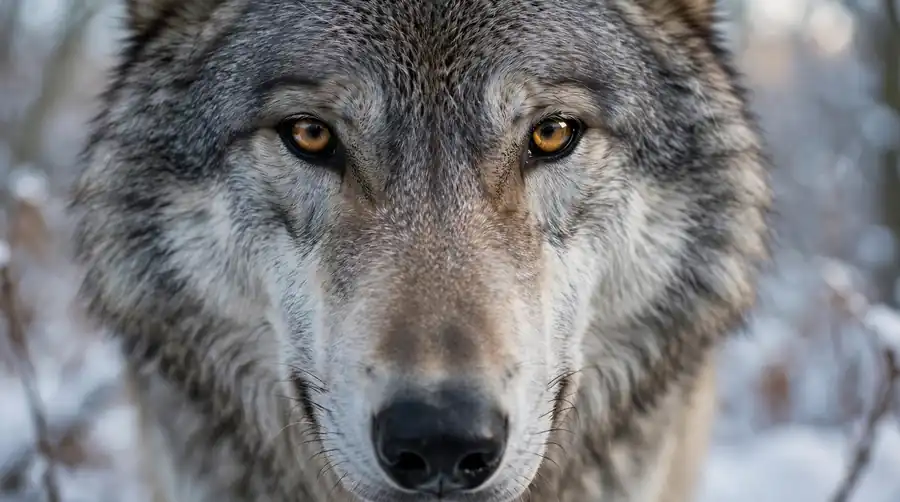
Wolves live in a social world built on signals, and direct eye contact is one of the clearest signals they have. Within a pack, a confident wolf holds another’s gaze to assert itself. A wolf lower in the order breaks eye contact, looks away, lowers its head. Staring and gaze-aversion are a functioning grammar, used constantly, and every wolf reads it fluently.
Compare that to the other animals people write about. A deer staring at you is calculating whether to run. A crow is being curious. A rabbit has simply frozen. In those cases the stare is a by-product of assessment.
For a wolf, the stare is a thing wolves do to each other on purpose. It is loaded before you arrive. That is why a wolf’s gaze feels so different from other wildlife encounters, and why people remember it for decades: you were, for a moment, inside a conversation you had no vocabulary for.
Read that back as symbolism and the traditional interpretation suddenly has a floor under it. The wolf’s message is conventionally about self-trust and standing in your own authority. The wolf’s actual behaviour, when it holds your eyes, is an animal declining to look away. Folklore and biology are pointing at the same thing.
Three Reasons It Stopped and Stared
Wild wolves are extraordinarily avoidant of people. The overwhelming majority of genuine wolf sightings are a few seconds of an animal that is already leaving, and most people who live in wolf country go years without seeing one at all. So a wolf that holds position deserves an honest explanation, and there are three.
1. It Was Assessing You, and Then It Left
Much the most common. Wolves are intensely curious animals and a few seconds of appraisal before withdrawing is normal. If it looked, then turned and went, you got the standard encounter. The stillness was a decision being made, and the decision was to leave.
2. It Has Learned About Human Food
The one scenario that genuinely matters. A wolf that approaches, lingers, follows, or shows no wariness at all has usually been fed, deliberately or through accessible rubbish, livestock carcasses or campsite scraps. Food-conditioned wolves lose their avoidance of people, and those are the animals involved in the very rare incidents that do occur.
This is worth reporting to your local wildlife agency, and not as a complaint. A habituated wolf is usually a wolf that will eventually be killed, so reporting it early is the thing most likely to save it.
3. It Was Not a Wolf
Said plainly because it is the most likely answer for most readers, and because no other page will say it.
Across most of the United States outside the northern Rockies, the Great Lakes region and Alaska, there are no wild wolves. What there are, in enormous and growing numbers, are coyotes — now established in essentially every American city — along with large loose domestic dogs and wolf-dog hybrids, which are kept privately in considerable numbers and look exactly like what people expect a wolf to look like.
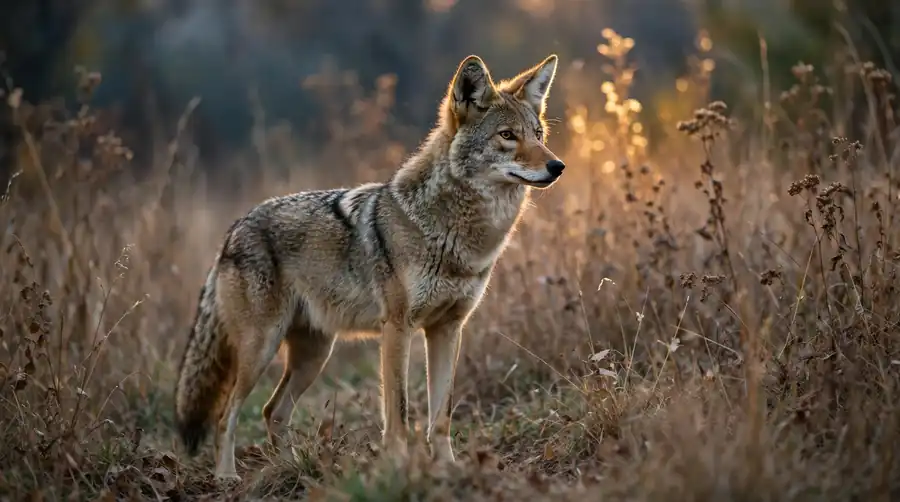
A coyote at dusk looks far bigger than it is. A German shepherd or husky-type dog seen at distance, alone, off-leash and unexpected reads as a wolf almost automatically. And a lone animal that stops and stares calmly at a human, with no fear whatsoever, is behaving much more like a dog than like a wolf.
The distinguishing features, if you want them: wolves are considerably larger, with blockier muzzles, shorter rounder ears and a tail carried straight out or low rather than curled up over the back. Coyotes are slighter, with narrower pointed muzzles, proportionally larger ears and a tail usually carried down.
Now, this does not undo your encounter, and here is why it matters that it does not. Sign traditions attach meaning to what came to you and how it landed. You met a large wild canid alone, it stopped, and it looked at you, and something in you responded before any part of you had identified the species. That response is the material. The taxonomy only changes which traditions apply.
Four Meanings of Seeing a Wolf
1. Instinct Over Instruction
The core reading, and the reason the wolf is the animal it is attached to. Wolves hunt by reading: tracks, scent, the condition and behaviour of prey, the age of a trail. They work from information the environment gives them rather than from a plan.
Read as a message, this is specifically about the gap between what you have concluded and what you have been told to conclude. The sign is usually reported by people midway through a decision in which the sensible advice and their own reading of the situation are pulling apart.
2. Territory and Boundaries
Wolves hold territories of a scale that is hard to grasp — often hundreds of square kilometres — and they maintain the edges constantly through scent marking and howling. A great deal of a wolf’s life is the work of defining where its own ground ends.
The standard reading is about your own boundaries, and it is usually blunter than people want: not a prompt to defend territory you already hold, but a question about what you have let become unclear.
3. Loyalty, Properly Understood
Every page says loyalty. Few say what wolf loyalty actually consists of, which is a shame, because the real version is better. Wolves raise pups cooperatively, the whole family feeds them, older siblings help, and food is carried back to animals that did not hunt.
So the loyalty reading is not about devotion as a feeling. It is about provision as a practice: who you bring things back to, and whether you are currently doing it.
4. The Thing You Have Been Told to Fear
No animal in the Western imagination has been more thoroughly cast as the enemy. The wolf is the villain of the fairy tales, the predator at the edge of the pastoral world, the creature exterminated across Europe and most of the United States with public money and public approval.
Meanwhile, documented attacks on people by wild healthy wolves are vanishingly rare — rarer than almost any other large carnivore, and overwhelmingly outnumbered by injuries from domestic dogs.
That gap between reputation and reality is itself the reading, and it is the sharpest one available. Something in your life has a reputation it has not earned, and you have been treating the reputation as the fact.
If It Was Alone: The Lone Wolf, Corrected
Most people see a single wolf, and almost everything written about the lone wolf is wrong in a way that wastes the best symbolism this animal has.
The popular image is the outcast: expelled from the pack, surviving alone, rejected. That is not what a lone wolf usually is.
Young wolves disperse. At somewhere between one and three years old, most leave the family they were born into and go looking for two things: unoccupied territory, and a mate to hold it with. They are not thrown out. They leave, because staying means never breeding, and the whole structure of wolf life depends on this departure happening.
And they travel. Dispersing wolves have been tracked over distances that are difficult to believe for an animal on foot, crossing highways, rivers, mountain ranges and state lines, sometimes covering many hundreds of kilometres before settling. One famously walked out of Oregon into California and became the first confirmed wild wolf in that state in generations. These journeys are solitary, long, and undertaken without any guarantee at the far end.
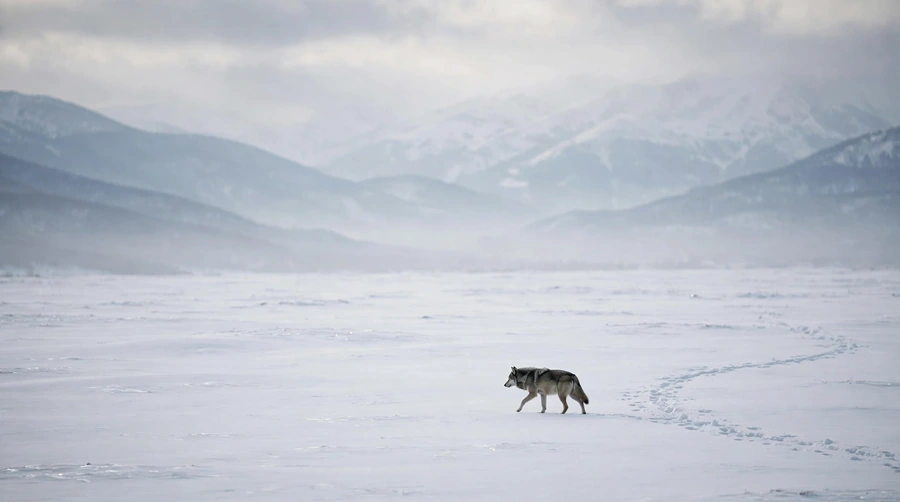
So the lone wolf is not a reject. It is an animal between two lives: it has left the family that made it and has not yet built the one it is going to make, and it is crossing unfamiliar ground in the gap.
That is a far more exact symbol than independence, and it is the reading to take if you saw a single wolf. Not “you are a loner.” Something closer to: you are in transit, the old arrangement is behind you, the new one is not built yet, and this stretch is supposed to be walked alone.
What a Pack Actually Is
Worth correcting, because an enormous amount of wolf symbolism is built on a model that researchers abandoned decades ago.
The idea of the alpha wolf — a dominant individual who fought its way to the top of a hierarchy — came largely from mid-twentieth-century studies of unrelated captive wolves confined together. Put any group of unrelated adult animals in an enclosure and you will get fighting and rank. It tells you very little about wolves in the wild.
A wild wolf pack is a family. It is typically a breeding pair and their offspring of various ages. The animals “in charge” are in charge because they are the parents. Notably, the researcher most responsible for popularising the alpha concept spent much of his later career trying to get people to stop using it.
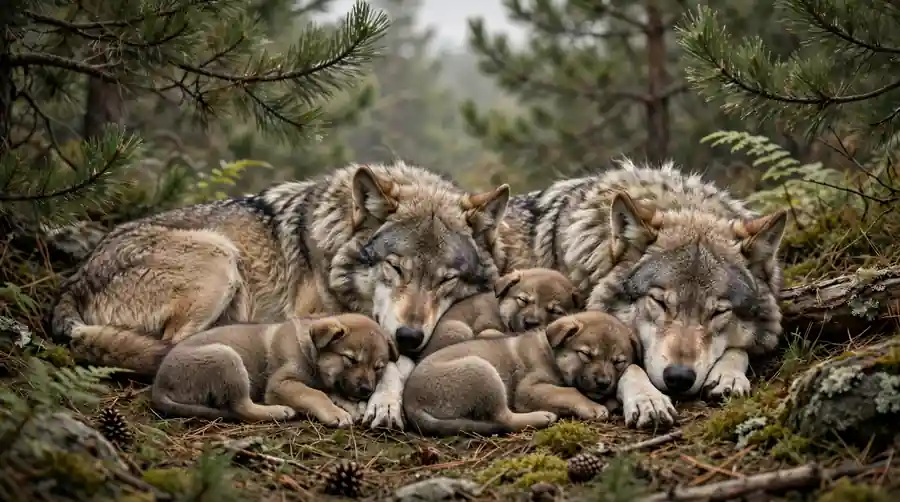
Which means that if you saw a group, the reading is not about dominance, competition or earning rank. It is about kinship, shared labour and the raising of young. That is a gentler message than the wolf’s reputation suggests, and it is the accurate one.
What Changes the Reading
It Crossed in Front of You and Kept Going
The classic crossing, read as information about your direction rather than a confrontation. Wolves travel at an efficient trot along habitual routes, and they place their hind feet almost exactly in the prints of their front feet, so their tracks fall in a near single line. A crossing wolf is an animal in transit on a road of its own that happens to intersect yours. Read accordingly: two paths met, briefly, and both continued.
It Stopped and Held Your Eyes
The strongest form of the sign, for the reasons in the section above. The traditional instruction is to recall what you were thinking in the seconds before it looked, on the principle that the moment the gaze lands is the moment the message is addressed.
You Heard It but Never Saw It
Howling is read as a call you are meant to answer, and the biology supports that unusually well: a howl is a contact call and a territorial announcement, used to locate pack members across distance and to tell neighbours where the boundary is. It is a message intended to be heard by someone far away.
It has nothing to do with the moon. Wolves howl more at night because they are more active then and because sound carries further in cool still air. They are not looking up. A howl heard alone is a separate question from a sighting — see our guide to hearing howling at night.
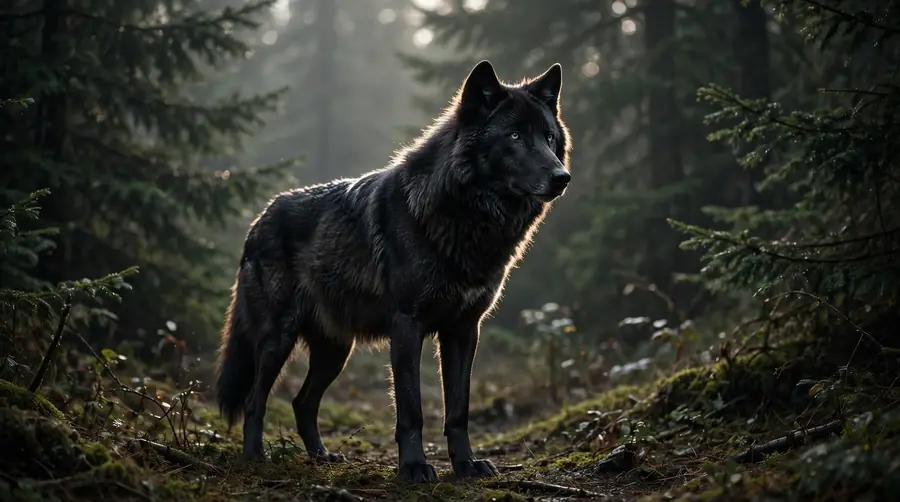
A Black Wolf
Read as the shadow reading: hidden knowledge, the unexamined part of yourself, the thing not yet brought into the light. Black coats in North American wolves are genuinely striking and are associated with a gene thought to have entered wolf populations through interbreeding with domestic dogs long ago — so the black wolf carries a trace of the dog in it, which is a fitting thing to know about an animal read as the meeting point of wild and familiar.
A White or Very Pale Wolf
Read as the most significant colour variant, associated with guidance, spirit and messages from beyond the ordinary. Pale wolves are common in Arctic populations and unusual further south, so in most places this is a rare sighting and the symbolism is correspondingly heavy.
It Followed You
Symbolically read as a message that has not finished being delivered. Practically, this is the behaviour that belongs in section 2 above: a wild wolf does not follow people unless something has gone wrong with its relationship to humans. Treat it as a safety matter first and a sign afterwards.
The Wolf Across Traditions
The wolf is unusual in that different traditions reach almost opposite conclusions about it, and a few hold both at once.
Across many Native American nations the wolf is a teacher and a pathfinder, associated with loyalty, family and the skill of finding the way. The specifics vary a great deal between nations and should not be reduced to one shared belief.
Rome was founded, in its own telling, by twins suckled by a she-wolf, which makes the wolf a nursing mother at the root of an empire.
Norse tradition holds the contradiction most openly: Odin keeps two wolves, Geri and Freki, as companions, while Fenrir is the bound wolf fated to devour. Companion and destroyer, same animal, same mythology.
Turkic and Mongol origin traditions trace descent from a wolf, with the grey wolf appearing as ancestor rather than enemy.
Japan is the one most people have never heard. The word ōkami is close to the word for a great god, and the now-extinct Japanese wolf was venerated as a protector of crops against deer and boar, with shrines dedicated to it that still stand.
Christian tradition is consistently negative, and the reason is worth naming: the wolf appears as the predator of the flock, in warnings about wolves in sheep’s clothing and sheep sent out among wolves. That is the view from inside a shepherding economy, where the wolf was a direct material threat to livelihood. It is a perspective rather than a verdict. The story of Saint Francis preaching to animals sits alongside it as the gentler counter-tradition.
What to Do If It Happens
Do not run. Running triggers pursuit in almost every predator and you cannot outrun a wolf. This is the one rule that matters.
Make yourself large and loud. Stand tall, raise your arms, shout firmly. Wolves want nothing to do with a confident noisy human, and the overwhelming likelihood is that it leaves immediately.
Back away while facing it. Do not turn your back and do not crouch. Keep your eyes on it and withdraw deliberately.
Keep dogs leashed and close. Wolves are territorial toward other canids, and a loose dog is the single most common way a quiet encounter becomes a problem. Most dog-wolf incidents involve an off-leash dog.
Report any wolf that showed no fear. For the animal’s sake as much as yours.
Then, afterwards, the reflective part. Note whether it was alone, whether it held your eyes, and which way it was going. Those three details decide which reading above is yours.
And if it was alone, sit with the dispersal question rather than the independence one. Not are you a lone wolf. What have you left, and what have you not built yet?
Frequently Asked Questions
What does it mean when a wolf crosses your path?
It is traditionally read as a sign about instinct and direction — a prompt to trust your own reading of a situation over the advice you have been given, and a question about whether the path you are on is genuinely yours. Because the wolf crossed rather than approached, it is treated as information rather than confrontation.
What does it mean when a wolf stares at you?
This is read as the strongest form of the encounter, because direct eye contact is a deliberate assertion signal in wolf social language rather than simple curiosity — wolves lower in the order break off a gaze, confident ones hold it. A wolf declining to look away is doing, in its own terms, what the symbolism describes.
Is seeing a wolf good or bad luck?
Good, in most traditions that have a view, and it is treated as a notable sign rather than a warning. The wolf-as-evil framing comes largely from European shepherding cultures where wolves threatened livestock. Native American, Turkic, Roman, Norse and Japanese traditions all hold the wolf in high regard.
What does seeing a lone wolf mean?
Not what the phrase suggests. A lone wolf is usually a disperser — a young animal that has left its birth family to find unclaimed territory and a mate, often travelling enormous distances alone. So the reading is about being between two lives rather than about being an outcast: the old arrangement is behind you and the new one is not built yet.
Was it really a wolf?
Possibly not. Most of the United States has no wild wolves, while coyotes are now in nearly every city and large dogs and wolf-dog hybrids are common. A lone canid that stares at a person with no fear at all is behaving much more like a dog than a wolf. Wolves are larger with blockier muzzles, shorter rounder ears and a tail held straight or low. What moved into the wolf’s empty range is another story: read what a coyote crossing your path means spiritually.
Wolves also have a famous companion: the raven that follows the pack.