
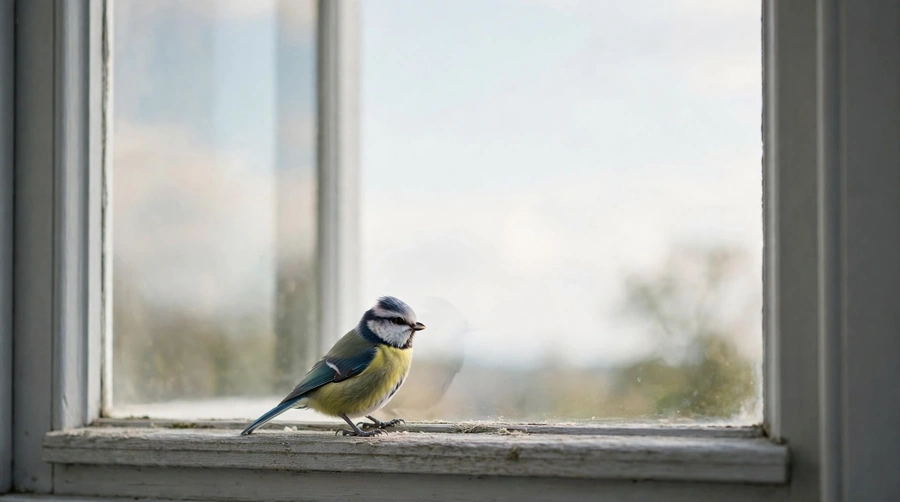
A bird in your house is not a symbolic event. It is an animal that has fallen out of its own sky into a space it cannot manage. Your first job is to get it back out alive. The meaning comes after.
Almost every page on this subject skips straight to the symbolism and never tells you what to actually do. This one will do both, because the practical answer is the honest one, and it is also the one that tells you what the bird was doing.
Get the bird out, first
The bird does not want to be in your house. It is trapped, confused, and flying into walls and windows because it cannot tell the difference between a window and open air. Every moment it is indoors it is hurting itself.
Here is what to do, in order, before you think about anything else.
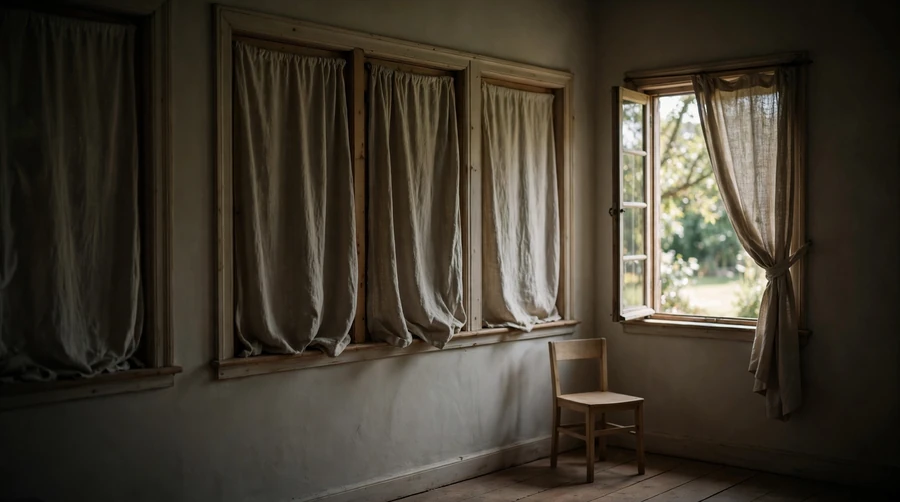
Close the room off. Doors to other rooms shut, windows in the bird’s room opened wide, lights on inside the room and off elsewhere. Curtains down on every window except one.
Give it one exit. Open a single window or door wide, and if it is dark outside, point a light outside so the opening is the brightest thing in the room. The bird is looking for light. Give it one obvious source and make it the only one.
Then leave it alone. Most birds find the exit within ten or twenty minutes once they are not being chased. Do not approach it, do not try to grab it, do not wave a towel at it. The more you do, the longer it stays.
If it is exhausted on the floor, you can catch it with a light towel, hold it firmly but gently, wings tucked, head out, and put it in a ventilated box in a quiet dark place. Most birds recover in an hour. Put the box outside and open it. If it does not fly, call a rehabilitator. If you live in the US, it is illegal to keep most wild birds without a permit, so you hand it over rather than nurse it yourself.
Why it flew in
There are three reasons birds come inside, and none of them is a message.
It was chasing insects. Birds hunt by sight and sometimes they follow a moth or a fly through an open window, and then they cannot find the way out because a house is not the open sky they evolved for.
It mistook the window for open air. Glass is invisible to birds. They see the sky in it, not the barrier. Once they hit it they are stunned and disoriented, and by then the bird is inside a space it does not understand.
It is young and doing something new. A juvenile bird on its first year in flight is figuring out how to be a bird. In spring and summer you get more birds indoors because that is when they are learning. It has nothing to do with you.
One useful clue. If the same bird or birds keep turning up in your house, look for the gap. A loose screen, a gap under the door, an open vent. The bird is not coming back for you. It is using a route that exists.
What a bird in the house is actually like for the bird
This is the part the symbolism pages never touch, and it is the part that makes the symbolism possible.
A bird in a room cannot see. Not literally, but in every way that matters. Birds navigate by sight in open air, by movement, by cues a house has none of. The sky is the wrong colour. The distance between walls is wrong. The light is all wrong.
So the bird does the one thing it knows: it moves towards light. It flies at windows. It crashes into glass. It panics at the door frame. It is doing exactly what it would do outside and it is getting nowhere, because inside the rules are different.
That is the whole story, and it is a much better symbol than any generic message. A bird in a house is something that has lost its bearing in a space it was never built for. It is frightened, it is trying, and it cannot figure out the rules of the room it is trapped in.
Four readings
1. Something you cannot see was let in
The window reading. Birds hit windows because glass is invisible to them. The most common cause of a bird in the house is that the bird thought there was no wall.
That is the shape of a lot of problems. Something that was always there and always invisible, until suddenly it was inside the room and you could not avoid it any more.
The bird did not come to announce itself. It came because it could not see the barrier. And you are the one left figuring out how it got in.
2. The exit is right there and it cannot see it
Here is the one thing that actually helps the bird, and it is the part of the rescue that doubles as the strongest reading.
You make the room dark except for one light. You give it one exit and you close off every other option. And then, and this is the part that people never manage, you leave the room.
Most of the hard things in life are solved this way. Not by more options, but by reducing the light to one thing and stepping back. The bird is not being told what to do. It is being shown one way out and then given the room to take it.
3. It is not the bird’s fault
A bird in a house did not choose to be there. It did not plan to enter. It was hunting or chasing or it misread the glass and then it was trapped.
A lot of what arrives uninvited is like this. Someone turns up in your life without meaning to, gets into a space they cannot handle, and then you are both in it, and neither of you can see the way out. The first thing that stops the panic is not more reaction. It is recognising that the thing that got in did not mean to.
4. You are not being judged
The omen pages will tell you a bird in the house means death is coming or that a spirit is visiting. Some of them will even tell you it is a dead relative trying to reach you.
I want to be honest about this. There is a real folk tradition of birds entering the house as a portent, and it is strong enough that people have feared it for centuries. The tradition exists. But it is built on the wrong idea, and it matters to say so.
The bird is not a message from the other side. It is a bird that got confused by glass. It is alive, it is frightened, it is not carrying anyone’s soul. If you want to believe in omens, you can. But the bird itself is innocent of everything you are reading into it.
What the traditions actually say
The belief that a bird entering a house means a death is genuinely old. It goes back to medieval Europe and it is still alive today. It is one of the most consistent pieces of folk belief in the English-speaking world.
But the belief is built on a misreading. A bird in a house was, for most of history, a bird that had flown in through an open window or down a chimney, and it would have been hard to get out. A bird that got in and stayed in was a bird in distress, and distress in the house was associated with illness and death. That is not prophecy. That is a correlation between an animal struggling in a space and people dying in that same space, which is not the same thing at all.
Other traditions are kinder. In some European folk beliefs, a bird entering the house was a sign of good news arriving. In some Asian traditions, a bird in the house is a visitor bringing luck. The omens are not consistent across cultures, which tells you that the meaning is not in the bird. It is in the culture that is looking at it.
The Bible does not say a bird in the house means anything. There is no verse about birds entering houses as signs. The belief is folk tradition, not scripture.
If you found a dead bird in the house
That is a different situation, and it is worth handling honestly because it is the one that brings people here at night.
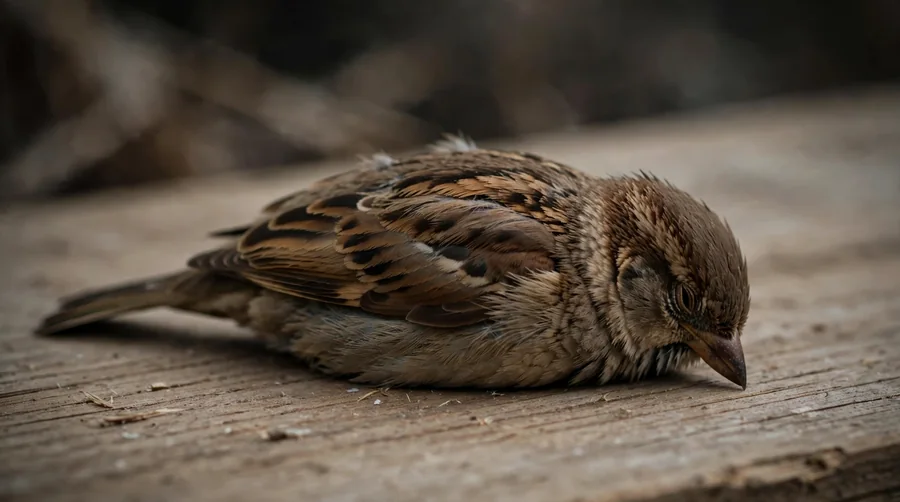
A dead bird in the house usually means the bird got in, could not get out, and died of stress or exhaustion before you found it. It is sad and it is not a message. It is the same bird that was flying at the windows yesterday, having run out of energy.
Some traditions read a dead bird indoors as a bad omen, and that reading exists and is documented. But the honest answer is that a dead bird in the house is the same as any dead animal you find. It was an animal that got into trouble. It is not a sign that something bad is coming for you.
The question to sit with
A bird in your house is not a message. It is a bird that misread a window, or chased an insect, or was young and did not know the difference between inside and outside. It is not a sign. It is an animal that needs to get back out.
The reading that matters is the one you give yourself after you have helped it leave. Something got in that could not handle the room it was in. Something that belonged outside. What was it, and why did it need to be let out?
That is the question worth keeping.
Related: the same situation with an owl in the house, doves around the house, or a goose crossing your path.