
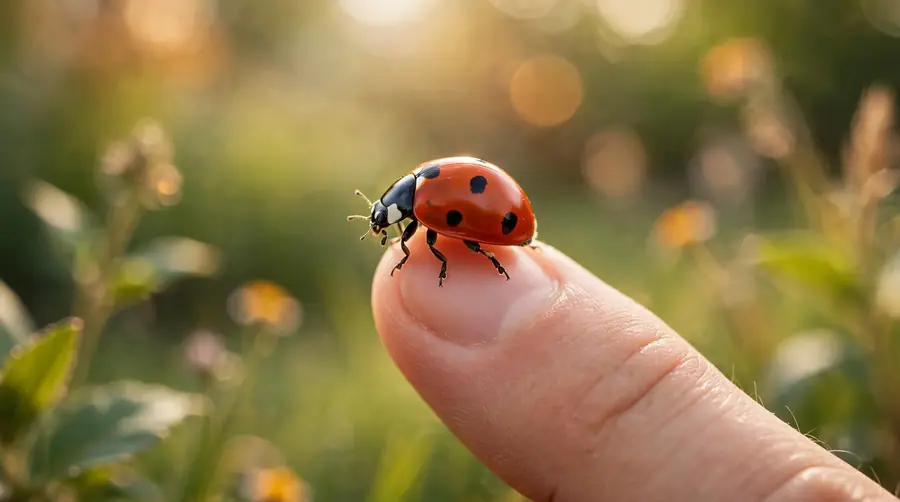
It landed on the back of your hand and you went completely still, the way everyone does, because nobody wants to be the reason a ladybug leaves.
Then it walked up your finger — upward, always upward — stopped at the very tip, opened a pair of wings you would not have believed fitted under there, and went.
Every page about this will tell you it means good luck. True, as far as it goes. But the ladybug is one of the very few lucky animals whose luck is not a superstition at all — it is a historical event, it has a date and a cause, and the beetle is named after the person people thanked for it.
Ladybug Landing on You: The Short Answer
A ladybug landing on you is read as good luck arriving directly — the luckiest version of an already lucky sign, because it chose to make contact rather than simply be seen. Traditionally you make a wish and let it fly off on its own; the direction it goes is said to be where the luck comes from, and brushing it away is the one thing you are not supposed to do.
Why it landed on you specifically has a real answer, usually a pale shirt or the salt on your skin. And the folklore about counting the spots has a real answer too, which is not the one you have been told: the spots do not count your luck, they identify the species.
Why the Ladybug Is Lucky at All
Start here, because it is the foundation of everything else and almost nobody tells you.
Look at the name. In English it is the ladybird or ladybug, and the “lady” is not a generic politeness. It is Our Lady — the Virgin Mary. In German the beetle is Marienkäfer, Mary’s beetle. Across a whole range of European languages the name refers to Mary, or to God, or to a saint.
The traditional story behind that dedication goes like this. Medieval European farmers watching aphids strip their crops prayed to the Virgin for help. Ladybirds arrived in numbers and ate the aphids. The crops were saved, and the beetles were named in her honour.
The red of the shell was read as her cloak, which is how she was most often painted. And the seven spots of the common European ladybird were read as her Seven Joys and Seven Sorrows.
Now here is what makes this different from every other luck superstition. The useful part actually happened.
Ladybirds are voracious predators of aphids. A single adult eats dozens a day and thousands across a lifetime, and the larvae — which look nothing like the adults and alarm gardeners who do not recognise them — are even hungrier. Ladybirds are so effective that they are bred and sold commercially today as biological pest control, released deliberately into greenhouses and crops.
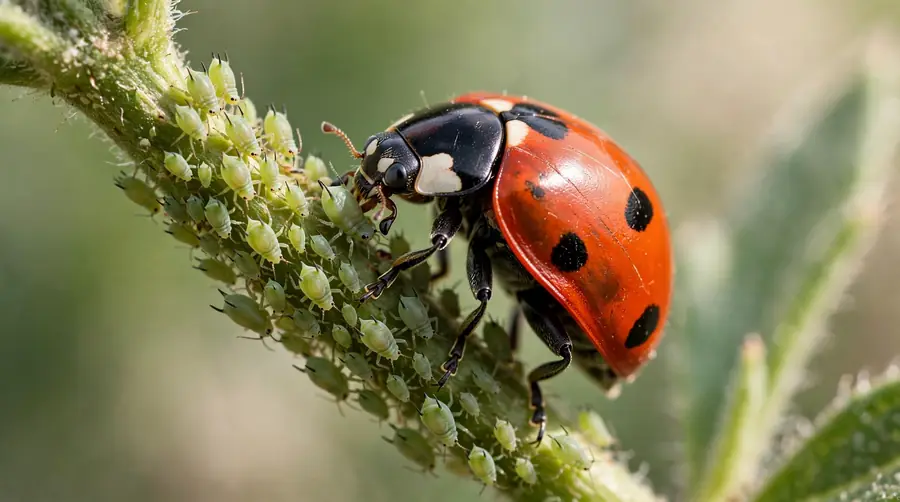
So the ladybug is not lucky because somebody decided it looked auspicious. It is lucky because it turned up when people were facing ruin and it fixed the problem. The folklore is a thank-you note.
Which gives the sign a reading no other lucky animal can offer. The ladybug does not represent luck in the abstract. It represents help that arrives in a form too small to have been expected, and that works anyway.
Why It Landed on You
There are real reasons, and knowing them does not spoil anything.
You were probably wearing something pale. Ladybirds are strongly drawn to light colours — white, cream, yellow, pale blue. If you were in a white t-shirt in a garden, you were the most attractive landing surface available.
You were warm. They seek out warm surfaces, particularly as the season cools, and a human arm in sunshine is a very good warm surface.
Or it was drinking from you. This is the one that surprises people. Ladybirds will settle on skin to take up moisture and salts from sweat. If it stayed a while on your arm on a hot day and seemed to be doing something rather than just resting, it may well have been having a drink.
And it needed to stop. Ladybirds are not strong long-distance fliers. They go up, get carried, and come down, and anything stationary and prominent will do.
Why It Walked to Your Fingertip Before Flying
Everyone notices this and nobody explains it. The ladybug does not take off from where it lands — it walks upward first, to the highest point available, and launches from there.
That behaviour is so characteristic that a whole language built its name on it. In Japanese the ladybug is tentōmushi, which means something close to “the insect that climbs toward the sun” — because it climbs to the top of a stem and flies upward into the light.
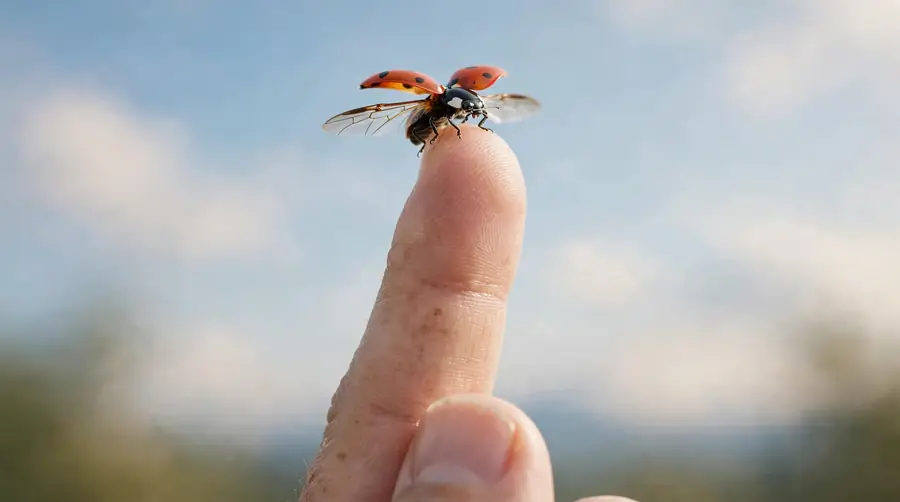
So the thing it did on your hand is the thing it is named for in Japan. It found the highest point on you and went up.
It is also, incidentally, the reason the folklore about watching which direction it flies works at all: give it a raised finger and it will reliably walk to the end and launch, which makes it the most cooperative oracle in the insect world.
Four Readings of a Ladybug Landing on You
1. Small Help, Arriving
The core reading, grounded in the aphid story above. Not a windfall and not rescue — something modest showing up and turning out to be sufficient.
People most often report this sign during a stretch where they have been waiting for something large to change and nothing large has. The ladybug’s answer is that the thing that saved the medieval harvest was four millimetres long.
2. Being Visible on Purpose
Here is the fact that turns the ladybug’s prettiness into something much more interesting. That red-and-black is not decoration. It is a warning.
Bright red against black is a signal to birds that the wearer tastes appalling, and in the ladybird’s case that is entirely true. The beetle is loaded with bitter compounds, and a bird that eats one does not make the mistake twice.
So the ladybug is not camouflaged. It has gone in the opposite direction — it is as conspicuous as it can possibly make itself, deliberately, as its defence. It survives by being impossible to miss.
That is a genuinely unusual reading for a small, soft-looking creature, and it is the one most worth taking: visibility can be protection rather than exposure. Some things are safer when everyone can see them.
3. Love and Wishes
The romantic reading is old and specific. In several European traditions a ladybird landing on an unmarried woman meant she would marry within the year, or that the direction it flew was the direction her future partner would come from. In others it was counted: the spots told you how many months until the wedding, or how many children would follow.
The wish version is the one most people know. Make the wish, do not brush it off, let it leave in its own time, and it carries the wish upward as it goes — which, given the climbing-and-launching behaviour above, it quite literally does.
4. A Cycle Turning
Ladybirds overwinter in a dormant state, packed into crevices, barely alive by any ordinary measure, and then come out again in spring. Like the bat and the dormouse, they are a genuine death-and-return animal rather than a symbolic one — the bat carries the same reading for the same reason.
And they transform completely on the way to adulthood. The larva is a small spiky dark-grey thing with orange markings that most people would not identify as a ladybird at all, and it becomes the beetle through a full pupation. So the creature on your hand has already been something unrecognisable.
What the Number of Spots Actually Means
This is the section people come for, so here is the folklore and then the fact, because the fact is better.
The Traditional Readings
In the counting traditions, the number is read as a quantity of something good. One spot is read as a single significant arrival, often love or news. Two as partnership and balance. Three as family or a creative outcome. Four as stability and home. Five as a change of direction. Six as harmony and domestic matters. Seven is the luckiest of all and carries the Marian reading of the Seven Joys. And in the most common version of the folk belief, whatever the number, it is how many months of good luck you have, or how many wishes, or how many children.
Take all of that as the lightest layer of the reading rather than its substance, for a reason that is about to become obvious.
And What the Spots Are Really Telling You
Two things, and the first one corrects a belief almost everybody holds.
Spots do not accumulate with age. A ladybird does not gain a spot per year, or per month, or at all. It emerges from the pupa with the number of spots it will have for life and never adds another. If you were told otherwise as a child, so was everyone.
And the spot count identifies the species. That is what it is for. A seven-spot ladybird has seven spots because it is a seven-spot ladybird — that is the animal, and the Latin name says so. A two-spot has two because it is a different species entirely. Ten-spots, fourteen-spots, sixteen-spots, twenty-two-spots: these are not ladybirds of different ages or fortunes. They are different kinds of ladybird.
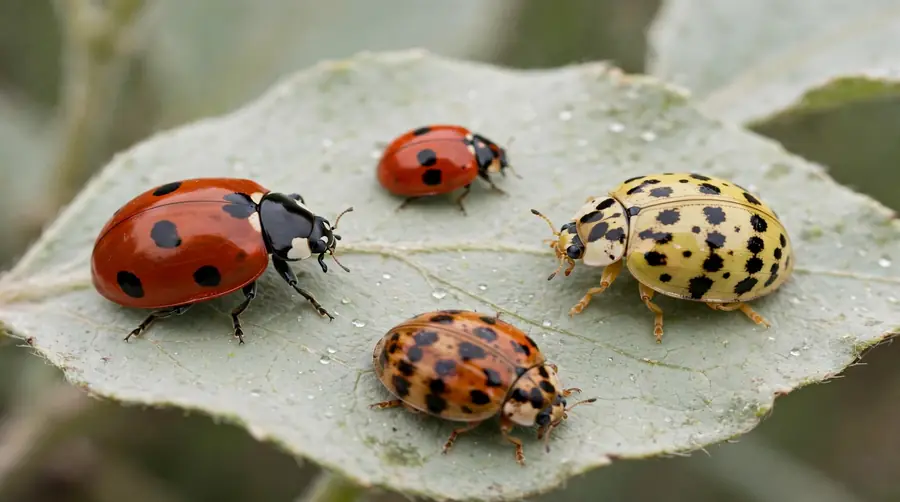
So counting the spots is a real and useful thing to do. It just answers a different question than the folklore thought. You were not being told how many months of luck you have. You were being told which species chose to land on you.
And I would argue that is the more satisfying answer, because it means the number was never random. It was information. It simply happened to be taxonomic information rather than prophetic information, and the medieval farmers who made the Seven Joys connection were, without knowing it, describing one particular species that was very common in their fields.
What the Colour Tells You
Colour works the same way — a traditional reading, and a factual one that is usually more interesting.
Classic red. The Marian colour and the luckiest in every tradition. Also, usually, a native species.
Orange. Read traditionally as creativity and warmth. Factually, an orange ladybird with many spots is very often a harlequin — an introduced species now widespread across Europe and North America, which is displacing native ladybirds and is the one responsible for mass invasions of houses. Still lucky, if you like, but it is the invasive one.
Yellow. Read as optimism and clarity. Factually, several yellow ladybirds — the twenty-two-spot in particular — do not eat aphids at all. They eat mildew, grazing fungus off leaves. A yellow ladybird is likely a completely different kind of specialist from the red one.
Black with red spots. Often read as the shadow variant and treated as unusual. It is a real and perfectly ordinary pattern — the inverse colouring exists in several species, and they are often small and glossy.
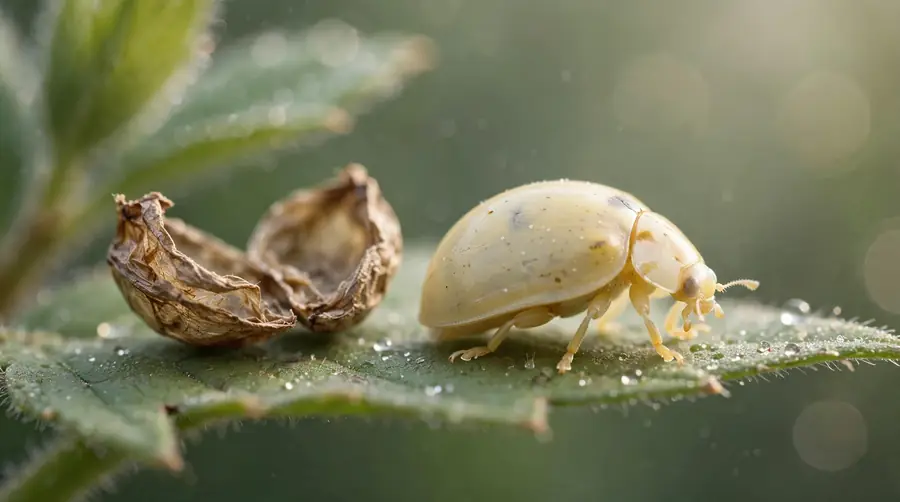
Pale, yellowish, washed-out, or with no spots at all. Save this one, because it is lovely. A ladybird that has just emerged from its pupa is pale and soft and often spotless, and its colour deepens and its spots darken over the following hours as the shell hardens.
So if the one that landed on you looked faded or unfinished, you did not meet an old ladybird or a sick one. You met a brand-new adult, hours into the only version of its life that can fly. For a sign about new beginnings, that is about as on the nose as nature gets.
If It Left a Yellow Mark on Your Skin
A small thing that happens to a lot of people and is explained nowhere.
If you picked it up and afterwards found a tiny yellow or orange stain where it had been, the ladybird did that on purpose. When frightened, ladybirds release a droplet of bitter yellow fluid from their leg joints — it is a defensive secretion, and it is the same foul taste the red shell is advertising.
It is harmless to you and washes off. But it means something worth knowing: the ladybug was alarmed. It is the insect equivalent of flinching, and it usually happens when one is handled rather than allowed to walk.
Which is a practical argument for the old instruction. Do not pick it up. Let it walk, and let it leave when it decides to.
Ladybugs in the House
Read traditionally as luck entering the home, and the stronger the better — in several European traditions a ladybird indoors was specifically not to be removed, and killing one was held to bring misfortune, which follows logically from having named it after the Virgin.
One in the house is a nice thing. Forty in the house is a different phenomenon, and it deserves the real explanation.
In autumn, ladybirds look for somewhere to spend the winter — a dry sheltered crevice out of the weather. Window frames, attic corners, the folds of a curtain, the gap behind a loose piece of trim. And they do not search alone: they release aggregation pheromones, chemical signals that say “this spot is good,” and others follow the signal in.
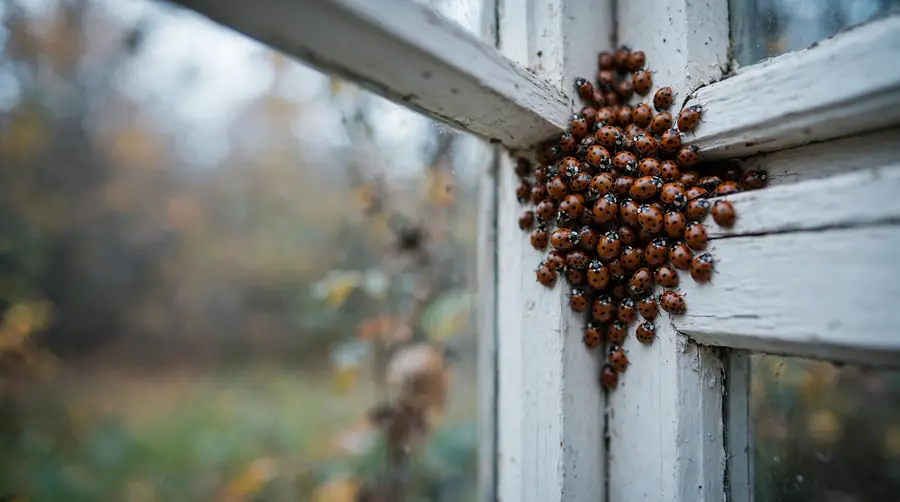
Which is why you never find one at a window in October. You find a cluster, and then a bigger cluster.
Those mass gatherings are usually harlequins, the introduced species, and they are also the ones that can stain curtains and walls when disturbed, for the reflex-bleeding reason above. If you want them out, the gentlest method is to gather them with a soft brush into a container and put them somewhere cold, dry and sheltered — an unheated shed or garage, not out into the open where a warm indoor beetle will die on a frozen lawn. Do not vacuum them; it kills them and the smell is genuinely unpleasant.
And the symbolic reading of a cluster, if you want one: the tradition treats repetition and multiplication as emphasis. Several hundred of something lucky has an obvious interpretation. It is also a hibernation party, and both are true.
What Changes the Reading
On Your Hand
The most commonly reported and read as the most direct: hands are what you make and act with, so the message concerns work and what you are building.
On Your Head or in Your Hair
Read as thought and as something arriving in your mind rather than your circumstances. Some traditions treat the head specifically as the luckiest placement of all.
On Your Chest or Over Your Heart
Read as the love placement, and it is the version that most often turns up in the romantic folklore above.
It Stayed a Long Time
Read as a stronger and more deliberate sign. Practically, it was probably warm, or drinking, or waiting for better flying conditions — ladybirds will not take off in cool or still-damp air.
It Would Not Leave
Charming, and worth knowing that in cold weather a ladybird may genuinely be unable to fly until it warms up. If you want to move it, let it walk onto a leaf rather than lifting it.
A Dead Ladybug
Read as a missed opportunity or a piece of luck that did not land, rather than anything ominous. Adults live roughly a year, so finding one is unremarkable, and in late winter you may find whole clusters that did not survive the cold.
What to Do
Do not brush it off. This is the one instruction every version of the folklore agrees on, and the reflex-bleeding fact gives it a practical basis too.
Hold still and raise your hand. It will walk upward to the highest point and take off on its own, usually within a minute or two. That is the cooperative part.
If you want the traditional version: make the wish while it is still on you, then watch which way it goes and note it. That is the whole ritual and it costs nothing.
And count the spots before it leaves. Not for the months of luck — for the species. Then look it up. You will find out exactly which animal chose to land on you, which is a better souvenir than a number.
Then the reflective part, which this encounter supplies more cheerfully than most on this site. The thing that landed on you is a tiny, conspicuous, badly-flying beetle that medieval Europe credited with saving its harvests, and it earned that by eating aphids one at a time.
What small help has already arrived that you have been discounting because it was not big enough to look like an answer?
Frequently Asked Questions
What does it mean spiritually when a ladybug lands on you?
It is read as good luck arriving directly, and as the strongest form of an already lucky sign because the ladybug made contact rather than simply being seen. The traditional response is to make a wish, not brush it off, and note which direction it flies. The deeper reading is help that arrives in a form too small to have been expected and works anyway.
What does the number of spots on a ladybug mean?
In folklore the count is read as months of luck, wishes, or children, with seven the luckiest because of its link to the Virgin Mary’s Seven Joys. In fact the spot count identifies the species — a seven-spot ladybird has seven spots because that is what it is — and spots never accumulate with age, despite the very widespread belief that they do.
Why is a ladybug considered good luck?
Because of a real event rather than a superstition. Medieval European farmers whose crops were being destroyed by aphids prayed to the Virgin Mary, ladybirds arrived and ate the aphids, and the beetle was named after her — “Our Lady’s bird,” or Marienkäfer in German. Ladybirds genuinely are voracious aphid predators and are still sold commercially as pest control today.
Why did a ladybug land on me specifically?
Most likely because you were wearing something pale — ladybirds are strongly attracted to white, cream and yellow — or because you were a warm surface. They will also settle on skin to drink moisture and salts from sweat, so on a hot day it may have been having a drink.
What does a ladybug in the house mean?
Luck entering the home, and in several European traditions one indoors was specifically not to be removed. If you have dozens rather than one, that is an overwintering aggregation — ladybirds release pheromones that attract others to a good sheltered spot, usually in autumn, and mass gatherings are generally the introduced harlequin species.