
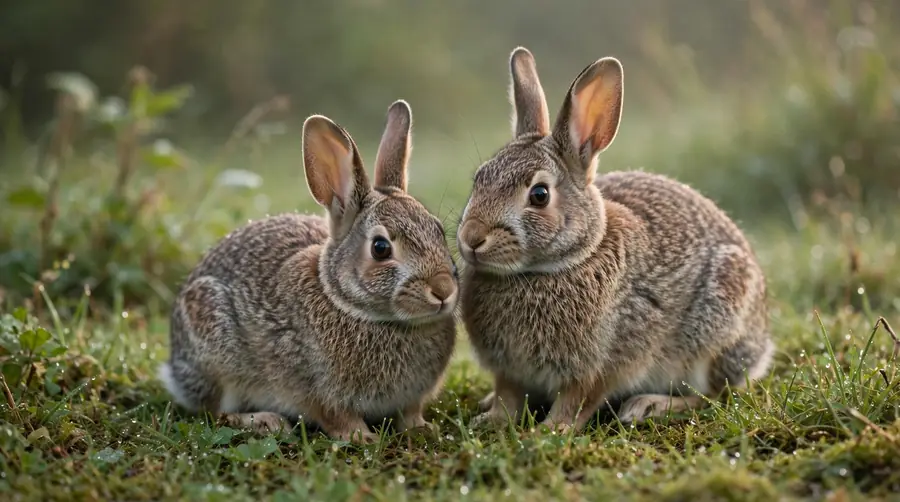
Two of them, sitting close together on the grass, not eating and not running. You stopped walking because you did not want to startle them, and they watched you for a while and then went back to whatever rabbits do.
Every page you will read about this says the same four words: partnership, balance, abundance, fertility.
Here is something better. Two rabbits is the exact starting condition of the most famous number sequence in mathematics — the one that turns up in sunflower heads, pinecones and nautilus shells. It did not arrive in European thought as a mystical principle. It arrived in the year 1202 as a question about a pair of rabbits. Which makes two rabbits the seed of a pattern rather than a symbol of balance, and that is a considerably sharper thing to be shown.
Seeing Two Bunnies: The Short Answer
Seeing two rabbits is traditionally read as a sign of abundance beginning rather than abundance arrived — the start of something that will multiply, and usually faster than you expect.
The partnership reading is real but secondary. The more accurate one is mathematical: with rabbits, two is never just two. Two is the first term in a sequence, and the biology of this animal makes that literal rather than poetic.
With Rabbits, Two Is Never Just Two
Almost every animal symbolism is a human projection. Rabbit fertility symbolism is one of the very few that is simply a description.
Female rabbits are induced ovulators. They do not release eggs on a fixed cycle and wait for the right window — they ovulate in response to mating itself. In practice this means a doe is nearly always capable of conceiving.
Gestation is roughly a month. And a doe can conceive again within hours of giving birth, so a female rabbit can be nursing one litter while carrying the next. Across a single breeding season a healthy wild rabbit can produce several litters of several young each.
“Breeding like rabbits” is not an insult or an exaggeration. It is an accurate technical summary.
So when you see two rabbits together, you are not looking at a pair. You are looking at an arithmetic condition. Two rabbits in a field in April is, left alone, a great many rabbits by August.
Which is why the abundance reading attached to this animal has survived everywhere it has been known. It is not a metaphor people invented. It is a thing people watched happen.
Two Rabbits Started the Fibonacci Sequence
This is the fact that should be at the centre of every article about seeing two rabbits, and it is in none of them.
In 1202 an Italian mathematician known as Fibonacci published a book called Liber Abaci, which is largely responsible for bringing Arabic numerals into European use. Tucked inside it is a worked problem. It runs, in essence: start with a single pair of rabbits; assume each pair produces a new pair every month from their second month onward; how many pairs will there be after a year?
Working it through month by month produces the series 1, 1, 2, 3, 5, 8, 13, 21, and onward — each number the sum of the two before it.
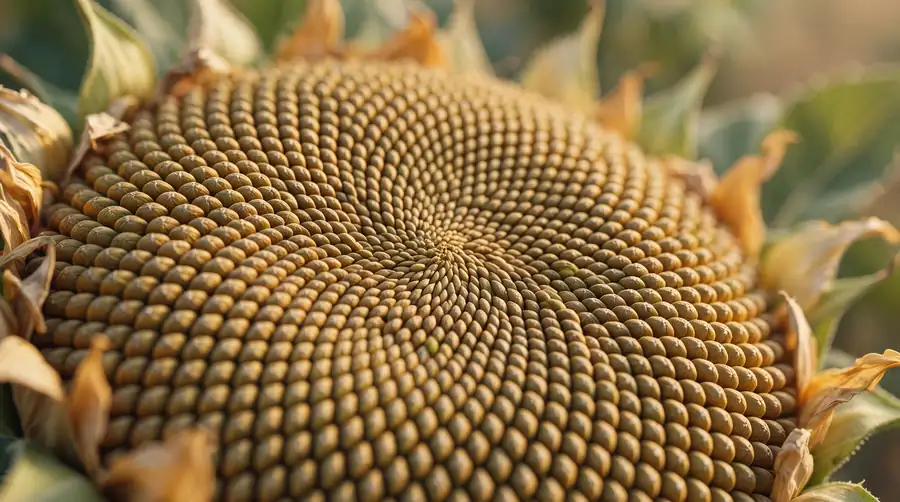
That is the Fibonacci sequence. It is the number series people point to in the spiral of a nautilus shell, the arrangement of seeds in a sunflower head, the scales of a pinecone, the branching of some plants. It is tied to the golden ratio, which has been treated as a signature of natural order for centuries and shows up in more spiritual writing than almost any other piece of mathematics.
And it entered Western mathematics as a question about a pair of rabbits.
Now read your encounter back through that. A pair of rabbits is not a symbol of two things in balance. It is the opening term of an expanding sequence — the smallest possible starting point of a pattern that grows according to a rule you cannot see while standing in it, where each stage is built out of the two that came before.
If you want a reading from that, it is this. What you are looking at is small and it is early, and it is not going to stay either. The growth will not be linear and you will not be able to forecast it from where you are standing. Each thing that comes will be made out of the things immediately before it.
One honest footnote, because it matters. Fibonacci’s rabbit problem is not biologically realistic — the rabbits never die, never stop breeding and always produce exactly one pair. It is a mathematical toy, not a field study. But that is almost the point: of all the animals available to him as an example of something that multiplies, the rabbit was the obvious one. It still is.
Were They Rabbits or Hares?
Worth settling, because the two animals carry genuinely different symbolism and almost nobody distinguishes them.
Rabbits are social. They live in colonies in connected burrow systems, they are smaller with shorter ears and legs, and their young are born underground — blind, hairless and completely helpless in a fur-lined nest.
Hares are solitary. They are larger, longer-eared and long-legged, they do not burrow but shelter in a shallow scrape in open ground called a form, and their young are born fully furred, eyes open, able to move almost immediately. A hare is born ready; a rabbit is born dependent.
Which gives you a quick answer. Two animals sitting companionably together on a lawn or at the edge of a garden were almost certainly rabbits, because hares do not keep company. Two large long-eared animals out in an open field in spring were more likely hares — and the reading shifts toward solitude, the moon and madness rather than community and increase.
And If They Were Up on Their Hind Legs Hitting Each Other
This is the single most commonly witnessed and most commonly misread “two rabbits” encounter, so it gets its own correction.
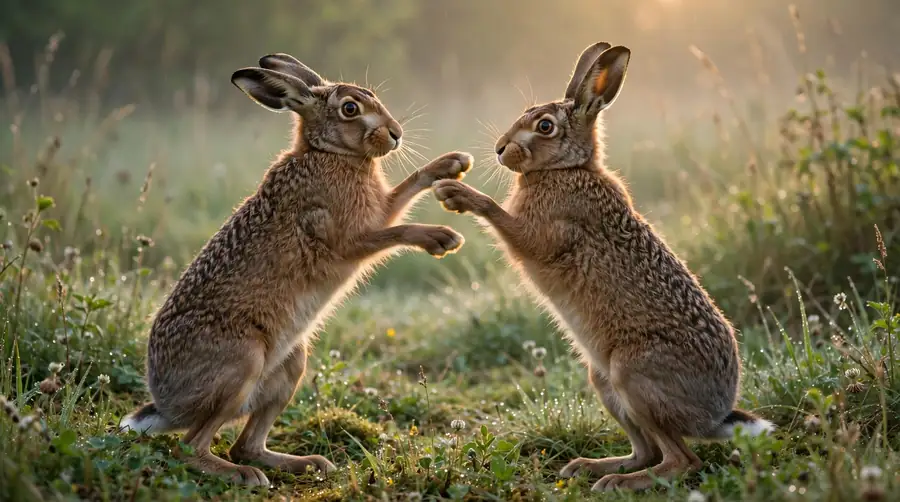
If you saw two animals rear up and box at each other with their front paws, that is the behaviour behind “mad as a March hare.” For centuries it was assumed to be two males fighting over a female.
It is usually not. It is typically a female fending off a male she is not ready to accept.
That changes the reading entirely. It is not a contest between rivals. It is one party setting a limit on another, physically and unmistakably, and the traditional interpretation shifts accordingly: not competition, but the right to refuse.
Four Meanings of Seeing Rabbits
1. Increase That Has Already Started
The core reading, and the one the biology earns. Not abundance as a wish but abundance as a process already underway and not yet visible at scale.
People most often report this sign early in something — the first weeks of a project, a pregnancy, a business, a relationship — when the thing is real but still small enough to doubt.
2. The Indirect Route as Strategy
Watch a rabbit flee and it does not run in a straight line. It bolts in sharp unpredictable zigzags, and that is not panic — it is a working anti-predator tactic. A pursuing animal has to commit its weight to a direction, and every sudden turn costs the pursuer more than it costs the rabbit.
Read as a message, this is the rabbit’s most useful teaching and the opposite of what people assume about it. The erratic path is the plan. You are not required to approach the thing head-on.
3. Alertness Without Aggression
A rabbit has eyes placed high and far to the sides, giving it a field of view approaching the full circle, and ears that rotate independently. It is built almost entirely for detection. It has no weapons worth the name.
The reading is about a particular kind of competence: knowing everything that is happening around you and having no intention of fighting any of it. Vigilance as a way of living rather than a prelude to conflict.
4. Going Back Over What You Already Have
An unusual one, built on a fact most people find startling.
Rabbits produce two kinds of droppings. The hard round pellets you find are waste. But they also produce soft pellets, usually at night, and they eat those — passing the material through a second time to extract nutrients their first pass could not reach. It is not a quirk; it is how they survive on grass.
As a reading, it is one of the more practical things in animal symbolism: there is something you have already been through that you did not finish getting the value out of. Go back over it. The nourishment is in the second pass.
Why the Rabbit Is a Moon Animal
Rabbits and hares are tied to the moon in an extraordinary number of unrelated cultures, and there is a reason that is better than coincidence.
In Chinese tradition a rabbit lives on the moon, pounding the elixir of immortality; the same figure appears in Japanese tradition pounding rice for mochi, and in Korean telling. In Mesoamerican tradition there is likewise a rabbit in the moon. A Buddhist story tells of a hare that offered itself to a disguised god and was placed in the moon as a memorial. Across Europe the hare was a creature of the moon, of night, and of witches.
Part of this is simply that the dark patches on the moon’s face resolve, if you look, into something rabbit-shaped. Once you have seen it you cannot unsee it.
But here is the part that makes the association feel less arbitrary. A rabbit’s gestation is roughly 28 to 31 days. The cycle of the moon from one new moon to the next is about 29 and a half.
The animal that cultures all over the world put in the moon is an animal whose entire reproductive cycle runs to the length of a lunar month. Conception to birth, one moon. Unrelated peoples watching rabbits and watching the sky were, in a real sense, watching the same clock.
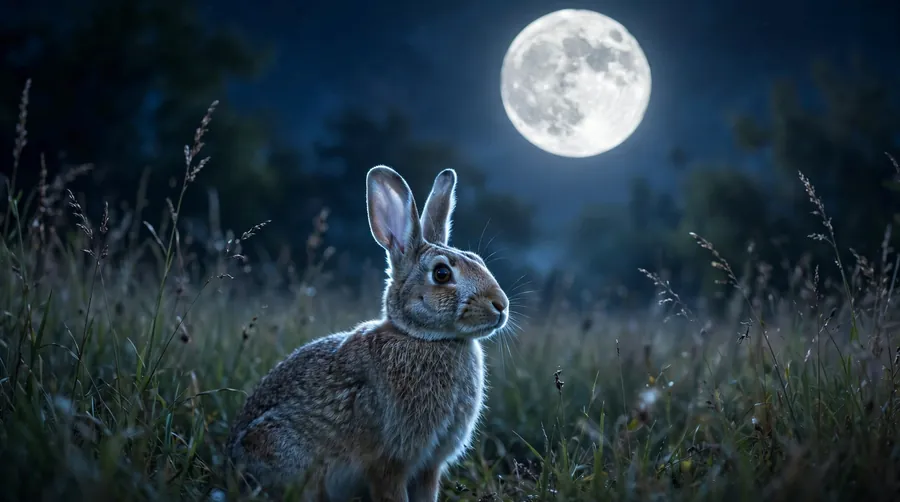
So if you saw your rabbits at dusk, at night, or under a bright moon, that is the oldest and most widely shared frame available for the encounter.
The Rabbit as a Spirit Animal
If the rabbit is the animal that keeps appearing for you rather than a single encounter, the traits usually assigned to it are quickness, fertility, alertness, adaptability and a tendency to avoid confrontation rather than resolve it.
The honest version includes the difficult part. The rabbit’s governing emotion is fear, and the rabbit as a guide is traditionally read as asking what you are running from and whether the running is still serving you. It is the one major spirit animal whose message is frequently uncomfortable, because its competence and its anxiety are the same faculty.
Balanced against that: no animal is better at beginning again. A rabbit that loses a litter breeds again within the month. Persistence through replacement rather than endurance.
What Changes the Reading
A Rabbit Crossing Your Path
Read as a message about your direction, and because it crossed rather than approached, as information rather than confrontation. If it crossed in that zigzag bolt, see meaning 2 above — the reading is about the route rather than the destination.
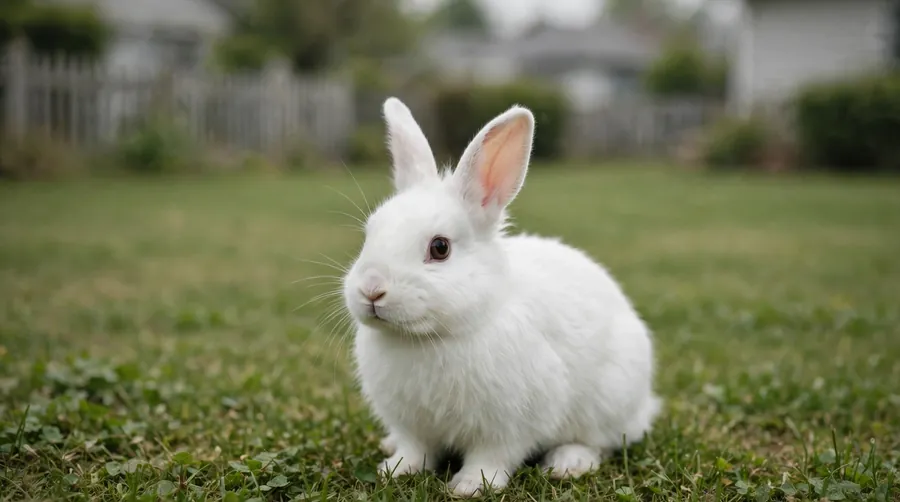
A White Rabbit
Traditionally the most significant variant — purity, guidance, the threshold between worlds, and in the best-known story in English literature the thing you follow somewhere you did not plan to go.
Practically, and this matters: there are essentially no wild white rabbits. Arctic and mountain hares turn white in winter, but a white rabbit sitting in a garden or park is almost certainly an escaped or abandoned domestic pet. It cannot camouflage, it has no warren, it does not know how to find wild food, and it is extremely visible to every predator in the area.
If that is your situation, it is worth contacting a local rabbit rescue or animal shelter. Dumped pet rabbits are a real and common problem and they do not last long outside. The bird equivalent comes up in our guide to doves around your house, where a pure white dove is usually a lost release bird for the same reason.
A Black Rabbit
Read as the shadow variant: something hidden, unexamined, or being kept out of sight. Also usually a domestic escapee for the same reasons as above, since wild rabbits are brown-grey for a living.
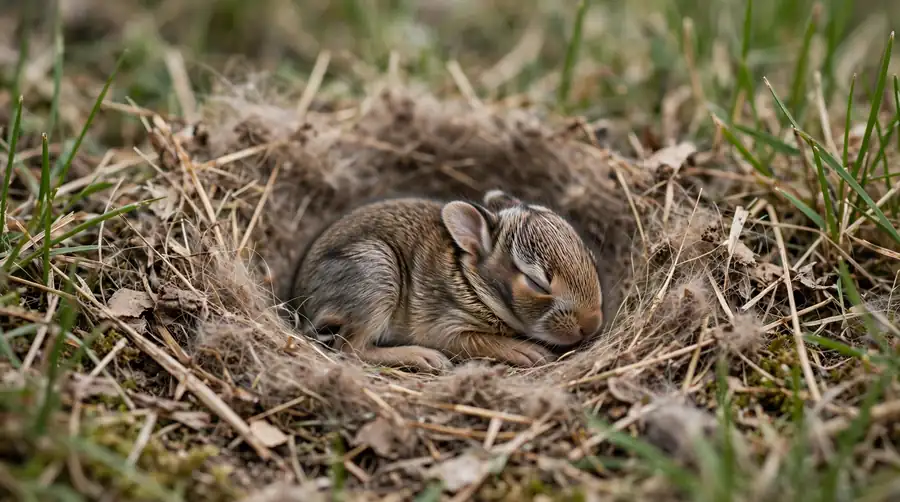
A Baby Rabbit
Read as fragile beginnings and as something needing protection rather than action. One practical note, because it saves lives: a baby rabbit sitting alone and still in a shallow scrape in the grass has not been abandoned. Mother rabbits visit the nest only a couple of times a day, usually at dawn and dusk, specifically so their scent does not lead predators to it. Leave it alone and keep cats in.
Rabbits in Your Garden, Repeatedly
Read as the message arriving at your home rather than on your journey, so the interpretation shifts toward family and household increase. Practically, you have food they like and somewhere to hide, and rabbits have small home ranges, so it is very likely the same individuals each time.
One That Thumped Its Foot
That hard thump of a hind foot is an alarm signal, carried through the ground to other rabbits as much as through the air. If it thumped while looking at you, you were the alarm. Read as a warning rather than a greeting.
A Dead Rabbit
Generally read as a false start or an ending of something that had only just begun, rather than as an omen about a person. Rabbits are prey for nearly everything, so finding one is sadly ordinary and not usually treated as directed at you. For the full reading, including why a rabbit’s fertility and its mortality are the same adaptation, see our guide to seeing a dead rabbit.
Rabbits in Tradition
The rabbit and hare are almost universally lucky, with two honest complications worth knowing.
The Easter connection is murkier than you have been told. The egg-bringing hare comes from German folk tradition — the Osterhase — recorded from around the seventeenth century and carried to America by German settlers. You will also read everywhere that a goddess named Eostre had a hare as her companion. Be careful with that one: the Venerable Bede mentions a goddess called Eostre in the eighth century, but he says nothing whatsoever about a hare. The hare was attached to her by Jacob Grimm more than a thousand years later, as speculation. It has been repeated as fact ever since. The spring-fertility association is genuine; the specific goddess-and-hare story is not well evidenced.
In Chinese tradition the rabbit is one of the twelve zodiac animals, associated with gentleness, elegance and caution, and the moon rabbit is among the most beloved figures in the tradition.
Across various Native American traditions the rabbit or hare appears as a trickster and a culture-bringer, clever rather than merely timid. As always the specifics differ considerably between nations and should not be collapsed into one story.
In Britain and Ireland the hare carried a strong association with witchcraft and shapeshifting, and saying “rabbits” or “white rabbits” on the first morning of the month was held to bring luck for the month — a superstition still alive in living memory.
And then the rabbit’s foot, which is the most widespread rabbit superstition in the English-speaking world and the one with the obvious problem in it. A charm for good fortune, obtained at the direct expense of the animal whose good fortune it represents. Worth noticing, if you are inclined to think about what we ask symbols to do for us.
What to Do
Stay still rather than backing away. Rabbits respond to movement, not to presence. Standing still is how you get to watch them for longer, and it is the only way you will see anything interesting.
Do not feed them. Garden vegetables and bread are genuinely bad for wild rabbits, whose digestion is built for grass and fibre.
Leave nests and lone babies alone. See the baby rabbit note above. Most “rescued” wild baby rabbits were not in trouble until they were picked up.
If it is white, black or unusually tame, try to get it help. That is somebody’s abandoned pet.
And then the question, which for this encounter is unusually specific. You were shown two of something, and two rabbits has never meant two for long.
What have you got exactly two of right now — two clients, two chapters written, two months saved, two people who believe you — that you have been dismissing as not enough yet?
That is the first term of the sequence. It is supposed to look small.
Frequently Asked Questions
What does it mean spiritually to see 2 bunnies?
It is read as abundance beginning rather than abundance arrived — the start of something that will multiply. The partnership reading is secondary. The sharper one is that a pair of rabbits is the opening term of an expanding sequence, which is literal: the Fibonacci sequence entered European mathematics in 1202 as a problem about one pair of rabbits breeding.
What does seeing a rabbit mean spiritually?
Increase, alertness, quick thinking and the value of the indirect route. The rabbit’s zigzag escape is a genuine tactic rather than panic, so the most useful reading is that you are not obliged to approach something head-on.
Is seeing two rabbits good luck?
Yes. Rabbits and hares are lucky in nearly every tradition that has a view, from the Chinese zodiac to the British habit of saying “white rabbits” on the first of the month. The one negative association, the hare’s link to witchcraft in parts of Europe, is more about mystery than misfortune.
What does it mean if the two rabbits were fighting?
If they reared up and boxed with their front paws, that is the “mad as a March hare” behaviour, and it is usually not two males fighting — it is typically a female fending off a male she is not ready to accept. So the reading is about setting a limit rather than about rivalry.
What does a white rabbit mean spiritually?
Purity, guidance and the threshold between worlds. But there are essentially no wild white rabbits, so a white rabbit in a garden is almost certainly an abandoned domestic pet that cannot survive outdoors and is worth reporting to a rescue or shelter.